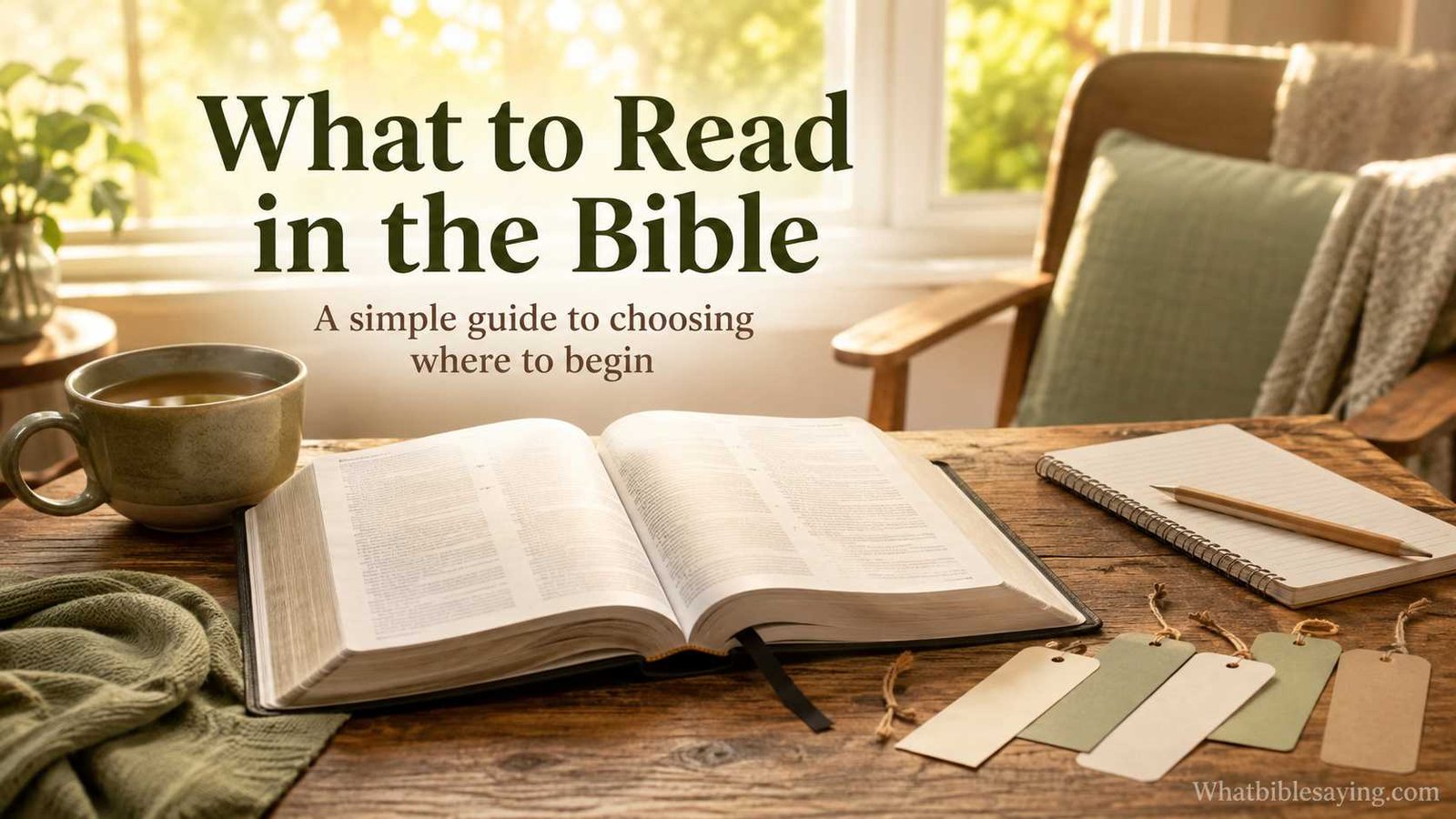
 If you are wondering what to read in the Bible, you are not alone. The Bible is a large book, and opening it for the first time can feel confusing.
Should you start with Genesis? Should you begin with Jesus? Should you read Psalms when you need comfort? And what happens if you start reading a book but do not understand it?
Here is the good news: there is no rule saying every person must begin in the same place.
For many new readers, the Gospel of John is one of the best places to start because it introduces you directly to Jesus, His words, His works, and His purpose. Psalms is wonderful when you need prayer and comfort. Proverbs gives practical wisdom. Genesis helps you understand the beginning of the biblical story.
The important thing is not finding a perfect reading plan. The important thing is beginning.
You can read slowly. You can ask questions. You can reread a passage tomorrow. God does not ask you to race through Scripture.
If you have been searching for how to read the Bible for beginners, the simplest advice is this: choose one book, read a little at a time, and keep coming back.
What to Read in the Bible If You Are Just Starting
A beginner does not need to understand all 66 books at once.
You may find it much easier to begin with a book that introduces you to the heart of the Christian faith.
Start With the Gospel of John
John is often a helpful starting point because its main focus is Jesus.
It tells us about His signs, His conversations, His teaching, His death, and His resurrection. It also explains why believing in Christ matters.
John even tells readers why the book was written. Near the end of the Gospel, John explains that these things were recorded so people might believe that Jesus is the Christ and have life through Him.
See John 20:30–31.
That makes John especially helpful when you want to understand:
- Who Jesus is
- Why Christians trust Him
- What Jesus taught
- What faith means
- Why Jesus died
- What His resurrection means
Do not worry if some parts seem deep. John contains both very simple teachings and profound ideas.
Read slowly.
One chapter at a time is enough.
Read Mark If You Want a Shorter Gospel
The Gospel of Mark is another good place to begin.
Mark moves quickly through the ministry of Jesus. You see Him teaching, healing, helping people, confronting evil, calling disciples, and moving toward the cross.
Mark is shorter than Matthew, Luke, and John.
If you want a direct introduction to what Jesus did, Mark can be a good first book.
What Is the Best Thing to Read in the Bible?
The best thing to read in the Bible depends partly on what you are trying to understand.
Every part of Scripture matters, but different books can help you focus on different questions.
Here is a simple guide.
| If You Want To… | A Good Place to Read |
|---|---|
| Learn about Jesus | John |
| Read a shorter account of Jesus | Mark |
| Find comfort and prayer | Psalms |
| Learn practical wisdom | Proverbs |
| Understand the beginning of the biblical story | Genesis |
| Understand Christian faith more deeply | Romans |
| Learn practical Christian living | James |
| Find encouragement during difficulty | Philippians |
This table does not mean that one book is more inspired or more important than another.
It simply gives you somewhere to begin.
Think of it like entering a large house. You do not have to visit every room on the first day. You enter through one door and begin learning where everything is.
Bible reading works much the same way.
What Books in the Bible Should I Read?
If you are asking, What books in the Bible should I read?, start with books that help you understand the main story of Scripture and the life of faith.
Here are six excellent choices.
John: To Know Jesus
John is a natural starting point when your main desire is to understand Jesus.
You will read familiar passages such as Jesus’ conversation with Nicodemus in John 3, the feeding of the five thousand in John 6, the raising of Lazarus in John 11, and Jesus’ teaching to His disciples before His arrest.
Again and again, John brings readers back to the identity of Jesus.
If someone asks me, “Where should I begin if I know very little about Christianity?” John is usually one of my first suggestions.
Psalms: When You Need Words for Prayer
The book of Psalms contains prayers, songs, cries for help, praise, thanksgiving, confession, and expressions of trust.
That is one reason so many people return to Psalms throughout life.
Some Psalms celebrate God’s goodness.
Others come from deep pain.
Some ask difficult questions.
Others express confidence in God’s protection.
Psalm 23 speaks about the Lord as a shepherd. Psalm 51 is connected with repentance. Psalm 100 is filled with thanksgiving. Psalm 121 speaks about looking to God for help.
Psalms shows us that prayer does not have to sound artificial.
You can come to God with joy, fear, sorrow, gratitude, confusion, and hope.
Proverbs: When You Need Everyday Wisdom
Proverbs is very practical.
It speaks about:
- Wisdom
- Work
- Money
- Speech
- Anger
- Friendship
- Family
- Temptation
- Pride
- Honesty
- Self-control
Many Proverbs are short, which makes them easy to remember.
But remember that Proverbs are wisdom sayings. They should be read carefully and in context rather than treated as automatic promises about every situation.
A helpful habit is to read one section of Proverbs slowly and ask:
What kind of person is this teaching me to become?
Genesis: To Understand the Beginning
Genesis means beginning or origin.
It introduces many people and events that shape the rest of the Bible.
You will read about:
- Creation
- Adam and Eve
- Cain and Abel
- Noah
- Abraham
- Sarah
- Isaac
- Jacob
- Joseph
Genesis also introduces important biblical themes such as sin, blessing, covenant, faith, family, and God’s promises.
If you start reading Genesis, you will understand many references that appear later in the Bible.
Romans: To Understand the Christian Message More Deeply
Romans is one of the most important letters in the New Testament.
Paul explains subjects such as:
- Sin
- Grace
- Faith
- Salvation
- God’s mercy
- Life in Christ
- Christian conduct
Romans can be more difficult than Mark or John, so do not feel discouraged if you need to reread parts of it.
Romans 8 is especially loved because it speaks about life in the Spirit, suffering, hope, prayer, God’s purpose, and His love.
James: For Practical Christian Living
James is short, direct, and practical.
It talks about:
- Trials
- Wisdom
- Faith
- Words
- Favoritism
- Prayer
- Patience
- Doing what is right
James reminds us that faith should affect the way we live.
If you want a book that challenges you to put belief into practice, James is an excellent choice.
How Do I Pick What to Read in the Bible?
You may still be asking, How do I pick what to read in the Bible?
Start by asking yourself what you want to understand.
If you want to know Jesus better, read a Gospel.
If you need help praying, read Psalms.
If you want wisdom for daily life, read Proverbs or James.
If you want to understand how the biblical story begins, read Genesis.
Then choose one book and stay with it for a while.
Constantly jumping from one random verse to another can make Scripture harder to understand because the Bible was written in books with context, structure, and purpose.
Here is a simple approach:
- Choose one book.
- Read one chapter or short passage.
- Notice who is speaking.
- Ask what is happening.
- Look at the verses before and after the passage.
- Write down anything you do not understand.
- Think about what the passage teaches about God, people, faith, or life.
- Pray about what you have read.
This simple process can become the beginning of learning how to study the Bible for yourself.
You do not need advanced training to start.
Careful reading is already a strong first step.
What to Read in the Bible When Life Feels Different
There will be days when you open the Bible because something specific is happening in your life.
Maybe you are afraid.
Maybe you feel alone.
Perhaps you need wisdom.
You may be grieving, thankful, confused, or trying to make an important decision.
Certain passages can be especially helpful during those seasons.
When You Feel Afraid
Try reading:
- Psalm 23
- Psalm 27
- Psalm 46
- Matthew 6:25–34
- Philippians 4:4–9
These passages do not pretend that fear and trouble do not exist.
Instead, they point us toward God’s care, prayer, trust, and peace.
When You Feel Alone
Read:
- Psalm 23
- Psalm 139
- John 14
- John 15
- John 16
Jesus prepared His disciples for a time when life would become difficult. His words remind believers that following God does not mean we will never feel lonely or troubled.
It means we do not face those moments without hope.
When You Need Wisdom
Start with Proverbs and James.
You might also read Solomon’s prayer for wisdom in 1 Kings 3.
The Bible’s picture of wisdom is much bigger than simply being intelligent.
Biblical wisdom involves learning how to live rightly before God and other people.
When You Have Sinned and Want to Return to God
Read:
- Psalm 51
- Luke 15
- 1 John 1
- Luke 18:9–14
These passages deal with repentance, confession, mercy, humility, and returning to God.
Luke 15 is especially powerful because Jesus tells stories about things that were lost and then found.
When You Are Grateful
Read:
- Psalm 100
- Psalm 103
- Psalm 136
- Philippians 4
Gratitude changes the way we notice God’s goodness.
The Psalms repeatedly call people to remember what God has done rather than taking His blessings for granted.
When You Are Suffering
Consider reading:
- Job
- Psalm 42
- Psalm 73
- Romans 8
- 2 Corinthians 4
- Philippians
The Bible does not hide suffering.
Some of its most meaningful passages come from people who experienced loss, fear, persecution, sickness, disappointment, or grief.
Scripture does not always give an easy explanation for every painful event. It does, however, continually direct us toward faith, endurance, hope, and God’s presence.
What Book of the Bible Should I Read to Get Closer to God?
Many people ask, What book of the Bible should I read to get closer to God?
I would begin with John.
John brings you again and again to Jesus.
But there is something important to remember.
Simply finishing a certain biblical book does not automatically create a close relationship with God.
You can read ten chapters quickly and remember almost nothing.
Or you can read ten verses slowly, think about them throughout the day, pray about them, and allow them to challenge your heart.
Closeness to God involves more than information.
It includes trust, prayer, worship, repentance, obedience, and love.
Jesus told His followers not only to hear His teaching but to live according to it.
So when you read the Bible, ask more than:
What does this verse say?
Also ask:
What is God teaching me here?
What should I believe?
Is there something I should change?
Is there something I should trust?
Is there someone I need to forgive?
Is there a truth I need to remember?
The Gospel of John, Psalms, Matthew, Mark, and Luke are all wonderful places to spend time when your desire is to know God better.
Should I Read the Bible From Genesis to Revelation?
You certainly can.
Reading from Genesis through Revelation is a valuable way to experience the whole Bible.
But beginners sometimes assume this is the only proper way to read Scripture.
It is not.
The Bible is not one long modern novel.
It is a collection of books written in different historical settings and literary forms. It contains history, poetry, wisdom, prophecy, Gospel accounts, letters, and other kinds of writing.
That means a beginner may benefit from reading certain books first.
If you are wondering what order should I read the Bible in, here is one possible beginner-friendly path:
John → Mark → Genesis → Psalms → Proverbs → Acts → Romans
After that, continue exploring the other biblical books.
This is not a sacred order.
It is simply a learning path.
Another perfectly good option is the traditional order:
Genesis → Exodus → Leviticus → Numbers → Deuteronomy → continuing through Revelation
Choose an approach that helps you keep reading and understanding.
How Much of the Bible Should You Read Each Day?
There is no Bible verse telling every Christian to read exactly three chapters, five chapters, or thirty minutes each day.
The important thing is developing a steady habit.
If you are wondering how much of the Bible should I read every day, start with an amount you can understand and continue.
For some people, that may be five minutes.
For others, it may be one chapter.
Someone else may spend thirty minutes studying only a few verses.
You could try:
- One chapter each morning
- Ten minutes before bed
- One Psalm plus a Gospel passage
- A short section during lunch
- A longer Bible-reading session on weekends
Do not turn Bible reading into a competition.
Reading twelve chapters without paying attention is not automatically better than carefully reading one.
And if you miss a day, do not give up.
Begin again.
A healthy Bible-reading habit is built over months and years, not through one perfect week.
A Simple 7-Day Bible Reading Starting Plan
If you want something you can begin today, try this seven-day plan.
Day 1: John 1
Read about Jesus as the Word and notice how John introduces His identity and mission.
Day 2: John 3
Read Jesus’ conversation with Nicodemus and think about faith, new life, and God’s love.
Day 3: Psalm 23
Read slowly and notice the picture of God as a shepherd who guides, provides, and stays near His people.
Day 4: Matthew 5
Begin reading Jesus’ Sermon on the Mount and notice the kind of life He calls His followers to live.
Day 5: Proverbs 3
Think about trust, wisdom, discipline, generosity, and relationships.
Day 6: Luke 15
Read Jesus’ stories about the lost sheep, the lost coin, and the lost son. Notice God’s concern for people who are lost and His joy when they return.
Day 7: Philippians 4
Notice Paul’s teaching about prayer, peace, contentment, thought, and trust.
At the end of seven days, choose one book and keep going.
You do not need another complicated plan.
Just continue reading.
How to Read the Bible Without Feeling Overwhelmed
The Bible contains difficult passages.
Every serious Bible reader eventually comes across verses that raise questions.
That is normal.
You do not have to understand everything immediately.
Even people who have studied Scripture for decades continue learning.
Here are a few habits that can make Bible reading easier.
Read the Surrounding Verses
Never assume one sentence means something without looking at what comes before and after it.
Context helps us understand who is speaking, what is happening, and why something is being said.
Do Not Treat the Bible Like a Fortune Cookie
Some people randomly open the Bible, point to a verse, and assume that sentence must be God’s personal message for that day.
God can certainly use Scripture to speak deeply to our lives, but the safest way to understand the Bible is to read passages in context.
Read books, chapters, stories, and arguments as they were written.
Use a Translation You Can Understand
A Bible translation should help you understand Scripture rather than make every sentence feel confusing.
Many English-speaking readers use translations such as the NIV, NLT, ESV, NKJV, CSB, or NRSV.
Different Christian traditions may prefer different translations.
You do not need to argue about which one everyone else should use.
Choose a trustworthy translation you can understand, and compare translations when a passage seems difficult.
Keep a Notebook
Write down:
- Questions
- Important verses
- Repeated ideas
- Names you want to remember
- Things you learn about God
- Things you want to pray about
You may be surprised how much more you remember when you write while reading.
Ask Questions
Questions are not the enemy of faith.
Questions can help us learn.
If you do not understand a word, person, location, custom, or event, make a note and research it carefully.
Bible study often begins with a simple question.
What to Read in the Bible With Children or as a Family
Families can read Scripture together without making Bible time long or complicated.
If you are deciding what book of the Bible should a child read first, start with stories and teachings that are easier to follow.
The Gospels contain many good starting points.
Children can read about:
- The birth of Jesus
- Jesus calling His disciples
- Jesus calming the storm
- Jesus feeding the five thousand
- Jesus welcoming children
- The Good Samaritan
- The lost sheep
- The resurrection
Genesis also contains memorable stories about Noah, Abraham, Jacob, and Joseph.
Selected Psalms can introduce children to prayer and praise.
Proverbs can lead to conversations about honesty, kindness, wisdom, speech, friendship, and choices.
The goal is not simply getting through a chapter.
Talk about it.
Ask:
What happened?
What did this person do?
What do we learn about God?
What choice was wise or unwise?
How could we practice this today?
A short conversation can make family Bible reading much more meaningful.
What to Read in the Bible When You Want to Know Jesus Better
If your main reason for opening Scripture is to know Jesus, spend time in all four Gospels.
Each Gospel tells the true story of Jesus while presenting His ministry with its own emphasis.
Matthew
Matthew contains much of Jesus’ teaching and repeatedly connects His life with the story and promises of Scripture.
The Sermon on the Mount begins in Matthew 5.
Mark
Mark is fast moving and often focuses on what Jesus did.
It can be especially helpful for readers who want a shorter introduction to His ministry.
Luke
Luke gives an orderly account of Jesus’ life and ministry.
It contains famous teachings and stories such as the Good Samaritan and the lost son.
Luke also continues into the book of Acts, which describes the growth of the early Christian movement.
John
John focuses strongly on who Jesus is and why believing in Him matters.
For that reason, John remains one of the strongest answers to the question, What to read in the Bible first?
Do not feel that you must choose only one Gospel forever.
Read John.
Then Mark.
Then Matthew and Luke.
Read them again later.
You will notice things the second time that you missed the first.
What Matters More Than Finding the Perfect Starting Book
There is no perfect Bible-reading order that every person must follow.
One reader may begin with John.
Another may begin with Psalms because life is painful.
Someone else may begin with Genesis because they want to understand the biblical story from its beginning.
All three can be good starting points.
What matters is that you read Scripture with an open heart and an attentive mind.
Do not rush.
Do not be embarrassed when you have questions.
Do not quit because one chapter is difficult.
And do not measure your spiritual life by how many pages you finish.
Choose a book.
Read a little today.
Come back tomorrow.
If you still do not know what to read in the Bible, start with John 1.
Read it slowly.
Think about what it says about Jesus.
Then continue to John 2.
That simple decision can become the beginning of a lifelong habit of reading, understanding, and living by God’s Word.

Reverend James has spent years studying and teaching the Bible. With warmth and wisdom, he shares deep truths in a way that’s clear, simple, and easy to understand.