

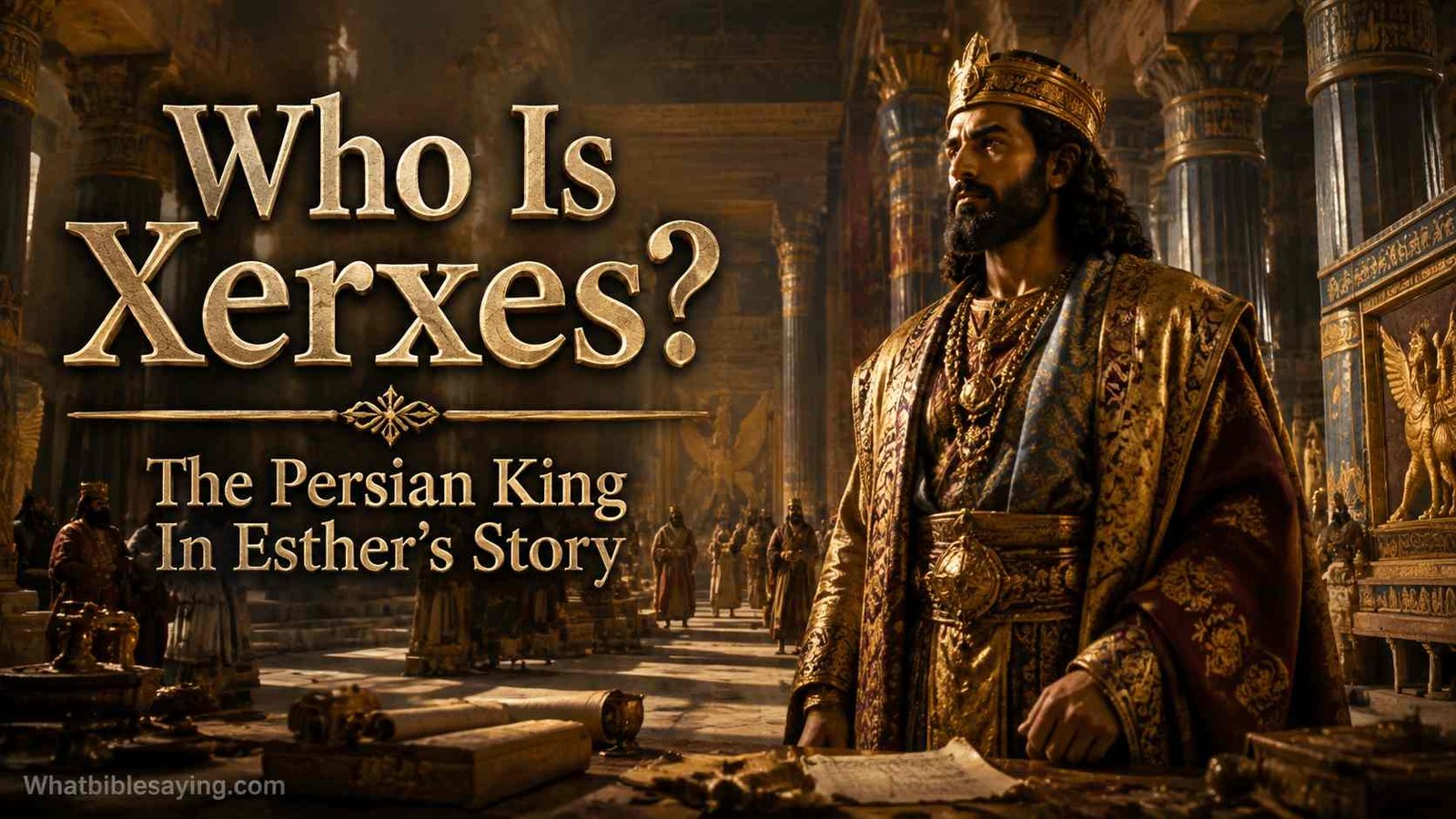
 When people ask, Who is Xerxes in the Bible?, they are usually asking about the powerful king mentioned in the Book of Esther. The Bible does not use the name Xerxes in most translations. Instead, it calls him King Ahasuerus, the ruler who reigned over the vast Persian Empire during the time when many Jewish people lived in exile.
Most biblical historians and scholars identify Ahasuerus in Esther with Xerxes I, who ruled the Persian Empire from approximately 486 to 465 BC. His story connects biblical faith with real ancient history, showing how God’s purposes continued even during the rule of foreign kings.
Xerxes is not remembered because of his own faith or personal devotion to God. Instead, he is remembered because his decisions became part of a much larger story involving Queen Esther, Mordecai, and the preservation of the Jewish people.
The story of Xerxes reminds us that even powerful rulers and major historical events remain under God’s ultimate authority.
Who Is Xerxes In The Bible And Why Is He Called Ahasuerus?
Xerxes I was one of the greatest kings of the ancient Persian Empire. He belonged to the Achaemenid dynasty, which ruled a large territory stretching from Egypt and parts of the Middle East to areas near India.
In the Bible, especially in the Book of Esther, he appears under the name Ahasuerus.
Esther 1:1 introduces him as:
“This is what happened during the time of Xerxes, the Xerxes who ruled over 127 provinces stretching from India to Cush.”
(Some translations use the name Ahasuerus instead of Xerxes.)
The difference between these names comes from language. The Persian royal name Xšayāršā was translated into different forms in various languages. The Greek form became Xerxes, while the Hebrew form used in Esther became Ahasuerus.
This is why readers may see different names when studying the same historical figure.
Understanding biblical names and historical backgrounds can help us better understand many people in the Bible and the world in which they lived.
Xerxes’ Role In The Book Of Esther
The main reason Xerxes appears in the Bible is because of his role in the Book of Esther.
The story begins with Xerxes hosting a great royal feast in the city of Susa, one of the important capitals of the Persian Empire. The king displayed his wealth and power before his officials and leaders.
During the celebration, King Xerxes commanded Queen Vashti to appear before his guests. When she refused, the king removed her as queen and later searched for a new queen.
Among the young women brought before the king was Esther, a Jewish woman who had been raised by her cousin Mordecai.
Esther was chosen as queen, but she initially kept her Jewish identity hidden.
Later, a powerful official named Haman became angry with Mordecai because Mordecai would not bow before him. Haman created a plan to destroy all the Jewish people throughout the Persian Empire.
Esther courageously approached Xerxes and revealed Haman’s evil plan. Through her bravery and wisdom, the king changed his decision, Haman was punished, and the Jewish people were saved.
The story shows that God can work through ordinary people placed in important positions.
Although the Book of Esther does not directly mention God by name, many readers see His providence throughout the events.
What Kind Of King Was Xerxes According To History?
Outside the Bible, Xerxes I is one of the best-known rulers of ancient Persia.
He became king after his father, Darius I, and continued expanding Persian influence. His empire was one of the largest and most organized kingdoms of the ancient world.
Historical records describe Xerxes as a powerful monarch who controlled many nations and peoples. He is especially known for his military campaign against Greece around 480 BC.
The famous battles of Thermopylae and Salamis occurred during his reign. Although Xerxes had enormous resources, his campaign against Greece ultimately failed.
The Bible’s description of Xerxes in Esther fits the historical picture of a wealthy Persian king who ruled over a large empire with many provinces.
His palace at Susa reflected Persian royal greatness, with impressive architecture, government officials, and international influence.
Xerxes And The Persian Empire In Biblical Times
The time of Xerxes was part of the Persian period of biblical history.
After the Babylonian exile, many Jewish people lived under Persian rule. The Persian kings allowed Jewish communities to return to Jerusalem and rebuild important parts of their national life.
Books such as:
- Ezra
- Nehemiah
- Esther
help readers understand this important period.
While Ezra and Nehemiah focus mainly on the rebuilding of Jerusalem, Esther shows what happened to Jewish people who remained throughout the Persian Empire.
Xerxes’ kingdom included many different cultures, languages, and nations. This diversity helps explain why Esther’s story involved political decisions affecting people across a huge empire.
Studying biblical history and places gives deeper meaning to stories that might otherwise seem distant.
Esther, Mordecai, And The People Connected To Xerxes
The story of Xerxes cannot be understood without the other important characters around him.
Esther
Esther was a Jewish woman who became queen of Persia. Her courage allowed her to protect her people during a dangerous time.
Her story teaches that God can use people in unexpected places for important purposes.
Mordecai
Mordecai was Esther’s relative and guardian. He refused to compromise his convictions by bowing to Haman.
His faithfulness eventually helped expose Haman’s plan.
Vashti
Vashti was the first queen of Xerxes mentioned in Esther. After refusing the king’s command during the royal feast, she was removed from her position.
Haman
Haman was a high-ranking official who planned destruction against the Jewish people. His pride and hatred eventually led to his downfall.
These individuals are among the many characters in the Bible whose choices reveal lessons about courage, pride, obedience, and faith.
What Can We Learn From Xerxes’ Story In The Bible?
Although Xerxes was a powerful king, his story teaches several important lessons.
Earthly power does not last forever
Xerxes ruled one of the greatest empires in history, yet his power was temporary.
The Bible repeatedly reminds readers that human authority is limited compared with God’s eternal rule.
Psalm 103:19 says:
“The Lord has established his throne in heaven, and his kingdom rules over all.”
Kings, governments, and nations change, but God remains constant.
Pride can lead to poor decisions
Several events in Esther’s story are connected with pride.
Xerxes displayed his wealth and authority, while Haman’s pride caused him to seek personal honor above all else.
The Bible warns that pride can lead people away from wisdom.
Proverbs 16:18 teaches:
“Pride goes before destruction, a haughty spirit before a fall.”
God can work through unexpected people
Esther was not born into royalty. She was a Jewish woman living in a foreign empire.
Yet her position became the way God used her to protect many lives.
This reminds believers that every person can have a meaningful purpose.
Courage matters during difficult times
Esther risked her own safety by approaching the king without being invited.
Her famous decision reflects courage and trust:
“If I perish, I perish.”
Esther 4:16
Her example encourages believers to stand for what is right even when circumstances are difficult.
Was Xerxes A Good Or Bad King In The Bible?
The Bible does not present Xerxes as a simple hero or villain.
He is shown as a powerful ruler with human weaknesses. He could make decisions based on emotion, influence, and advice from others.
In Esther, his choices had both positive and negative effects:
- His decision to choose Esther as queen placed her in a position to save her people.
- His approval of Haman’s plan created danger for the Jewish people.
- His later response allowed justice to take place.
The biblical account focuses less on judging Xerxes’ character and more on showing how God’s purposes unfolded through historical events.
How Xerxes Connects Biblical History And Ancient Persia
The story of Xerxes is a reminder that the Bible takes place within real historical settings.
The Persian Empire was not a fictional background. It was a major civilization with known rulers, cities, and political systems.
Learning about Xerxes helps readers understand:
- The Persian world of Esther
- The challenges faced by Jewish communities after exile
- The connection between Scripture and ancient history
The Bible often introduces people from many nations, showing how God’s work extends beyond one location or culture.
From kings like Xerxes to prophets, apostles, and ordinary believers, Scripture contains the stories of many people whose lives shaped biblical history.
What This Teaches Us About God’s Work Through History
The story of Xerxes in the Bible is ultimately not about the greatness of a Persian king. It is about how God can guide events, even when His name is not directly mentioned.
Xerxes had wealth, power, and authority, but the story of Esther shows that God’s purposes are greater than human plans.
A young Jewish woman became queen. A faithful man named Mordecai stood firm. A dangerous plot was overturned. A nation was preserved.
The story encourages us to trust that God can work through circumstances we do not fully understand.
Whether we look at the great rulers of history or the quiet decisions of everyday people, Scripture reminds us that God is always able to bring hope, protection, and purpose.

Dr. Rachel is very smart and knows a lot about the Bible. He helps us understand the Bible better by talking about the old texts in a simple way.