
 Have you ever read a Bible story and thought, “I understand exactly why that person reacted that way”?
Maybe you admire David because he stepped toward a giant while everyone else stepped back. Perhaps you understand Moses because he doubted whether he was ready for the job God gave him. Maybe Ruth’s loyalty feels familiar to you, or Esther’s quiet courage reminds you of how you handle difficult moments.
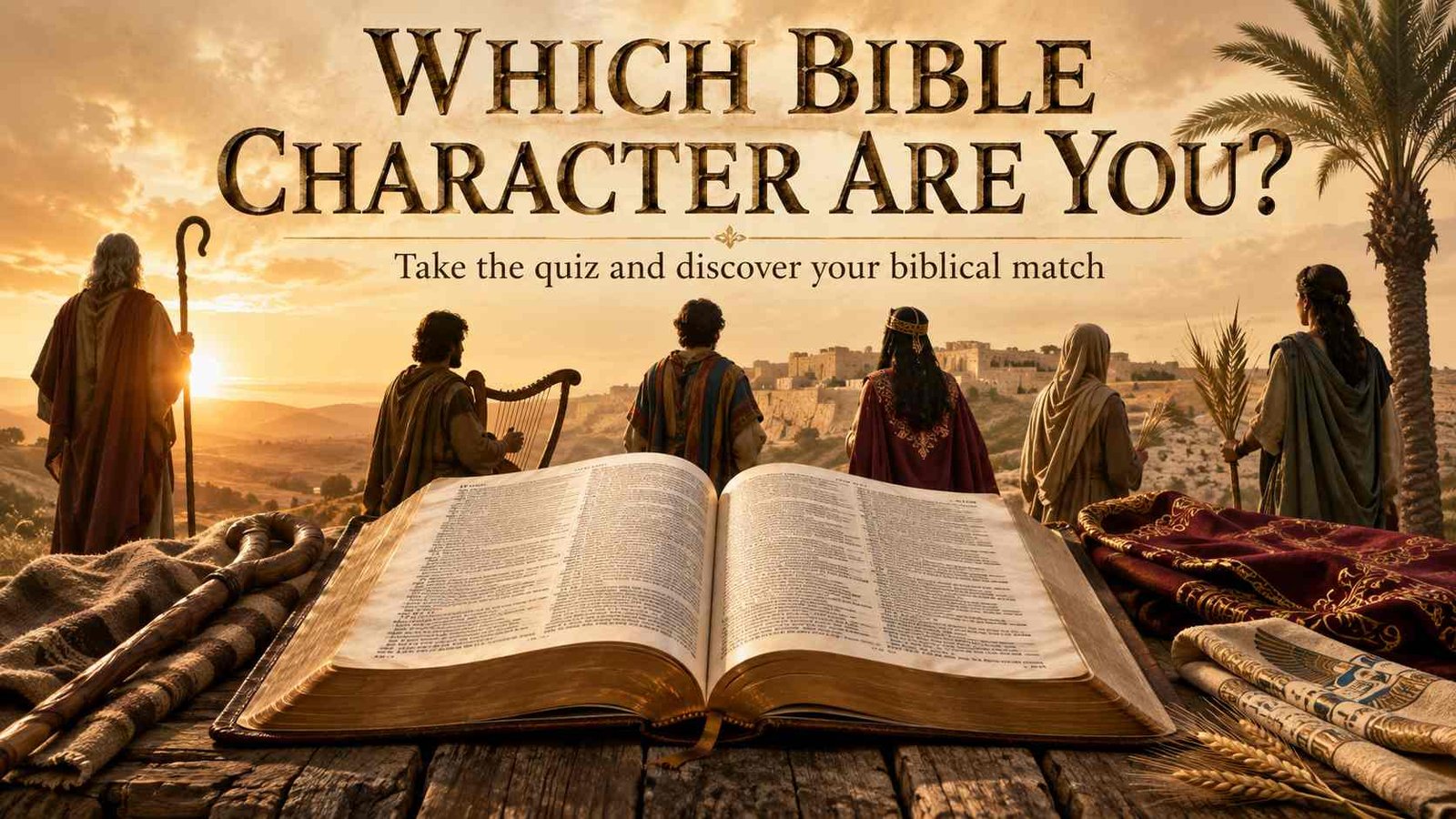
So, which Bible character are you most like?
This Scripture-based personality quiz can help you find out.
Of course, no quiz can define your spiritual identity. You are not literally Moses, David, Ruth, Esther, Joseph, or Deborah. The purpose is simply to notice which biblical person shares some of your strongest personality traits.
Personality quizzes about Bible characters have been popular for years. If you have searched phrases such as which Bible character are you uQuiz or which Bible character are you BuzzFeed, you may already have seen playful versions of this idea. BuzzFeed and uQuiz both host Bible-character personality quizzes, while Beliefnet and ProProfs use similar personality-based formats.
Here, however, the results are connected directly to the stories Scripture actually tells.
Grab a piece of paper or use your phone to record your answers. Choose A, B, C, D, E, or F for each question.
At the end, count your letters and discover your biblical match.
Which Bible Character Are You? Take the 12-Question Quiz
1. When a difficult responsibility is suddenly placed on you, what is your first reaction?
A. I wonder whether I am really qualified to do it.
B. I feel nervous, but I want to face the challenge immediately.
C. I stay calm and think about what the situation may become later.
D. I take time to understand the risks before making my move.
E. I think first about how my decision will affect the people I love.
F. I look at the facts and start working out the best plan.
2. What do people usually depend on you for?
A. Patient guidance.
B. Courage when everyone else feels afraid.
C. Calm thinking during hard times.
D. Wisdom in sensitive situations.
E. Loyalty and emotional support.
F. Leadership and clear decisions.
3. Someone treats you unfairly. What are you most likely to do?
A. Feel deeply hurt but try to keep doing what is right.
B. Confront the problem directly.
C. Wait, learn from it, and try not to become bitter.
D. Choose the right moment before responding.
E. Try to preserve peace without abandoning what is right.
F. Deal with the problem clearly and firmly.
4. What best describes your leadership style?
A. I lead even when I sometimes doubt myself.
B. I lead by inspiring people to be brave.
C. I lead through patience, planning, and wisdom.
D. I influence people quietly before taking public action.
E. I lead mostly through example and faithfulness.
F. I am comfortable making decisions and giving direction.
5. What is one of your greatest strengths?
A. Humility.
B. Courage.
C. Resilience.
D. Thoughtfulness.
E. Loyalty.
F. Wisdom.
6. When life does not go according to plan, how do you respond?
A. I sometimes question whether I can handle what is happening.
B. I look for the next challenge I can overcome.
C. I try to believe that something meaningful can still come from the situation.
D. I wait carefully until I see the right opportunity to act.
E. I stay close to the people who matter most.
F. I reorganize the plan and decide what needs to happen next.
7. Which sentence sounds most like you?
A. “I may not feel ready, but I will keep going.”
B. “Someone has to be brave enough to step forward.”
C. “This painful chapter does not have to be the end of my story.”
D. “Timing matters as much as courage.”
E. “I will not abandon the people I love.”
F. “A difficult situation needs wise and clear leadership.”
8. What kind of friend are you?
A. The patient listener.
B. The encouraging friend who pushes others forward.
C. The calm friend who helps people see the bigger picture.
D. The thoughtful friend who gives careful advice.
E. The loyal friend who stays when life becomes difficult.
F. The practical friend who helps solve the problem.
9. What frightens you most?
A. Being asked to do something beyond my ability.
B. Allowing fear to stop me from doing what is right.
C. Becoming bitter because of what others have done to me.
D. Missing the moment when I should speak or act.
E. Losing people or relationships that deeply matter to me.
F. Watching others suffer because nobody is willing to lead.
10. What do you value most when making a major decision?
A. Knowing that God will be with me.
B. Faith strong enough to move forward.
C. Patience and a long-term view.
D. Wisdom and proper timing.
E. Faithfulness to people and promises.
F. Clear direction and responsibility.
11. Which difficult situation would bring out your strongest qualities?
A. Leading people through uncertainty.
B. Facing something everyone else believes is impossible.
C. Recovering after betrayal or disappointment.
D. Speaking up when silence would be easier.
E. Starting over while caring for someone else.
F. Helping a group make an important decision.
12. What kind of spiritual growth do you most want?
A. Greater confidence when God calls me to act.
B. Courage that remains rooted in faith rather than pride.
C. A forgiving heart that does not become bitter.
D. Wisdom to know when to speak and when to wait.
E. Deeper faithfulness in everyday life.
F. Wisdom to lead others well.
Bible Character Quiz With Answers and Scoring
Now count how many times you chose each letter.
Your most common letter points to the Bible character whose story shares some of your strongest traits.
| Your Most Common Answer | Bible Character | Main Strength |
|---|---|---|
| A | Moses | Humble leadership |
| B | David | Courageous faith |
| C | Joseph | Resilience and wisdom |
| D | Esther | Courage with purpose |
| E | Ruth | Loyalty and faithfulness |
| F | Deborah | Wisdom and leadership |
If two letters are tied, do not worry.
You may strongly relate to two characters. Human personality is complicated, and the people described in Scripture were complicated too.
That is actually one reason Bible stories continue to speak to us. They are filled with people who showed faith one day and struggled the next.
Now find your result.
Which Bible Character Are You If You Chose Mostly A? Moses
If you chose mostly A, you may relate to Moses.
You probably care deeply about doing things correctly. You may also feel uncomfortable when people expect you to take charge.
You are not necessarily afraid of responsibility. You simply understand how serious responsibility can be.
That sounds a lot like Moses.
When God called Moses to go to Pharaoh and lead the Israelites out of Egypt, Moses did not respond like a man excited to become famous.
He asked:
“Who am I?”
That question appears in Exodus 3:11. God’s answer focused not on Moses’ personal greatness but on His presence: “I will be with you.”
Moses continued to express doubts about his ability, including concern about his speaking. Yet his story became one of the great stories of leadership in Scripture.
Your strengths may include
You may be:
- Humble
- Patient
- Responsible
- Serious about important decisions
- Concerned about other people
- Willing to continue even when leadership feels heavy
Your possible struggle
Your humility can sometimes turn into self-doubt.
You may see every reason you are not ready while overlooking what God can do through an imperfect person.
Moses reminds us that faith does not always begin with confidence.
Sometimes faith begins with a trembling question followed by one obedient step.
If this sounds familiar, you may also enjoy reading about who had faith in the Bible.
Which Bible Character Are You If You Chose Mostly B? David
If B was your most common answer, you may relate to David.
You probably have a strong heart.
When you believe something is right, fear does not easily stop you. You may be emotional, passionate, creative, and willing to take risks.
David’s confrontation with Goliath shows this clearly.
The Israelite soldiers were afraid of the Philistine warrior. David saw the same danger they saw, but he interpreted it differently.
In 1 Samuel 17:45, David told Goliath that although Goliath came with weapons, David came in the name of the Lord. His courage was tied to his confidence in God rather than simply confidence in himself.
David later became king.
He was also deeply human.
Scripture does not hide his failures. His life included poor choices, grief, conflict, repentance, worship, victories, and painful consequences.
That makes David more useful as a character study, not less.
Your strengths may include
You may be:
- Bold
- Passionate
- Creative
- Emotionally expressive
- Willing to defend others
- Quick to act when something matters
Your possible struggle
Courage can become impulsiveness when it is not joined with wisdom.
Strong emotions can also lead to strong mistakes.
David’s life reminds us that bold faith must still remain humble and accountable.
If you received David, your lesson is not simply “be brave.”
It is: Be brave for the right reasons.
Which Bible Character Are You If You Chose Mostly C? Joseph
If you chose mostly C, your closest match may be Joseph, the son of Jacob.
Joseph’s story contains one painful turn after another.
His brothers became jealous of him. He was sold into slavery, taken to Egypt, falsely accused, and imprisoned. Yet those painful chapters were not the final chapters of his life.
Joseph eventually rose to great authority in Egypt.
Years later, when he faced the brothers who had harmed him, he did not pretend that what they had done was good.
He called it what it was.
They had intended harm.
But Joseph also recognized that God had brought good from a terrible situation. Genesis 50:20 connects his suffering with the saving of many lives during a time of famine.
That is a powerful kind of resilience.
Your strengths may include
You may be:
- Patient
- Thoughtful
- Resilient
- Good at seeing long-term possibilities
- Able to function under pressure
- Slow to allow pain to define your future
Your possible struggle
Resilient people sometimes hide their pain too well.
You may appear calm while carrying memories that still hurt.
Joseph’s story does not teach us that betrayal is harmless. It shows that harm does not have to control the rest of your life.
You can remember what happened without allowing bitterness to become your identity.
If Joseph is your match, your strength may be the ability to believe that today’s painful chapter is not necessarily tomorrow’s ending.
Which Bible Character Are You If You Chose Mostly D? Esther
Mostly D answers point toward Esther.
You may not always be the loudest person in the room.
That does not mean you lack courage.
Your courage may simply be quieter.
Esther became queen in Persia during a dangerous period for the Jewish people. When a plan threatened her people, Mordecai urged her to consider whether she had come to her royal position for that very moment.
Esther 4:14 contains the famous idea of being placed somewhere “for such a time as this.”
Esther did not rush thoughtlessly into the situation.
She prepared.
She considered the danger.
Then she acted.
That mixture of patience and courage makes her story powerful.
Your strengths may include
You may be:
- Thoughtful
- Observant
- Calm under pressure
- Good at reading difficult situations
- Courageous when something truly matters
- Careful about timing
Your possible struggle
Because you naturally think before acting, you may sometimes wait too long.
There are moments when silence is wise.
There are other moments when remaining silent becomes the greater danger.
Esther’s story reminds us that courage does not always shout.
Sometimes courage quietly says, “I know this may cost me something, but I must do what is right.”
Which Bible Character Are You If You Chose Mostly E? Ruth
If most of your answers were E, you may relate strongly to Ruth.
Your greatest strength may not be dramatic leadership.
It may be something quieter and just as valuable: faithfulness.
Ruth was a Moabite widow. After her husband died, her mother-in-law Naomi prepared to return home.
Ruth could have remained behind.
Instead, she chose loyalty.
Her words in Ruth 1:16 have become some of the best-known words of commitment in Scripture. She tells Naomi that where Naomi goes, she will go, and Naomi’s people and God will become hers as well.
Ruth then entered a new country and began rebuilding her life.
She worked.
She remained loyal.
She showed humility.
Her story eventually became connected to the family line of King David.
Your strengths may include
You may be:
- Loyal
- Dependable
- Patient
- Hardworking
- Kind
- Willing to stay when other people leave
Your possible struggle
Loyal people sometimes give too much without taking care of themselves.
You may also remain in situations longer than necessary because leaving feels like betrayal.
Biblical faithfulness is not the same as allowing people to mistreat you.
Ruth’s loyalty was joined with courage, action, wisdom, and hope.
If Ruth is your match, never underestimate quiet faithfulness.
The person who shows up again and again may influence more lives than the person standing in the spotlight.
Which Bible Character Are You If You Chose Mostly F? Deborah
If F appeared most often, Deborah may be your closest match.
You probably notice problems quickly.
You may have a natural ability to make decisions when other people feel uncertain. People may come to you for advice because you can separate emotion from the question that needs to be answered.
Judges 4 describes Deborah as a prophet and as a leader who judged Israel. Israelites came to her to have disputes decided. She also summoned Barak and gave him instructions concerning the conflict with Sisera’s forces.
When Barak said he would go only if Deborah went with him, she agreed to go.
Deborah combined wisdom with action.
Your strengths may include
You may be:
- Decisive
- Wise
- Courageous
- Practical
- Comfortable with responsibility
- Able to encourage others to act
Your possible struggle
Strong leaders can become frustrated when other people do not move as quickly as they do.
You may see a solution clearly and wonder why everyone else needs so much time.
Deborah’s example reminds us that leadership is not only about knowing what should happen.
It also involves helping people move forward.
Readers interested in her story can continue with Who Was Deborah in the Bible?.
Which Female Bible Character Are You?
Maybe you came here specifically wondering, which female Bible character are you most like?
That is a popular quiz idea on its own. Current uQuiz and Quotev results include quizzes devoted specifically to identifying which biblical woman matches a reader’s personality.
Among the three women included in our main quiz, here is the simplest comparison.
You may be like Esther if you are courageous and thoughtful
Esther represents a kind of courage that thinks before it acts.
You may relate to her if you:
- Choose your words carefully
- Think about timing
- Remain calm during tension
- Can become very brave when someone needs you
You may be like Ruth if you are loyal and dependable
Ruth may be your match if people know that they can count on you.
You may value:
- Family
- Friendship
- Commitment
- Hard work
- Quiet faithfulness
You may not want public attention. You would rather be known as someone who keeps promises.
You may be like Deborah if you are wise and decisive
Deborah may fit you if leadership feels natural.
You may:
- Give clear advice
- Notice problems quickly
- Take responsibility
- Encourage hesitant people
- Remain steady during difficult decisions
But these are not the only important women in Scripture.
You might also identify with Hannah’s persistence in prayer, Abigail’s wisdom during conflict, Rahab’s courage, Priscilla’s involvement in teaching and ministry, or Mary’s willingness to accept a life-changing calling from God.
The Bible includes women from very different backgrounds and circumstances. Their stories remind us that there is no single personality type for a faithful woman.
You can explore more of these stories in Who Are the Women in the Bible?.
Which Bible Character Are You According to Your Greatest Strength?
If you do not want to count all twelve answers, this shorter comparison may help.
| If Your Strongest Trait Is… | You May Relate To… |
|---|---|
| Humble leadership | Moses |
| Bold faith | David |
| Resilience | Joseph |
| Thoughtful courage | Esther |
| Loyalty | Ruth |
| Wise leadership | Deborah |
Yet remember something important.
One strength does not describe your whole personality.
You might have David’s courage but Joseph’s patience.
You could have Ruth’s loyalty and Deborah’s leadership.
You may feel like Moses when beginning something new but become more confident as you grow.
That is normal.
Real people cannot be reduced to one letter on a personality test.
Neither can biblical characters.
Can a Quiz Really Tell You Who You Are Biblically?
This question matters.
The answer is no, not completely.
A personality quiz can be interesting. It can even make you notice things about yourself that you have overlooked.
Some online assessments take this idea much further. One Bible-personality assessment, for example, currently compares users with 43 biblical figures and says its goal is self-discovery rather than diagnosis.
That distinction is useful.
A quiz should not tell you your worth.
It cannot tell you God’s complete plan for your life.
It cannot measure the depth of your faith.
And it certainly cannot replace Scripture, prayer, wise counsel, or a real relationship with God.
The Bible gives a deeper answer to the question, Who am I?
Moses asked, “Who am I?” when God called him.
Many of us ask the same question for different reasons.
Who am I when I fail?
Who am I when people reject me?
Who am I when I do not feel talented?
Who am I when someone else seems more successful?
Those questions go much deeper than personality.
That is why topics such as Who Am I Bible Verses? and What Does the Bible Say I Am? are worth studying alongside a quiz like this.
Your personality describes some of your tendencies.
It does not determine your value.
What Your Bible Character Match Can Teach You About Growth
Finding your closest character match becomes more useful when you ask what that person’s story can teach you.
Do not only look at the strength.
Look at the struggle too.
If you are like Moses
Ask yourself:
Am I calling humility something that is actually fear?
There is a difference between knowing your limitations and constantly refusing opportunities because you do not feel good enough.
Moses grew into responsibilities that once frightened him.
You may need to do the same.
If you are like David
Ask:
Does my courage come with wisdom?
Bold personalities can do wonderful things.
They can also make fast decisions they later regret.
Learn to keep courage under the guidance of truth, patience, and humility.
If you are like Joseph
Ask:
Have I truly released bitterness?
You may be excellent at surviving.
But survival and healing are not always the same thing.
Joseph’s story points toward forgiveness without pretending that evil was good.
If you are like Esther
Ask:
Is this a time to wait or a time to speak?
Careful people can sometimes become too careful.
Wisdom includes recognizing moments when action cannot be delayed forever.
If you are like Ruth
Ask:
Is my loyalty healthy?
Faithfulness is beautiful.
But good loyalty should be joined with wisdom.
Do not confuse devotion with allowing harmful behavior to continue without boundaries.
If you are like Deborah
Ask:
Do I help other people become stronger?
Leadership is more than being the person with the answer.
Great leaders help other people find courage and use their own gifts.
That is an important part of what the Bible says about character.
Bible Character Quiz With Answers: What If My Result Surprised Me?
Sometimes the most interesting quiz result is the one you did not expect.
Maybe you always thought of yourself as a David but received Ruth.
Perhaps you pictured yourself as Esther but ended up with Moses.
Do not worry about the label.
Instead, ask why your answers led there.
Maybe your courage is quieter than you realized.
Maybe loyalty matters more to you than public leadership.
Maybe you have spent years thinking of yourself as hesitant when other people actually see wisdom and patience.
Personality tests work best as conversation starters.
The Bible itself is far richer.
Read the complete story of your result.
Notice what the person did well.
Notice what they did poorly.
Watch how they changed.
Look at how God worked through situations they could not control.
You may discover that the character you thought you knew is much more complicated than the children’s Bible version you first heard.
Which Bible Character Are You Becoming More Like?
After finishing this Which Bible Character Are You quiz, there is one more question worth asking.
Not simply:
“Who am I like?”
But:
“What kind of person am I becoming?”
Biblical character is not frozen.
Moses grew.
David learned through victories and painful failures.
Joseph passed through betrayal before reaching a place where he could speak words of forgiveness.
Esther moved from caution to courage.
Ruth walked from loss toward a new life.
Deborah used her wisdom and influence to help others move forward.
Their stories matter because they show people living through real choices.
You may recognize yourself in one of them today and another person several years from now.
That is fine.
The goal is not to become more like Moses, David, Joseph, Esther, Ruth, or Deborah simply because a quiz gave you their name.
The better goal is to learn from what Scripture praises, learn from what Scripture warns against, and continue growing in faith, wisdom, courage, love, humility, and faithfulness.
So keep your result.
Have fun sharing it.
Then open your Bible and read that person’s complete story.
The quiz may tell you which Bible character resembles you.
Scripture can help shape the character you are becoming.

Pastor David shares Bible stories in a way that feels real and personal. The way he speaks makes it easier to understand and live out our faith every day.