
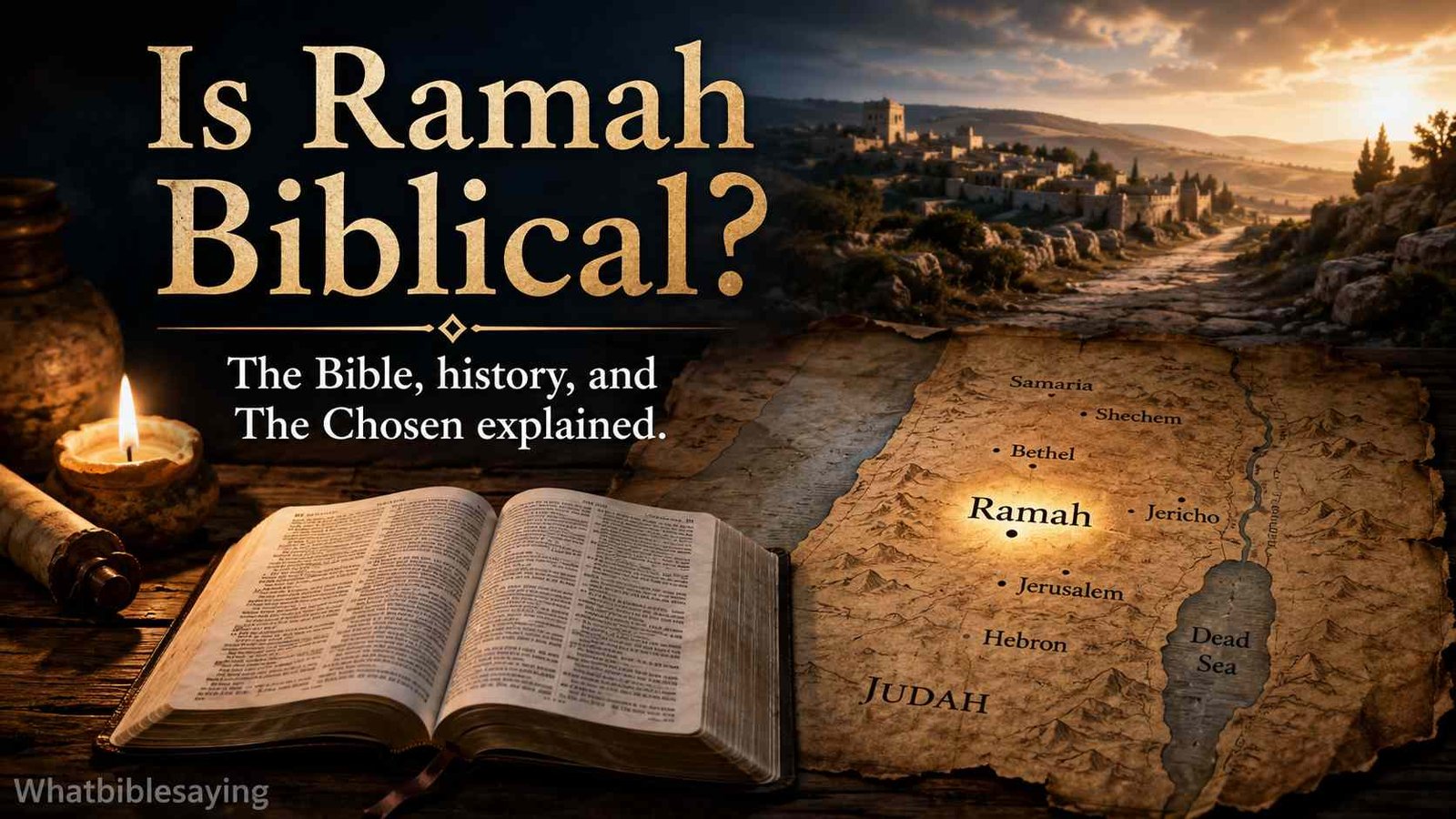
 Many people ask, “Is Ramah in the Bible?” after watching The Chosen. The answer is simple, but it needs a careful explanation.
Yes, Ramah is in the Bible as a place. But Ramah from The Chosen is not a named Bible character.
That difference matters.
The Bible mentions places called Ramah in the Old Testament. One of the most moving references appears in Jeremiah 31:15, where Rachel is described as weeping for her children. Matthew later connects that sorrow to the killing of children around the time of Jesus’ birth in Matthew 2:17–18.
But the woman named Ramah in The Chosen, connected romantically with Thomas, is not found in Matthew, Mark, Luke, John, Acts, or any other Bible book. She is a fictional character created for the show’s storytelling. Bible-media reviewers have also noted that The Chosen uses Ramah to represent unnamed female followers of Jesus and to build Thomas’s emotional story, not because she is directly named in Scripture.
That does not mean every scene with Ramah is bad. It means we must read the Bible first and watch Bible-based shows with wisdom.
Is Ramah In The Bible As A Person Or A Place?
Ramah appears in the Bible as a place name, not as a female disciple of Jesus.
In the Old Testament, “Ramah” can refer to more than one location. The name itself means something like height or high place. Several towns carried this name because they were likely built on elevated ground.
One important Ramah is linked with the tribe of Benjamin. It appears in passages connected with Israel’s history, travel, war, exile, and sorrow. So when someone asks, “Is Ramah in the Bible?” the answer depends on what they mean.
If they mean:
Is Ramah a biblical location?
Yes.
Is Ramah from The Chosen a real Bible person?
No.
That is the cleanest way to explain it.
This is a common issue with Bible-based shows. They often mix real people, real places, and imagined characters. Thomas is a real apostle. Jesus is real. Mary Magdalene is real. The Roman world is real. But Ramah, as Thomas’s love interest in The Chosen, is not directly recorded in Scripture.
A wise reader can still enjoy a show while saying, “This part is biblical, and this part is storytelling.”
Does Ramah From The Chosen Exist In The Bible?
No, Ramah from The Chosen does not exist in the Bible as a named person.
The Bible never says Thomas had a fiancé named Ramah. It never says he worked with her in a catering or wine business. It never says she followed Jesus by that name. It never records her death.
The Gospels do tell us that women followed and supported Jesus. Luke 8:1–3 names Mary Magdalene, Joanna, and Susanna, then adds that many other women helped provide for Jesus and His disciples. That phrase, “many others,” gives a storyteller room to imagine possible followers around Jesus.
But imagination is not the same as Scripture.
This is important because many viewers feel emotionally connected to Ramah. That is understandable. A good fictional character can feel real. But our faith must rest on what God has revealed in Scripture, not on scenes added by writers.
So the balanced answer is this:
Ramah from The Chosen may represent the kind of women who followed Jesus, but she is not named in the Bible.
Is The Story Of Ramah Real?
The story of Ramah in The Chosen is not a real Bible event.
It is a dramatic storyline.
The Bible does not tell us that Thomas loved Ramah. It does not say they were engaged. It does not say she was killed by Quintus. It does not say Jesus refused to raise her from the dead.
Thomas himself is real. He appears in the New Testament as one of the twelve apostles. He is best known for struggling to believe the resurrection until he saw the risen Christ in John 20:24–29. Because of that moment, people often call him “Doubting Thomas,” though that nickname can be a little unfair. Thomas also showed courage in John 11:16, when he said the disciples should go with Jesus even if it meant dying with Him.
That is the real Thomas we meet in Scripture.
The Chosen adds Ramah to deepen Thomas’s emotional journey. The show gives him a wound that may help explain his later grief, doubt, and struggle. But the Bible itself does not give that background.
Here’s what matters: fiction can help us think, but it cannot become our foundation.
The Bible is the source. The show is an artistic retelling.
Why Is Ramah Killed In The Chosen?
In The Chosen, Ramah is killed as part of Thomas’s emotional story. Reports and interviews around Season 4 describe her death as one of the show’s major shocking turns. The actress Yasmine Al-Bustami played Ramah, and public discussion around Season 4 focused heavily on the grief this scene created for Thomas and for viewers.
The scene was painful for many fans because Ramah had become gentle, loyal, and easy to love. Viewers had watched her grow close to Thomas. They had seen her follow Jesus. So when she died, many people asked the same question Thomas asked in the show:
Why did Jesus not heal her?
That question is heavy.
But we must remember that the scene is not in the Bible. It was written to explore sorrow, unanswered prayer, and trust in God when life feels unbearable. Dallas Jenkins and others connected with the show have publicly framed the Ramah storyline around themes such as suffering and God’s sovereignty.
Some Christians felt the scene was powerful. Others felt it went too far because it placed a fictional tragedy next to the real ministry of Jesus.
Both reactions are understandable.
The safest biblical response is this: we should not judge Jesus by a fictional scene. We should understand Jesus through the Gospels.
Why Did Jesus Not Raise Ramah In The Chosen?
This may be the most emotional question viewers ask.
In The Chosen, Jesus does not raise Ramah after her death. Thomas is crushed. The audience is left sitting with grief.
But again, this did not happen in the Bible.
In Scripture, Jesus does raise people from the dead. He raises Jairus’s daughter in Mark 5:35–43. He raises the widow’s son in Luke 7:11–17. He raises Lazarus in John 11. These miracles show His compassion and His power over death.
Yet the Bible also shows that Jesus did not remove every sorrow from every person during His earthly ministry. Many people in Israel still suffered. Many still died. Jesus’ miracles were signs of the Kingdom of God, not a promise that no believer would ever grieve.
That is a hard truth, but it is also honest.
The problem comes when a fictional scene makes people wonder whether Jesus was cold or unfair. The Jesus of Scripture is never cold. He weeps at Lazarus’s tomb. He touches lepers. He notices widows. He welcomes children. He forgives sinners. He carries the cross.
So we can say this gently:
The Chosen used Ramah’s death to ask a real question about suffering, but Christians should answer that question from Scripture, not from the show alone.
Why Is Rachel Weeping At Ramah?
This is where Ramah becomes deeply biblical.
Jeremiah 31:15 says Rachel is weeping for her children. The picture is poetic and painful. Rachel, the beloved wife of Jacob and mother of Joseph and Benjamin, becomes a symbol of Israel’s mothers grieving over loss.
Ramah was likely connected with sorrow during the time of exile. The people of Judah were taken away from their land. Families were broken. Children were lost. The nation was wounded.
Then Matthew uses this same verse in Matthew 2:17–18 after King Herod orders the killing of young boys in Bethlehem. Matthew sees Rachel’s weeping as a picture of the deep grief around Jesus’ early life.
This does not mean Rachel was physically standing in Ramah crying. It is a biblical image. It shows a mother’s sorrow over the suffering of her people.
But Jeremiah 31 does not end in grief.
That same chapter also gives hope. God promises restoration. He speaks of return, mercy, and a new covenant. So Ramah becomes more than a place of tears. It becomes a place where God sees pain and promises hope.
That is one of the most beautiful lessons in this topic.
Ramah reminds us that the Bible does not hide sorrow. It names it. It gives it language. Then it brings that sorrow before God.
What Is The Difference Between Ramah And Rachel In The Bible?
Ramah and Rachel are not the same.
Ramah is a place name.
Rachel is a person.
Rachel was Jacob’s wife and the mother of Joseph and Benjamin. Her story appears in Genesis. She is remembered as one of the matriarchs of Israel’s family story. Her grief in Jeremiah is symbolic. It represents the mourning of Israel’s mothers.
This matters because people sometimes hear “Rachel weeping at Ramah” and think Ramah might be a woman. But in that passage, Ramah is a location connected with mourning.
So we can put it simply:
Rachel is the weeping mother figure.
Ramah is the place connected with sorrow.
Ramah from The Chosen is a fictional woman created for the show.
Three different ideas. One shared name.
Why Did Jesus Refuse Mary To Touch Him?
Another question people often ask after watching Bible shows is: Why did Jesus tell Mary not to touch Him?
This comes from John 20:17, after Jesus rises from the dead and appears to Mary Magdalene. Some translations say, “Do not touch me.” Others bring out the meaning as “Do not cling to me.”
Jesus was not rejecting Mary. He was not being harsh. He was teaching her that things had changed. His resurrection had begun a new stage in God’s plan. Mary could not hold Him as though everything would return to the old way.
Instead, Jesus gave her a mission. He told her to go to His brothers and tell them what had happened.
That is powerful.
Mary Magdalene became the first witness to the risen Christ. Her grief turned into testimony.
This connects gently with the Ramah discussion because both stories touch grief. But Mary’s scene is biblical. Ramah’s death scene is not. We should keep that difference clear.
How Old Was Mary When Jesus Was Conceived By The Holy Spirit?
Some search questions use careless or disrespectful wording about Mary and Jesus’ conception. A biblical article should speak more carefully.
The Bible teaches that Jesus was conceived by the Holy Spirit, not through human relations. Luke 1:34–35 says the Holy Spirit would come upon Mary, and the child would be called the Son of God.
The Bible does not give Mary’s exact age.
Many historians believe Jewish girls in that time were often betrothed in their teenage years. But we should not give an exact number as if the Bible states it. It does not.
So the honest answer is:
Mary was likely young, but Scripture does not tell us her exact age. Jesus was conceived by the Holy Spirit, according to Luke’s Gospel.
That keeps the answer respectful and faithful to the Bible.
Who Was The Only Female Apostle In The Bible?
This question usually points to Junia in Romans 16:7.
Paul mentions Andronicus and Junia and describes them in a phrase that many translations render as “outstanding among the apostles” or “well known to the apostles.” Christians have discussed this verse for a long time.
Some scholars believe Junia was a woman recognized among the apostles in some sense. Others believe Paul meant she was well known by the apostles. Because faithful Christians read this phrase differently, we should speak carefully.
What we can say with confidence is this:
Junia was a respected early Christian. Paul honored her. Her name reminds us that women served faithfully and courageously in the early church.
That also helps us think about Ramah from The Chosen. The New Testament clearly shows women following Jesus and serving the church. But it does not name Ramah among them.
Which Disciple Was Boiled Alive?
A later church tradition says the apostle John was placed in boiling oil and survived. But this story is not recorded in the Bible.
The Bible tells us that John was exiled to the island of Patmos in Revelation 1:9. That is the biblical fact.
The boiling oil story belongs to later Christian tradition. Many Christians have heard it, but we should not treat it with the same authority as Scripture.
That same principle helps with Ramah.
A story may be meaningful. It may be old. It may be popular. But if it is not in the Bible, we should say so honestly.
Was Anyone Fired From The Chosen?
Some viewers ask this because Ramah died in Season 4 and wonder whether the actress was removed for behind-the-scenes reasons.
It is better not to repeat rumors.
What we can say is that Yasmine Al-Bustami played Ramah, and the character was written into a major death storyline in Season 4. Public posts from The Chosen later joked about Yasmine being “back on set” for related Chosen content, so it would be careless to claim she was simply fired without reliable proof.
A Christian article should not build a claim from gossip.
The better focus is the Bible question: Ramah is not a named Bible character.
Why Is 2033 Important To Christians?
The year 2033 is sometimes discussed because it may mark about 2,000 years since the death and resurrection of Jesus, depending on which historical date one accepts for the crucifixion.
But Christians should be careful.
The Bible does not say 2033 is a prophetic deadline. It does not tell believers to set dates around that year. Jesus Himself warned His followers not to claim secret knowledge of times and seasons in Acts 1:7.
So 2033 may be meaningful for reflection, worship, or historical remembrance. But it should not be treated as a guaranteed end-times date.
Faith should make us watchful, not reckless.
Why Did Fatima Not Like Abu Bakr?
This question belongs to Islamic history, not the Bible.
Fatima, the daughter of Muhammad, and Abu Bakr, the first caliph in Sunni Islamic history, are not Bible figures. Their dispute is discussed in Islamic historical sources, especially around inheritance and leadership after Muhammad’s death.
A Christian Bible article can mention this only briefly because it is not connected to Ramah, Jesus, Thomas, or the Gospels.
For this article, the honest answer is simple:
Fatima and Abu Bakr are not part of the biblical story of Ramah.
What Was The Final Warning Of Fatima?
This also belongs to Catholic devotional history, not directly to the Bible.
The “warnings of Fatima” refer to reported Marian apparitions in Fatima, Portugal, in 1917. Catholics and other Christians may view these claims differently. They are not part of the Bible itself.
Because whatbiblesaying.com serves readers from different Christian backgrounds, the best tone is respectful and careful.
A Bible-based answer should say:
Fatima’s warnings are not biblical passages. They belong to later Catholic devotional tradition and should not be confused with Scripture.
How Long Did Mary Live After Jesus Died?
The Bible does not tell us exactly how long Mary, the mother of Jesus, lived after the crucifixion.
We know Jesus entrusted Mary to the beloved disciple in John 19:26–27. We also see Mary with the believers after Jesus’ ascension in Acts 1:14. After that, Scripture does not give details about her later life or death.
Different Christian traditions say different things. But the Bible itself is quiet.
So the answer is:
We do not know exactly how long Mary lived after Jesus died. Scripture shows she remained among the early believers, but it does not record her death.
Who Does Gaza Belong To In The Bible?
Gaza is mentioned in the Bible as one of the cities of the Philistines. It appears in Old Testament passages connected with the Philistine region, Samson, judgment oracles, and Israel’s surrounding peoples.
But modern political ownership cannot be settled by one Bible verse.
That is important to say.
The Bible names ancient peoples and lands. Modern Gaza involves centuries of history, law, war, displacement, religion, and politics. A faithful Christian should avoid using Scripture in a careless way that ignores human suffering.
So the biblical answer is:
Gaza appears in the Bible as an ancient Philistine city, but modern political claims require careful historical and ethical discussion beyond a simple Bible-label answer.
What Was The Age Gap Between Mary And Joseph?
The Bible does not tell us the age of Joseph or Mary. It also does not tell us their age gap.
Some traditions picture Joseph as much older than Mary. Other Christians believe he may have been closer to her age. Scripture does not settle the question.
The safest answer is:
We do not know the exact age gap between Mary and Joseph because the Bible does not say.
When the Bible is silent, we should be silent too, or at least speak with humility.
What Ramah Teaches Us About Reading The Bible Wisely
Ramah teaches us a helpful lesson.
A Bible-based show can make people curious about Scripture. That is a good thing. Many viewers search Bible questions because a scene moved them. They want to know what is true, what is added, and what God’s Word really says.
That curiosity can lead to deeper faith.
But we must keep the order right.
First comes Scripture.
Then comes interpretation.
Then comes artistic storytelling.
When we reverse that order, we may become confused. We may start asking the Bible to defend something a screenwriter invented. That is not fair to Scripture, and it is not fair to Jesus.
So when watching The Chosen, or any Bible-based film, ask gentle questions:
Does the Bible actually say this?
Is this a real person, or a fictional addition?
Does this scene agree with the character of Jesus in Scripture?
Is this helping me read the Bible more carefully?
Those questions protect the heart.
They also make Bible study richer.
A Gentle Way To Understand Ramah, Grief, And Faith
So, is Ramah in the Bible?
Yes, Ramah is in the Bible as a place.
No, Ramah from The Chosen is not a named Bible character.
That answer may feel small, but it gives us something important. It helps us love Scripture with a clear mind. It helps us enjoy storytelling without confusing it with God’s Word. It helps us grieve with characters on screen while remembering the real Jesus revealed in the Gospels.
The biblical Ramah is connected with sorrow. Rachel weeps there. Israel mourns there. Matthew hears that old sorrow echo again around the birth of Jesus.
But sorrow is not the final word.
Jeremiah 31 moves from tears toward hope. Matthew’s Gospel moves from Herod’s cruelty toward Christ’s saving mission. The Bible does not deny grief, but it places grief inside God’s larger promise.
That is the deeper comfort.
Ramah from The Chosen may make viewers cry. Biblical Ramah teaches us that God sees tears. And Jesus, the real Jesus of Scripture, does not stand far away from human pain. He enters it. He carries it. He defeats death through His resurrection.
That is where faith rests.
Not in a fictional scene.
Not in a rumor.
Not in a dramatic twist.
Faith rests in Christ, and Christ is known most clearly through the Word of God.
Dr. Rachel is very smart and knows a lot about the Bible. He helps us understand the Bible better by talking about the old texts in a simple way.