

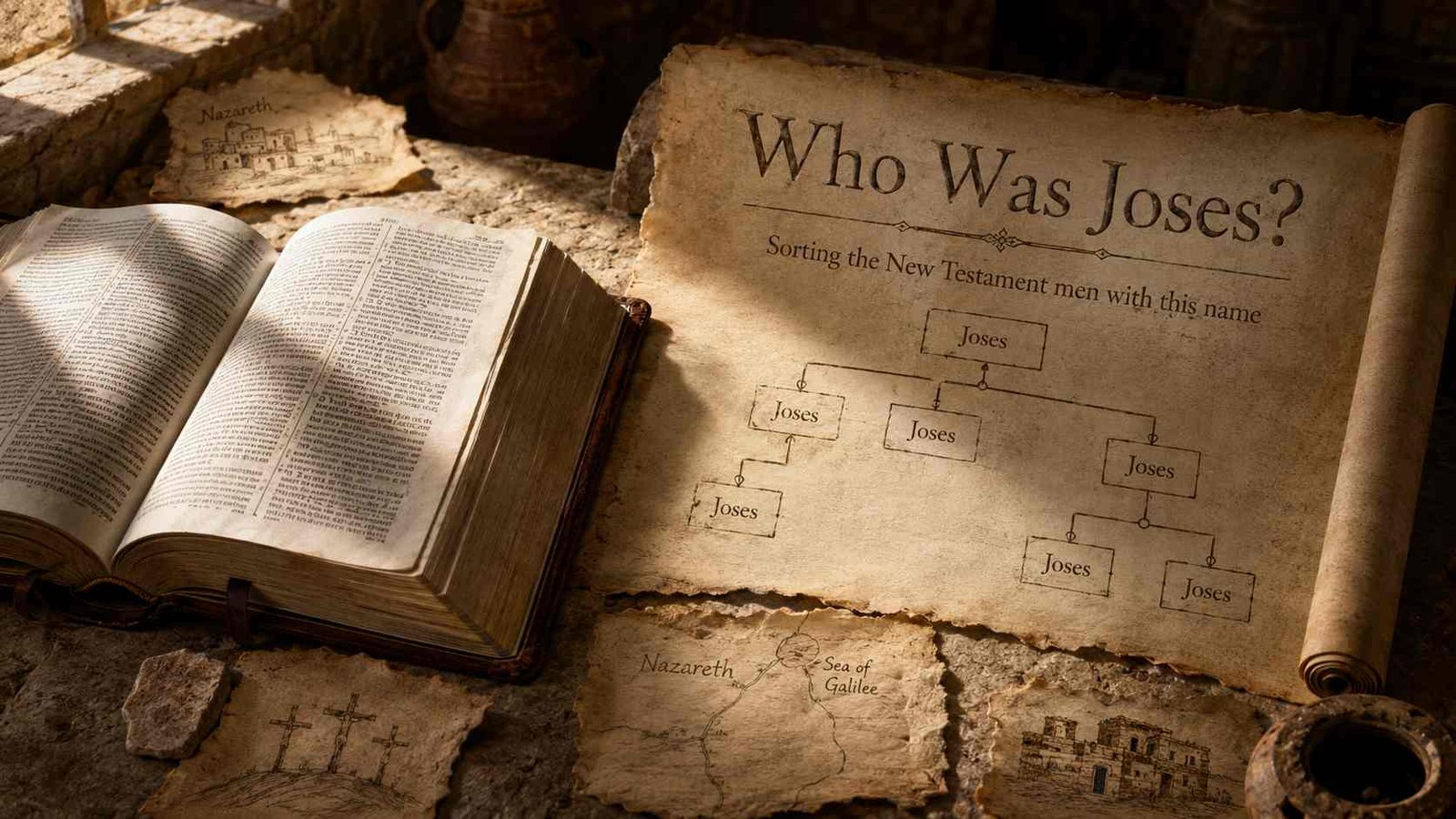
 If you have come across the name Joses while reading the New Testament, you may wonder who he was. The question sounds simple, but there is an important detail: the Bible uses the name Joses in connection with more than one person, and some Bible translations use Joseph or Jose where others use Joses.
So, who is Joses in the Bible?
One Joses is named among the brothers of Jesus in Mark 6:3. Another Joses is identified as the son of a woman named Mary who witnessed Jesus’ crucifixion and burial. In Acts 4:36, some Bible translations also use the name Joses for the man better known as Barnabas. Luke 3:29 adds another name form, Jose, in the genealogy of Jesus.
These references should not automatically be combined into one person.
Understanding Joses becomes much easier when we look at each passage separately and pay attention to how different Bible translations handle the name.
Who Is Joses in the Bible? A Quick Answer
Joses is a New Testament name closely related to Joseph. In different passages and translations, you may see Joses, Joseph, or Jose.
Here is a simple overview:
| Biblical reference | Person mentioned | What we know |
|---|---|---|
| Mark 6:3 | Joses, brother of Jesus | Named with James, Judas, and Simon |
| Matthew 13:55 | Joses/Joseph | Parallel account listing Jesus’ brothers |
| Mark 15:40, 47 | Joses, son of Mary | His mother witnessed the crucifixion and burial |
| Acts 4:36 | Joses/Joseph, called Barnabas | A Levite from Cyprus and early Christian leader |
| Luke 3:29 | Jose/Joses/Joshua in some translations | Appears in Jesus’ genealogy |
Mark 6:3 is especially helpful because the NIV translates the name as Joseph while adding a note that the Greek reads Joses, a variant of Joseph.
This explains why someone reading the King James Version may see Joses while someone reading another translation sees Joseph.
Who Is Joses in the Bible as Jesus’ Brother?
The best-known Joses appears in Mark 6:3.
Jesus had returned to His hometown and was teaching in the synagogue. The people were amazed by His wisdom, but instead of responding with faith, they began talking about His family.
They identified Him as Mary’s son and named His brothers:
“James, and Joses, and of Juda, and Simon”
— Mark 6:3, KJV
Mark also says that Jesus had sisters, though their names are not given.
The parallel passage in Matthew 13:55 gives the same basic family list. Depending on the Bible translation, the second brother may be called Joses or Joseph. The KJV and NKJV use Joses in Matthew 13:55, while many modern translations use Joseph.
So when someone asks, “Did Jesus have a brother named Jose?” the simple biblical answer is:
The Gospels name a man called Joses or Joseph among Jesus’ brothers.
The exact nature of that family relationship, however, has been understood differently within Christian history.
Who Are James and Joses?
James and Joses appear together in several New Testament passages, which is one reason readers sometimes confuse different people.
Mark 6:3 lists James and Joses among Jesus’ brothers. James later became a prominent person in the early Christian community.
The New Testament gives us much more information about James than Joses. James appears in Acts and in Paul’s letters and became an important leader among the believers in Jerusalem.
Joses, by contrast, remains mostly in the background.
That does not mean he was unimportant. It simply means Scripture tells us very little about his later life.
If you want to understand the different men named James, our related study on Who Was James in the Bible? explains why the name can also cause confusion.
Was Joses the Biological Brother of Jesus?
This question needs a respectful answer because Christian traditions understand the word “brother” differently.
Mark 6:3 and Matthew 13:55 plainly describe James, Joses, Judas, and Simon as Jesus’ brothers.
Many Protestant Christians understand these men as younger biological children of Mary and Joseph, making them Jesus’ maternal half-brothers.
Other ancient Christian traditions, including Catholic and Orthodox traditions, understand these men differently. They may be viewed as close relatives or as children of Joseph from an earlier marriage.
The Bible itself does not stop in these passages to explain the precise family relationship.
For that reason, the safest non-denominational statement is this:
Joses is explicitly called a brother of Jesus in the Gospel text, while Christians differ on how that relationship should be understood biologically.
Our purpose should be to state clearly what Scripture says without turning a brief Gospel reference into an argument between Christian traditions.
Who Is Joses in the Bible at the Crucifixion?
A second important reference appears near the death of Jesus.
Mark 15:40 tells us that several women watched the crucifixion from a distance. Among them were Mary Magdalene, Salome, and:
Mary the mother of James the younger and Joses.
This Mary had followed Jesus from Galilee and helped care for Him during His ministry. Mark 15:41 says these women had followed and served Jesus before coming with Him to Jerusalem.
Joses himself is not described as standing at the cross. Instead, his name is used to identify his mother.
That was common in a world where several people shared the same name. Saying “Mary the mother of James and Joses” helped readers know which Mary the Gospel writer meant.
The same woman appears again in Mark 15:47.
After Joseph of Arimathea placed Jesus’ body in a tomb, Mark says that Mary Magdalene and Mary the mother of Joses watched where He was laid.
That detail matters.
This Mary was not just mentioned in passing. She was connected to the final hours of Jesus’ earthly life and witnessed where His body was buried.
Who Was Mary, the Mother of Joses, in the Bible?
Mary, the mother of Joses, was one of the faithful women associated with Jesus’ ministry.
Mark tells us three important things about her.
First, she followed Jesus.
Second, she helped support or care for Him during His ministry in Galilee.
Third, she remained close enough to witness both His crucifixion and burial.
Mark 15:40 calls her the mother of James the younger and Joses. Mark 15:47 refers to her more simply as the mother of Joses.
Matthew gives a closely related account.
Matthew 27:56 mentions Mary Magdalene, the mother of Zebedee’s sons, and Mary the mother of James and Joseph. Some translations use Joses instead of Joseph in this verse.
Because so many women in the New Testament are named Mary, it is easy to mix them together. Our study on How Many Marys Are in the Bible? can help separate Mary Magdalene, Mary of Bethany, Jesus’ mother Mary, and the other women who shared this very common name.
Was the Mother of Joses Mary of Clopas?
This is possible, but we should not present it as certain.
John 19:25 describes women standing near Jesus’ cross. John mentions Jesus’ mother, His mother’s sister, Mary the wife of Clopas, and Mary Magdalene.
Mark 15:40 mentions Mary Magdalene, Mary the mother of James and Joses, and Salome.
Because both passages describe women present during the crucifixion, many Christians and commentators have identified Mary the mother of James and Joses with Mary of Clopas.
That identification may be correct.
However, John never directly says:
“Mary of Clopas was the mother of James and Joses.”
We therefore need to distinguish between a reasonable comparison of the Gospel accounts and something Scripture states explicitly.
A careful Bible reader can say:
Mary of Clopas is often identified with Mary the mother of James and Joses, but the Bible does not directly make that identification in one sentence.
That distinction may seem small, but it is important. Good Bible study means knowing the difference between what the text says and what we infer by comparing passages.
Are Jesus’ Brother Joses and Mary’s Son Joses the Same Person?
This is one of the hardest questions connected with Joses.
Consider the two passages.
Mark 6:3 names:
- James
- Joses
- Judas
- Simon
as brothers of Jesus.
Mark 15:40 then names a woman as:
Mary the mother of James the younger and Joses.
The repeated pair of names, James and Joses, naturally makes readers wonder whether these are the same brothers mentioned earlier.
Some Christian interpretations connect the two passages. Others understand them as referring to different men who happened to have the same names.
The Bible does not clearly settle the question.
James, Joseph, Judas, Simon, and Mary were common Jewish names in the first century. We should therefore be careful about identifying two people solely because their names match.
Even biblical lexicons distinguish different uses of Joses rather than assuming every occurrence refers to one individual. The Greek name Iōsēs appears in several New Testament contexts and is closely related to Joseph.
The most responsible answer is:
The Joses of Mark 6:3 and the Joses of Mark 15:40 may have been the same person under some interpretations, but Scripture does not make that identification certain.
This is a good example of why careful Bible study sometimes ends with a humble “we cannot know for sure.”
There is nothing wrong with that.
Faith does not require us to pretend the Bible gives details that it does not give.
Why Do Some Bibles Say Joses and Others Say Joseph?
The difference comes largely from the way the name has been transmitted and translated.
The Greek form connected with Joses is Iōsēs (Ἰωσῆς). Greek lexical sources connect this form with Joseph, and modern Bible footnotes sometimes describe Joses as a variant of Joseph.
That is why you may read:
- Joses in the KJV
- Joses in the NKJV
- Joseph in the NIV
- Joseph in the NLT
- Joses in the ESV in some passages
These translations are not necessarily talking about different people simply because the English spelling changes.
Mark 15:40 is a perfect example.
The ESV and CSB use Joses.
The NIV uses Joseph, while its footnote explains that the Greek has Joses, a variant of Joseph.
Think of it as a name appearing in closely related forms when moved between Hebrew or Aramaic background, Greek manuscripts, and English translation.
The important question is not simply, “How is the name spelled?”
The better question is:
Which person does this passage describe?
Was Barnabas Also Named Joses?
Yes, in some Bible traditions and translations.
Acts 4 introduces a generous believer who later becomes one of the most important workers in the early church.
Acts 4:36 identifies him as a Levite from Cyprus. The apostles called him Barnabas, a name explained in the passage as meaning “son of encouragement” or, in older wording, “son of consolation.”
Many modern translations give his personal name as Joseph.
However, several translations, including older English traditions, use Joses. Greek lexical resources also include Barnabas among the New Testament uses connected with the name Iōsēs.
This Joses should not be confused with the Joses named as Jesus’ brother.
Barnabas had a major role in Acts.
He encouraged the young Christian community. He supported Saul, later known as Paul, when other believers were still afraid of him. He later traveled with Paul as the gospel spread beyond Jerusalem.
Barnabas became so strongly associated with encouragement that most Bible readers remember his nickname rather than whether their translation calls him Joses or Joseph.
What Was Joses, or Barnabas, Known For?
Barnabas was known for generosity and encouragement.
Immediately after Acts introduces him, Scripture says that he sold a field and brought the proceeds to the apostles.
Later, when Saul came to Jerusalem after his conversion, many disciples were afraid to trust him. Barnabas helped bring Saul to the apostles.
This fits his name beautifully.
He was a man who helped other people move forward.
The Joses called Barnabas reminds us that a person does not need to be the most famous voice in the room to make a lasting difference. Encouraging the right person at the right moment can change far more than we realize.
Barnabas was also related to John Mark according to Colossians 4:10, and his later disagreement with Paul involved taking Mark on another missionary journey. Readers interested in that part of early church history may also enjoy our study of John Mark and the Gospel of Mark.
Did Jesus Have a Brother Named Jose?
If by Jose you mean the man called Joses or Joseph in Mark 6:3, then yes: the Gospel text lists him among Jesus’ brothers.
The spelling Jose, however, introduces another layer of confusion because the KJV uses Jose in Luke 3:29.
Luke 3 is not discussing Jesus’ brothers. It is giving a genealogy.
Luke 3:29 in the KJV includes a man called Jose between Eliezer and Er. Other translations use forms such as Joses, Joshua, or Jesus at this point because of textual and translation differences.
Therefore, the Jose in Luke 3:29 should not simply be treated as Jesus’ brother from Mark 6:3.
They appear in completely different contexts.
This is why searching for “Jose in the Bible” can produce confusing answers. The English spelling by itself does not tell us which person is meant.
What Is Jose Known for in the Bible?
If you mean Jose in Luke 3:29, he is known mainly as a person listed in the genealogy associated with Jesus.
Scripture gives no story about his life.
He does not perform a miracle, lead Israel, become an apostle, or deliver a recorded speech. His importance in the text comes from his place in the family line.
Genealogies can feel like long lists of names, but they serve an important purpose in Scripture. They connect generations and place biblical events within real human history.
Luke’s genealogy extends beyond Abraham and ultimately back to Adam. Its wide scope helps present Jesus in connection with the whole human family.
So the Jose of Luke 3 is important not because we know much about his personal life, but because his name belongs to the genealogy Luke records.
How Many People Named Joses Are in the Bible?
There is no simple number that works perfectly across every English Bible.
The answer depends partly on translation and manuscript choices.
For example, Blue Letter Bible’s Strong’s entry for the Greek name Iōsēs notes several KJV uses associated with Jesus’ brother, Mary’s son, and Barnabas. It also discusses the genealogical name form found in Luke 3:29.
For ordinary Bible reading, it is helpful to remember four main Joses/Jose contexts:
- Joses named among Jesus’ brothers
- Joses, son of Mary and brother of James the younger
- Joses or Joseph who became known as Barnabas
- Jose or a related name form in Jesus’ genealogy in Luke
The first two may be connected under some interpretations, but that identification is not certain.
So rather than saying, “There were exactly four men named Joses,” it is better to say that the New Testament contains several Joses/Jose/Joseph references that need to be distinguished carefully.
What Do We Actually Know About Joses, Jesus’ Brother?
Surprisingly little.
We know his name.
We know he was known in Jesus’ hometown.
We know he was mentioned with James, Judas, and Simon.
Beyond that, Scripture does not give us a biography of him.
The Gospels later speak collectively about Jesus’ brothers, but Joses is not usually singled out by name.
This silence is worth respecting.
Sometimes Bible readers want every person to have a complete story. We want to know where Joses lived, what work he did, whether he became a Christian leader, whom he married, when he died, and where he was buried.
The Bible does not answer those questions.
When Scripture is silent, responsible teaching should be silent too.
We can study later traditions, but they should never be presented as though they were verses from the Bible.
What Joses Teaches Us About Reading the Bible Carefully
Joses may not be one of the most famous people in Scripture, but studying his name gives us several valuable Bible-reading lessons.
Compare Parallel Passages
Mark 6:3 and Matthew 13:55 describe the same basic hometown reaction to Jesus, yet different English translations may spell Joses differently.
Reading both passages helps us see the larger picture.
Check Translation Notes
A small footnote can solve a large mystery.
Someone may wonder why one Bible says Joses and another says Joseph. The NIV note on Mark 6:3 directly explains that the Greek name is Joses, a variant of Joseph.
Translation notes are not distractions. They can be valuable study tools.
Do Not Merge People Too Quickly
Two people can have the same name without being the same person.
The New Testament contains several Marys, several Jameses, several Judases, several Simons, and several men with forms of the name Joseph.
Names alone are not enough.
We must also consider family relationships, locations, events, and the surrounding passage.
Separate Scripture From Tradition
Christian tradition can preserve valuable history, but we should clearly label it as tradition when the Bible itself does not make the same statement.
For example, Mary the mother of James and Joses is often connected with Mary of Clopas by comparing the crucifixion accounts. That may be a reasonable identification, but John 19:25 does not directly call Mary of Clopas the mother of Joses.
That small distinction protects readers from turning an interpretation into a biblical quotation.
Be Comfortable With Unanswered Questions
Some Bible questions have clear answers.
Others have likely answers.
A few remain uncertain.
Joses teaches us that careful faith does not fear uncertainty. We can confidently affirm what Scripture clearly says and remain humble about details it does not reveal.
Remembering the Different Men Named Joses
So, who is Joses in the Bible?
The answer depends on the passage.
In Mark 6:3, Joses is named among the brothers of Jesus alongside James, Judas, and Simon. In Mark 15:40 and 15:47, another reference identifies Joses as the son of Mary, a woman who faithfully followed Jesus and witnessed His crucifixion and burial. Acts 4:36 connects the Joses/Joseph name with Barnabas, the Levite from Cyprus known for encouragement. Luke 3:29 also contains the related form Jose in some translations as part of Jesus’ genealogy.
The name itself is closely related to Joseph, which explains why your Bible may use a different spelling from someone else’s.
The most important lesson is simple: read each Joses in his own context.
A familiar name does not always mean a familiar person.
When we slow down, compare passages, check translation notes, and admit where Scripture leaves questions open, even a small name can deepen our understanding of the Bible.
Joses may stand quietly in the New Testament, but his name connects us with Jesus’ family, faithful witnesses at the cross, the genealogy of Christ, and the encouraging ministry of Barnabas.
Sometimes the people with only a few lines in Scripture still lead us into a much larger story.

Dr. Rachel is very smart and knows a lot about the Bible. He helps us understand the Bible better by talking about the old texts in a simple way.