
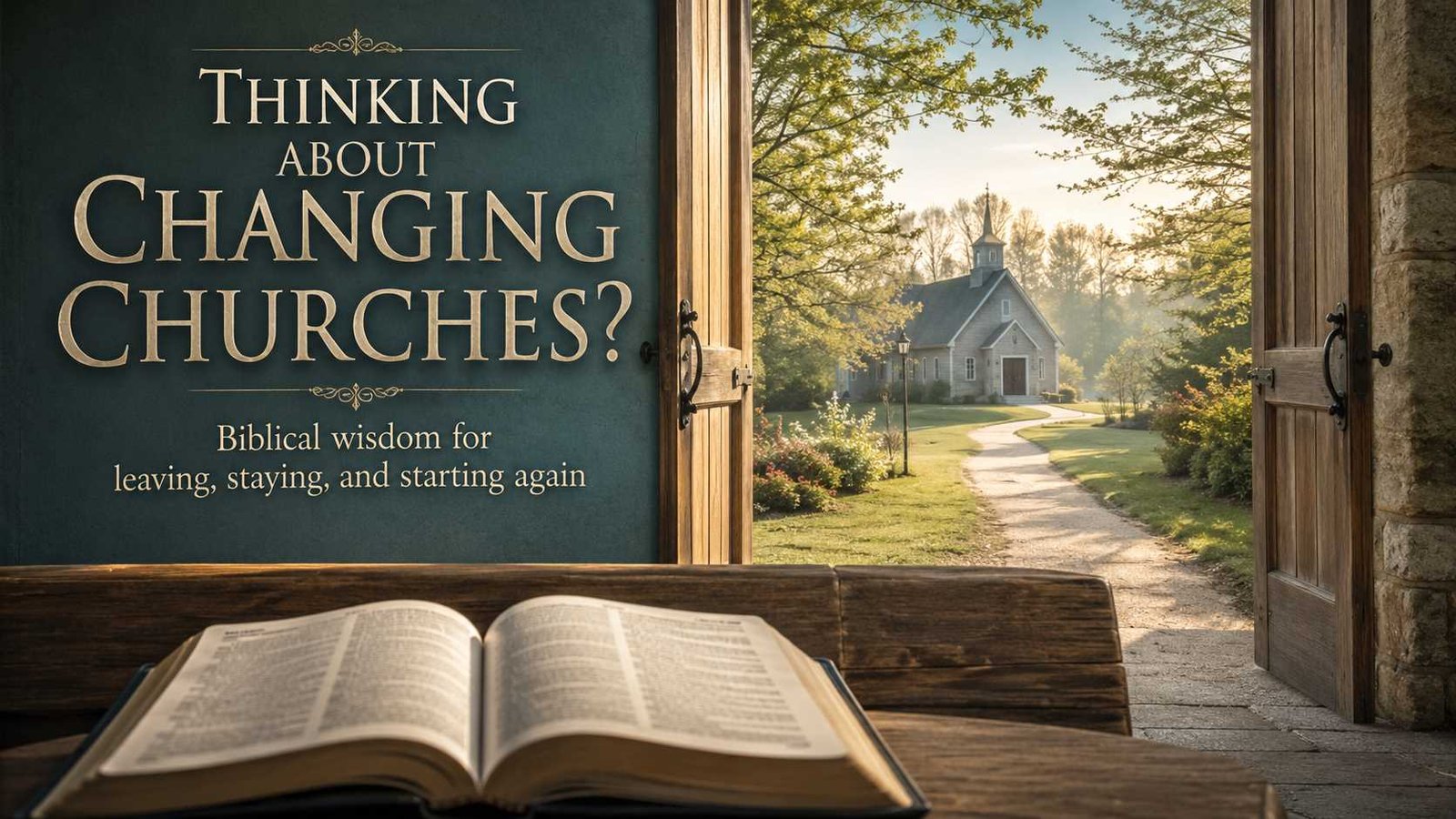
 Changing churches can be a difficult decision.
Maybe you have attended the same church for years. You know the pastor, the families, the songs, and even where everyone usually sits. Yet something no longer feels right. Perhaps you are concerned about the teaching. Maybe there has been conflict. Your family may have moved, your needs may have changed, or you may simply feel that you are no longer growing spiritually.
So, what does the Bible say about changing churches?
The Bible does not say that a Christian must stay in the same local church for life. At the same time, Scripture clearly teaches that believers should gather together, learn God’s Word, encourage one another, worship, serve, and live in Christian fellowship.
This means changing churches is not automatically sinful. But our reasons for leaving, the way we leave, and what we do afterward matter.
Hebrews 10:24–25 encourages Christians not to give up meeting together. Acts 2:42 shows the early believers devoted to teaching, fellowship, prayer, and life together.
The question, then, is usually not simply, “Am I allowed to leave this church?”
A better question is:
“Can I make this decision in a way that honors Christ?”
That changes how we think about the whole matter.
What Does the Bible Say About Changing Churches in General?
There is no Bible verse that says, “You must remain a member of the same local congregation for the rest of your life.”
Christians in the New Testament were deeply committed to the church, but circumstances sometimes changed.
Believers traveled. Families moved. Missionaries went from city to city. New churches were planted. Christians sometimes found themselves worshiping with different groups of believers.
What remained constant was their commitment to Christ.
This is an important distinction.
Your faith is first in Jesus Christ, not in a church building, pastor, denomination, worship style, or congregation.
At the same time, following Jesus is not meant to be a completely private life.
Church Fellowship Matters to God
Hebrews 10:24–25 tells believers to encourage one another and not abandon gathering together.
Acts 2:42 describes the first Christians as devoted to:
- The apostles’ teaching
- Fellowship
- Breaking bread
- Prayer
Christian fellowship is therefore not an optional extra.
When studying what the Bible says about attending church, we see that gathering with other believers helps us learn, serve, encourage, worship, and grow.
Paul also compares Christians to parts of one body in 1 Corinthians 12. A hand, foot, eye, and ear have different functions, but they belong together.
In the same way, Christians need one another.
So if you leave one church, the normal Christian goal should not be to abandon church life completely. It should be to find a healthy Christian community where you can continue following Christ with other believers.
The Bible Does Not Require Lifetime Membership in One Congregation
Some Christians feel guilty even thinking about attending another church.
That guilt is not always necessary.
Scripture calls us to faithfulness, love, truth, fellowship, humility, and service. But it does not command every Christian to remain permanently in one particular local congregation.
There are times when moving to another church may be reasonable.
You might move to another city.
Your family situation might change.
A church may close.
Serious problems may arise.
A congregation’s teaching may change.
You may discover that the church is moving away from central biblical truths.
Changing churches should therefore be treated seriously, but it should not automatically be treated as rebellion against God.
What Does God Say About Switching Churches?
When people ask, “What does God say about switching churches?”, they often want a simple yes or no.
The Bible gives us something better: principles for making wise decisions.
God cares about truth.
God also cares about love.
He cares about unity, humility, forgiveness, integrity, and peace.
Ephesians 4:1–3 urges believers to live with humility, patience, love, and eagerness to maintain unity.
Romans 12:18 teaches Christians to live at peace with others as far as it depends on them.
These passages remind us that changing churches should not normally be our first response to every disagreement.
Before leaving, it may help to ask yourself:
- Am I leaving because Scripture is being seriously compromised?
- Is there harmful or unaccountable leadership?
- Am I reacting mainly because someone offended me?
- Have I tried to resolve the problem peacefully?
- Am I expecting a perfect church?
- Can I continue growing and serving here?
- Is my family spiritually healthy in this congregation?
- Have I prayed rather than simply reacted emotionally?
These questions can reveal what is really happening in our hearts.
Sometimes the problem is serious.
Other times, God may be teaching us patience.
Knowing the difference requires prayer and wisdom.
How Do You Know When It’s Time to Change Churches?
There is no single verse that gives Christians a checklist titled “Seven Signs You Should Leave Your Church.”
Still, Scripture gives several principles that can help.
When the Gospel Is Being Seriously Distorted
One of the strongest reasons to reconsider your church is persistent false teaching about the heart of the Christian faith.
Paul speaks very strongly in Galatians 1:6–9 about people preaching a different gospel.
In Acts 20:28–30, church leaders are warned that harmful teachers may arise and distort the truth.
This does not mean Christians must leave whenever they disagree about a minor issue.
Faithful Christians have disagreed about many secondary matters throughout church history.
Churches may differ over:
- Worship styles
- Church government
- Baptism practices
- End-times interpretations
- Music
- Communion practices
- Certain traditions
Not every difference means a church has abandoned Christianity.
The central question is whether the church faithfully teaches the good news of Jesus Christ and treats Scripture seriously.
If the gospel itself is continually being replaced, denied, or distorted, the concern is much deeper than personal preference.
When Church Leadership Becomes Seriously Unbiblical
Pastors and church leaders are not expected to be perfect.
No leader is.
But Scripture does describe the kind of character Christian leaders should have.
First Timothy 3 and Titus 1 speak about qualities such as self-control, faithfulness, good character, and responsible leadership.
First Peter 5:2–3 tells church leaders to care for God’s people willingly and not to dominate those under their care.
This matters when considering what the Bible says about false leaders.
A leader who makes an occasional mistake is different from a leader who continually manipulates, intimidates, deceives, exploits, or refuses accountability.
Serious warning signs can include:
- Persistent false teaching
- Financial dishonesty
- Sexual misconduct
- Threats or intimidation
- Manipulative control
- Covering up serious wrongdoing
- Refusing reasonable accountability
- Using Scripture to silence legitimate concerns
Understanding what a pastor is in the Bible helps us see that biblical leadership is meant to serve God’s people, not control them for personal benefit.
If leadership becomes seriously harmful and refuses correction, leaving may be wise.
When Serious Problems Remain Unresolved
Jesus teaches in Matthew 18:15–17 that believers should try to deal honestly with sin and conflict.
The goal is reconciliation.
This means that if someone has hurt you, it may sometimes be better to speak with that person before deciding to disappear from the church.
Not every uncomfortable conversation should be avoided.
Christian maturity often involves forgiveness, patience, honesty, and difficult conversations.
But there is an important difference between ordinary conflict and abuse.
If you or someone in your family is being abused, threatened, stalked, assaulted, or placed in danger, you do not have to remain in an unsafe environment just to prove that you are forgiving.
Safety matters.
Serious criminal behavior should not be hidden simply because it happened in a church setting.
Seeking safety, professional help, or appropriate legal protection is not the same as refusing Christian forgiveness.
When Your Life Circumstances Change
Sometimes changing churches has nothing to do with conflict.
You may move.
You may get married.
Your work schedule may change.
You may need to care for aging parents.
Transportation may become difficult.
A congregation may close or move.
These are normal parts of life.
A Christian should not feel guilty simply because circumstances make another faithful church a more practical place to worship and serve.
What Does the Bible Say About Changing Churches Because of Conflict?
Churches are made of people.
That means conflict will happen.
Even the New Testament churches experienced disagreements.
Paul and Barnabas had a sharp disagreement in Acts 15:36–40. The Corinthian church struggled with division. Paul repeatedly called Christians to patience, forgiveness, and unity.
So conflict itself does not always mean you should leave.
Ephesians 4 teaches believers to be patient with one another.
Colossians 3:12–14 calls Christians to compassion, kindness, humility, patience, forgiveness, and love.
Romans 12:18 says:
If it is possible, as far as it depends on you, live at peace with everyone.
Notice the wisdom in that principle.
It recognizes both responsibility and limits.
You should pursue peace where possible, but peace does not always depend on one person alone.
Here is a helpful way to think through common situations:
| Situation | A Wise Biblical Response |
|---|---|
| Personality disagreement | Practice patience and understanding |
| Music or worship preference | Avoid treating preference like doctrine |
| Hurt feelings | Seek honest conversation and forgiveness |
| Serious false teaching | Examine Scripture carefully |
| Unhealthy leadership | Seek wisdom and accountability |
| Abuse or danger | Protect yourself and seek appropriate help |
| Minor church changes | Give yourself time before reacting |
When considering what the Bible says about unity in the church, remember that unity does not mean pretending every problem is acceptable.
Biblical unity is built around truth and love.
Sometimes staying and working through a disagreement strengthens us.
Sometimes leaving peacefully is wiser.
The important thing is not to let bitterness control the decision.
When Changing Churches May Not Be the Best Answer
It is easy to imagine that another church will solve every frustration.
But there is no perfect congregation.
If you find one filled entirely with perfect people, the perfection will not last long after the rest of us arrive.
Every church has human beings with weaknesses.
People misunderstand each other.
Pastors make mistakes.
Volunteers forget things.
Music may not suit everyone.
Church programs change.
Someone may sit in your usual seat.
None of these things automatically mean God is leading you somewhere else.
Sometimes staying teaches us things leaving cannot teach us.
It can teach patience.
It can teach forgiveness.
It can teach humility.
It can teach us how to love people who are different from us.
Changing churches may not be the best answer if you are leaving only because:
- Someone disagreed with you
- You did not receive the recognition you wanted
- The music changed
- A pastor gave you biblical correction
- Another church seems more exciting
- You are avoiding a conversation you should have
- You expect every decision to match your preference
Before leaving, ask yourself a difficult but useful question:
“Am I running from something God wants me to work through?”
Sometimes the answer will be yes.
Sometimes it will be no.
But it is worth asking.
What Does the Bible Say About Going to a New Church?
If you believe it is time to leave, another important question appears:
What does the Bible say about going to a new church?
Choosing a church should involve more than asking whether the building is attractive or whether the music sounds good.
Those things may matter to us, but Scripture points us toward deeper questions.
Look at What the Church Teaches
Acts 17:11 describes people examining the Scriptures carefully to see whether what they were being taught was true.
That is a healthy habit.
Listen carefully to what a church teaches about:
- Jesus Christ
- Salvation
- Scripture
- Sin and grace
- Christian living
- Love for God and neighbor
A church does not have to match every personal opinion you have.
But its teaching should point people toward Christ and treat Scripture faithfully.
Look at the Character of Its Leadership
Do not judge a church only by a charismatic speaker.
Character matters more than performance.
First Timothy 3 and Titus 1 show that biblical leadership involves integrity, self-control, faithfulness, maturity, and good character.
Ask whether leaders seem accountable.
Notice how they speak to people who disagree with them.
Notice how they treat the weak, the elderly, children, volunteers, and people who cannot offer them anything.
A person’s character often becomes clearest in the way they treat people from whom they have nothing to gain.
Look for Christian Love and Fellowship
Jesus said His followers would be known by their love for one another in John 13:34–35.
No church will love perfectly.
Still, love should be visible.
Are people welcomed?
Are hurting people cared for?
Are members encouraged to serve rather than simply attend?
Can people ask sincere questions?
Are forgiveness and humility practiced?
A healthy church is more than a Sunday service.
It is a community learning to follow Christ together.
Ask Whether You Can Grow and Serve There
Church is not only about what you receive.
It is also about what you give.
When considering what spiritual growth in the Bible means, remember that growth includes learning Scripture, becoming more like Christ, serving others, developing spiritual maturity, and practicing love.
Ask:
“Can I grow here?”
But also ask:
“Can I serve here?”
A healthy church should help you do both.
What Does the Bible Say About Changing Churches and Leaving Gracefully?
Sometimes the decision to leave is correct, but the way a person leaves creates unnecessary wounds.
You can make a wise decision in an unwise way.
If circumstances allow, try to leave with grace.
1. Pray Before Making the Decision
Do not decide only when you are angry.
Strong emotion can make every problem look larger.
Give yourself time to pray.
Ask God for wisdom.
James 1:5 encourages believers to ask God for wisdom.
2. Examine Your Motives
Be honest.
Are you leaving because of a serious biblical concern?
Or are pride, resentment, jealousy, or personal preference influencing the decision?
You do not need to condemn yourself. You simply need to tell the truth before God.
3. Study Scripture
A decision about church should involve more than feelings.
Compare your concerns with biblical principles.
If you are worried about teaching, study the teaching.
If the issue is leadership, study biblical leadership.
If the problem is conflict, study forgiveness and reconciliation.
4. Seek Wise Counsel
Talk with mature Christians who know you well and are not emotionally involved in the dispute.
Do not only ask people who will automatically agree with you.
Wise counsel may confirm your concerns.
It may also help you see something you missed.
5. Address Conflict When Appropriate
If the issue is a misunderstanding or personal disagreement, a respectful conversation may solve more than you expect.
Do not assume another person’s motives.
Ask questions.
Listen.
Explain your concern calmly.
Again, this advice does not mean someone should confront an abusive or dangerous person alone. Safety comes first in those situations.
6. Avoid Gossip
Leaving a church does not require destroying its reputation.
There may be cases where serious wrongdoing must be reported or exposed responsibly. That is different from spreading rumors because you are angry.
Speak truthfully.
Speak carefully.
Do not exaggerate.
7. Explain Your Decision Respectfully When Appropriate
You do not always owe every person a detailed explanation.
But if you have served closely with leaders or members for years, quietly disappearing may cause unnecessary confusion.
A short and respectful conversation can sometimes bring peace.
8. Leave Bitterness Behind
You can leave a church physically while carrying it emotionally for years.
That is a heavy burden.
Forgiveness does not mean saying wrong behavior was acceptable.
It means refusing to let resentment rule your heart.
9. Find Another Christian Community
Do not allow a painful church experience to slowly separate you from every Christian community.
Healing may take time.
Still, Hebrews 10:24–25 reminds us that believers need encouragement and fellowship.
A bad experience with one congregation does not mean every congregation will be the same.
What Does the Bible Say About Switching Religions?
The question “What does the Bible say about switching religions?” is different from changing churches.
These two decisions should not be confused.
Changing from one Christian congregation to another may still mean that you remain committed to Jesus Christ and the Christian faith.
Switching religions means something much deeper.
From a Christian biblical perspective, believers are called to remain faithful to Christ.
Hebrews 10:23 encourages Christians to hold firmly to the hope they profess.
In John 6, when many people stopped following Jesus, He asked the Twelve whether they wanted to leave too. Peter responded that Jesus had the words of eternal life.
For Christians, this is the heart of the issue.
Churches can disappoint us.
Christ remains the center of our faith.
Pastors can fail.
Christ remains faithful.
Congregations can change.
Christ does not stop being Lord because human beings make mistakes.
This does not mean Christians should speak disrespectfully about people of other religions. Scripture teaches us to treat people with love and respect.
But Christian teaching is clear that faithfulness to Jesus is not the same question as membership in one particular congregation.
You may need to change churches without changing whom you follow.
Questions to Ask Yourself Before Changing Churches
If you are still unsure, take these questions slowly.
You might even write your answers down.
- Is Jesus Christ clearly at the center of this church?
- Is Scripture being taught faithfully?
- Is my concern truly biblical, or mainly a personal preference?
- Have I prayed seriously about leaving?
- Am I making this decision while angry?
- Is there a conflict I should try to resolve first?
- Are church leaders accountable and trustworthy?
- Is there manipulation, abuse, or serious misconduct?
- Can my family grow spiritually here?
- Can I use my gifts to serve others here?
- If I leave, where will I worship next?
- Can I leave without revenge, gossip, or unnecessary division?
- Will this decision help me follow Christ more faithfully?
You may not have perfect certainty.
Most important life decisions do not come with a sign from heaven giving us every detail.
Sometimes wisdom means praying, studying Scripture, seeking counsel, and then making the best faithful decision you can.
A Simple Biblical Test: Truth, Love, Growth, and Peace
When the details feel confusing, four words can help.
Truth
Is the church faithfully teaching the gospel and Scripture?
Christian unity cannot be built by ignoring truth.
Love
Are believers being encouraged to love God and one another?
Jesus placed great importance on love among His followers.
Growth
Is the church helping you become more like Christ?
Growth does not mean being entertained every Sunday. Sometimes spiritual growth is uncomfortable because God is changing us.
Peace
Have you genuinely tried to pursue peace where possible?
Romans 12:18 reminds us that we should do what we can to live peacefully with others.
These four questions will not answer every situation, but they provide a helpful biblical framework.
What This Teaches Us About Faithful Church Life
So, what does the Bible say about changing churches?
Scripture does not command you to remain in the same local church forever.
It does command you to remain faithful to Christ.
It calls you to value Christian fellowship, biblical truth, love, unity, wisdom, service, forgiveness, and spiritual growth.
There may be times when staying is the more mature choice.
There may also be times when leaving is wise.
If the problem is a small disagreement, God may be teaching you patience.
If the problem is serious false teaching, harmful leadership, abuse, or persistent spiritual danger, changing churches may be necessary.
And sometimes there is no crisis at all. Life simply changes.
Whatever your situation, try not to make the decision from anger alone.
Pray.
Read Scripture.
Listen carefully.
Seek wise counsel.
Examine your own heart.
And remember that leaving a congregation does not mean leaving Christ.
The church belongs to Jesus. No single pastor, denomination, building, or congregation represents the whole body of Christ.
If you do change churches, look for a community where Scripture is respected, Christ is central, people are loved, leaders show godly character, and you can both grow and serve.
And if your experience with church has been painful, do not let another person’s failure convince you that God has abandoned you.
People can disappoint us.
Jesus remains faithful.

Reverend James has spent years studying and teaching the Bible. With warmth and wisdom, he shares deep truths in a way that’s clear, simple, and easy to understand.