
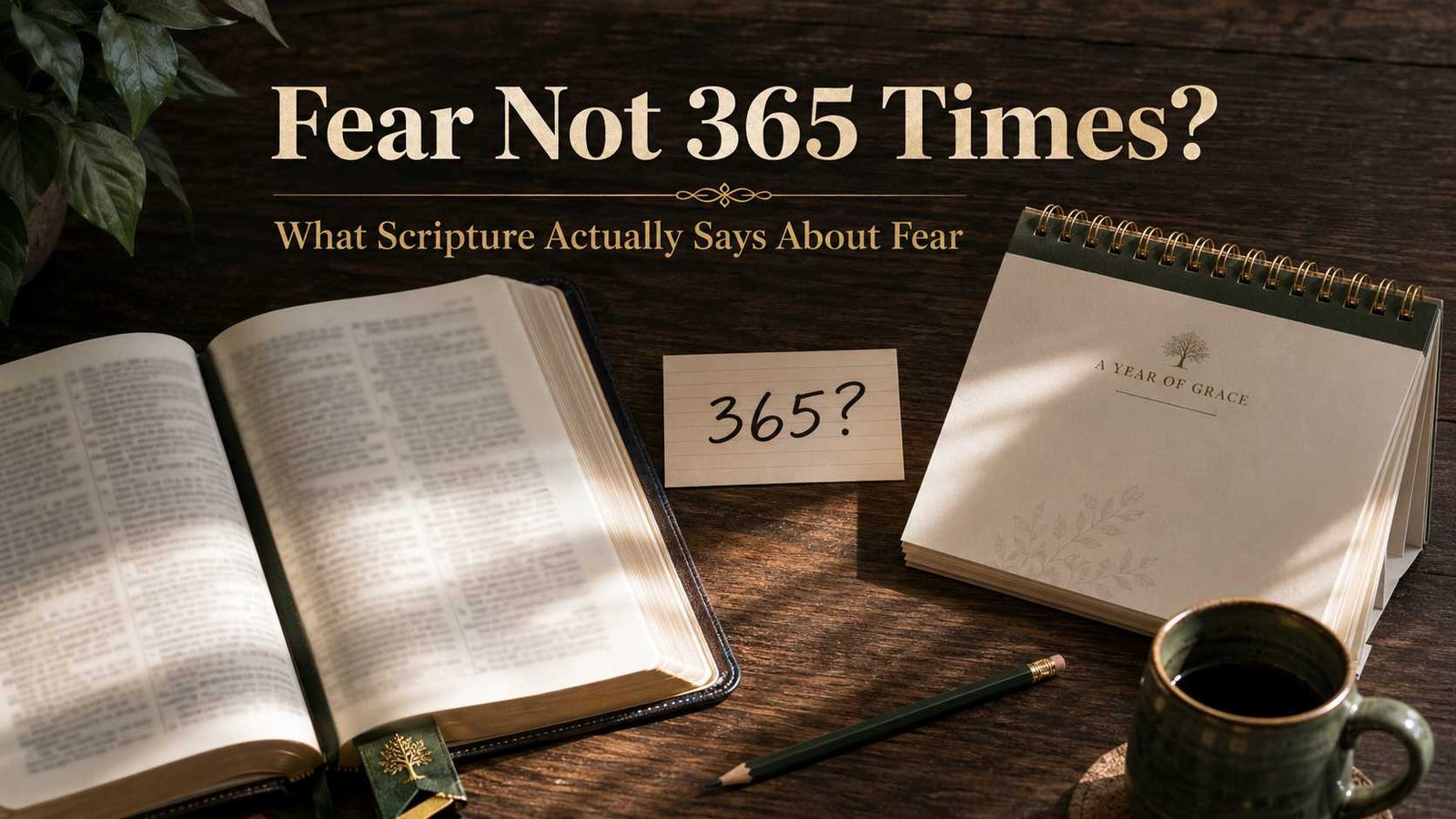
 You may have heard a beautiful Christian saying: The Bible says “Fear not” 365 times, one reminder for every day of the year.
It sounds perfect. There are 365 days in a normal year, so the idea gives us a comforting picture. Wake up each morning, and somewhere in Scripture God has a fresh “Fear not” waiting for you.
But does the Bible say “Fear Not” 365 times?
The simple answer is no, not as an exact count.
There is no standard Bible translation in which the exact command “Fear not” appears 365 times. Even when similar expressions such as “do not fear,” “do not be afraid,” and “be not afraid” are added, the result depends on the translation and on what phrases a person decides to count.
Published searches illustrate the problem. One count reports 71 occurrences of the exact phrase “fear not” in the King James Version. Another broader count, combining expressions such as “fear not” and “be not afraid,” gives 103. Those different totals show why the popular number 365 cannot be treated as a precise biblical statistic.
Yet the saying points toward something that is deeply biblical.
From Genesis to Revelation, Scripture repeatedly speaks to people who are frightened, worried, threatened, uncertain, or overwhelmed. Again and again, God calls people to trust Him. Jesus also directly told people not to be afraid.
So the real lesson is even better than a clever number.
The Bible does not need to contain exactly 365 “Fear not” statements for us to know that God cares about our fears.
Does the Bible Really Say “Fear Not” 365 Times?
The idea has circulated for many years in sermons, devotionals, social media posts, inspirational books, and Christian conversations.
It is easy to understand why people love it.
“365 fear nots” creates a memorable picture:
One command against fear for every day of the year.
The problem begins when a devotional illustration becomes a statement about the actual number of phrases in the Bible.
If you search the King James Version for the exact words “fear not,” you will not find 365 occurrences. One published search puts that exact phrase at 71 instances. Other researchers produce different totals when they include expressions such as “be not afraid,” “do not fear,” or verses that encourage courage without using the word fear.
That is why a responsible answer must begin with a question:
What exactly are we counting?
Are we counting only:
- “Fear not”?
- “Do not fear”?
- “Do not be afraid”?
- “Be not afraid”?
- “Do not be terrified”?
- “Do not be discouraged”?
- Every verse about courage?
- Every verse about anxiety?
- Every promise of God’s presence?
Different rules give different numbers.
This is also why claims about how many times fear is mentioned in the Bible must name the translation being searched.
The biblical message is clear. The mathematical slogan is not.
Why Bible Translations Give Different Counts
Bible translations do not always use the same English words.
Consider Jesus speaking to Simon Peter in Luke 5:10.
The King James Version uses the words “Fear not.” Other English translations express the same command as “Don’t be afraid” or “Do not fear.” Bible Gateway’s comparison of the verse shows several of these different English renderings.
The same thing happens in Luke 12:32.
The KJV begins the verse with “Fear not, little flock.” The NIV renders the command, “Do not be afraid, little flock.”
The meaning is closely related, but a computer searching only for the words “fear not” would count one translation and miss the other.
This is one reason we should be cautious whenever someone says a particular English phrase occurs an exact number of times in “the Bible.”
Which Bible translation?
Which wording?
Which verses are included?
Those questions matter.
How Many Times Has God Said “Fear Not” in the Bible?
There is no single number that works for every Bible translation and every method of counting.
If someone asks, “How many times has God said fear not in the Bible?” we also need to distinguish between every occurrence of the words and occasions when God Himself is speaking.
Sometimes God says not to fear.
Sometimes Jesus says it.
Sometimes an angel says it.
Sometimes a prophet, leader, or another person tells someone not to be afraid.
For example, in Genesis 50:19 Joseph tells his brothers, “Fear not.” In 2 Kings 6:16, Elisha tells his servant not to fear. Those verses contain the language, but they are not examples of God directly speaking the command.
This makes counting even more complicated.
A person counting every appearance of “fear not” is doing something different from a person counting only direct commands spoken by God.
So rather than building our faith around an uncertain number, it is better to notice the repeated biblical pattern:
People become afraid. God meets them in their fear. He gives them a reason to trust Him.
That pattern appears throughout Scripture.
Why Do People Say “Do Not Be Afraid” 365 Times?
The answer is probably simple: it makes a powerful devotional message.
There are 365 days in a normal year. Saying there are 365 commands not to fear makes it sound as though God intentionally placed one in Scripture for every calendar day.
It is memorable. It is comforting. It preaches well.
But memorable does not automatically mean accurate.
One Christian discussion of the claim notes that people have even suggested 366 “fear not” statements, enough to cover a leap year. Yet that same discussion acknowledges that no Bible version literally says “Fear not” 365 times.
We do not need to criticize people who have repeated the saying. Most probably shared it because they wanted to encourage someone.
Still, Christians should value truth even when correcting a beautiful idea.
Scripture does not become less comforting because the number 365 does not work.
In fact, knowing what the Bible actually says gives our faith a stronger foundation.
Did Jesus Ever Say “Fear Not”?
Yes. Jesus clearly told people not to fear.
Luke 5 gives one direct example.
Simon Peter and the other fishermen had witnessed an astonishing catch of fish. Peter became deeply aware of Jesus’ holiness and his own sinfulness. Jesus responded by telling Simon not to fear and then called him toward a new purpose.
In the King James Version, Jesus says:
“Fear not.”
Luke 5:10 then moves immediately toward Simon’s calling.
Fear was not the end of Peter’s story.
Jesus was calling him forward.
Jesus Said “Fear Not, Little Flock”
Another beautiful example appears in Luke 12:32.
Jesus had been teaching His disciples about worry, possessions, food, clothing, and trusting their heavenly Father.
Then He reassured them:
“Fear not, little flock.”
The KJV uses those words, while the NIV expresses the same command as “Do not be afraid, little flock.”
Notice the tenderness of the picture.
Jesus does not speak as though frightened people are foolish or worthless.
He speaks of a little flock cared for by the Father.
Fear is answered with relationship.
Jesus Also Told His Followers Not to Fear People
In Matthew 10, Jesus prepared His disciples for opposition. He did not pretend that following Him would always be easy.
Yet He repeatedly directed their attention away from fear and toward God’s authority and care.
Jesus reminded them that God even knows about the sparrows and knows the hairs of their heads. His point was that His followers are seen and valued by their Father.
The biblical answer to fear is therefore not always:
“Nothing difficult will happen.”
Often it is:
“God sees you, God values you, and God remains with you.”
What Does the Bible Say About Fear?
To understand what the Bible says about fear, we need to notice that Scripture does not use the idea of fear in only one way.
Sometimes fear means being frightened by danger.
Sometimes it describes anxiety about what might happen.
Sometimes Scripture speaks positively about the “fear of the Lord.”
These ideas should not all be treated as identical.
Fear Can Be a Natural Response to Danger
Biblical people were not emotionless.
They became frightened.
They worried about enemies.
They faced sickness, loss, violence, storms, persecution, family problems, hunger, uncertainty, and death.
The Bible does not hide these moments.
That matters because sometimes Christians hear “Do not fear” and assume that feeling afraid means they have failed spiritually.
Scripture gives us a more human picture.
Fear may arise.
The important question is what we do when it does.
Psalm 56 presents that movement clearly: fear appears, and trust follows. The psalmist does not say he has never felt frightened. He chooses to place confidence in God when fear comes.
Faith is not always the absence of emotion.
Sometimes faith is trusting God while your heart is still learning to be calm.
God Often Answers Fear With His Presence
Isaiah 41:10 is one of the clearest examples.
God tells His people not to fear and gives the reason: He is with them. He also promises strength and help.
This pattern appears again in Joshua 1:9.
Joshua was stepping into an enormous responsibility after the death of Moses. God told him to be strong and courageous, not afraid or discouraged, because the Lord would be with him wherever he went.
The command and the promise belong together.
God does not merely say:
“Stop being scared.”
He gives Joshua a reason for courage:
“I will be with you.”
That difference matters.
What Does Fear in the Bible Mean?
The word fear can describe several experiences, so context is important.
A person may fear an enemy.
A disciple may fear persecution.
Someone may fear bad news.
People encountering angels may become afraid.
But the Bible also speaks about the fear of the Lord.
That phrase is usually not teaching believers to live in constant terror of God.
It points toward recognizing God’s greatness, holiness, authority, justice, and wisdom. It includes reverence and a willingness to take God seriously.
Proverbs connects the fear of the Lord with wisdom and knowledge.
So Scripture can tell us to fear God while also telling us not to be afraid.
There is no contradiction when the words are understood in context.
One kind of fear draws us toward reverence and obedience.
Another kind of fear can control us, discourage us, or tempt us to forget God’s faithfulness.
If you want to study this distinction more deeply, the related topic what does fear in the Bible mean is especially helpful because it looks beyond simple word counts.
Does God Expect Christians Never to Feel Afraid?
Imagine a mother waiting for medical test results.
Imagine a father who has lost his job.
Imagine a young person starting a new school.
Imagine someone sitting beside a loved one in a hospital.
Imagine a family facing an uncertain future.
Telling such people, “A real Christian never feels afraid,” can add guilt to an already painful situation.
The Bible’s repeated calls not to fear should not be used as weapons against frightened people.
Instead, they invite frightened people toward trust.
Many biblical passages follow a pattern like this:
Fear appears → God speaks → God’s character is remembered → the person is called to trust.
That means courage can be an act of faith even when fear is present.
Joshua needed courage because there was something difficult ahead.
Peter needed reassurance because he was overwhelmed.
The disciples needed Jesus’ words because they lived in a world where opposition and uncertainty were real.
“Do not fear” does not mean, “Nothing frightening exists.”
It means fear does not have to become your master.
“Do Not Be Afraid” Is About More Than a Number
Focusing too heavily on whether the Bible says “Fear not” 71, 100, 200, or 365 times can cause us to miss the larger message.
Look at what often surrounds these commands.
| Biblical Situation | Message Connected With Fear |
|---|---|
| Joshua faces a new responsibility | God will be with him |
| Israel faces uncertainty | God promises help |
| Peter is overwhelmed before Jesus | Jesus gives him a new calling |
| Jesus teaches worried disciples | The Father knows their needs |
| God’s people face enemies | They are called to trust God |
| Believers face anxious thoughts | They are directed toward prayer and trust |
The repeated theme is not merely “be brave.”
Biblical courage is usually connected to who God is.
He is present.
He sees.
He knows.
He strengthens.
He guides.
He remains faithful.
That is why the Bible’s teaching about fear has comforted believers for generations.
Bible Verses to Remember When You Are Afraid
If you are looking for when you are scared Bible verses, these passages are a good place to begin.
Isaiah 41:10
God tells His people not to fear because He is with them. He promises strength, help, and support.
When fear whispers, “You are alone,” this passage answers, “God is present.”
Joshua 1:9
Joshua is commanded to be strong and courageous and not to become afraid or discouraged. The reason again is God’s presence.
Courage begins not with Joshua’s personality but with God’s promise.
Psalm 56:3–4
The psalmist describes turning toward trust when fear comes.
This is a helpful passage for anyone who thinks faith means never experiencing fear.
Fear may be felt.
Trust can still be chosen.
Deuteronomy 31:8
Moses encourages God’s people with the truth that the Lord goes before them and will remain with them.
That image is especially comforting when you are entering a situation you cannot control.
Luke 5:10
Jesus tells Simon not to fear and then points him toward his future calling.
The moment reminds us that fear does not have to prevent obedience.
Luke 12:32
Jesus speaks tenderly to His “little flock,” telling His followers not to be afraid because of the Father’s gracious care.
John 14:27
Jesus speaks about peace while preparing His disciples for His departure.
Christian peace is not simply a comfortable environment. It is connected to Christ even when circumstances are changing.
Philippians 4:6–7
Paul directs believers away from being consumed by anxiety and toward prayer, thanksgiving, and bringing requests before God.
This is why the related topic don’t be anxious Bible verse connects naturally with the Bible’s larger teaching on fear.
2 Timothy 1:7
Paul reminds Timothy that the life God gives His people is not meant to be ruled by cowardice but shaped by divine strength, love, and self-control.
These passages do not promise a life without difficult moments.
They teach us where to turn in those moments.
Is “Fear Not” the Most Repeated Command in the Bible?
You may also hear the statement:
“Fear not is the most repeated command in the Bible.”
That claim should be treated carefully for the same reason as the 365 claim.
How do we define a command?
Are “fear not,” “do not be afraid,” and “be courageous” one command or several?
Do repeated commands to praise God, obey God, love, listen, remember, pray, or worship belong in the same comparison?
Because the Bible contains many books, genres, speakers, and translations, declaring one English phrase to be “the most repeated command” requires a clear method of counting.
The safer statement is this:
Commands and encouragements against fear appear repeatedly throughout Scripture and form an important biblical theme.
That says what the Bible clearly supports without turning a devotional observation into a statistic we cannot confidently prove.
What Should We Fear Instead?
The Bible’s answer to fear is not simply positive thinking.
It redirects our attention.
Jesus taught His followers that human threats should not hold ultimate power over their hearts. Scripture repeatedly places the greatness of God above the things that frighten us.
That is one reason the biblical fear of God can actually free a person from unhealthy fear.
When God is seen as greater than everything else, other fears begin to lose their absolute power.
This does not mean believers become careless.
Courage is not the same as recklessness.
If a road is dangerous, wisdom takes precautions.
If someone threatens you, seeking help can be wise.
If you are sick, receiving appropriate care is sensible.
Biblical trust does not require pretending that danger is imaginary.
Faith says that even real danger is not greater than God.
Why God’s Words About Fear Still Matter Today
Fear changes shape from generation to generation.
An ancient Israelite might fear an invading army.
A first-century disciple might fear persecution.
Today a person may fear losing employment, becoming sick, losing a relationship, failing an exam, growing old, being rejected, or facing an uncertain future.
The circumstances change.
The human heart does not change very much.
We still ask:
What will happen?
Will I be safe?
Can I handle this?
Will someone help me?
Am I alone?
Biblical passages about fear answer those questions by directing us toward God rather than promising that we can control everything.
Isaiah 41:10 does not tell us that we will always know what happens next.
Joshua 1:9 does not tell Joshua that leadership will be easy.
Jesus does not promise His disciples a trouble-free life.
The promise is deeper:
God remains present.
That truth is worth remembering every day, whether or not there are exactly 365 verses saying it.
Does the Bible Say “Fear Not” 365 Times? The Simple Answer
So, does the Bible say “Fear Not” 365 times?
No. The popular claim that “Fear not” or “Do not be afraid” appears exactly 365 times is not supported by a straightforward count of standard Bible translations.
The number changes depending on which translation is searched and which expressions are included. Published searches of the KJV using different methods have produced totals well below 365, illustrating why the claim should not be treated as an exact Bible fact.
But we should not allow the correction to hide the beautiful truth behind it.
The Bible does repeatedly tell God’s people not to be ruled by fear.
God told His people not to fear.
Jesus told His followers not to fear.
Scripture calls frightened people toward courage, prayer, faith, wisdom, and trust.
And again and again, the reason for courage is not human strength.
It is God’s presence.
What Matters More Than the Number
There is something appealing about imagining one “Fear not” for every day of the year.
But our confidence does not need a perfect numerical pattern.
Suppose the Bible said “Fear not” only once.
Would God’s word suddenly become less trustworthy?
Of course not.
A promise is not powerful because we can multiply it by 365.
It is powerful because of the One who gives it.
When God says He is with His people, the strength of that promise rests in His character.
When Jesus tells His little flock not to be afraid, the comfort rests in the Father’s care.
When Joshua is told to be courageous, his hope rests in the God who goes with him.
So the next time you see the statement “The Bible says Fear Not 365 times,” you can appreciate the encouragement while remembering the more accurate answer.
The number is not established.
The message is.
When fear comes, Scripture does not tell you that you must face it alone.
It calls you back to God.
Remember His character.
Remember His promises.
Pray.
Trust.
Take the next faithful step.
And when tomorrow brings another concern, you do not need to search for verse number 366.
The same faithful God will still be there.
For further study, see What Does Fear in the Bible Mean? and When You Are Scared: Bible Verses for Trusting God.
Dr. Rachel is very smart and knows a lot about the Bible. He helps us understand the Bible better by talking about the old texts in a simple way.