

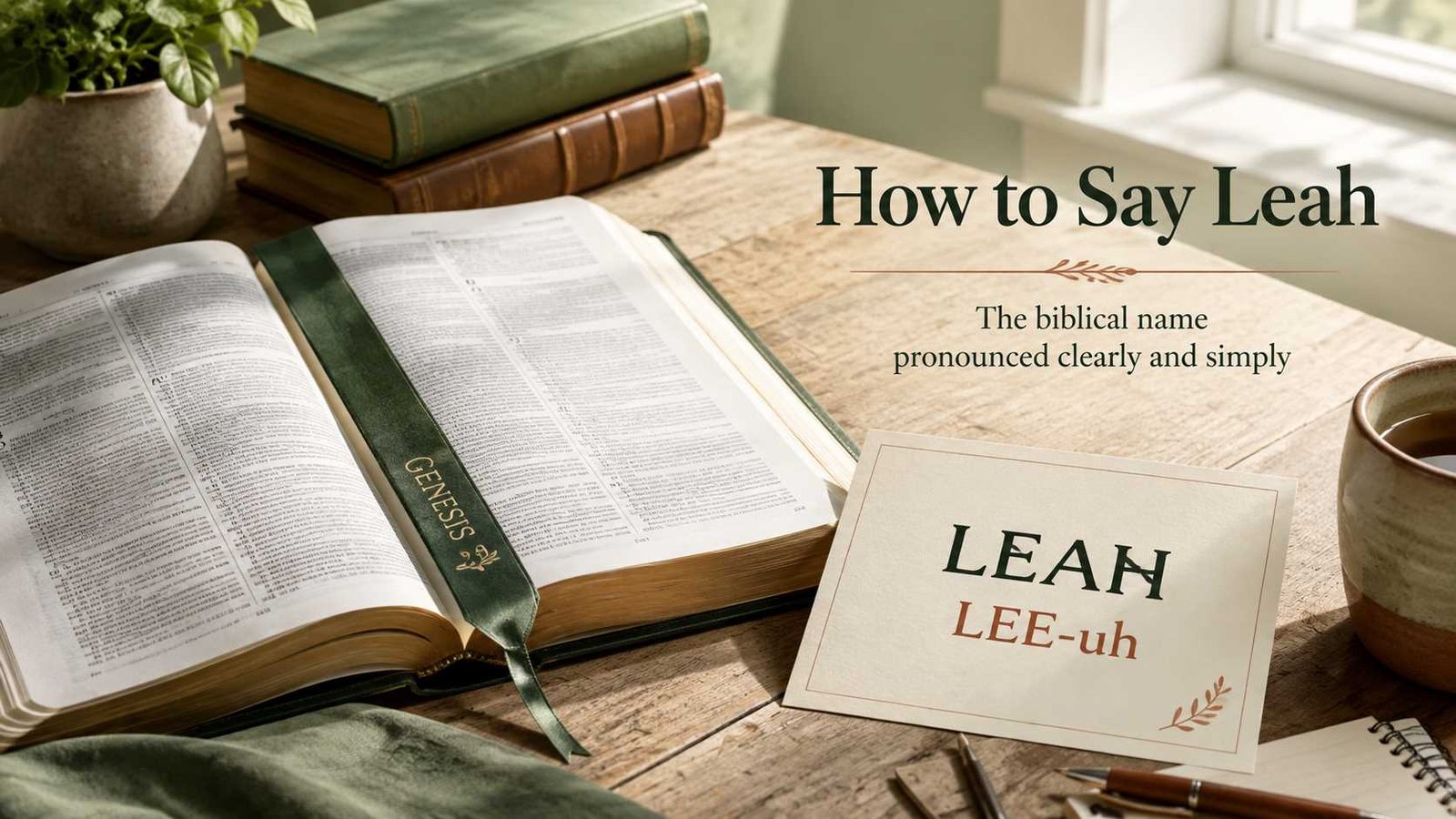
 If you have ever stopped while reading Genesis and wondered how to pronounce Leah in the Bible, the simplest answer is LEE-uh.
Say it in two clear parts:
LEE + uh = Leah
The first part sounds like the word “lee.” The second part is a short, soft “uh.” Cambridge Dictionary gives both its UK and US pronunciation as /ˈliː.ə/, which matches LEE-uh.
You may also hear some people pronounce Leah as LAY-uh. That does not mean they invented the pronunciation. Collins Dictionary records both LEE-uh and LAY-uh as American pronunciations of the name.
So, if you are reading the Bible aloud in English, LEE-uh is the safest and most widely recognized pronunciation.
But there is much more behind this beautiful biblical name. Leah was an important woman in the Book of Genesis. She was Laban’s older daughter, Rachel’s sister, Jacob’s wife, and the mother of several sons who became part of the tribes of Israel.
Understanding her name can make her story feel a little more familiar each time you meet her in Scripture.
How To Pronounce Leah In The Bible Correctly
The common English pronunciation of Leah is:
Leah: LEE-uh
You can break it into two syllables:
LEE
uh
Put them together naturally:
LEE-uh
The stress falls on the first syllable, so the “LEE” part is stronger than the softer “uh” at the end.
Cambridge Dictionary writes the pronunciation as /ˈliː.ə/ for both British and American English.
You do not need to make the name sound complicated. If you can say:
“Lee” + “uh”
you can pronounce Leah naturally in an English Bible reading.
For example:
“Jacob married Leah.”
Say it as:
“Jacob married LEE-uh.”
This is especially helpful if you are learning how to pronounce Bible names for personal Bible reading, Sunday school, a Bible study group, or reading Scripture aloud with your family.
Biblical names sometimes look difficult because many of them came into English from Hebrew, Aramaic, or Greek. The spelling we see today may not tell us exactly how the name sounded thousands of years ago. That is why a simple English pronunciation guide can be useful.
With Leah, fortunately, the common English pronunciation is easy to remember.
Is Leah Pronounced Lee-Ah or Lay-Ah?
This is where many readers become confused.
Should you say:
LEE-uh
or:
LAY-uh?
For normal English Bible reading, LEE-uh is the standard pronunciation. Cambridge gives only the LEE-uh form for both British and American English.
However, LAY-uh is also a recognized pronunciation variant. Collins lists both forms in American English.
That means it is better not to tell someone that LAY-uh is completely wrong.
Pronunciation can change because of language, region, family tradition, and the way biblical names have traveled from Hebrew into other languages.
Here is the easiest way to think about it:
| Pronunciation | How It Sounds | Usage |
|---|---|---|
| LEE-uh | Lee + uh | Most common English pronunciation |
| LAY-uh | Lay + uh | Recognized variant |
| Le’ah | Hebrew transliteration | Used when discussing the Hebrew name |
If you are unsure which form to use while reading an English Bible, choose LEE-uh.
It will sound natural to most English-speaking listeners.
Why Do Some People Pronounce Leah as Lay-Ah?
The answer partly comes from the name’s Hebrew background.
Leah was not originally an English name. The biblical form comes from Hebrew לֵאָה, commonly transliterated as Le’ah or Lê’âh. Hebrew reference works connect this spelling with Strong’s number H3812.
Because Hebrew sounds do not always move neatly into English, pronunciation guides can represent the same biblical name differently.
Blue Letter Bible, for example, gives a traditional Strong’s-style pronunciation rendering that sounds closer to “lay-aw,” while modern English dictionaries generally give LEE-uh for the English name Leah.
This is an important distinction.
When you ask, “How do you pronounce Leah?”, there can actually be two questions hiding inside it:
How do English speakers normally pronounce the name today?
Or:
How might the underlying Hebrew name be represented?
Those are not always the same thing.
For ordinary English Bible reading, you are not expected to reproduce an ancient Hebrew pronunciation every time you read a biblical name.
Christians around the world read biblical names through their own languages. Moses, Isaiah, Jeremiah, Jesus, Peter, and many other names sound different depending on the language being spoken.
Leah is no different.
So if you say LEE-uh, you are using the normal English form.
How Do You Pronounce the Name Leah in the Bible?
If someone asks you directly, “How do you pronounce the name Leah in the Bible?”, you can give this simple answer:
Leah is normally pronounced LEE-uh in English.
The name has two syllables.
LEE is the first syllable.
uh is the second.
Say it smoothly rather than placing a long pause between them.
Not:
“LEE … AH!”
But:
“LEE-uh.”
Imagine reading Genesis aloud:
“Now Laban had two daughters; the name of the older was Leah and the name of the younger was Rachel.”
Genesis 29 identifies Leah as Laban’s older daughter and Rachel as his younger daughter.
When reading that passage, say:
LEE-uh and RAY-chul.
Once you hear the name this way a few times, it becomes very natural.
This same method works well when you are trying to learn how to pronounce Bible names that seem unfamiliar. Break the name into smaller sound units, identify which syllable receives the stress, and then say the whole name naturally.
Is Leah a Biblical Name?
Yes. Leah is definitely a biblical name.
She appears prominently in Genesis.
Genesis 29 introduces Leah as the older daughter of Laban and the sister of Rachel. Jacob loved Rachel and agreed to work for Laban for seven years so he could marry her. But after the wedding celebration, Laban gave Leah to Jacob instead. Jacob later married Rachel as well and agreed to serve Laban for another seven years.
This places Leah at the center of one of the most memorable family stories in Genesis.
She was not a minor person who appeared only once.
Leah became the mother of six of Jacob’s sons: Reuben, Simeon, Levi, Judah, Issachar, and Zebulun. Genesis 35 lists these six as the sons of Leah.
Genesis also records Leah as the mother of Dinah.
Her family line became deeply important in the later story of Israel.
Two of her sons especially stand out.
Levi became the ancestral name connected with the Levites.
Judah became the ancestral name of the tribe of Judah.
This means that a reader who first searches only for how to pronounce Leah in the Bible soon discovers that Leah is connected with some of the most important family lines in the Old Testament.
Her name may be simple to pronounce, but her place in Scripture is significant.
Who Was Leah in the Bible?
Leah’s story begins with family relationships that were often painful and complicated.
Jacob arrived in the household of his uncle Laban and met Rachel. He loved Rachel and offered years of work in exchange for marriage to her. But Laban arranged for Leah, his older daughter, to become Jacob’s wife first.
That decision created a difficult family situation.
Scripture does not hide Leah’s pain.
Genesis describes Jacob’s greater love for Rachel and then tells us that God saw Leah’s difficult position. Leah began having children, and the names and statements connected with her sons show how deeply she desired love and acceptance.
When Reuben was born, Leah hoped her husband would love her.
When Simeon was born, she spoke about God hearing that she was unloved.
When Levi was born, she hoped Jacob would become attached to her.
But when Judah was born, something in her words changed.
She turned toward praise.
Genesis 29:35 records Leah saying that this time she would praise the Lord, and she named her son Judah.
It is a small sentence, but it gives us a moving glimpse into her story.
Leah lived with disappointment, comparison, marriage struggles, and longing. Yet her life was not without purpose.
God worked through her family in ways she could not have fully seen at the time.
That is one reason Leah continues to interest Bible readers today.
You may begin by wondering how to say her name. Then you discover a woman whose life touches questions of rejection, family, faith, motherhood, hope, and God’s care.
What Does the Name Leah Mean in Hebrew?
The meaning of Leah’s name deserves a little care because not every reference source gives exactly the same explanation.
The Hebrew form is לֵאָה, transliterated as Le’ah.
A common explanation connects Leah with a Hebrew root associated with being weary or grieved. Blue Letter Bible’s Strong’s entry also gives “weary” as the meaning associated with the biblical name.
However, the origin of ancient names is not always certain.
Behind the Name notes the common connection with a Hebrew word meaning “weary” or “grieved,” while also mentioning a possible connection with an Akkadian word referring to a cow.
So it is wiser to say:
Leah is commonly understood to mean “weary,” but the exact ancient origin of the name is not completely certain.
You may sometimes find websites confidently giving meanings such as “delicate,” “gazelle,” “wild cow,” or other descriptions.
Some of these ideas come from different dictionaries, language traditions, or attempts to connect Leah’s name with ancient Semitic words. Collins, for example, records different etymological information in different dictionary entries.
For a Bible reader, the safest approach is not to build a spiritual message on an uncertain name meaning.
Leah’s actual story in Genesis tells us far more about her than a debated dictionary definition ever could.
Does Leah’s Meaning Change Its Pronunciation?
No.
The meaning of Leah and the pronunciation of Leah are two different questions.
Even if the name is connected with a Hebrew word meaning “weary,” that does not mean an English reader must pronounce the name according to the pronunciation of that Hebrew root.
Names regularly change pronunciation when they move from one language into another.
The biblical name we write as Leah has passed through centuries of translation and language development before reaching modern English Bibles.
That is why the ordinary English pronunciation can be LEE-uh even when Hebrew-focused reference tools represent the underlying Hebrew sounds differently.
You can therefore confidently say LEE-uh without worrying that you are changing the biblical meaning of her name.
Where Does Leah Appear in the Bible?
Leah’s main story is found in the Book of Genesis.
She first becomes a major figure in Genesis 29, where Jacob arrives among Laban’s family.
The chapter introduces Leah and Rachel and then tells the story of Jacob’s marriages.
Her story continues through the following chapters as her children are born and the relationships within Jacob’s household develop.
If you want to study Leah beyond the pronunciation of her name, several passages are especially useful:
Genesis 29
This chapter introduces Leah, Rachel, Jacob, and Laban’s marriage arrangement.
It also records the births of Leah’s first four sons: Reuben, Simeon, Levi, and Judah.
Genesis 30
Leah’s family story continues here.
The competition and tension between Rachel and Leah become more visible, and additional children enter Jacob’s household.
Genesis 33
Leah appears with her children when Jacob prepares to meet Esau. Genesis describes how Jacob arranged his household as Esau approached.
Genesis 35
This chapter provides a list of Jacob’s sons and identifies Reuben, Simeon, Levi, Judah, Issachar, and Zebulun as Leah’s sons.
Genesis 49
Near the end of Jacob’s life, he speaks about the family burial place and says that Leah had been buried there. Genesis 49:31 places her burial with the family at the cave associated with Abraham, Sarah, Isaac, and Rebekah.
This verse is especially useful for readers wondering how did Leah die in the Bible. Scripture tells us where she was buried, but it does not give a detailed account of the circumstances or cause of her death.
That is an important example of reading Scripture carefully. We should say what the biblical text tells us and avoid inventing details when it remains silent.
Leah, Rachel, and Jacob
You cannot understand Leah’s story without also understanding Rachel and Jacob.
Leah and Rachel were sisters.
Genesis 29 specifically calls Leah the older daughter of Laban and Rachel the younger.
Both women became wives of Jacob.
This is why questions such as who was Jacob married to in the Bible and how many wives did Jacob have in the Bible often lead readers back to Leah’s story.
Their household also included Bilhah and Zilpah, who bore children to Jacob within the family structure described in Genesis.
The result was a large and complicated family whose sons became connected with the tribes of Israel.
Modern readers can easily become distracted by the unusual marriage customs and family arrangements in Genesis. It is important to remember that the Bible often describes human behavior without automatically telling us that every action described should be copied.
Leah’s story is not presented as a simple picture of an ideal marriage.
It is filled with deception, competition, jealousy, longing, and unequal affection. Genesis allows us to see these struggles rather than hiding them.
Yet God’s purposes continued through a deeply imperfect family.
That is one of the larger themes readers can notice as Leah’s story unfolds.
Was Leah Less Important Than Rachel?
It may sometimes feel that way when first reading Genesis because Jacob clearly preferred Rachel.
But being less loved by Jacob did not make Leah unimportant in the biblical story.
Genesis says that God saw Leah’s situation. Her children became major figures in Israel’s history.
Her son Levi stands behind the name of the tribe associated with the Levites.
Her son Judah stands behind the tribe of Judah.
And when Jacob later spoke about his burial place, he said Leah had been buried in the family tomb with Abraham and Sarah and Isaac and Rebekah.
Leah’s life reminds us that human attention and biblical significance are not always the same thing.
Someone may feel overlooked and still have a meaningful place in God’s unfolding purposes.
We should be careful not to force every detail of Leah’s life into a modern devotional lesson. But the text itself certainly shows that her story did not end with rejection.
Common Mistakes When Pronouncing Leah
Most mistakes happen because readers try to guess the pronunciation only from the spelling.
Here are a few forms you may hear.
Saying Only “Lee”
Leah normally has two syllables.
It is not simply:
Lee
It is:
LEE-uh
Cambridge’s pronunciation confirms the two-vowel structure.
Saying “Lay” as One Syllable
Even people who use the LAY-uh variant normally pronounce two syllables.
So:
LAY
is not the same as:
LAY-uh.
Collins records LAY-uh as a variant, not simply “Lay.”
Thinking Lay-Ah Must Always Be Wrong
This is another mistake.
LEE-uh is the standard English form given by Cambridge, but Collins recognizes LAY-uh as an American variant.
Bible readers do not need to argue over a legitimate pronunciation variation.
Assuming English Must Sound Exactly Like Hebrew
English Bible names have been adapted into English pronunciation.
If you are reading an English Bible, using an accepted English pronunciation is perfectly natural.
You can study the Hebrew form when you want deeper language knowledge, but ordinary Bible reading does not require you to reproduce every ancient sound.
How To Pronounce Leah In The Bible During Public Reading
If you are reading Scripture aloud at church, school, Bible study, or home, use:
LEE-uh
Speak naturally and keep moving through the sentence.
For example:
“Laban had two daughters, Leah and Rachel.”
Pronounce that as:
“Laban had two daughters, LEE-uh and Rachel.”
There is no need to stop and explain the Hebrew pronunciation unless your lesson is actually about Hebrew language or biblical names.
Good public Bible reading is usually helped by preparation.
Before reading a passage aloud, look over unfamiliar names once or twice. Break difficult names into syllables and say them out loud.
The goal is not to impress people with pronunciation.
The goal is to read clearly enough that people can follow the Word being read.
If you occasionally pronounce a biblical name differently from someone else, that does not destroy the meaning of the passage.
Names often vary across churches, countries, and accents.
Clarity matters more than embarrassment or argument.
A Simple Leah Pronunciation Guide
Here is the whole answer in one place:
Name: Leah
Common English pronunciation: LEE-uh
Number of syllables: Two
Stress: First syllable
Cambridge IPA: /ˈliː.ə/
Recognized alternative: LAY-uh
Hebrew form: לֵאָה, Le’ah
Bible location: Mainly Genesis 29–35
Family: Daughter of Laban, sister of Rachel, wife of Jacob
Cambridge supports the standard LEE-uh pronunciation, while Collins records both LEE-uh and LAY-uh in American English.
That gives you an easy rule:
When reading the Bible in English, say LEE-uh.
What Leah’s Story Teaches Us Beyond Her Name
Learning how to pronounce Leah in the Bible takes only a few seconds.
Understanding Leah herself takes much longer.
She entered a marriage under painful circumstances. She lived beside a sister whom her husband loved more. She wanted affection and struggled with comparison. Her words surrounding the births of her children show how deeply those experiences affected her.
Yet Scripture does not allow Leah simply to disappear into Rachel’s shadow.
Her children became deeply woven into Israel’s story.
Her son Judah’s name is connected with one of Israel’s most important tribes. Her son Levi is connected with another major tribal line. And Leah herself was eventually buried in the family burial place mentioned by Jacob near the end of Genesis.
There is something gentle to remember here.
People often measure their worth by who notices them, chooses them, praises them, or loves them most.
Leah’s story warns us that human preference is not the full measure of a person’s significance.
Genesis repeatedly brings God into Leah’s story. Her pain was seen. Her life mattered. Her family became part of a story far larger than she could have understood while living through those difficult years.
So the next time you see her name in Genesis, you will know how to say it:
LEE-uh.
But perhaps you will also pause long enough to remember the woman behind the name.
Leah was the older sister of Rachel, the wife of Jacob, and the mother of children whose descendants became deeply connected with the story of Israel.
And that makes Leah far more than a difficult Bible name to pronounce.
It makes her a person worth remembering.

Dr. Rachel is very smart and knows a lot about the Bible. He helps us understand the Bible better by talking about the old texts in a simple way.