 Reading the whole Bible can feel like a huge goal when you first look at it. Genesis begins with creation, Revelation ends with a new heaven and new earth, and between them are history, poetry, prophecy, wisdom, letters, and the story of Jesus.
Yet you do not have to read it all at once.
If you want to know how to read the Bible in a year, the simplest answer is to divide the journey into small daily readings and keep going one day at a time.
You do not need to be a Bible scholar. You do not need hours of free time every morning. You also do not need to understand every difficult passage the first time you read it.
What you need most is a plan, a regular time, and a willingness to return to Scripture each day.
Several established Bible-reading plans divide the entire Bible into 365 daily portions. Some go straight from Genesis to Revelation. Others combine readings from different parts of Scripture or arrange events in chronological order.
The important part is not finding a perfect method.
It is beginning.
Can You Really Read the Bible in a Year?
Yes, you can finish reading the Bible in a year.
A year gives you 365 days. When the Bible is divided into daily portions, the amount becomes much easier to manage.
For example, ESV’s straight-through reading plan uses 365 readings and averages about three chapters of biblical text each day. Another ESV plan divides Scripture into daily Old Testament, New Testament, Psalms, and Proverbs readings and describes the daily commitment as about 15 minutes.
Your actual reading time will vary.
Some chapters are very short. Others are long. You may also stop to pray, reread a verse, check a map, or think about something you have learned.
So do not turn the clock into another rule.
If you read for 15 minutes one day and 30 minutes the next, that is fine.
The goal is steady progress through God’s Word.
If you have previously wondered how long it takes to read the Bible, remember that reading speed is only part of the question. Understanding and reflection matter too.
You are not racing through a book.
You are learning its message.
How To Read The Bible In A Year Without Feeling Overwhelmed
Many people begin a new Bible plan with excitement. They read several chapters each day for a week or two.
Then life becomes busy.
A child gets sick. Work becomes stressful. Travel interrupts the routine. You miss Tuesday, Wednesday, and Thursday.
Suddenly the plan feels like homework.
That is where many people stop.
A better approach is to make your Bible-reading habit simple enough to continue even during busy weeks.
Choose a Regular Reading Time
Think about a normal day in your life.
When are you usually able to have a few quiet minutes?
For some people, early morning works best. Others can focus better during lunch or before going to bed.
There is no biblical command saying you must read your Bible at 5:00 a.m.
Choose a time you can realistically keep.
You might read:
- after breakfast
- before leaving for work
- during your lunch break
- after taking the children to school
- in the evening before watching television
- before going to sleep
Try connecting Bible reading with something you already do every day.
For example:
Breakfast → Bible
or
Morning coffee → Bible
or
Before bed → Bible
The more natural the habit becomes, the less you will depend on motivation.
Use a 365-Day Reading Schedule
One of the easiest mistakes is opening the Bible each morning and asking, “What should I read today?”
A reading plan removes that decision.
You already know where to begin and where to stop.
That makes consistency easier.
Bible Gateway offers several 365-day approaches, including chronological reading and a plan that gives passages from both the Old and New Testaments each day.
YouVersion also hosts many one-year plans, including plans divided into 365 daily readings.
Printed plans work just as well.
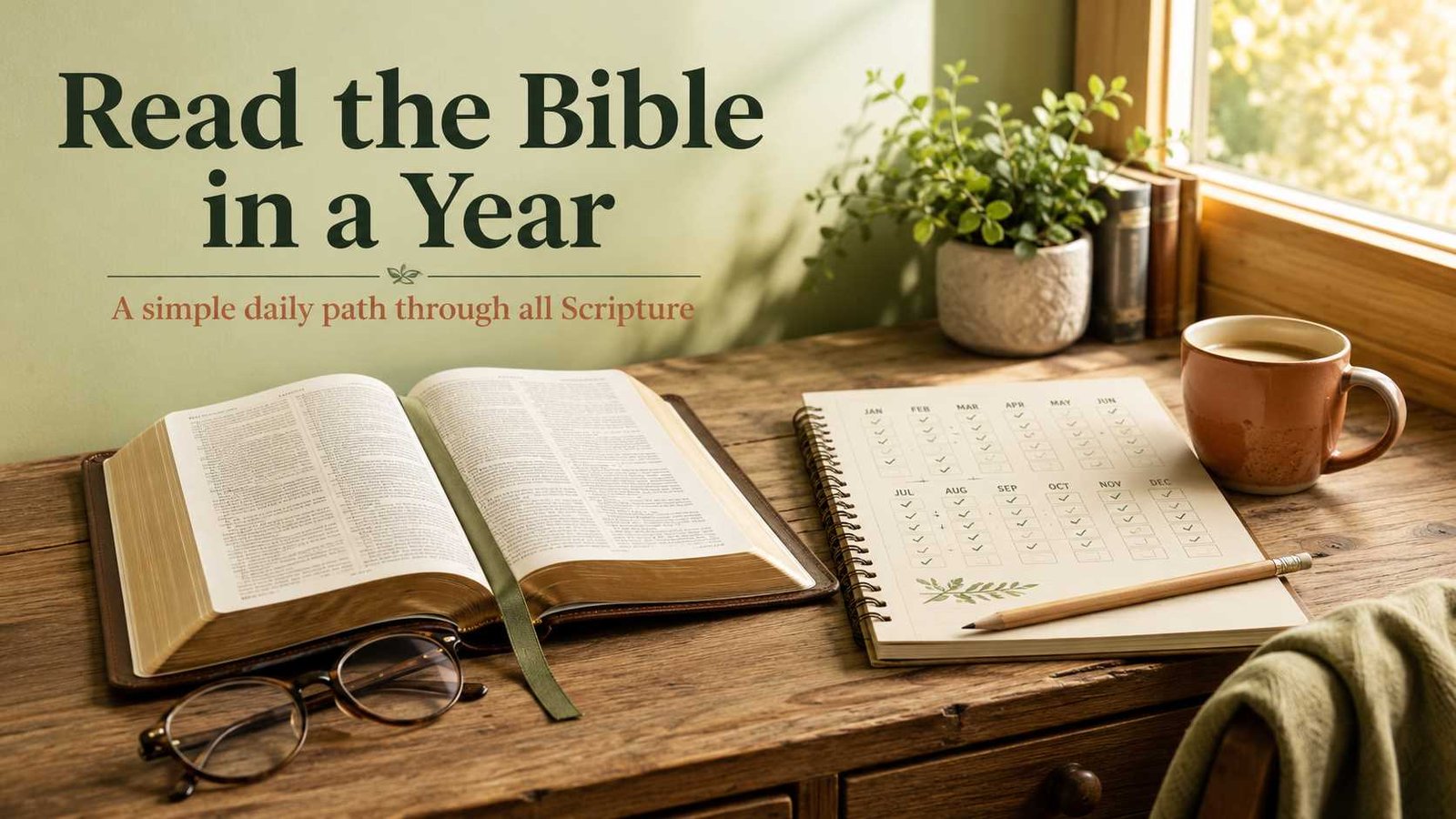
You can keep one inside your Bible and place a small check beside each completed day.
Read for Understanding, Not Just Completion
Finishing the Bible in one year is a good goal.
But it is not the highest goal.
You could read five chapters while thinking about something else and remember almost nothing.
Or you could read two chapters carefully and notice something that changes the way you pray, think, forgive, work, or treat other people.
Scripture repeatedly points us toward hearing God’s Word and living by what we learn. James 1:22, for example, warns against hearing the Word without putting it into practice.
So when you read, ask simple questions:
What is happening here?
What does this passage show me about God?
What does it show about people?
Is there something I should believe, avoid, remember, or do?
If certain passages still confuse you, that is normal. Learning how to understand the Bible is a lifelong process.
You do not have to solve every difficult question before moving forward.
What Is a 365-Day Plan for Reading the Bible?
A 365-day Bible reading plan divides Scripture into portions for every day of the year.
There is more than one way to do this.
Different plans have different strengths.
Genesis-to-Revelation Plan
This is probably the easiest plan to understand.
You begin with Genesis and continue through the Bible in the order the books appear in your edition.
You move through the Law, historical books, poetry, prophets, Gospels, Acts, letters, and Revelation.
An ESV straight-through plan uses this basic method for 365 daily readings.
This method works well if you like clear progress.
You always know what comes next.
The challenge is that some sections, such as long genealogies, laws, or prophetic books, may feel harder to read for several weeks in a row.
That does not mean those books are unimportant.
It simply means you may need extra patience.
Chronological Bible Reading Plan
A chronological plan tries to arrange Scripture according to the approximate order in which biblical events happened.
For example, material from different biblical books may be placed together when they relate to the same historical period.
Bible Gateway’s chronological plan is designed for 365 days and organizes the Bible around the sequence of its stories and events. YouVersion also offers several 365-day chronological plans.
This approach can help you see connections that are less obvious when reading the Bible in its normal book order.
It can be especially helpful when reading Kings, Chronicles, Psalms, and the prophets.
Still, remember that chronological arrangements involve some scholarly judgment. Not every biblical event can be dated with complete certainty.
Old and New Testament Together
Some readers find it difficult to spend months in the Old Testament before reaching Matthew.
A mixed plan solves that problem.
You read something from the Old Testament and something from the New Testament each day.
Bible Gateway has a 365-day Old/New Testament plan built around this approach.
This gives your daily reading more variety.
You might spend part of your time with Moses or David and then move directly to Jesus, Paul, Peter, or another New Testament writer.
For many beginners, that variety helps maintain interest.
Old Testament, New Testament, Psalms, and Proverbs
Another popular method divides each day among several parts of Scripture.
One established 365-day plan includes readings from the Old Testament, New Testament, Psalms, and Proverbs.
This method gives your reading a different rhythm.
You may read history or prophecy, then a Gospel or letter, followed by worship or wisdom.
Some readers enjoy this because every day feels balanced.
There is no single plan that every Christian must follow.
Choose the structure that helps you keep reading.
What Is the Best Way to Read the Bible in a Year?
The best way to read the Bible in a year is the way you can follow faithfully.
That sounds simple, but it matters.
A complicated plan that you abandon in February is not better than a simple plan you complete in December.
Here is an easy way to choose.
| If You Want… | Try This Plan |
|---|---|
| The simplest structure | Genesis to Revelation |
| Historical flow | Chronological reading |
| Daily variety | Old and New Testament together |
| Wisdom and worship every day | Old Testament + New Testament + Psalms/Proverbs |
| More help seeing the Bible’s larger story | A plan with study videos or summaries |
BibleProject, for example, offers a one-year reading option designed to help readers see Scripture as a connected story and pairs the journey with explanatory resources.
If you keep asking what order should I read the Bible in, do not become stuck trying to find the only correct order.
There is no command in Scripture requiring Christians to read every biblical book in one particular sequence.
The books themselves were written across different periods and in different literary forms.
Your reading plan is a tool.
The Bible is the treasure.
How Much of the Bible Should You Read Each Day?
People often ask how many chapters they need to read every day.
For many standard one-year plans, the answer is around three chapters a day, though some days will contain more or less.
But chapter count is not always the best measurement.
Psalm 117 is very short. Psalm 119 is very long.
A short New Testament letter can be read quickly, while a longer historical section may require more time.
That is why a prepared plan is helpful.
Instead of calculating pages or chapters every morning, simply read the passages assigned for that day.
A reasonable routine might look like this:
| Part of Your Routine | Time |
|---|---|
| Brief prayer | 1–2 minutes |
| Bible reading | 15–20 minutes |
| Reflection or notes | 5 minutes |
| Closing prayer | 1–2 minutes |
These times are not rules.
Some days you may spend ten minutes.
Other days you may sit with Scripture for an hour.
If you are wondering how much of the Bible should I read every day, the better question may be:
How much can I read carefully and consistently?
Consistency usually wins over intensity.
Reading a manageable amount for 365 days is better than reading ten chapters a day for one week and then stopping.
What Is the Simplest Way to Read the Bible?
You can make Bible reading very complicated.
You can collect commentaries, notebooks, highlighters, maps, dictionaries, study Bibles, apps, podcasts, and reading systems.
All of those things can be useful.
But you do not need all of them to start.
The simplest method is this:
- Pray briefly.
- Read today’s assigned passage.
- Notice one important truth.
- Write down one thought if helpful.
- Return tomorrow.
That is enough.
Before reading, you might pray something as simple as:
“God, help me understand Your Word and live by what I learn.”
Then read.
Do not feel pressure to create pages of notes.
Sometimes one sentence is enough.
You might write:
God remained faithful even when His people failed.
Or:
Jesus showed compassion to someone others ignored.
Or:
I need to be more patient with my family.
Simple reflection turns reading into something personal and practical.
How To Read The Bible In A Year as a Beginner
If you have never read the whole Bible, you may encounter places that surprise you.
Some parts will feel familiar.
You may already know about Noah, Moses, David, Daniel, Jesus, Peter, and Paul.
Other parts may be completely new.
You may encounter names you cannot pronounce, ancient customs you do not understand, difficult laws, wars, visions, long family records, and symbols that seem strange.
Do not be discouraged.
Every experienced Bible reader was once a beginner.
Choose a Translation You Can Understand
Christians use many Bible translations around the world.
Some translations use older English. Others use more modern language.
For daily reading, choose a faithful translation that you can understand without constantly struggling with the wording.
You can also compare another translation when a passage seems unclear.
The goal is not to win an argument about translations.
The goal is to understand Scripture faithfully.
Learn the Bible’s Big Story
The Bible contains many books, but they are not simply random religious writings placed beside one another.
As you read, look for the larger movement of the biblical story:
Creation
God creates the world and humanity.
Human rebellion
Sin damages humanity’s relationship with God and with one another.
God’s covenant purposes
God works through people such as Abraham and through the people of Israel.
Jesus Christ
The Gospels present Jesus’ life, teaching, death, and resurrection at the center of the New Testament message.
The early church
Acts and the New Testament letters show the message of Jesus spreading among different peoples.
Restoration
Revelation points toward God’s final victory and the renewal of creation.
Seeing that larger story makes individual passages easier to place.
BibleProject describes its resources around helping readers discover the Bible as a unified story.
Keep Simple Notes
You do not need a complicated Bible-study system.
Try three questions:
What happened?
Write one sentence about the passage.
What did I learn?
Write one truth that stood out.
What will I remember?
Write one practical response, question, or prayer.
This can also help if you are learning how to do a Bible study alone.
Reading and studying are not exactly the same thing, but they work beautifully together.
Your one-year reading gives you the big picture.
Deeper study lets you return later to passages that deserve more time.
A Simple Seven-Day Bible Reading Routine
You do not need to think about all 365 days at once.
Think about one week.
Here is a simple pattern:
Monday
Read your assigned passages.
Write down one truth about God.
Tuesday
Read your passages.
Notice one person and what you can learn from that person’s choices.
Wednesday
Read your passages.
Write down one question you would like to study later.
Thursday
Read your passages.
Notice a promise, warning, command, prayer, or example.
Friday
Read your passages.
Think about how they connect with something you read earlier in the week.
Saturday
Read your passages.
Spend a few extra minutes reviewing your notes.
Sunday
Read normally, or use a little extra time to catch up if necessary.
Then begin again.
A year is simply many ordinary weeks placed together.
What If You Miss a Day?
You probably will.
That is not a prediction of failure.
It is recognition that real life happens.
Suppose you miss Monday.
Do not decide Tuesday is ruined too.
Simply return to your Bible.
You have several options.
Option 1: Continue where you stopped.
Your one-year plan might become a one-year-and-three-day plan.
Nothing terrible has happened.
Option 2: Divide the missed reading across several days.
If you missed four chapters, add one extra chapter to the next four days.
Option 3: Use a catch-up day.
Some people leave one day each week with a lighter schedule so they can recover missed reading.
What should you avoid?
Trying to punish yourself with a huge reading session.
If you are five days behind and suddenly force yourself through 20 chapters, you may finish the pages without absorbing much.
The Bible should not become a source of panic.
Psalm 119 presents God’s Word as something that gives direction. Scripture is meant to draw us toward God, teach us wisdom, correct us, and shape our lives.
A missed checkbox does not erase that purpose.
Return and continue.
Do You Have to Start on January 1?
No.
You can start a one-year Bible plan on January 1, March 17, August 11, or any other day.
January is popular because the new year gives people a natural starting point.
But Scripture does not require a particular calendar date.
If today is the day you want to begin reading God’s Word consistently, begin today.
Waiting for the perfect Monday, perfect month, or perfect New Year can become another form of delay.
Call today Day 1.
Then tomorrow becomes Day 2.
That is enough.
How To Stay Consistent for All 365 Days
Motivation is helpful at the beginning.
Habit carries you through the middle.
Here are some ways to make that habit stronger.
Keep Your Bible Where You Can See It
If you read at breakfast, leave your Bible near the table.
If you read before bed, keep it on your bedside table.
A visible Bible becomes a simple reminder.
Reduce Distractions
Your phone can help you read Scripture, but it can also interrupt you.
A message appears.
Then an email.
Then a video.
Twenty minutes disappear.
If possible, silence notifications while reading.
Give Scripture your attention for a few minutes.
Use a Reading Tracker
Some people enjoy checking off each completed day.
That can provide a helpful picture of progress.
Just remember what the check mark means.
It does not mean:
“I completed my religious duty.”
It means:
“I spent time reading Scripture today.”
Read With Someone Else
You might invite your spouse, friend, parent, child, or church friend to use the same plan.
You do not have to read at the same time.
Simply check in once a week.
Ask:
“What stood out to you?”
“What was difficult?”
“What did you learn?”
Reading with another person can provide encouragement when motivation drops.
Listen When Reading Is Difficult
Some days your eyes may be tired.
You may be traveling or doing work that allows you to listen safely.
An audio Bible can help you remain connected to your reading plan.
Listening to Scripture is still engaging with Scripture.
For many centuries, believers often encountered biblical texts by hearing them read aloud in community.
Do Not Chase a Perfect Streak
A perfect record can become more important than the reason you started.
Your goal is not 365 impressive check marks.
Your goal is to know Scripture better.
If your plan takes 370 days, you still read the Bible.
If it takes 400 days, you still accomplished something valuable.
Keep going.
How To Read The Bible In A Year and Remember What You Read
Reading the entire Bible is one challenge.
Remembering it is another.
You will not remember every name, date, city, king, law, parable, or prophecy after one reading.
Nobody should expect that.
Instead, focus on building a mental map.
Ask yourself four questions as you move through Scripture:
Where am I in the biblical story?
Are you reading about Israel in Egypt? The kingdom under David? The exile? The ministry of Jesus? The early church?
Who are the main people?
Notice important figures and relationships.
What is happening between God and His people?
Look for faith, rebellion, judgment, mercy, covenant, forgiveness, obedience, and restoration.
How does this connect with what I already read?
Connections become clearer with repetition.
You may read something in Isaiah and remember it when you reach Matthew.
You may see an idea in Exodus return in Hebrews.
You may read a psalm of David differently after learning what David experienced in Samuel.
This is one reason reading the whole Bible is so valuable.
You begin to see connections that isolated verse reading can miss.
Should You Stop and Study Difficult Passages?
Sometimes.
Suppose you find a passage you do not understand.
You have two good options.
First, make a note and keep reading.
Second, stop briefly and check a reliable study resource.
What you should probably avoid is turning every difficult verse into a two-hour investigation.
If you do that every day, your one-year reading plan may quickly become impossible to maintain.
Try writing a question mark beside the passage.
Later, return to it during deeper study.
Acts 17:11 praises people who examined the Scriptures carefully. There is great value in thoughtful study.
But reading widely and studying deeply are different habits.
You need both.
A one-year plan helps you see the forest.
Focused study helps you examine individual trees.
Do You Need to Understand Everything the First Time?
No.
The Bible contains ancient history, poetry, wisdom, prophecy, letters, narrative, law, parables, and symbolic visions.
Some passages are immediately clear.
Others require knowledge of history, language, culture, or the surrounding chapters.
Even mature Christians return to the same passages many times and continue learning.
That should encourage you.
Your first journey through the whole Bible does not need to answer every question.
Think of it as your first walk through a large city.
The first time, you learn the main roads.
Later, you notice smaller streets.
Eventually, places that once seemed confusing become familiar.
Bible reading works in a similar way.
Keep returning.
A Simple Bible-in-a-Year Routine You Can Start Today
If all the advice so far feels like too much, use this routine.
Step 1: Pick one 365-day plan.
Do not spend two weeks comparing twenty plans.
Choose one.
Step 2: Choose one daily time.
Aim for a period when you can normally give Scripture your attention.
Step 3: Pray for understanding.
Keep the prayer simple and sincere.
Step 4: Read today’s passages.
Do not worry about next month’s readings.
Read today.
Step 5: Write one sentence.
Record one thing you learned.
Step 6: Pray again.
Respond to what you read.
Step 7: Come back tomorrow.
That last step may be the most important.
Come back.
Again and again.
A 365-Day Plan Does Not Have to Look the Same for Everyone
Christians around the world use Bible editions with some differences in their collections of biblical books. Protestant, Catholic, and Orthodox traditions do not all contain exactly the same number of books.
For that reason, a whole-Bible 365-day schedule can vary according to the Bible tradition you use.
That is okay.
Choose a reading plan designed for the Bible you normally read.
The principle remains the same:
Divide the Scriptures into manageable portions and read consistently throughout the year.
The purpose of this practice is not to create competition between Christian traditions.
It is to encourage faithful reading of Scripture.
What Should You Do When a Book Feels Difficult?
Almost every reader eventually reaches a biblical book that feels harder than expected.
Maybe it is Leviticus.
Maybe it is 1 Chronicles.
Maybe it is Ezekiel.
Maybe it is Revelation.
Do not assume that difficulty means you are doing something wrong.
Slow down slightly.
Ask what kind of book you are reading.
Look at the surrounding context.
Notice repeated themes.
Use a Bible dictionary, map, study note, or trusted teaching resource when necessary.
Then continue.
Some parts of Scripture become meaningful only after you understand how they connect with the rest of the Bible.
For example, laws and sacrifices in the Old Testament may seem distant at first. Later New Testament books often use ideas and language rooted in those earlier texts.
This is another reason finishing the whole Bible can deepen your understanding.
You begin to see the pieces together.
How To Read The Bible In A Year and Still Hear Its Message
There is one danger in every reading plan.
You can become so concerned about finishing that you stop listening.
You look at the calendar.
You count chapters.
You check boxes.
You hurry through the final paragraph because you are already late for work.
Soon Bible reading becomes another item on your daily task list.
When that happens, remember why you started.
Second Timothy 3:16–17 describes Scripture as useful for teaching, correction, and training in righteous living.
Joshua 1:8 connects meditation on God’s instruction with living according to it.
Psalm 119 repeatedly celebrates God’s Word as a source of guidance and wisdom.
The Bible is meant to shape us.
So after reading, ask:
What should stay with me today?
Maybe the answer is a truth about God’s faithfulness.
Maybe it is Jesus’ compassion.
Maybe it is a warning against pride.
Maybe it is an example of courage.
Maybe it is a call to forgive.
Maybe it is a reason to hope.
Carry that one truth with you.
One remembered truth may influence your day more than five hurried chapters.
Can I Finish Reading the Bible in a Year?
Yes.
And you do not need unusual discipline or hours of daily free time to do it.
Established one-year plans show that Scripture can be divided into manageable daily portions. Some are straight through the Bible, some chronological, and some combine passages from several biblical sections each day.
But there is something more important than the date you finish.
What kind of reader are you becoming?
Are you beginning to recognize the people and places of Scripture?
Are you seeing how the Old and New Testaments connect?
Are you understanding Jesus more clearly?
Are biblical truths coming to mind during ordinary life?
Are you learning to pray from what you read?
Those are signs that your reading is becoming more than a challenge.
It is becoming a habit.
One Year of Reading Can Become a Lifetime Habit
Learning how to read the Bible in a year begins with something surprisingly small.
Today’s reading.
Not all 365 days.
Not the entire Old Testament.
Not every difficult prophecy.
Not every question you may eventually face.
Just today’s passage.
Open your Bible.
Pray.
Read slowly enough to understand what you can.
Notice one truth.
Then return tomorrow.
There may be days when the words feel powerful and personal. There may also be days when your reading feels ordinary.
Keep going through both.
A year from now, you may discover that the greatest accomplishment was not simply reaching the final page.
You built a habit of opening Scripture.
And when Day 365 arrives, you do not have to stop.
You can begin again.
Perhaps next time you will use a chronological plan. Maybe you will study one Gospel slowly. Perhaps you will spend more time learning how to understand the Bible or explore how to read the Bible for beginners with someone who is just starting.
The Bible is not a book you finish once and leave behind.
It is a book Christians return to throughout life.
So begin where you are.
Read what is in front of you.
Trust that small, faithful days can become a year.
And one year can become a lifetime of knowing God’s Word more deeply.

Pastor David shares Bible stories in a way that feels real and personal. The way he speaks makes it easier to understand and live out our faith every day.