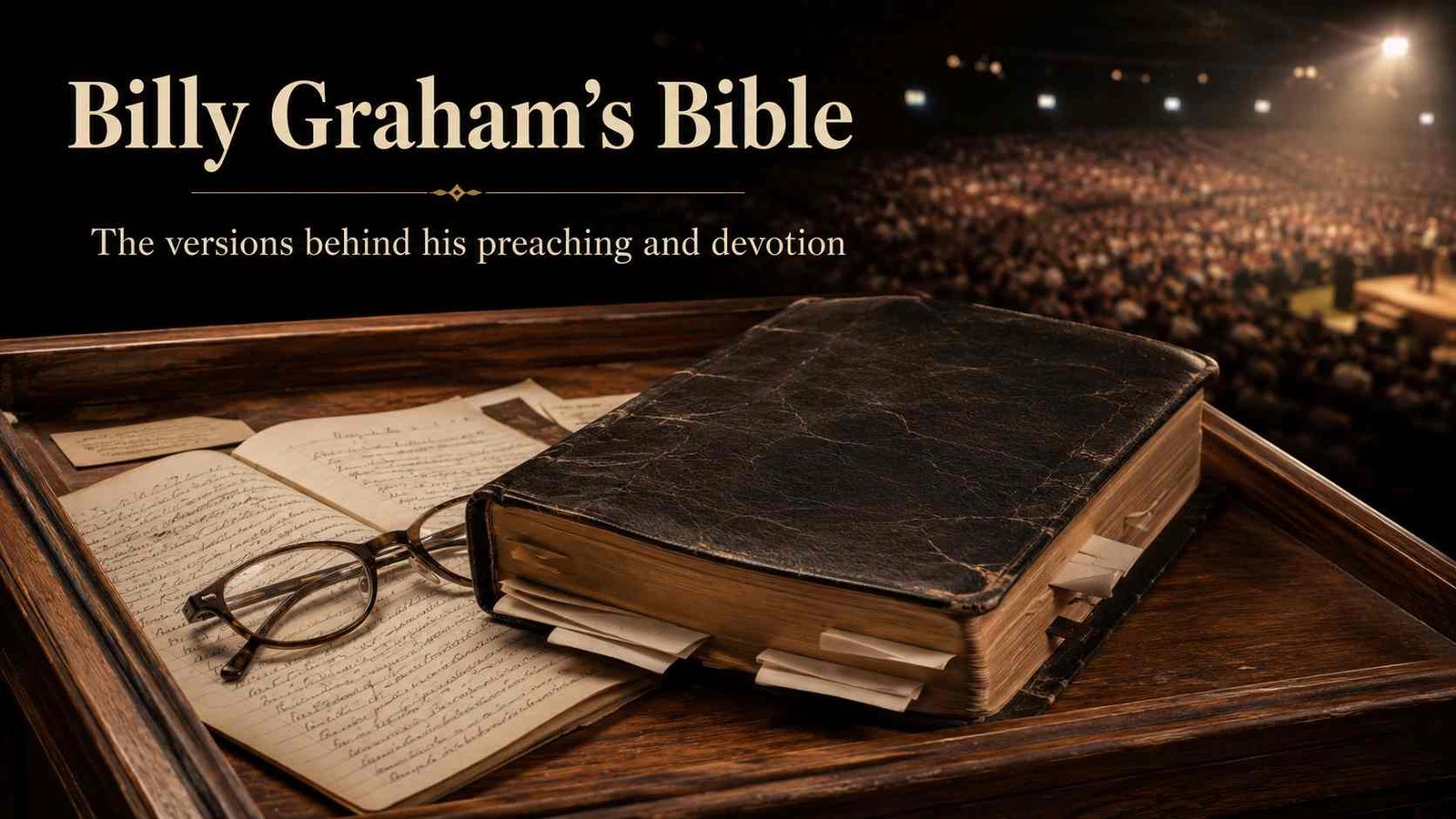
 Billy Graham stood before millions of people with an open Bible in his hand. Again and again, he would begin a point with the familiar words, “The Bible says…” For him, Scripture was not simply a source of sermon ideas. It was the foundation of his preaching and Christian faith.
So, what Bible did Billy Graham use?
There is not just one answer. According to information the Billy Graham Library gave to Bible Gateway, Graham never officially named one Bible translation as his favorite. However, the Library said he typically used the King James Version when preaching, the New International Version in his writings, and The Living Bible for personal devotions.
That distinction matters.
Billy Graham certainly loved the King James Version, but he was not a KJV-only preacher who rejected every modern translation. In fact, he regularly encouraged Christians to use a reliable translation they could understand clearly.
Here is the simple picture:
| Purpose | Bible Billy Graham commonly used |
|---|---|
| Public preaching | King James Version (KJV) |
| Published writings | New International Version (NIV) |
| Personal devotional reading | The Living Bible (TLB) |
| Bible study and recommendations | KJV and reliable modern translations |
Understanding this helps us see something important about Graham. His focus was not mainly on defending one English Bible version. His greater concern was that people would read Scripture, understand its message, trust Christ, and live by what God says.
What Bible Did Billy Graham Use When He Preached?
When people remember Billy Graham preaching in a stadium, they often picture him holding a Bible and speaking with conviction. That Bible was commonly the King James Version.
The Billy Graham Library has stated that Graham typically used the KJV in his preaching. It also preserves what it describes as his most-used preaching Bible, a Bible given to him by longtime pastor W. A. Criswell.
This makes sense when we consider the period in which Graham began his ministry.
Graham was born in 1918 and began his major evangelistic work before the NIV, NLT, ESV, and many other translations familiar to modern Christians existed. The King James Version had shaped English-speaking Protestant churches for generations.
Its language was familiar to churchgoers.
People recognized phrases such as:
“The Lord is my shepherd.”
“For God so loved the world…”
“I am the way, the truth, and the life.”
Graham could speak a few words from a familiar passage, and many people in the audience already knew what he was quoting.
Why the King James Version Fit Billy Graham’s Preaching
The KJV also matched Graham’s public preaching style.
He spoke in short, memorable sentences. He repeated important phrases. He called people to make clear decisions about Christ. The strong rhythm of the King James Bible worked naturally with that kind of preaching.
But there was a deeper reason.
Graham wanted people to hear his message as something grounded in Scripture rather than simply in Billy Graham’s personal opinion.
That is why “The Bible says…” became such an important expression in his ministry.
The Billy Graham Library notes that he used the phrase during Crusades, interviews, and even meetings with world leaders. It reflected his conviction that Scripture had greater authority than the preacher standing behind the pulpit.
For anyone asking what is the KJV Bible, this history also shows why the King James Version remained so influential among twentieth-century evangelists. It was not merely an old book sitting in churches. Its wording was woven into worship, preaching, memory, and Christian culture.
What Version of the Bible Did Billy Graham Prefer?
This question needs a careful answer.
Billy Graham did not officially identify one translation as his single favorite Bible version, according to the Billy Graham Library.
He clearly valued the King James Version. In one of his published answers about choosing a Bible, Graham wrote that he and his wife Ruth loved the majesty of the old KJV.
But he immediately recognized a practical problem: English had changed over the centuries, and many people found modern translations easier to understand.
That tells us more about his approach than simply putting one translation above every other one.
For Graham, a useful Bible needed to communicate God’s Word clearly.
He advised readers to choose a translation that was easy to understand. Elsewhere, he encouraged a person struggling with Bible reading to obtain a reliable modern translation and begin with an understandable book such as Psalms or the Gospel of John.
So if someone asks, “Which Bible translation did Billy Graham prefer?” the fairest answer is:
He had a strong affection for the King James Version, especially in preaching, but he did not teach that Christians must use only the KJV. He also welcomed accurate modern translations.
That is very different from claiming that he abandoned the KJV or that he believed only modern translations should be used.
He appreciated both.
What Bible Did Billy Graham Use in His Writings?
Billy Graham’s use of Scripture changed somewhat when he moved from the pulpit to the printed page.
According to the Billy Graham Library, he typically used the New International Version in his writings.
The NIV was designed to communicate Scripture in contemporary English while still functioning as a translation rather than simply a paraphrase. It became especially popular in evangelical churches during the later decades of Graham’s ministry.
Graham himself acknowledged that the NIV was widely used. In one published response about Bible translations, he wrote that his column usually quoted from the New International Version.
This reveals something practical about his ministry.
A preacher speaking to a crowd can explain an unfamiliar word immediately. A reader sitting alone with a book cannot ask the author what an old English phrase means.
Clear modern wording therefore had real value in Graham’s books, columns, and devotional material.
It also explains why there are so many Bible translations today. Languages change. A word that was perfectly understandable hundreds of years ago may sound strange or carry a different meaning now.
Graham did not believe making Scripture understandable weakened Scripture. He believed understanding it was essential.
As he advised one reader, a good translation should be both accurate and understandable.
What Bible Did Billy Graham Use for Personal Devotions?
This part sometimes surprises people.
The Billy Graham Library said Graham typically used The Living Bible for personal devotions.
The Living Bible became widely known during the 1970s. Unlike the KJV or NIV, it is more accurately described as a paraphrase. Kenneth N. Taylor developed it to express biblical passages in clear contemporary language, and it became extremely popular among readers who found older wording difficult.
That does not mean Graham replaced careful Bible study with a paraphrase.
His own published works show familiarity with many translations, and his ministry encouraged believers to compare reliable translations when studying Scripture.
Using The Living Bible devotionally served another purpose. It could make familiar passages sound fresh.
Think about a verse you have heard hundreds of times. Sometimes you know the wording so well that your eyes move across it without stopping to think.
Reading the same truth in different words can make you notice the meaning again.
That seems consistent with Graham’s wider approach. The goal was never simply to own the “right” Bible. The goal was to hear what Scripture was saying.
Did Billy Graham Use the KJV Bible?
Yes. Billy Graham regularly used the King James Version and typically preached from it.
But the fuller answer is equally important:
Billy Graham was not KJV-only.
His own ministry directly addressed the question of whether the King James Bible is the only reliable Bible.
The response says that some Christians prefer the KJV because they have known it since childhood, while others prefer modern translations because they are easier to understand. It also explains that the KJV should not be considered more authoritative simply because King James authorized the translation for the Church of England.
The advice then becomes very practical: Christians should not become trapped in divisive arguments over which good translation is best and may benefit from using several translations in study.
That is an important point because discussions about which Bible translation is the most accurate can quickly become emotional.
Graham’s approach was calmer.
Respect the KJV.
Use accurate modern translations.
Compare translations when useful.
Most importantly, read the Bible and obey its message.
He once advised readers who were choosing a new Bible that although he valued the old King James Version, he also encouraged accurate modern translations so the Bible’s meaning would be clear.
That hardly sounds like a man who believed Christians were spiritually required to read only one English translation.
Billy Graham’s Favorite Bible Verse Was John 3:16
If Billy Graham did not officially declare one favorite translation, he certainly did identify a favorite verse.
It was John 3:16.
The Billy Graham Library records a 1995 statement in which Graham said his mother had taught the verse to him when he was a boy. He said he regularly preached on John 3:16 during his Crusades because he regarded it as a compact expression of the Gospel.
That choice tells us a great deal about Graham’s ministry.
John 3:16 speaks about:
God’s love.
God giving His Son.
Faith in Christ.
Salvation.
Everlasting life.
Those themes formed the heart of Graham’s preaching for decades.
He did not usually build his public ministry around complicated speculation. His sermons repeatedly came back to sin, forgiveness, the cross, repentance, faith, Christ, and eternal life.
The Gospel of John Was Especially Important to Him
Graham also said that among the New Testament books, he had preached from the Gospel of John more than any other Gospel.
He liked its stories and the way Jesus communicated spiritual truths through memorable encounters and illustrations. He also pointed to Luke 15 and the story of the prodigal son as a powerful picture of God’s love, mercy, and grace.
When people asked Graham how to begin reading the Bible, he often suggested starting with the Gospel of John because the Gospels lead readers directly to Jesus Christ.
That is still practical advice for a person who wonders what is the easiest Bible translation to read or where a new Christian should begin. Translation matters, but choosing an understandable part of Scripture matters too.
Billy and Ruth Graham Had a Remarkable Daily Bible Habit
Billy Graham’s relationship with Scripture did not exist only on a Crusade platform.
He and his wife, Ruth Bell Graham, practiced regular Bible reading in private life.
According to the Billy Graham Library, Graham said they would read five chapters of Psalms and one chapter of Proverbs each day.
He explained the practice simply: Psalms helped a person understand his or her relationship with God, while Proverbs offered wisdom for relationships with other people.
That pattern is worth noticing.
Five Psalms each day takes a reader through the 150 Psalms in roughly a month. One chapter of Proverbs each day fits naturally into a month as well because Proverbs has 31 chapters.
It created a steady rhythm of worship and wisdom.
Graham’s affection for Psalms also came from how deeply human the book is. The Psalms contain joy and sorrow, confidence and fear, worship and questions.
For Graham, Scripture was not separated from ordinary life.
It spoke to ordinary life.
That helps explain why his advice about Bible reading was usually simple rather than complicated: set aside time, pray, read carefully, ask what the passage says about God, and consider how it should affect your life.
Billy Graham’s 1949 Turning Point With the Bible
To understand why the Bible became so central to Billy Graham’s ministry, we need to go back to 1949.
Graham was still a young preacher. He was preparing for the Los Angeles evangelistic campaign that would soon bring him national attention.
At the same time, he was wrestling with difficult questions about the Bible.
A friend had challenged Graham’s confidence in Scripture. Graham later admitted that while he had not abandoned his Christian faith, questions about the complete trustworthiness of the Bible troubled him.
During a retreat at Forest Home in the mountains of Southern California, Graham walked into the woods with his Bible.
There he prayed.
He admitted that there were passages and questions he did not understand. Then he made a decision to receive Scripture as God’s Word by faith. Graham later regarded the moment as a major turning point in his spiritual life.
Soon afterward came his famous 1949 Los Angeles Crusade.
From that point forward, his preaching carried an unmistakable emphasis:
The authority belonged to Scripture, not to Billy Graham.
That is one reason “The Bible says” became so closely connected with his preaching.
Whatever Bible translation was in his hand on a particular day, his deeper conviction remained the same. He believed Scripture should stand above human opinion.
Did Billy Graham Believe the KJV Was More Authoritative?
No.
This is one of the clearest points in his ministry’s published material.
When asked whether the King James Bible was the only reliable Bible, the Billy Graham Evangelistic Association explained that the KJV was not more authoritative merely because it carried royal authorization.
The response also notes that the King James Bible itself went through revisions and that the form commonly read today is associated with the 1769 revision.
Graham therefore distinguished between two ideas:
The authority of Scripture and the authority of a particular English translation.
He had an extremely high view of Scripture. His ministry repeatedly described the Bible as God’s Word and the central guide for Christian faith and life.
But he did not transfer that unique authority to one English translation.
That distinction helps make sense of his use of the KJV, NIV, and Living Bible without contradiction.
What Did Billy Graham Think of the Book of Enoch?
Claims about Billy Graham and the Book of Enoch deserve special caution.
There are videos and posts online that appear to present Billy Graham discussing secret teachings from Enoch or claiming that the book was deliberately hidden.
I could not verify those claims from reliable Billy Graham sources.
Searches of the Billy Graham Evangelistic Association and Billy Graham Library material do show Graham speaking about Enoch the biblical person. For example, material drawn from Graham’s writings discusses Enoch as a man who walked closely with God. But that is not the same as Graham endorsing the ancient work commonly called 1 Enoch or the Book of Enoch.
A particularly important warning comes from modern online videos.
One YouTube video published in 2025 uses Billy Graham’s name in its title while its own description says the speech is delivered in the style or voice of Billy Graham. Graham died in 2018. Such material cannot be treated as an authentic Graham sermon.
So what did Billy Graham think of the Book of Enoch?
There is no reliable, well-sourced statement I could verify showing that Billy Graham either endorsed the Book of Enoch as Scripture or taught the sensational claims attributed to him online.
That is the responsible answer.
Is the Book of Enoch in the Bible?
This depends on which Christian biblical canon is being discussed.
Billy Graham’s Protestant understanding of Scripture centered on the familiar 66-book Bible. Material published under his name explicitly refers to the Bible as a collection of 66 books.
The Book of Enoch is not one of those 66 Protestant canonical books.
However, Enoch does have an important place in Christian history. The Ethiopian Orthodox Tewahedo Church includes Enoch within its larger biblical canon. Its official listing describes an 81-book canon and names Enoch among its Old Testament books.
So an article about is there a Book of Enoch in the Bible should avoid saying that every Christian tradition has treated Enoch identically.
They have not.
For Billy Graham, however, there is no good evidence that the Book of Enoch held the same scriptural authority as the Protestant Bible he preached.
What Bible Does Donald Trump Use?
A related question sometimes appears beside searches about Billy Graham: What Bible does Donald Trump use?
The answer again requires more than naming one version.
Donald Trump owns a childhood Bible that his mother, Mary Anne MacLeod Trump, gave him after Sunday school graduation in 1955. That Bible is a 1953 Revised Standard Version (RSV).
Trump later said at the 2017 National Prayer Breakfast that he had been sworn in using the Bible from which his mother had taught the family when he was young.
Trump has also been associated with the historic Lincoln Bible. The Library of Congress identifies the Lincoln inaugural Bible as an 1853 Oxford Bible and confirms that it is a King James translation.
Separately, Trump has promoted the God Bless the USA Bible, whose biblical text is based on the King James Version.
So the short answer is:
Trump’s personal childhood Bible is an RSV, while other Bibles associated with him, including the Lincoln Bible and the God Bless the USA Bible, use the KJV.
That should not be confused with Billy Graham’s Bible habits. Graham’s translation choices grew out of a long preaching, writing, and devotional ministry rather than a single ceremonial Bible.
What Bible Did Billy Graham Use? The Version Was Not His Main Message
If we only ask which translation Billy Graham carried, we may miss the deeper lesson.
Yes, the King James Version mattered greatly in his preaching.
Yes, the New International Version appeared regularly in his writings.
Yes, the Living Bible was used for personal devotional reading.
But Billy Graham’s central concern was bigger than any of those labels.
He wanted people to read the Bible.
He wanted them to understand it.
And above all, he wanted them to encounter Jesus Christ through its message.
When readers struggled with old English, he did not tell them to stop reading until they could master seventeenth-century vocabulary. He encouraged them to find a reliable modern translation they could understand.
When people became divided over translations, his ministry warned against turning the issue into a fruitless controversy.
When people asked where to begin, he pointed them toward the Gospel of John.
And when Graham himself stood before vast crowds, his message repeatedly returned to Scripture.
“The Bible says…”
Those three words tell us more about Billy Graham’s relationship with the Bible than the initials printed on its cover.
What Billy Graham’s Bible Habits Can Teach Us
Most Christians will never preach to a stadium full of people. We may never write a bestselling Christian book or travel around the world sharing the Gospel.
But Graham’s Bible habits offer several simple lessons anyone can practice.
Read Scripture regularly. A Bible cannot guide us while it remains unopened.
Choose a translation you can understand. Accuracy matters, but understanding matters too.
Compare trustworthy translations when a passage is difficult. Different wording can sometimes make the meaning clearer.
Read whole books and passages, not only isolated verses. Graham often encouraged readers to begin with John, Psalms, or another understandable biblical book.
Pray as you read. Bible study is more than gathering information. Christians read Scripture seeking to know God and respond faithfully.
Keep Christ at the center. Graham’s favorite verse, John 3:16, summarizes the truth that shaped his ministry: God’s love is revealed through His Son.
Billy Graham used more than one Bible translation during his long ministry, but he preached one consistent message: God’s Word deserves to be heard, trusted, and lived.

Dr. Rachel is very smart and knows a lot about the Bible. He helps us understand the Bible better by talking about the old texts in a simple way.