
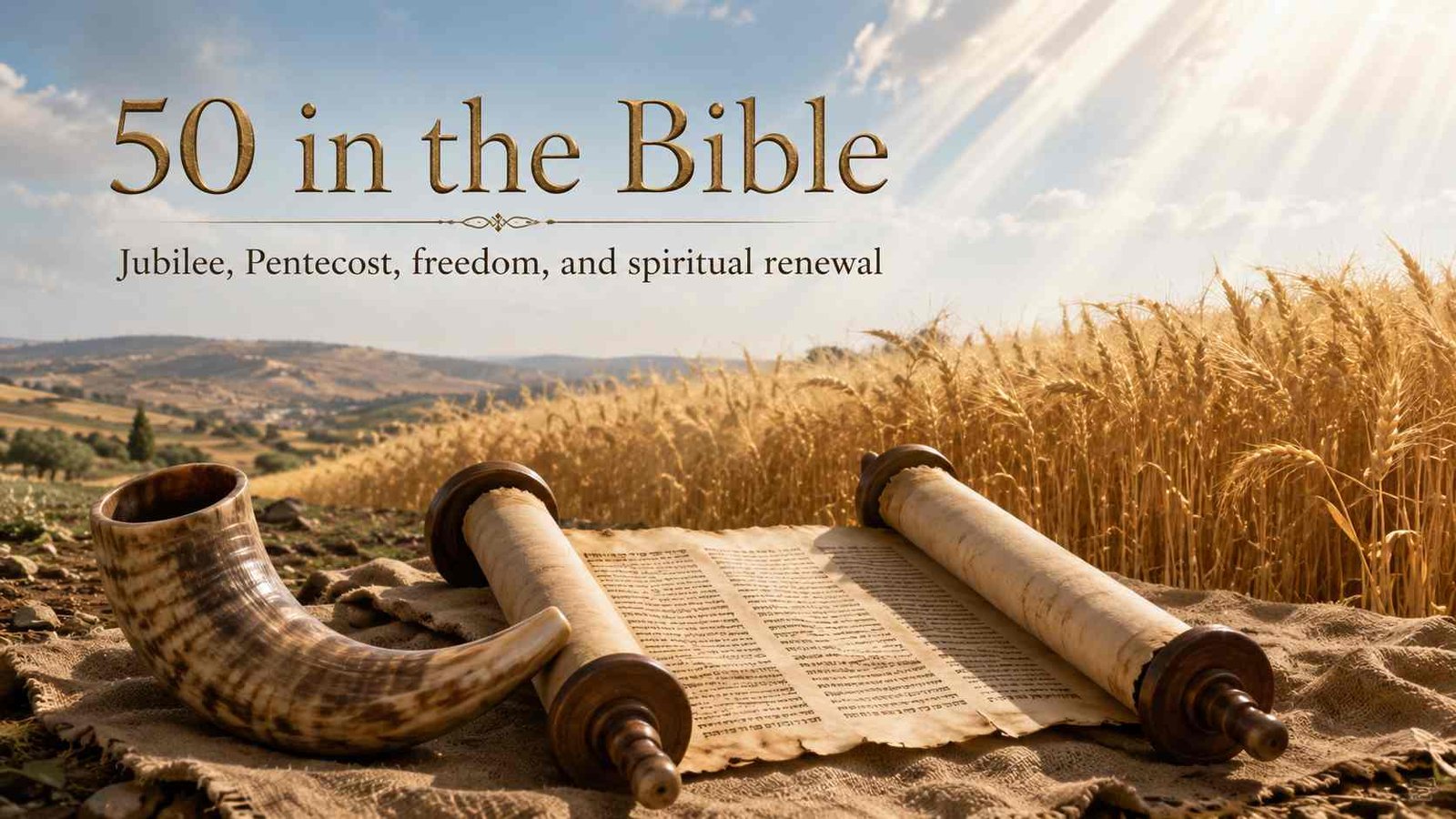
 If you are wondering what does 50 mean in the Bible, the clearest answer comes from two major biblical events: the Year of Jubilee and Pentecost.
In Scripture, 50 is strongly connected with liberty, restoration, a completed period of waiting, harvest, and a new season of God’s work. The fiftieth year was declared a Jubilee in ancient Israel. Fifty days were also counted to the Feast of Weeks, later commonly called Pentecost. In the New Testament, Pentecost became the setting for the coming of the Holy Spirit upon Jesus’ disciples.
Still, we need to be careful.
The Bible does not say that every appearance of the number 50 carries a hidden spiritual message. Sometimes 50 simply means fifty people, fifty cubits, fifty years, or fifty coins. Biblical numbers should first be understood in the setting where Scripture uses them.
That gives us a much safer way to understand the spiritual meaning of 50.
| Biblical setting | Use of 50 | Main idea |
|---|---|---|
| Leviticus 25 | Fiftieth year | Jubilee, liberty, restoration |
| Leviticus 23 | Fifty-day count | Harvest and sacred celebration |
| Acts 2 | Pentecost | Holy Spirit and mission |
| Numbers 4 and 8 | Age fifty | Transition in Levitical service |
| Exodus 26 | Fifty loops and clasps | Exact tabernacle instructions |
| Genesis 6 | Fifty cubits | Measurement of Noah’s ark |
| Mark 6 | Groups of fifty | Order while feeding the crowd |
| Luke 7 | Fifty denarii | Literal amount in Jesus’ parable |
The pattern is meaningful, but the meaning comes from Scripture itself rather than from modern numerology.
If you enjoy studying biblical numbers, you may also find what does the number 40 in the Bible mean helpful because 40 appears in many important periods of testing and preparation.
What Does 50 Mean in the Bible Through the Year of Jubilee?
The strongest Old Testament meaning of 50 appears in Leviticus 25.
God told Israel to count seven periods of seven years. Seven times seven equals forty-nine. After those forty-nine years came a special fiftieth year.
Leviticus 25:10 says:
“And ye shall hallow the fiftieth year, and proclaim liberty throughout all the land unto all the inhabitants thereof.” — KJV
This year was called the Jubilee.
The word carries the idea of a trumpet or ram’s horn announcement. The Jubilee was not simply another year on Israel’s calendar. It reminded the people that the land ultimately belonged to God and that their lives were lived under His authority.
Several important things happened in connection with the Jubilee.
Family property that had been transferred because of poverty could return to the original family line. Israelites who had entered forms of debt-servitude were released. The land also received rest rather than being planted and harvested in the normal way.
This makes the number 50 closely connected with liberty and restoration.
The Jubilee showed that loss did not always have to be permanent.
A family could fall into poverty. Land could leave its hands. A person could become economically dependent on another household. Yet God’s law placed limits on how permanently those losses could shape Israelite society.
The fiftieth year said, in effect, that God had not forgotten the family, the poor, or the land.
Was Every Debt Automatically Canceled in the Jubilee?
This point deserves careful wording.
Many explanations of biblical number 50 say that the Jubilee simply meant “all debts were forgiven.” That summarizes part of the broader idea of economic release, but Leviticus 25 is more specific.
The chapter directly speaks about the return of hereditary property, release from certain forms of Israelite servitude, redemption rights, and rest for the land. The separate law concerning periodic release from debts appears especially in Deuteronomy 15, where Israel was instructed about release in the seventh year.
So the safest description of Jubilee is not merely “debt cancellation.”
It was a God-given system of liberty, return, redemption, rest, and restoration.
That distinction matters because we want our understanding of biblical symbolism to grow from the text rather than from phrases repeated on the internet.
What Does 50 Mean Spiritually?
When people ask, “What does 50 mean spiritually?”, they may be asking whether 50 represents a spiritual principle that Christians can apply today.
Within the Bible, the number can reasonably remind us of several themes:
Freedom from bondage. Jubilee announced liberty.
Restoration. Property returned to families, and people returned to their clans.
Completion followed by a new beginning. Seven cycles of seven years were completed before the fiftieth year began.
Harvest and thanksgiving. Fifty days were counted in connection with the Feast of Weeks.
The work of the Holy Spirit. Acts 2 connects Pentecost with the Spirit filling Christ’s followers.
These themes are biblical because they come from passages where fifty actually matters to the story or command.
But there is a difference between biblical symbolism and modern number mysticism.
The Bible does not teach that seeing 50 on a clock, receipt, address, license plate, or dream automatically means God is sending you a coded personal message.
There is no biblical “angel number 50” doctrine.
God certainly guides His people, but Scripture consistently points believers toward His Word, prayer, wisdom, obedience, and the work of the Holy Spirit rather than secret number codes.
That same principle helps when studying other numbers. For example, what does the number 5 represent in the Bible should also be answered from actual biblical contexts rather than assigning a meaning to every appearance of five.
What Does 50 Mean in the Bible at Pentecost?
The second major biblical connection with 50 is Pentecost.
Long before Acts 2, Israel had been commanded to observe the Feast of Weeks.
Leviticus 23:15–16 instructed the people to count seven complete weeks and then count to the fiftieth day. A new grain offering was presented to the Lord.
This celebration was closely connected with harvest, gratitude, worship, and God’s provision.
The English word Pentecost comes through Greek from pentēkostē, meaning fiftieth.
That makes the number part of the name itself.
Then something remarkable happened in the New Testament.
Acts 2 begins:
“And when the day of Pentecost was fully come, they were all with one accord in one place.” — Acts 2:1, KJV
The disciples were gathered together when a sound like a mighty rushing wind filled the house. They were filled with the Holy Spirit and began speaking in other languages as the Spirit enabled them.
People from many regions were in Jerusalem and heard the message in their own languages.
Pentecost therefore became one of the most important moments in early Christian history.
Fifty and the Coming of the Holy Spirit
The connection between 50 and Pentecost gives Christians another strong biblical theme: God equips His people for His work.
The disciples had followed Jesus. They had seen His death and resurrection. Yet Jesus had instructed them to wait for the promised power from God.
At Pentecost, that waiting moved into mission.
Fearful followers became public witnesses.
People from different languages heard the works of God proclaimed.
Peter preached about Jesus, and thousands responded.
The event was not about the number 50 by itself. The importance comes from what God did on the day called Pentecost.
This is why Christians can connect 50 with empowerment, spiritual harvest, witness, and a new stage in God’s work without turning the number into a magical symbol.
If you want to understand this event more deeply, see what happened on the day of Pentecost in the Bible.
What Is Significant About 50 in the Bible?
When we place Jubilee and Pentecost beside each other, an interesting biblical pattern appears.
Jubilee involved liberty.
Pentecost involved empowerment.
Jubilee restored people to what had been lost.
Pentecost prepared believers for what lay ahead.
Jubilee concerned God’s people living under His rule in the land.
Pentecost sent God’s people outward with the message of Christ.
We should not force every detail into a symbolic system. Scripture itself does not say, “The number fifty always means these five things.”
Yet these two major uses make it reasonable to associate 50 with release, restoration, fulfillment, harvest, and renewed purpose.
There is also a mathematical pattern behind Jubilee: seven times seven years, followed by the fiftieth year.
Seven is another important biblical number, though it too should be interpreted with care. Readers interested in that subject can compare this pattern with what does the number 7 signify in the Bible.
What Does the Bible Say About Being 50?
This question is especially interesting because Scripture actually mentions the age of fifty in connection with the Levites.
The Levites had special responsibilities connected with Israel’s tabernacle.
Numbers 4 describes certain Levites being counted for tabernacle work from age thirty through age fifty.
Numbers 8:25 then says that at fifty they were to withdraw from their regular service. The next verse adds an important detail: they could still assist their fellow Levites even though they no longer carried the same regular workload.
This was not a command that everyone must retire at fifty.
It concerned a particular form of demanding Levitical service associated with the tabernacle.
So if you turn fifty today, the Bible is not telling you that your useful years are over.
Quite the opposite can be seen in the passage.
The Levite’s role changed, but his connection to service did not disappear.
He could still help.
That gives us a gentle practical principle, even though we should not turn the ancient law into a modern retirement rule.
Life has seasons.
At one stage we may carry heavy responsibilities ourselves. Later, experience allows us to guide, support, teach, and strengthen someone younger.
Fifty can be a wonderful age for that kind of service.
You may have learned lessons about marriage, children, work, disappointment, faith, patience, and prayer that you did not understand at twenty-five.
God can use those lessons.
Being fifty is therefore not presented in Scripture as a spiritual limit. In the specific Levitical law, it marked a transition of responsibility, not the end of a person’s value.
What Does 50 Years Represent in the Bible?
When Scripture gives symbolic importance to a period of 50 years, the clearest answer is the Jubilee.
Leviticus 25 begins its Jubilee calculation with forty-nine years:
seven years multiplied by seven.
Then came the fiftieth.
It was a sacred reset within Israel’s covenant life.
Imagine what that meant for a family that had lost ancestral land because of poverty. Economic hardship might have changed their circumstances for years, but Jubilee declared that the loss did not have to continue forever.
The land itself was also allowed to rest.
This pointed Israel back to an important truth: they were stewards, not absolute owners.
Leviticus 25:23 explains that the land ultimately belonged to God.
That makes Jubilee much more than an economic policy. It taught humility.
Human beings can easily begin believing that everything belongs permanently to us: our money, our property, our success, our position.
Jubilee interrupted that thinking.
God remained Lord of the land.
God remained Lord of time.
God remained the One who had delivered Israel from Egypt.
So what does 50 years represent in the Bible?
Most clearly, it represents a Jubilee cycle of liberty, restoration, rest, return, and acknowledgment of God’s ownership.
Other Places Where the Number 50 Appears
Not every fifty in Scripture is a Jubilee or Pentecost reference.
This is important when interpreting biblical numbers.
God told Noah that the ark was to be fifty cubits wide in Genesis 6:15. The number describes its dimensions.
In Exodus 26, the tabernacle curtains had fifty loops and were joined with fifty clasps. Again, the immediate point is precise construction according to God’s instructions.
Abraham began his appeal concerning Sodom by asking whether God would spare the city if fifty righteous people were found there in Genesis 18. The conversation later moved to smaller numbers.
Esther 5 describes the structure Haman prepared for Mordecai as fifty cubits high. Haman himself eventually died on it.
During the feeding of the multitude, Mark 6:40 records people sitting in organized groups that included groups of fifty.
Jesus also used fifty as a normal monetary amount in the parable of two debtors in Luke 7:41.
These examples teach an important rule:
Context decides whether a biblical number carries special symbolic weight.
If we insist that every 50 must mean Jubilee, grace, freedom, or the Holy Spirit, we can make Scripture say things that the biblical writers never said.
Good Bible study allows a number to be ordinary when the passage uses it ordinarily.
The same caution applies when asking what does 12 represent in the Bible or what does 10 represent in the Bible. Some appearances form meaningful patterns; others are simply numbers.
Does 50 Mean Grace in the Bible?
You may sometimes hear that the number 50 means grace.
There is a reason people make that connection.
Jubilee certainly displayed God’s mercy and provision. Pentecost displayed God’s gracious gift of the Holy Spirit. Both events can therefore teach us about God’s grace.
However, the Bible never gives us a dictionary statement saying:
“50 means grace.”
That distinction is worth remembering.
It is better to say that biblical events associated with fifty display God’s grace, freedom, restoration, and provision than to claim that fifty has one fixed definition everywhere in Scripture.
Biblical symbolism works best when it points us back to biblical events.
It becomes unreliable when we create a numerical code that Scripture itself never explains.
Is 50 a Number of Completion?
There is some biblical support for describing 50 as a number connected with completion followed by transition.
The reason is straightforward.
Forty-nine years completed seven cycles of seven before Jubilee.
Seven complete weeks were counted before the fiftieth-day celebration described in Leviticus 23.
So in those specific settings, 50 arrives after a completed pattern.
That does not mean the Bible teaches a universal mathematical rule in which fifty always equals perfection or completion.
A better phrase would be:
In Jubilee and Pentecost, fifty marks the point reached after a completed period of counting and the beginning of something new.
That is both spiritually meaningful and faithful to the text.
Jubilee, Pentecost, and Jesus
Christians naturally see deeper themes of freedom and restoration when reading Scripture through the life and ministry of Jesus.
Jesus spoke about freedom from sin.
He announced good news to the poor and liberty to the oppressed.
He died and rose again.
After His resurrection, His followers received the Holy Spirit at Pentecost and began proclaiming the gospel far beyond their small community.
Because of this, Jubilee language has often helped Christians think about the freedom and restoration found in Christ.
Yet the main focus should remain Jesus, not the number.
Numbers can help us notice patterns.
They cannot save us.
The Jubilee calendar could point toward freedom, but Christ brings the believer into relationship with God.
Pentecost happened on the fiftieth-day festival, but the power came from the Holy Spirit, not from the mathematical value of fifty.
That distinction protects Christian faith from superstition.
What If I Keep Seeing the Number 50?
If you repeatedly notice 50, you do not need to be afraid or assume a supernatural event is about to happen.
Human minds naturally notice patterns. Once a number becomes important to us, we often begin noticing it more frequently.
Scripture does not instruct Christians to interpret repeated everyday numbers as secret divine messages.
Instead, if seeing 50 causes you to think about God, use the moment in a healthy biblical way.
Remember Jubilee and thank God for freedom.
Remember Pentecost and ask God to help you live faithfully.
Think about restoration where relationships have been damaged.
Think about whether someone needs forgiveness.
Think about whether God is calling you to serve, encourage, or help another person.
The number does not control your future.
God does.
Our confidence should rest in His character and His Word, not in numerical signs.
What the Number 50 Can Teach Us About Faith
So, what does 50 mean in the Bible?
Its clearest biblical meaning comes from Jubilee and Pentecost.
The fiftieth year brought Jubilee, with liberty, restoration, return, and rest at the center of God’s command.
The fiftieth-day festival became known as Pentecost, and Acts 2 records the Holy Spirit filling Christ’s followers on that day.
The age of fifty also marked a transition in the regular physical service of certain Levites, while still allowing them to assist others.
Together, these passages give us a beautiful picture.
There are seasons for carrying.
There are seasons for releasing.
There are seasons for waiting.
There are seasons for receiving.
And there are seasons when God opens a new chapter after a long period has been completed.
But Scripture never asks us to worship numbers or search them for secret predictions.
The true value of studying 50 is that it leads us back to God’s character.
He values freedom.
He restores.
He provides.
He gives rest.
He empowers His people.
He remains Lord over our possessions, our years, our service, and our future.
That is far more comforting than any hidden numerical code.
When the Bible gives a number special meaning, we should receive that meaning with gratitude. When Scripture simply uses a number for counting or measurement, we should allow it to remain what it is.
Faith does not require us to find a mystery behind every number.
Sometimes the clearest truth is also the deepest: the God who proclaimed liberty in the Jubilee and poured out His Spirit at Pentecost is still a God of restoration, purpose, and faithful provision.

Dr. Rachel is very smart and knows a lot about the Bible. He helps us understand the Bible better by talking about the old texts in a simple way.