
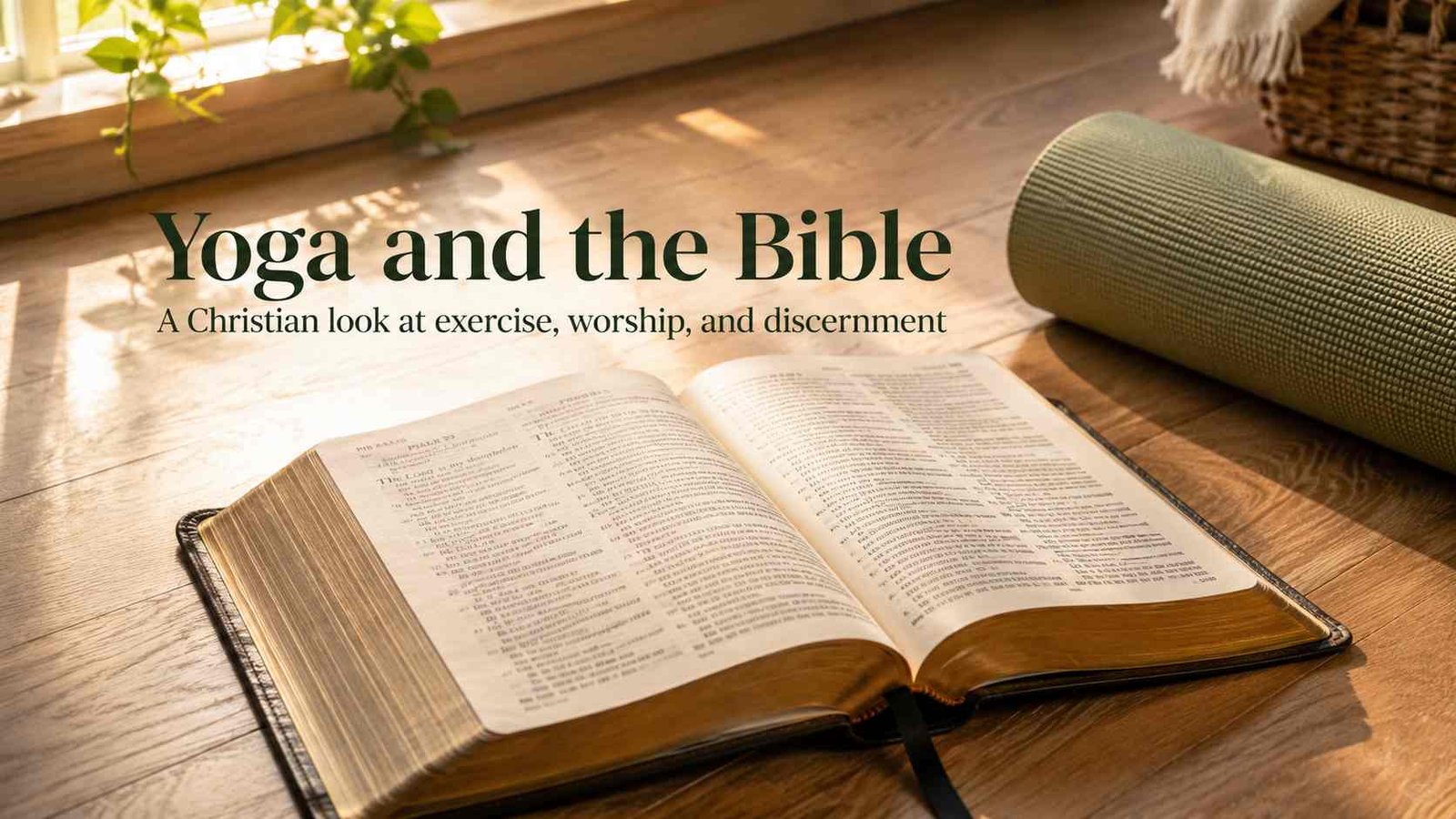
 The King James Version does not mention yoga by name. There is no KJV verse that says, “Do not practice yoga,” and there is no verse that directly calls yoga a sin.
That matters because Christians should be careful not to make the Bible say something it does not say.
At the same time, Scripture gives clear principles about worship, idolatry, exercise, meditation, spiritual teaching, and personal conscience. Those principles can help a Christian decide whether a particular form of yoga is simply physical exercise or whether it includes spiritual beliefs that conflict with faith in Christ.
So, what does the Bible say about yoga KJV?
The short answer is this: physical stretching and exercise are not forbidden in Scripture, but Christians are called to worship God alone and to examine spiritual practices carefully. If yoga involves worship, mantras, spiritual devotion, or beliefs that replace biblical faith, a Christian has good reason to avoid those elements.
The real question is therefore not only, “Is yoga allowed?”
A better question is:
What am I actually doing, what does it mean, and can I sincerely do it for the glory of God?
What Does the Bible Say About Yoga KJV Directly?
The Bible was written long before the modern fitness classes most people now call yoga. The word “yoga” does not appear in the King James Version.
This means we need to distinguish between a direct biblical command and a biblical principle.
For example, Scripture directly says:
“Thou shalt have no other gods before me.”
Exodus 20:3 KJV
That is a clear command.
Scripture does not directly say:
“Thou shalt not attend a yoga class.”
Therefore, Christians should avoid pretending such a verse exists.
Instead, we ask whether the beliefs and actions involved in a particular yoga practice agree with biblical commands such as worshiping God alone, avoiding idolatry, guarding our minds, and honoring Christ.
One helpful principle comes from 1 Corinthians 10:31:
“Whether therefore ye eat, or drink, or whatsoever ye do, do all to the glory of God.”
Paul’s words reach far beyond food and drink.
They give Christians a practical test for daily choices.
Can this activity be done in a way that honors God?
If yes, there may be Christian freedom.
If the activity requires beliefs or acts that contradict Christian worship, the situation becomes different.
That distinction is important when discussing what the Bible says about spirituality in general. Christianity does not teach that every spiritual idea is automatically from God. Christians are repeatedly told to examine beliefs according to the truth revealed in Christ.
Can Christians Do Yoga According to the Bible?
Some Christians practice yoga for stretching, flexibility, balance, or exercise. Others avoid yoga completely because of its historical connection with Indian religious and philosophical traditions.
Both groups may sincerely want to honor Christ.
So can Christians do yoga according to the Bible?
There is no single verse saying yes or no. The answer depends greatly on what kind of yoga is being practiced and what the participant is doing spiritually.
Consider three different situations.
A person may follow a video containing simple stretches for the back, legs, and shoulders. There are no chants, spiritual teachings, prayers, or religious rituals.
Another person may attend a class that combines physical postures with meditation but treats meditation simply as quiet breathing and relaxation.
A third person may attend a class involving mantras, invocation of spiritual ideas, religious teachings, or meditation intended to achieve a particular spiritual state.
Calling all three situations exactly the same can make the discussion confusing.
Christians should look beyond the label.
When Yoga Is Mainly Physical Exercise
The Bible does not condemn taking care of the body.
Paul writes in 1 Timothy 4:8 that “bodily exercise profiteth little,” while explaining that godliness has greater and lasting value.
The older English wording can be misunderstood.
“Profiteth little” does not necessarily mean physical exercise is worthless. Paul is contrasting its limited value with the much greater value of godliness.
Physical health matters, but spiritual health matters even more.
Stretching your muscles is not automatically an act of worship.
Balancing on one foot is not automatically an act of idolatry.
Taking slow breaths to calm yourself is not the same thing as praying to another god.
A movement of the body does not necessarily carry every religious meaning that may have been associated with similar movements in another setting.
This is why some Christians are comfortable using yoga-style stretches while deliberately separating them from religious teaching.
They may even prefer to call what they do stretching, mobility training, or flexibility exercise rather than yoga.
The important point is intention and participation.
What are you actually doing?
What are you being taught?
What do you believe is happening spiritually?
Those questions are more useful than arguing over a label alone.
When Yoga Becomes a Spiritual Practice
The issue becomes more serious when yoga includes spiritual beliefs or religious acts.
Scripture is very clear about worship.
God told Israel:
“Thou shalt have no other gods before me.”
Exodus 20:3 KJV
Paul gives an equally direct warning:
“Wherefore, my dearly beloved, flee from idolatry.”
1 Corinthians 10:14 KJV
For Christians, worship belongs to God.
So if a yoga practice requires a Christian to worship another deity, invoke another spiritual power, repeat a religious confession contrary to Christian faith, or seek spiritual salvation apart from Christ, the biblical problem is much clearer.
This connects directly with the larger question, what is worship in the Bible?
Biblical worship is not limited to singing songs in church.
Worship involves devotion, allegiance, trust, prayer, reverence, and the direction of the heart toward God.
That means Christians should pay attention when an exercise program begins making spiritual claims.
A fitness routine may simply strengthen muscles.
A religious practice may ask for much more.
Why Are Some Christians Opposed to Yoga?
Some Christians oppose yoga because yoga has historical roots in Indian religious and philosophical traditions.
That concern should not simply be dismissed as fear.
Classical yoga was far broader than a modern exercise class.
The Yoga Sutras associated with Patanjali describe an eight-part path containing ethical disciplines, personal observances, posture, breath control, withdrawal of the senses, concentration, meditation, and samadhi or absorption. The Internet Encyclopedia of Philosophy describes yoga in this classical setting as a collection of meditative and spiritual practices aimed at liberation, not merely a fitness routine.
The traditional eight limbs are often listed as:
| Limb | Basic meaning |
|---|---|
| Yama | Ethical restraints |
| Niyama | Personal observances |
| Asana | Posture |
| Pranayama | Breath control |
| Pratyahara | Withdrawal of the senses |
| Dharana | Concentration |
| Dhyana | Meditation |
| Samadhi | Deep absorption |
For many people in Western countries today, the word yoga mainly brings to mind asana, or physical posture.
Historically, however, posture was only one element within wider traditions.
This is one reason some Christians say yoga cannot easily be separated from its spiritual background.
They argue that practicing yoga may slowly introduce ideas about God, consciousness, the self, meditation, or spiritual enlightenment that differ from biblical teaching.
Other Christians disagree.
They argue that physical exercises can change meaning when used in a different setting. They see stretching poses as movements of the human body that can be practiced without accepting Hindu theology or another religious worldview.
Here’s what matters: Christians should understand both arguments instead of pretending only one exists.
The historical religious background of yoga is real.
It is also real that many modern people practice yoga primarily as physical exercise.
Wisdom requires knowing which kind you are dealing with.
What Does Colossians 2:8 Teach About Yoga?
Colossians 2:8 is often quoted in discussions about yoga:
“Beware lest any man spoil you through philosophy and vain deceit… and not after Christ.”
This verse deserves careful handling.
Paul was not writing specifically about yoga. We should not insert the word “yoga” into the passage.
His warning is broader.
Christians should not allow philosophies, traditions, or spiritual systems to carry them away from Christ.
That principle can certainly apply to yoga when yoga is being taught as a spiritual philosophy.
But the verse does not mean that every idea called “philosophy” is sinful, nor does it prove that every physical yoga posture is evil.
The question is whether the teaching leads a person toward Christ or away from Him.
Suppose an instructor says:
“This stretch can improve flexibility.”
That is a physical claim.
But suppose someone says:
“This practice will unite your divine self with ultimate spiritual reality and give you spiritual liberation.”
Now the claim has moved into theology.
A Christian should examine that teaching in light of Scripture.
This same principle is useful when considering subjects such as what the Bible says about manifestation KJV or what the Bible says about praying to the universe.
The Christian faith directs prayer toward God.
It does not teach believers to place ultimate trust in spiritual techniques, impersonal cosmic forces, or the universe itself.
Is Yoga Meditation the Same as Biblical Meditation?
No. The words may sound similar, but the content and purpose can be very different.
The Bible actually encourages meditation.
Joshua 1:8 tells Joshua to keep God’s law before him and to “meditate therein day and night.”
Psalm 1 gives a similar picture of the righteous person delighting in God’s law and meditating on it day and night.
Biblical meditation therefore does not mean simply trying to experience a spiritual state.
It involves giving deep attention to God’s truth.
You read.
You remember.
You think.
You pray.
You allow Scripture to shape your choices.
You ask how God’s Word should change the way you live.
Philippians 4:8 also tells believers to direct their thoughts toward things that are true, honest, just, pure, lovely, virtuous, and worthy of praise.
Christian meditation has content.
It centers on God, His works, His character, and His Word.
Some yoga traditions have different understandings of meditation, consciousness, the self, and spiritual liberation. Classical yoga traditions cannot therefore simply be treated as identical to biblical meditation.
At the same time, not every person sitting quietly and breathing slowly is practicing another religion.
Christians need to know what a particular practice actually teaches before reaching a judgment.
What Did Pope Francis Say About Yoga?
Pope Francis is often brought into conversations about Christianity and yoga.
Unfortunately, his words are sometimes presented without their full context.
During a January 9, 2015 homily, Pope Francis discussed the hardness of the human heart and the work of the Holy Spirit.
He said that a person could take many courses in catechism, spirituality, yoga, Zen, and similar subjects, but these things by themselves could not produce the freedom that comes through the Holy Spirit.
The important detail is that he included catechism courses and spirituality courses in the same comparison.
He was not simply attacking yoga.
His larger point was that religious instruction and spiritual techniques cannot replace the transforming work of God.
Contemporary reporting and later academic commentary on the homily both note this wider context.
Did Pope Francis Say All Yoga Is a Sin?
No clear statement in that homily says that every form of yoga or every physical yoga exercise is sinful.
Turning the homily into “Pope Francis banned yoga” would therefore go beyond what he actually said.
There is, however, a broader Catholic concern about mixing Christian prayer with non-Christian spiritual methods.
In 1989, the Vatican’s Congregation for the Doctrine of the Faith published Letter to the Bishops of the Catholic Church on Some Aspects of Christian Meditation. The document specifically identified yoga among Eastern methods being adopted by some Christians and warned that attempts to combine Christian and non-Christian meditation require careful examination so that Christians do not fall into religious syncretism.
The document also made an important distinction.
It recognized that some people turn to Eastern methods for therapeutic reasons or for psychological calm, while its main concern was theological and spiritual.
That distinction is useful far beyond Catholicism.
Exercise and theology are not automatically the same thing.
But when theology enters the exercise, Christians should pay attention.
What Does the Bible Say About Yoga KJV and Idolatry?
Idolatry may be the most important biblical issue in this discussion.
The Bible repeatedly teaches that God’s people must not give worship to other gods.
That does not mean Christians should become afraid of every object, movement, word, or custom with a non-Christian history.
It does mean Christians should avoid actual participation in worship that belongs to another faith.
Paul’s teaching in 1 Corinthians 10 is especially useful.
He does not treat idolatry casually. He tells believers to flee from it.
So imagine a yoga class where the teacher says:
“Now we will worship this deity.”
For a Christian, the answer should be clear.
But imagine another class where the teacher says:
“Place your feet shoulder-width apart and slowly stretch your back.”
That is not the same activity.
Wisdom requires distinguishing the two.
Christians should neither become careless about idolatry nor start calling ordinary body movements idolatry without evidence.
Is Christian Yoga Different From Traditional Yoga?
Some churches and Christian fitness instructors use the term Christian yoga.
Usually they mean physical movements or stretches combined with Christian music, Bible verses, prayer, or reflection on Scripture.
Supporters believe they are taking useful physical movements and giving them an explicitly Christian purpose.
Critics argue that the word yoga itself and some traditional practices remain too closely connected to other religious systems.
The Bible does not settle the terminology for us.
Scripture never discusses whether Christians should call a stretching program “Christian yoga.”
This becomes an issue of wisdom and conscience.
A believer who is uncomfortable with the term may choose another form of exercise.
There are many options:
walking, swimming, Pilates, mobility exercises, strength training, stretching routines, cycling, or simple home exercises.
A Christian does not need yoga in order to stay healthy.
At the same time, Christians should be cautious about judging another believer merely because that person performs a stretch commonly seen in yoga.
Romans 14 provides a helpful principle for disputed matters involving conscience.
Paul teaches that believers should not act against sincere conviction and says, “whatsoever is not of faith is sin.”
If your conscience is deeply troubled by yoga, you do not need to force yourself to practice it.
Choose another exercise.
There is freedom in walking away.
Can Yoga Open a Christian to Evil Spirits?
This is one of the strongest claims sometimes made against yoga.
The Bible clearly teaches that Christians should avoid idolatry, occult practices, and spiritual rebellion.
But Scripture does not contain a verse saying that performing a particular stretch automatically invites an evil spirit.
That claim goes beyond what the biblical text directly states.
If a practice involves deliberate occult activity, invocation of spirits, or worship opposed to God, then biblical warnings about spiritual practices become relevant.
But Christians should not spread fear by presenting speculation as Scripture.
A person bending forward to stretch tight hamstrings has not automatically performed an occult ritual.
Context matters.
Belief matters.
Participation matters.
This same careful approach is needed when Christians ask what the Bible says about zodiac signs KJV, spiritual manifestations, occult practices, or other religious traditions.
We should take genuine spiritual dangers seriously without inventing dangers the Bible itself never identifies.
KJV Bible Verses Christians Should Consider About Yoga
The Bible does not contain a “yoga verse,” but several passages provide useful principles.
| KJV Passage | Biblical principle |
|---|---|
| Exodus 20:3 | Worship God alone |
| Joshua 1:8 | Keep God’s Word at the center of meditation |
| 1 Corinthians 10:14 | Flee from idolatry |
| 1 Corinthians 10:31 | Do everything for God’s glory |
| 1 Timothy 4:8 | Physical training has value, but godliness matters more |
| Romans 14:22–23 | Respect conscience and do not act against faith |
| Colossians 2:8 | Test spiritual philosophies against Christ |
| Philippians 4:8 | Direct the mind toward truth and purity |
Taken together, these passages give us a much stronger answer than trying to force yoga into one isolated verse.
They remind us that the Christian life involves the body, mind, heart, and spirit.
A Simple Biblical Test Before Practicing Yoga
If you are unsure about a yoga class, video, retreat, or instructor, ask a few practical questions.
1. Is this exercise or worship?
Find out what actually happens during the session.
Physical stretching and religious devotion are not automatically the same thing.
2. Are mantras or prayers included?
Ask what the words mean before repeating something you do not understand.
A Christian should not unknowingly make a religious confession that contradicts Christian faith.
3. What is being taught about God and the self?
Listen carefully when an instructor begins talking about ultimate reality, divine energy, spiritual liberation, deities, or the nature of the soul.
Those are theological claims, not merely fitness advice.
Colossians 2:8 calls Christians to evaluate philosophies according to Christ.
4. Can I do this for God’s glory?
Remember 1 Corinthians 10:31.
That simple question can bring surprising clarity.
5. Is my conscience troubled?
If you constantly feel that you are compromising your faith, do not ignore that concern.
Romans 14 teaches believers to take conscience seriously.
6. Could I get the same physical benefit another way?
Sometimes Christians become trapped in an unnecessary argument.
If yoga troubles your conscience, you can stretch without practicing yoga.
You can improve flexibility without joining a spiritual system.
There is no biblical requirement to use one particular form of exercise.
Should Christians Be Afraid of Yoga?
Fear is not a good foundation for Christian discernment.
Neither is carelessness.
Christians do not need to panic because they see someone using a yoga mat.
At the same time, they should not assume every spiritual practice is harmless simply because it feels peaceful.
Something can feel calming and still contain beliefs a Christian should examine.
The better path is informed faith.
Know Scripture.
Understand the practice.
Ask questions.
Do not repeat religious words you do not understand.
Do not participate in worship that contradicts your faith.
Do not condemn ordinary physical exercise merely because similar movements appear within another tradition.
Most importantly, keep Christ at the center.
What Does the Bible Say About Yoga KJV for Christians Today?
When Christians ask what does the Bible say about yoga KJV, the most accurate answer begins with humility.
The Bible does not mention yoga by name.
It therefore does not directly declare every yoga class sinful, nor does it directly approve every form of yoga.
Instead, Scripture gives principles.
Christians are commanded to worship God alone.
They are told to flee idolatry.
They are encouraged to meditate on God’s Word.
They are warned about teachings that draw them away from Christ.
They are reminded that physical exercise has value while godliness has far greater value.
They are also taught to act with faith and a clear conscience.
Those principles create a balanced answer.
Stretching is not automatically worship. Breathing is not automatically prayer. Exercise is not automatically another religion.
But religious devotion is more than exercise.
If yoga becomes a path to another form of worship, spiritual salvation, religious union, or beliefs that replace Christ, Christians should recognize the difference.
Keeping Christ at the Center of Body, Mind, and Worship
A Christian does not have to fear the human body.
God created it.
Moving it, strengthening it, stretching it, and caring for it can be good.
But our bodies are not the center of our faith.
Neither is relaxation.
Neither is a spiritual technique.
Christian faith centers on God and His truth revealed in Jesus Christ.
That is why the deepest question about yoga is not whether you can perfectly perform a pose.
It is where your worship rests.
If your exercise is simply exercise, approach it wisely.
If spiritual teachings are added, examine them carefully.
If something asks you to give devotion that belongs to God, step away.
And if your conscience remains troubled, you are free to choose another form of exercise.
There is no need for fear, pressure, or confusion.
Scripture gives Christians a steady principle:
“Whatsoever ye do, do all to the glory of God.”
1 Corinthians 10:31 KJV
That principle reaches far beyond yoga.
It shapes what is worship in the Bible, how Christians understand spirituality, how we pray, what we believe, and how we use both our minds and bodies.
When Christ remains at the center, discernment becomes much clearer.

Dr. Michael is a well-known author who shares why trusting the Bible matters. He speaks in a way that’s easy to follow, helping people see its truth clearly.