

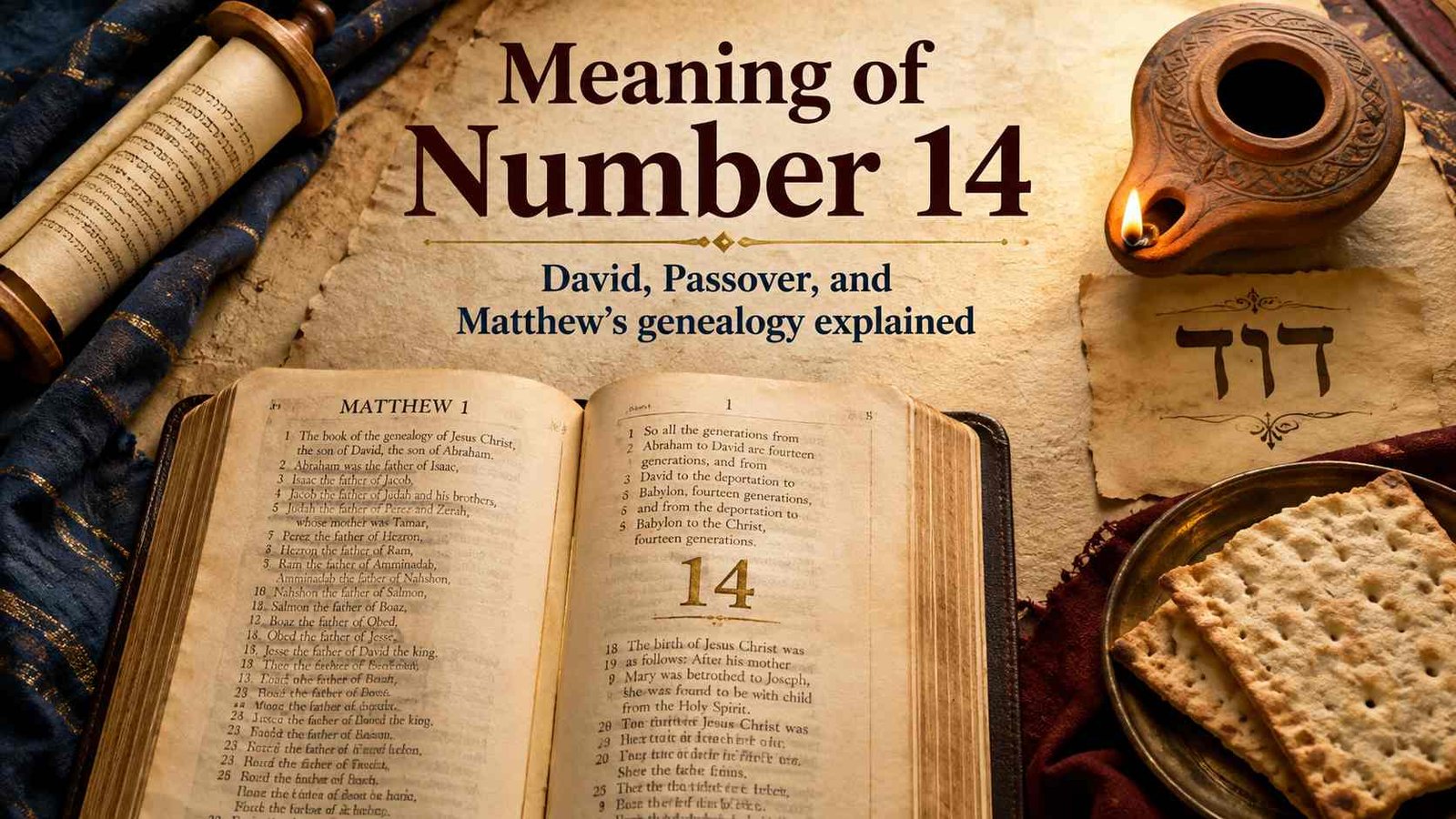
 What does 14 mean in the Bible? The safest answer is that the Bible does not give the number 14 one fixed spiritual definition. Still, fourteen appears in several important places, and some of those uses are clearly meaningful.
The strongest biblical connection is found in Matthew 1, where the genealogy of Jesus is arranged around three groups of fourteen generations. The number is closely connected with King David, whose Hebrew name has the numerical value of 14. Fourteen also appears in the story of Passover, when Israel remembered God’s deliverance from Egypt.
Because seven is often connected with completeness in Scripture, some Christians also understand fourteen, or seven plus seven, as a picture of doubled completeness. That idea can be useful as a reflection, but Scripture itself never directly says, “Fourteen means double perfection.”
So, when we study the biblical meaning of 14, we need to stay close to what the text actually says. That gives us a much richer answer than trying to turn every appearance of 14 into a secret spiritual code.
What Does 14 Mean in the Bible? The Short Answer
The number 14 is especially important in the Bible because of three major connections:
| Biblical connection | Why 14 matters |
|---|---|
| Jesus’ genealogy | Matthew divides the genealogy into three groups of fourteen |
| King David | The Hebrew letters in David’s name have a numerical value of 14 |
| Passover | Passover was appointed for the fourteenth day of the first month |
Matthew makes the first connection especially clear. He summarizes Jesus’ genealogy as fourteen generations from Abraham to David, fourteen from David to the Babylonian exile, and fourteen from the exile to Christ.
This repeated pattern tells us that fourteen is not an accidental number in Matthew’s opening chapter. The writer wants the reader to notice it.
But that does not mean every 14 in the Bible carries exactly the same message.
In some passages, fourteen simply tells us how many days passed, how many years someone served, or on which day something happened. Good Bible study always begins with context.
Why Is 14 Important in the Bible?
One reason fourteen attracts so much attention is that Matthew deliberately emphasizes it.
The first chapter of Matthew begins by presenting Jesus Christ as the son of David and son of Abraham. Matthew then gives a long genealogy connecting Jesus with Israel’s history.
At the end of the genealogy, Matthew stops and explains its structure:
Abraham to David forms one group.
David to the Babylonian exile forms another.
The exile to Christ forms the third.
Each group is counted as fourteen generations.
This arrangement helps Matthew tell the story of Israel in three great stages.
First comes the movement from Abraham to David, from promise to kingdom.
Then comes the movement from David to exile, from royal glory to national judgment.
Finally comes the movement from exile to Christ, from loss and waiting to the arrival of the Messiah.
The number fourteen becomes part of that carefully arranged story.
Three Groups of Fourteen in Matthew 1
Matthew 1:17 states the pattern directly. There are fourteen generations from Abraham to David, fourteen from David to the exile, and fourteen from the exile to the Messiah.
Why would Matthew arrange his genealogy this way?
One practical reason may have been memory. Genealogies were important in the ancient world, and a structured list was easier to remember. Bible.org notes both the memorable structure and the connection between fourteen and David.
There is also a deeper literary purpose.
David stands at the center of Matthew’s structure.
That matters because Jesus is introduced as the promised Son of David. Matthew is not merely giving us a list of ancestors. He is showing where Jesus fits into the story of God’s covenant promises.
The number fourteen helps keep David before the reader’s eyes.
Why Matthew Focuses on King David
David was one of the most important figures in Israel’s history.
He was Israel’s great king, and God made a covenant with him concerning his royal line. In 2 Samuel 7, God promised that David’s house and kingdom would have an enduring place in His plan.
Later Jewish expectation became closely connected with a coming ruler from David’s line.
This is why the New Testament repeatedly uses the expression Son of David for Jesus.
Matthew begins with that very idea.
When Matthew then builds his genealogy around groups of fourteen, the pattern appears to reinforce his message: Jesus stands in the royal line associated with David.
There is another detail that makes this connection even stronger.
In Hebrew, David’s name has the numerical value fourteen.
What Does the Number 14 Mean in Hebrew?
The normal Hebrew word for fourteen is not itself a secret spiritual word.
Hebrew numbers change form according to grammatical gender. The masculine form is commonly written ארבעה עשר, while the feminine form is ארבע עשרה. Hebrew dictionaries identify both as forms of the number fourteen.
But when people ask what the number 14 means in Hebrew Bible study, they are usually asking about something different: the numerical value of Hebrew letters.
Ancient Hebrew letters could also be associated with numerical values. This makes the name David especially interesting when studying Matthew 1.
David’s Hebrew Name Adds Up to 14
David’s name is written in Hebrew as:
דוד
The three consonants are traditionally assigned these numerical values:
ד — Dalet = 4
ו — Vav = 6
ד — Dalet = 4
Add them together:
4 + 6 + 4 = 14
This method of associating letters with numerical values is known as gematria.
Bible.org notes this connection when explaining Matthew’s genealogy and says that the numerical value of David’s Hebrew name helps explain the repeated fourteen-generation structure.
That does not mean Christians should turn every Hebrew name into a mathematical code.
Gematria can easily become speculative if it is used without limits. But Matthew’s repeated use of fourteen is different because Matthew himself draws attention to the number.
That gives us a reason to ask why fourteen matters in this particular passage.
The David connection gives a strong and historically reasonable answer.
It also explains why we should distinguish careful biblical study from unrestricted numerology.
If you are interested in this larger subject, it connects naturally with the question what do numbers mean in the Bible. Some biblical numbers clearly form important patterns, but their meaning should come from context rather than imagination.
What Does 14 Mean in the Bible Through Passover?
The second major biblical association with fourteen comes from the Passover.
The story begins in Exodus.
Israel was living under slavery in Egypt. God called Moses and sent signs of judgment against Egypt. Before the final plague, Israelite families were instructed to prepare a Passover lamb.
Exodus 12:6 says the animal was to be kept until the fourteenth day of the month, when the community would slaughter the Passover animals at twilight.
Later, the Law continued to identify the fourteenth day with Passover.
Leviticus 23:5 states that the Lord’s Passover was to take place on the fourteenth day of the first month at twilight.
That gives fourteen a clear historical connection with one of the greatest acts of deliverance in the Old Testament.
God brought His people out of slavery.
He protected them.
He led them toward a new life.
The fourteenth day became connected with the annual remembrance of that deliverance.
Does 14 Therefore Mean Deliverance?
We should phrase this carefully.
It is reasonable to say that 14 has an important association with Passover and deliverance because Passover took place on the fourteenth day.
It is less accurate to say that the Bible defines fourteen as “the number of deliverance.”
Scripture never gives us that formula.
The difference may seem small, but it matters.
Imagine reading Genesis 31:41, where Jacob says that he worked fourteen years for Laban’s two daughters. It would be strange to assume that those fourteen years automatically symbolize Passover deliverance.
That is not what the passage says.
A number can have an important symbolic role in one passage while functioning as a simple measurement in another.
This is why context should always come before symbolism.
Other Important Appearances of 14 in Scripture
Fourteen appears in several other interesting biblical settings.
One of the best-known is Jacob’s long service to Laban.
Jacob loved Rachel and agreed to work seven years to marry her. After Laban gave him Leah instead, Jacob served another seven years for Rachel.
Later Jacob summarized his time with Laban by saying that he had served fourteen years for Laban’s two daughters and another six years for the flocks.
Here, the fourteen years are mainly a historical period. The passage emphasizes Jacob’s long labor and Laban’s treatment of him.
Another appearance comes during Solomon’s reign.
First Kings 8 describes a great celebration connected with the dedication of the temple. The Hebrew textual tradition reflected in many translations describes seven days and seven more days, fourteen days in all.
This example is interesting because fourteen is explicitly made from two periods of seven.
The book of Esther gives us another important fourteenth day.
After the Jews defended themselves against their enemies, Esther 9:17 explains that those in the provinces rested on the fourteenth day of Adar and made it a day of feasting and gladness.
The number also appears in Paul’s writings.
In Galatians 2:1, Paul says that after fourteen years he went again to Jerusalem with Barnabas and Titus.
In 2 Corinthians 12:2, he refers to an extraordinary experience that had happened fourteen years earlier.
These examples are useful because they remind us not to overstate symbolism.
Sometimes fourteen marks a meaningful structure.
Sometimes it identifies a festival date.
Sometimes it measures a period of service.
Sometimes it simply tells us how long ago an event happened.
The passage itself must guide our interpretation.
Does 14 Mean Double Completion or Perfection?
You may have heard the claim that fourteen means double completion, double perfection, or perfect spiritual order.
The usual reasoning is simple:
Seven is often associated with completeness in biblical interpretation.
Fourteen equals seven plus seven.
Therefore, fourteen represents a doubled form of completeness.
There is some biblical background behind the first part of that idea.
Seven certainly has an important place in Scripture.
Creation unfolds across the pattern of seven days, with God’s rest on the seventh day. Israel’s calendar includes patterns built around seven. Revelation repeatedly uses groups of seven, including seven churches, seven seals, seven trumpets, and seven bowls.
For this reason, many interpreters understand seven as a number connected with completeness or fullness. Even careful discussions of biblical numbers recognize the unusually strong pattern surrounding seven while warning that not every appearance must be symbolic.
That makes it understandable why Christians may look at fourteen as two sevens.
We even see that structure clearly in 1 Kings 8:65, where the fourteen-day period is described as seven days followed by seven more.
Still, there is an important limit.
The Bible never says:
“Fourteen means double perfection.”
That is an interpretation built from the symbolic use of seven.
It can be mentioned as a devotional observation, but it should not be presented with the same certainty as Matthew’s three groups of fourteen or the fourteenth-day Passover.
If you want to understand this idea more deeply, studying what is the meaning of number 7 in the Bible provides the necessary background.
Why Is the Number 14 So Significant?
Fourteen becomes most significant when Scripture itself places unusual emphasis on it.
Matthew 1 is the clearest example.
Matthew did not merely happen to mention fourteen once. He repeated it three times in a summary of Jesus’ genealogy.
That repetition draws attention to the number.
Then we notice that David has a central position in the genealogy.
Then we notice that David’s Hebrew name has the numerical value fourteen.
Then we remember how Matthew opened his Gospel: Jesus Christ is introduced in connection with David and Abraham.
All of these details work together.
The main point is not that fourteen has mysterious power.
The point is that Matthew appears to use fourteen as part of his presentation of Jesus as the promised Davidic Messiah.
This is much more meaningful than simply saying, “Fourteen is a lucky biblical number.”
Biblical numbers do not have power by themselves.
Their importance comes from the way inspired Scripture uses them.
Passover offers another good example.
The fourteenth day is significant because God appointed Passover for that day. The meaning comes from the event connected with the date: God’s deliverance of Israel from Egypt.
So if someone asks, “Why is 14 so significant?” a balanced answer is:
Fourteen is significant mainly because Scripture deliberately connects it with important moments, especially Matthew’s presentation of Jesus in relation to David and the Passover date connected with Israel’s deliverance.
Is 14 a Messianic Number?
Calling fourteen a Messianic number can be helpful if we explain what we mean.
Matthew’s use of fourteen strongly points toward the royal line of David.
Jesus is not presented as Messiah because the number fourteen magically proves His identity.
Rather, Matthew uses the genealogy, Israel’s history, David’s royal line, and the literary structure of fourteen generations to tell the reader who Jesus is.
That distinction protects us from turning Scripture into a puzzle book.
Matthew wants us to look at Christ, not become obsessed with arithmetic.
The genealogy carries us through generations of faithful people, sinful people, kings, outsiders, periods of prosperity, national disaster, exile, and restoration.
Human history changes.
Kingdoms rise and fall.
Families go through broken seasons.
Yet the biblical story moves toward Christ.
That is the real beauty behind Matthew’s pattern.
Does Seeing the Number 14 Mean God Is Sending You a Message?
This question has become more common because of interest in angel numbers and repeated-number symbolism.
Someone may keep seeing 14 on clocks, bills, addresses, license plates, or dates and wonder whether God is trying to communicate something.
The Bible gives us no teaching that repeatedly seeing the number 14 means an angel is sending a private message.
It also does not tell Christians to find personal prophecies through random numbers in everyday life.
Scripture certainly contains meaningful numbers. But there is a major difference between studying a number that a biblical writer deliberately emphasizes and assigning spiritual messages to numbers we happen to notice during the day.
Even Christian discussions of biblical numerology warn that people can put too much significance on numbers and begin searching for hidden codes where Scripture gives none.
That caution is healthy.
If you see 14 and it reminds you of Matthew 1, there is nothing wrong with remembering God’s faithfulness through generations.
If it reminds you of Passover, you may thank God for His saving work.
But there is no biblical reason to believe that seeing 14 repeatedly predicts a relationship, financial blessing, future event, or supernatural change.
Christian faith rests on God’s revealed Word, not on decoding ordinary numbers around us.
Is 14 an Angel Number in the Bible?
The phrase angel number does not come from biblical teaching.
Modern angel-number systems often claim that repeated numbers carry messages from spiritual beings or reveal what will happen in a person’s future.
That is different from the biblical use of numbers.
In Scripture, when a number is important, its meaning comes from the biblical text itself.
For example, we know fourteen matters in Matthew because Matthew explicitly repeats fourteen.
We know the fourteenth day matters for Passover because God gave that date in the Law.
We do not need to invent another message.
This approach keeps our faith focused on what God has actually revealed.
It also helps us avoid superstition.
Does 14 Have the Same Meaning Everywhere in the Bible?
No.
This may be the most important rule to remember when studying biblical numbers.
The same number can appear in very different settings.
Jacob’s fourteen years of service do not automatically carry the same meaning as Matthew’s fourteen-generation structure.
Paul’s reference to fourteen years does not automatically symbolize David.
The fourteenth day in Esther does not mean exactly what the fourteenth day of Passover means.
Each passage has its own setting.
Think of other biblical symbols.
Water can represent cleansing in one passage, danger in another, physical thirst somewhere else, and life in another setting.
A lion can represent strength and royalty, yet Peter also uses the picture of a roaring lion for the devil.
Context decides meaning.
Numbers should be studied in the same careful way.
This principle also applies when researching what does number 4 mean in the Bible, what does 12 represent in the Bible, or what does the number 40 mean in the Bible. Patterns can be meaningful, but we should never force every occurrence into the same definition.
What Can We Learn Spiritually From the Number 14?
Once we stop looking for secret codes, several beautiful themes become easier to see.
Matthew’s genealogy teaches us about God’s faithfulness across generations.
The people listed in Matthew 1 lived across very different periods of history. Some experienced national success. Others lived through failure, judgment, exile, and uncertainty.
Yet God’s promise continued.
That can encourage us when our own lives feel uncertain.
We may see only one small part of the story. God sees generations.
The Passover connection reminds us that God is a God who delivers.
Israel’s escape from Egypt was not merely a political event. It became a central memory of God’s saving power.
Year after year, Passover reminded God’s people of what He had done for them.
Fourteen also reminds us to read Scripture patiently.
Not everything needs a hidden meaning.
Sometimes careful study leads us to a rich connection, as with David’s name in Matthew.
At other times, the faithful response is simply to accept that a number is recording a date or period of time.
Knowing when not to speculate is part of wise Bible study.
What 14 Teaches Us About God’s Redemptive Story
So, what does 14 mean in the Bible?
It does not have one universal definition that can be placed beside every verse containing the number.
Its clearest biblical significance comes from Matthew’s genealogy, where fourteen is repeated three times and points our attention toward David and the coming Messiah.
David’s Hebrew name, דוד, carries the numerical value 14, making Matthew’s structure especially meaningful.
Fourteen is also connected with Passover, since God appointed the fourteenth day of the first month for its observance. That gives the number a real historical association with God’s deliverance of Israel.
Some readers also see fourteen as seven plus seven and therefore connect it with doubled completeness. That can be a thoughtful observation, but it should remain an interpretation rather than a rule Scripture directly teaches.
Perhaps the greatest lesson is not really about mathematics.
It is about God’s faithfulness.
Matthew looks across generations of human history and shows that God’s promise did not disappear during hardship, bad kings, exile, or long years of waiting.
The story kept moving toward Christ.
When Scripture uses the number fourteen in that story, the number does not call us to superstition. It calls us to notice the careful way God’s purposes unfold through history.
And that is far more meaningful than any secret numerical prediction.

Dr. Rachel is very smart and knows a lot about the Bible. He helps us understand the Bible better by talking about the old texts in a simple way.