
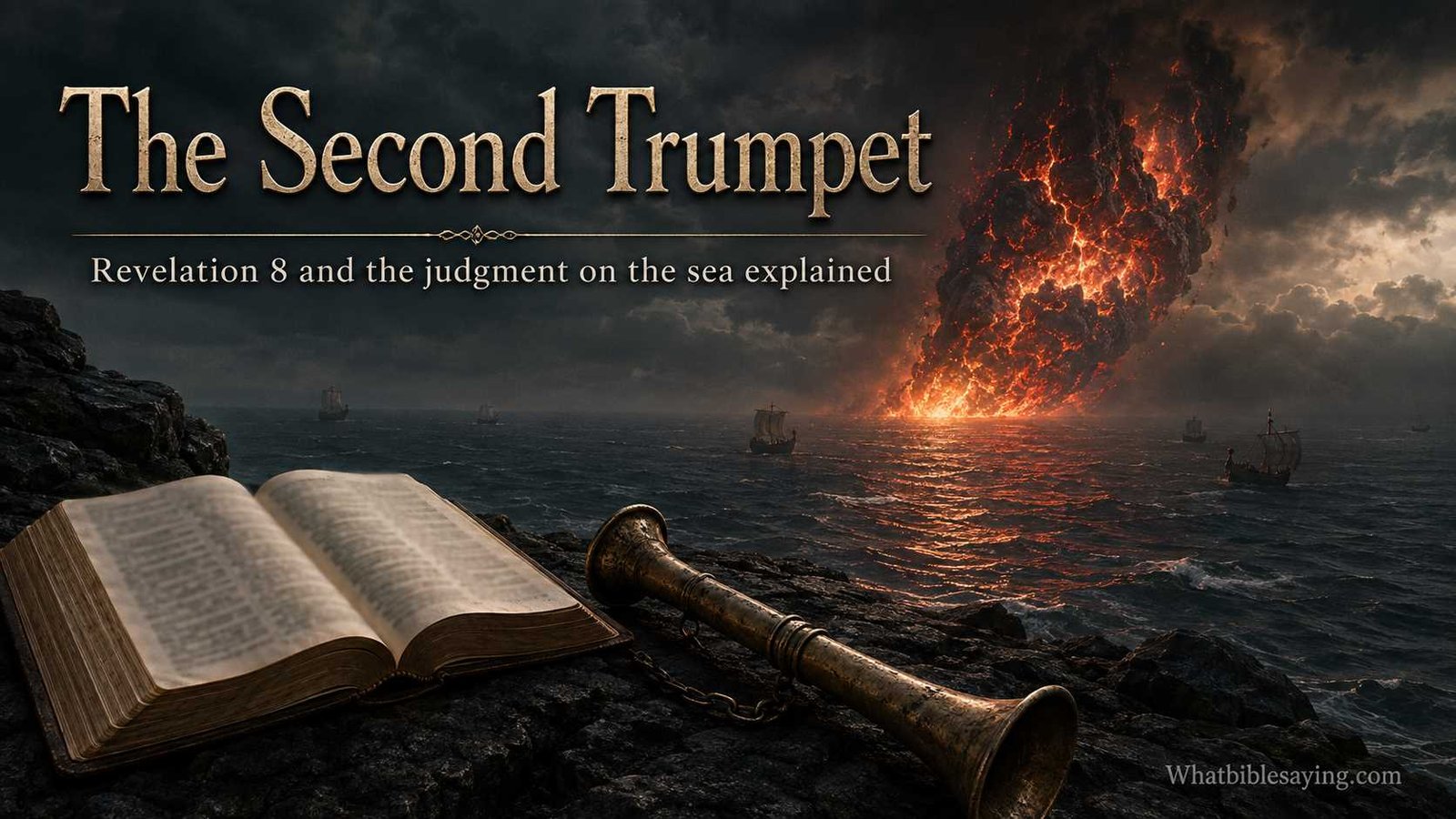
 The second trumpet in the Bible appears in Revelation 8:8–9. John sees the second angel sound a trumpet. Then something resembling a huge mountain burning with fire is thrown into the sea. A third of the sea becomes blood, a third of the living creatures in the sea die, and a third of the ships are destroyed.
It is one of the most dramatic scenes in the book of Revelation.
Because the picture is so powerful, people have offered many explanations. Some believe the burning mountain represents a literal future disaster. Others understand it mainly as symbolic prophecy. Some have connected it with an asteroid, volcano, war, or other modern event.
But Revelation itself does not identify the burning object as any of those things.
That distinction matters.
The safest way to understand the second trumpet is to begin with what Scripture actually says, then consider possible meanings with humility. Revelation gives us a vision of serious judgment. It shows that God remains Lord over the earth, sea, nations, and human history.
It does not give Christians permission to turn every disaster in the news into a fulfillment of Revelation 8.
What Is the Second Trumpet in the Bible and Where Is It Found?
The second trumpet is found in Revelation 8:8–9.
To understand it, we need to look at what happens just before it.
Revelation contains several groups of seven, including seven seals, seven trumpets, and seven bowls. The seven trumpet judgments begin after the opening of the seventh seal. Revelation 8:1 describes silence in heaven after that seal is opened. Soon afterward, seven angels are given seven trumpets.
This means the second trumpet is not an isolated vision. It belongs to a larger sequence.
Readers who are studying what is the seven seals in the Bible will notice that the seals and trumpets are closely connected in Revelation’s structure.
Revelation 8:8–9 Describes the Second Trumpet
When the second angel sounds, John sees something like a great mountain burning with fire thrown into the sea.
Notice the word like.
John does not simply say that an ordinary mountain falls into the sea. He describes what he sees by comparison. The object or event appears to him like a massive burning mountain.
Then several consequences follow:
- A third of the sea becomes blood.
- A third of the living creatures in the sea die.
- A third of the ships are destroyed.
The vision moves from something enormous entering the sea to widespread damage within the sea and to human activity upon it.
This is why the second trumpet is usually described as a judgment involving the sea.
Why the Words “Something Like” Matter
Small words can make a big difference when reading prophecy.
Revelation is filled with visions. John often describes extraordinary things by comparing them with things people know.
In Revelation 8, he does not give the burning object a modern scientific name.
He does not call it:
- an asteroid
- a meteor
- a volcano
- a missile
- a nuclear weapon
- a particular country
- a modern military attack
Those interpretations may appear in books, sermons, videos, or prophecy discussions, but they go beyond the wording of Revelation 8:8–9.
Good Bible study begins by asking, What does the text say?
Only after that should we ask what the imagery may represent.
What Does the Second Trumpet Mean in the Bible?
The clearest meaning of the second trumpet is divine judgment affecting the sea and what depends upon it.
The passage describes damage to the water, marine life, and ships. It presents a frightening disruption of creation and human activity.
Revelation repeatedly shows that creation itself is involved in these judgment scenes. Land, sea, rivers, heavenly lights, and human societies are all affected as the trumpet sequence unfolds.
That does not mean every detail is easy to interpret.
Christians have understood Revelation in different ways for centuries. Some expect many of these events to happen in a very literal future form. Others believe much of Revelation uses symbolic pictures to describe spiritual and historical realities. Still others see elements of both.
We do not need to settle every debate to understand the main point.
The second trumpet is a picture of severe judgment under God’s authority.
What Scripture Clearly Tells Us
Several facts come directly from Revelation 8.
The second angel sounds a trumpet.
The trumpet is not blown randomly. It belongs to an ordered sequence involving seven angels.
Something like a burning mountain enters the sea.
John tells us what it looks like, but he does not identify its physical composition.
A third of the sea becomes blood.
The image recalls other biblical scenes of judgment involving water and blood.
A third of sea creatures die.
The judgment affects living creation.
A third of the ships are destroyed.
The consequences also reach human activity, travel, trade, or life associated with the sea.
These details are clear enough.
What is less clear is exactly how each part will be fulfilled or whether every feature should be understood in a strictly physical way.
Is the Burning Mountain Literal or Symbolic?
This is one of the biggest questions readers ask about the second trumpet.
The text allows us to say that John saw something that looked like a huge burning mountain.
Going beyond that requires interpretation.
A literal reading may expect a future physical catastrophe involving the sea. A symbolic reading may understand the mountain-like object as representing overwhelming judgment, political power, destruction, or another large-scale event.
Both approaches try to take Revelation seriously, but they read its imagery differently.
A wise approach is to hold firmly to what Scripture makes clear and gently where Scripture leaves details unexplained.
If Revelation wanted us to know that the object was a particular asteroid, nation, weapon, or volcano, it could have named it. It does not.
That should make us careful about confident modern claims.
Why Does Revelation Keep Saying “One Third”?
The phrase one third appears repeatedly in the early trumpet judgments.
The first trumpet affects a third of the earth and trees. The second affects a third of the sea, sea creatures, and ships. The third affects a third of the rivers and springs. The fourth affects a third of the sun, moon, and stars.
The repeated fraction creates a clear pattern.
At the very least, it shows that these judgments are severe but described as affecting only a portion rather than everything at once.
We should be careful about turning the fraction into a secret mathematical code. Revelation itself does not tell readers to calculate a hidden date or identify a modern nation from the number one third.
The repeated pattern is more important than speculative mathematics.
The Second Trumpet and the Plagues of Egypt
The book of Revelation often uses language and images that echo earlier parts of the Bible.
The trumpet judgments are no exception.
Official notes on Revelation describe these disasters as being modeled in part on the plagues of Egypt recorded in Exodus.
That connection becomes especially clear when we think about water becoming blood.
In Exodus, God judged Egypt through a series of plagues before bringing Israel out of slavery. One of those plagues involved the waters of the Nile being turned to blood.
Revelation uses similar judgment imagery on a much larger stage.
This does not mean the second trumpet is simply a repeat of Exodus. Revelation develops the imagery in its own way. The sea is affected, creatures die, and ships are destroyed.
Still, knowing the Old Testament background helps us read Revelation as part of the whole Bible rather than as a collection of strange pictures with no connection to earlier Scripture.
The God revealed in Revelation is the same God who acts throughout biblical history.
That is also why readers asking what happens in Revelations in the Bible should not begin with modern headlines. Revelation continually reaches backward into the language, stories, and symbols of the Old Testament.
What Are the 7 Trumpets in the Bible?
The seven trumpets stretch from Revelation 8 through Revelation 11.
They form an important part of John’s vision and grow increasingly intense as the sequence continues.
Here is a simple overview:
| Trumpet | Bible Passage | What Happens |
|---|---|---|
| First | Revelation 8:7 | Hail and fire mixed with blood affect the earth and vegetation |
| Second | Revelation 8:8–9 | A burning mountain-like object enters the sea; a third is affected |
| Third | Revelation 8:10–11 | A blazing star called Wormwood affects rivers and springs |
| Fourth | Revelation 8:12 | A third of the sun, moon, and stars are darkened |
| Fifth | Revelation 9:1–12 | Locust-like beings emerge from the Abyss and bring torment |
| Sixth | Revelation 9:13–21 | Judgment is connected with four angels at the Euphrates and a vast mounted force |
| Seventh | Revelation 11:15–19 | Heaven announces the kingdom of God and His Christ |
The basic sequence is confirmed across Revelation 8–11.
The second trumpet therefore belongs near the beginning of the trumpet judgments.
It comes after judgment on the land and before judgment involving fresh water.
If you are studying what does the Bible say about trumpets, this is important. Trumpets have several purposes across Scripture. They can signal worship, assembly, warning, battle, royal announcement, or divine action.
In Revelation, these seven trumpets announce major moments of judgment and the unfolding of God’s purposes.
Who Blows the Trumpets?
Another common question is who blows the trumpet in the Bible during these Revelation scenes?
Revelation 8 says seven angels are given seven trumpets. Each angel sounds in turn.
So the second trumpet is sounded by the second angel.
The Bible does not give that angel a name.
That is another detail worth protecting from speculation. Scripture does not say that Michael, Gabriel, Raphael, or another named angel blows the second trumpet.
Sometimes popular teaching fills biblical silence with imaginative details. A careful reader should resist doing that.
How Is the Second Trumpet Different From the First and Third?
The first three trumpets have a clear progression.
The First Trumpet Affects the Land
Revelation 8:7 describes hail and fire mixed with blood being thrown upon the earth. The judgment affects the land, trees, and green grass.
The focus is mainly terrestrial.
The Second Trumpet Affects the Sea
Revelation 8:8–9 shifts attention to the sea.
The burning mountain-like object is thrown into it. Water, marine life, and ships are affected.
That makes the second trumpet distinct from the first.
The Third Trumpet Affects Fresh Water
The third angel then sounds.
A great blazing star falls upon a third of the rivers and springs. The star is called Wormwood, and the affected waters become bitter. Many people die because of the water.
This provides a natural connection with the study what is Wormwood in the Bible.
Notice the movement:
First trumpet: land.
Second trumpet: sea.
Third trumpet: rivers and springs.
The sequence presents judgment reaching different parts of the created world.
What Does the Fourth Trumpet Mean?
The fourth trumpet appears in Revelation 8:12.
This trumpet changes the focus again.
Instead of the earth or water, the vision turns toward the heavenly lights. A third of the sun, a third of the moon, and a third of the stars are struck so that their light is reduced.
This answers the common question, What does the fourth trumpet mean?
At its most basic level, the fourth trumpet portrays judgment through the darkening of heavenly lights.
Once again, the word third appears.
The pattern continues.
Second Trumpet vs. Fourth Trumpet
The two scenes are easy to distinguish.
| Second Trumpet | Fourth Trumpet |
|---|---|
| Revelation 8:8–9 | Revelation 8:12 |
| Focuses on the sea | Focuses on heavenly lights |
| Sea becomes blood | Light is darkened |
| Sea creatures die | Sun, moon, and stars are affected |
| Ships are destroyed | Day and night are affected |
Readers sometimes mix these visions together because Revelation moves quickly from one trumpet to the next.
Reading the passage slowly helps.
The second trumpet is about the sea.
The fourth trumpet is about the sun, moon, stars, and light.
What Does the Bible Say About the Second Trumpet?
When someone asks, What does the Bible say about the second trumpet?, the best answer should be shorter than many prophecy theories make it.
The Bible says that the second angel blows his trumpet, something like a great burning mountain is thrown into the sea, one third of the sea becomes blood, one third of the sea creatures die, and one third of the ships are destroyed.
That is what we know directly.
Everything else requires interpretation.
This difference between text and interpretation is important for healthy Bible study.
Does the Second Trumpet Predict an Asteroid?
The Bible never uses the word asteroid in Revelation 8.
A large burning object falling toward the sea may remind a modern reader of an asteroid or meteor. That comparison is understandable.
But resemblance is not identification.
We should say:
It could remind readers of such an event.
We should not say:
The Bible clearly says the second trumpet is an asteroid.
Scripture does not make that statement.
Is the Second Trumpet a Volcano?
Some readers imagine a volcanic mountain collapsing into the sea.
Again, Revelation does not say this.
The vision contains a mountain-like object burning with fire, but it gives no geological explanation.
A volcano is therefore an interpretation, not an explicit biblical identification.
Is It a Nuclear Attack or Modern Weapon?
Revelation 8 does not mention nuclear weapons, missiles, aircraft, or modern military technology.
It is possible for people to see similarities between ancient prophetic imagery and modern destruction. But similarity alone does not prove that John was describing a particular twenty-first-century weapon.
Christians should be especially careful when people claim that a current war or new weapon proves the second trumpet is happening now.
Revelation does not provide us with that certainty.
Does It Point to a Specific Country?
No country is named in Revelation 8:8–9 as the burning mountain.
Attempts to identify a modern nation from this passage depend on interpretation rather than a direct statement from Scripture.
That does not mean prophecy has nothing to say about nations.
It does mean we should avoid putting names into a passage that the passage itself does not provide.
This is particularly important when studying the great tribulation in the Bible, end-times events, or current world conflicts. Prophecy deserves careful reading, not fear-driven guessing.
Why Are Ships Mentioned in the Second Trumpet?
The mention of ships is easy to overlook.
Yet Revelation specifically says a third of the ships are destroyed.
Ships mattered greatly in the ancient world.
They carried people, goods, food, soldiers, and wealth across seas. Coastal cities could depend heavily on maritime trade.
So when the sea is struck, the effects do not remain underwater.
Human society is affected too.
The vision therefore has several layers of loss:
- the sea itself is struck
- living creatures die
- human vessels are destroyed
The judgment reaches creation and human activity together.
We do not need to calculate how many modern ships this would mean. Revelation gives the proportion within the vision, not a shipping forecast for readers to calculate in advance.
The point is the seriousness of the event.
Is the Second Trumpet Part of the Great Tribulation?
Many Christians connect the trumpet judgments with what they call the Great Tribulation.
However, Christian traditions differ over how Revelation’s end-times sequence should be arranged.
Some interpreters place the trumpet judgments within a future tribulation period. Others understand Revelation’s visions through different chronological or symbolic frameworks.
Because sincere Christians hold more than one view, we should avoid pretending that every detail has only one agreed timeline.
What we can say confidently is that the seven trumpets belong to Revelation’s major judgment visions.
They begin in Revelation 8 and culminate with the seventh trumpet in Revelation 11.
At the seventh trumpet, loud voices in heaven announce the kingdom of the Lord and His Christ.
So the trumpet sequence is not meaningless destruction.
It moves toward God’s rule, justice, and victory.
Why Does Revelation Use Such Frightening Images?
Revelation can feel frightening when we read scenes of fire, blood, darkness, death, and judgment.
But fear is not the only message of the book.
Revelation also contains worship, prayer, perseverance, God’s justice, Christ’s victory, and hope for God’s people.
The judgment passages tell us that evil does not continue forever without an answer.
Human violence, rebellion, oppression, and sin matter to God.
The world is not abandoned.
God sees.
God judges rightly.
God remains sovereign.
This gives Revelation both seriousness and hope.
The second trumpet reminds us that creation itself is not beyond God’s authority. The sea may seem wild and uncontrollable to human beings, but it is not beyond the Creator.
That is an important spiritual lesson even when we cannot explain every prophetic detail.
What Is the Second Trumpet in the Bible Teaching Christians Today?
The second trumpet was not written merely to satisfy curiosity about disasters.
Prophecy should shape the way we live.
Take God’s Holiness Seriously
Revelation does not present sin as harmless.
God is loving, but His love does not mean He ignores evil forever.
The judgment scenes remind us that God’s holiness and justice are real.
That truth should move us toward humility, repentance, and faithfulness.
Do Not Build Faith on Predictions
Every generation has produced people who believed they could match current events with Revelation perfectly.
Wars happen.
Natural disasters happen.
Political powers rise and fall.
New technologies appear.
These events can make Revelation feel very close, but Christians should not declare fulfillment without clear biblical grounds.
Jesus calls His followers to faithfulness, not sensational guessing.
Read Prophecy With the Rest of the Bible
The trumpet judgments become easier to understand when we see their connection with earlier Scripture.
The Exodus plagues are an important example. Revelation’s judgment imagery draws on themes already familiar from the Old Testament.
That means Revelation should not be read as though John invented an entirely new symbolic language.
The book stands at the end of the Bible, but its imagery reaches back through the Bible.
Remember Where the Trumpets Lead
The trumpet sequence eventually reaches the seventh trumpet.
There, the message turns toward God’s kingdom and the reign of Christ.
That matters.
The Christian story does not end with chaos.
It ends with God’s purposes fulfilled.
Judgment is part of Revelation, but judgment is not its final hope.
Understanding the Second Trumpet Without Fear or Speculation
So, what is the second trumpet in the Bible?
It is the second of seven trumpet visions in Revelation. It appears in Revelation 8:8–9.
The second angel sounds his trumpet. John sees something resembling a huge burning mountain thrown into the sea. A third of the sea becomes blood, a third of sea creatures die, and a third of the ships are destroyed.
That is the biblical foundation.
Beyond that point, humility matters.
The Bible does not specifically identify the burning mountain as an asteroid, volcano, nuclear weapon, nation, or current world event. We can discuss those theories, but we should label them honestly as interpretations.
Revelation was not given so that Christians could live in panic.
It calls readers to see history from God’s perspective.
Human kingdoms are not ultimate. Evil is not ultimate. Disaster is not ultimate.
God remains Lord.
The seventh trumpet eventually directs our attention toward His kingdom and the reign of Christ.
That gives us a better way to read the second trumpet.
Take the warning seriously. Respect the mystery. Avoid claims Scripture does not make. And keep the larger message of Revelation in view.
God’s justice is real, His authority reaches over all creation, and His purposes will not fail.
For further study, continue with What Does the Bible Say About Trumpets? and What Is Wormwood in the Bible? These topics help place Revelation 8 within the larger biblical picture of trumpets, judgment, warning, and hope.

Dr. Michael is a well-known author who shares why trusting the Bible matters. He speaks in a way that’s easy to follow, helping people see its truth clearly.