
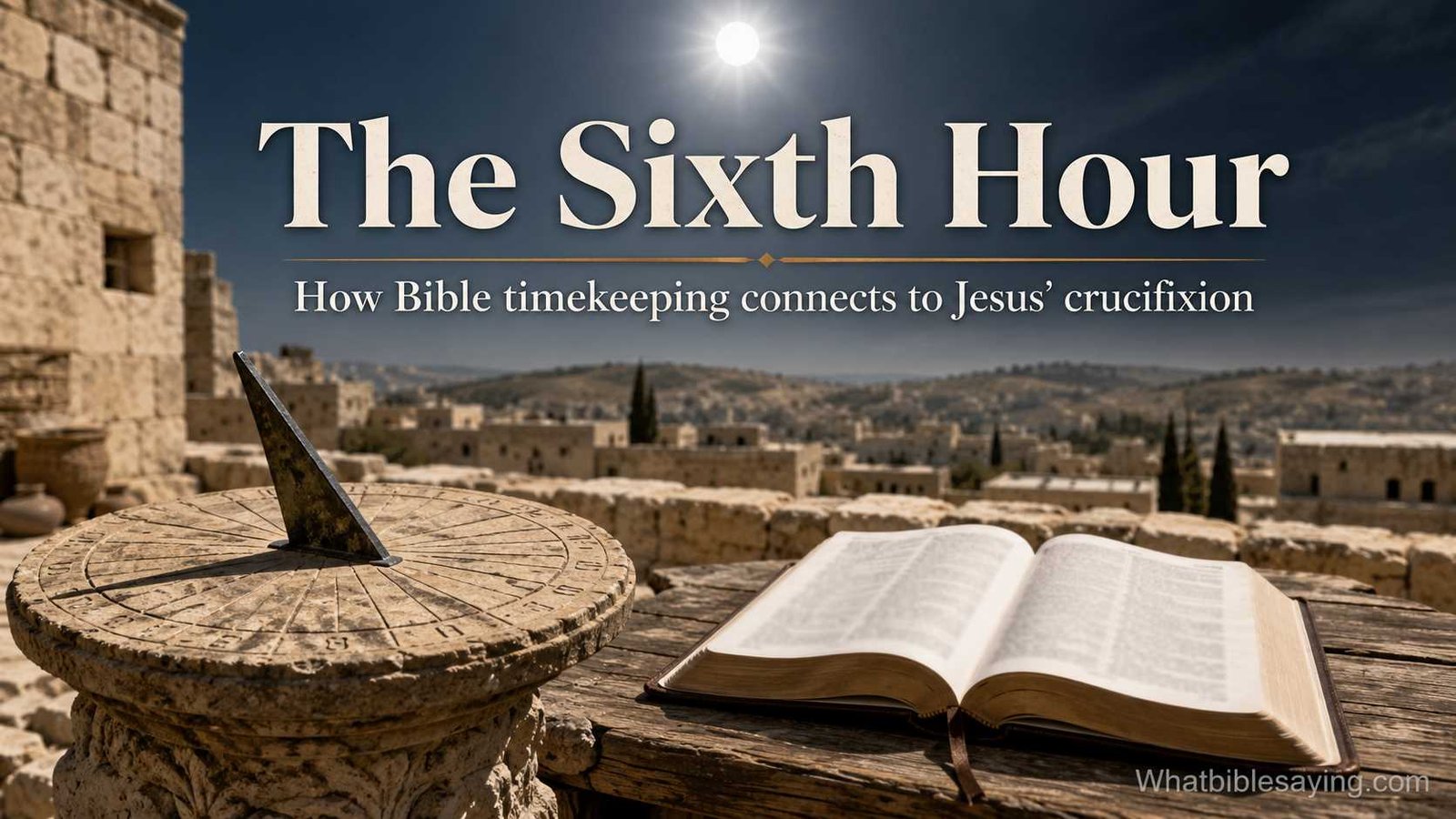
 If you are reading the New Testament and come across the words sixth hour, you may wonder what time that means today.
The simple answer is this: the sixth hour in the Bible usually means about 12 noon when the passage is using the common Jewish way of counting daylight hours.
People in Bible times did not normally describe time the way we do today. They did not say 11:47 a.m. or 2:15 p.m. Instead, daylight was divided into hours beginning around sunrise. This is why the Bible speaks about the third hour, sixth hour, ninth hour, and other parts of the day.
The sixth hour becomes especially important when we read about Jesus’ crucifixion. Mark tells us that darkness came over the land at the sixth hour and continued until the ninth hour. In modern terms, that means roughly from noon until 3 p.m. Mark also says Jesus was crucified at the third hour, traditionally understood as about 9 a.m.
There is another reason this subject can feel confusing. John 19:14 mentions the sixth hour while Jesus was still before Pilate. That seems different from Mark’s account at first glance. Christians and biblical scholars have offered several ways of understanding the difference, and we will look at them carefully rather than pretending the question does not exist.
Understanding biblical time helps us read these passages with greater clarity. It also reminds us of something simple but important: the Bible was written in a real historical world, where people measured their days differently from the way we do now.
What Was the 6th Hour in the Bible?
The sixth hour was approximately noon.
A common way of measuring daytime in the New Testament world was to count about twelve daylight hours from sunrise to sunset. If sunrise was near 6 a.m., the sixth hour fell around midday. This is why many modern Bible translations simply translate or explain the sixth hour as noon. Ancient daylight hours could vary somewhat with the season, so these modern clock times are best understood as approximations rather than exact minute-by-minute conversions.
Here is a simple way to understand it:
| Biblical Time | Approximate Modern Time |
|---|---|
| First hour | Around 6 a.m. |
| Third hour | Around 9 a.m. |
| Sixth hour | Around 12 noon |
| Ninth hour | Around 3 p.m. |
| Twelfth hour | Around sunset |
This makes many New Testament passages much easier to follow.
If you read that something happened at the third hour, think roughly 9 a.m.
If something happened at the sixth hour, think roughly noon.
If something happened at the ninth hour, think roughly 3 p.m.
The Bible itself shows this way of speaking about the day in several places. Jesus used the language of the third, sixth, ninth, and eleventh hours when telling the parable of the workers in the vineyard in Matthew 20.
The important point is that these expressions were normal ways of talking about time. They were not automatically secret spiritual codes.
Why Biblical Hours Are Different From Our Clock
Our modern clock begins a calendar day at midnight and divides it into twenty-four equal hours.
Biblical writers did not always describe time in that same way.
For ordinary daylight reckoning, sunrise provided a natural starting point. People watched the position of the sun and understood the movement of the day through broad divisions of time.
Imagine waking as the sun rises around 6 a.m.
Three hours later would be the third hour.
Another three hours would bring you to the sixth hour, around noon.
Three more hours would bring you to the ninth hour, around 3 p.m.
By the twelfth hour, daylight would be approaching its end.
This explains why simply reading sixth hour as 6 a.m. can lead to confusion. In many New Testament passages, the number is counting the hours after the beginning of daylight, not giving a modern clock reading.
What Is the Meaning of the Sixth Hour?
When people ask about the meaning of the sixth hour, there are really two different questions.
The first is historical:
What time was it?
The answer is usually about noon.
The second is spiritual:
Does the sixth hour carry a special spiritual meaning every time it appears?
Here we need to be more careful.
The Bible does not teach that every event happening at the sixth hour has one fixed mystical meaning. In most passages, the phrase first tells us when something happened.
That does not make the hour unimportant. Important events happened at the sixth hour. But the meaning comes mainly from the event and its biblical context, not simply from the number six.
One good example appears in Acts 10.
Peter went up on the roof to pray at about the sixth hour. Modern translations commonly identify this as around noon. While Peter was praying, he received the vision that prepared him for the arrival of messengers from Cornelius. This became part of a major turning point in Acts as the gospel moved more clearly among Gentiles.
The verse therefore gives us both a time and an important moment in the story.
It does not say, however, that noon itself has magical power.
Was the Sixth Hour a Time of Prayer?
Acts 10:9 tells us that Peter went up to pray around the sixth hour.
That certainly shows that noon could be a time of prayer.
Prayer at different points in the day also appears elsewhere in Scripture. Psalm 55:17 speaks of calling upon God in the evening, morning, and at noon.
Yet we should not turn these examples into a rule that Christians must pray at exactly twelve o’clock.
The deeper biblical lesson is not that God hears prayer only at certain hours. It is that prayer was woven into the lives of God’s people.
Morning could become a time of prayer.
Noon could become a time of prayer.
Evening could become a time of prayer.
Peter’s experience reminds us that an ordinary part of the day can become a deeply important moment when a person turns toward God.
What Happened at the Sixth Hour During Jesus’ Crucifixion?
The best-known reference to the sixth hour appears in the crucifixion story.
Mark 15:33 tells us that when the sixth hour came, darkness covered the land until the ninth hour. Matthew gives the same basic time frame. In ordinary modern terms, the darkness lasted from about noon until about 3 p.m.
This is striking because noon is normally one of the brightest parts of the day.
The Gospel writers present the darkness as part of the solemn scene surrounding Jesus’ death. They do not stop to give a scientific explanation for it. Their focus is on what is happening to Jesus.
At about the ninth hour, Mark records Jesus crying out before His death.
That gives us a basic timeline:
Third hour: Jesus is crucified according to Mark.
Sixth hour: darkness begins.
Ninth hour: the darkness ends, and the events surrounding Jesus’ death reach their climax.
Understanding those hour markers helps the crucifixion account feel less distant. We begin to see the movement of the day.
Jesus was not simply placed on the cross in one timeless scene. The Gospel writers describe a sequence of events unfolding through the morning and afternoon.
If you are also studying where the crucifixion is in the Bible or what chapter of the Bible describes Jesus being crucified, the main accounts are found in Matthew 27, Mark 15, Luke 23, and John 19.
Each Gospel gives us details that help form a fuller picture of that day.
Was Jesus Crucified on the Third Hour or the Sixth Hour?
This question deserves special attention because it is one of the first things careful readers notice.
Mark 15:25 says Jesus was crucified at the third hour.
Under the usual Jewish daylight reckoning, that would be approximately 9 a.m.
But John 19:14 says it was about the sixth hour when Jesus was before Pilate shortly before Pilate handed Him over to be crucified. Some translations render John’s expression directly as about noon.
At first, the two passages appear difficult to place on the same modern timeline.
So was Jesus crucified on the third hour or the sixth hour?
The safest answer is:
Mark explicitly identifies the crucifixion with the third hour, while John mentions about the sixth hour during the proceedings before Pilate.
That is what the texts say.
The next question is how the two accounts should be understood together.
What Mark 15:25 Says
Mark gives a short and direct statement about the crucifixion.
He places it at the third hour.
If we use ordinary Jewish daylight reckoning, this points roughly to 9 a.m.
Later in the same chapter, Mark says darkness began at the sixth hour and continued until the ninth hour. This sequence is internally clear: third hour, sixth hour, ninth hour.
So in Mark’s presentation, the crucifixion begins in the morning, darkness comes around noon, and the events surrounding Jesus’ death continue into the afternoon.
What John 19:14 Says
John gives us a different time reference.
Jesus is still involved in the proceedings before Pilate when John says it was about the sixth hour. Shortly afterward, Pilate hands Jesus over for crucifixion.
This has led readers for centuries to ask how John’s sixth hour relates to Mark’s third hour.
It is a real interpretive question, and Christians do not need to be afraid of acknowledging it.
Careful Bible study does not mean pretending difficult verses are easy.
It means reading each passage closely, respecting what it says, and considering reasonable explanations without claiming more certainty than the evidence allows.
Why Do Mark and John Appear Different?
Several explanations have been proposed.
One suggestion is that ancient time references were approximate. People did not usually carry precise clocks, and expressions such as third hour or sixth hour could describe broader parts of the day rather than an exact minute. John himself says about the sixth hour, which signals approximation.
Another proposal is that John may have been using a different method of counting hours from Mark. Some interpreters have suggested a Roman-style reckoning for John’s Gospel. Under such a proposal, John’s sixth hour could refer to an earlier point in the morning. This is one of several harmonizing explanations, but it should be presented as a proposed interpretation rather than as a fact stated directly by John.
Others emphasize that the Gospel writers may have been using conventional time markers rather than giving the kind of precise chronological record expected in a modern legal document or digital timestamp.
There are also discussions about manuscript evidence and how ancient writers grouped events.
For an everyday Bible reader, here is what matters most:
Mark says third hour in connection with the crucifixion.
John says about the sixth hour while Jesus is before Pilate.
There are reasonable attempts to explain the difference, but interpreters do not all settle the issue in exactly the same way.
We should therefore avoid saying that the Bible unquestionably teaches one particular harmonization when the texts themselves do not explain the difference for us.
That careful approach strengthens Bible study rather than weakening it.
What Is the 6th and 9th Hour in the Bible?
The sixth and ninth hours are easy to remember once we understand how biblical daylight time worked.
The sixth hour was approximately noon.
The ninth hour was approximately 3 p.m.
These two expressions appear together in the crucifixion accounts.
Mark says darkness came over the land at the sixth hour and lasted until the ninth hour. Around the ninth hour, Jesus cried out with a loud voice.
The ninth hour also appears elsewhere in Acts.
In Acts 10, Cornelius receives a vision around the ninth hour. The chapter then connects his story with Peter, who is praying around the sixth hour the following day.
So within one chapter we find both times:
Cornelius has his experience around the ninth hour.
Peter prays around the sixth hour.
This shows again that these expressions function naturally as time markers.
Why the Ninth Hour Matters
The ninth hour, roughly 3 p.m., appears in important New Testament scenes.
Acts 3:1 also describes Peter and John going to the temple at the hour of prayer, identified as the ninth hour.
This helps us understand that time and worship were connected in the daily rhythm of Jewish life.
But just as with the sixth hour, the Bible does not tell believers to treat the ninth hour as a magical moment.
Biblical faith is not controlled by the clock.
The hours help us understand the story.
God is the One who gives the story its meaning.
Other Places the Sixth Hour Appears in the Bible
The crucifixion is not the only place where the sixth hour appears.
Acts 10:9 gives one of the clearest examples. Peter goes to the rooftop to pray at about noon.
Jesus also uses sixth-hour language in His parables.
In Matthew 20, the owner of a vineyard goes out at different times of day to hire workers. The text mentions the third, sixth, ninth, and eleventh hours.
The point of the parable is not to teach readers how to build a clock. The time markers simply help tell the story of workers being hired throughout the day.
John’s Gospel also contains numbered hours. Because John’s time references sometimes create questions when compared with other Gospel passages, they have received a great deal of scholarly discussion.
Still, the basic reading principle remains simple:
Before asking what an hour symbolizes, first ask what time the writer is describing and what is happening in the passage.
Context comes before symbolism.
That principle can protect us from many misunderstandings when studying Scripture.
Does the Sixth Hour Have a Special Spiritual Meaning?
People often search for spiritual meanings behind numbers and times in the Bible.
Sometimes numbers do play an important literary or symbolic role in Scripture.
Seven is frequently connected with completeness.
Twelve appears with the tribes of Israel and the apostles.
Forty appears in several periods of testing, preparation, or judgment.
But we should not assume every number always carries the same spiritual message.
The same caution applies when asking what does 6 represent in the Bible.
The number six appears in many settings, but that does not mean every sixth-hour passage is secretly about the symbolic meaning of six.
When Mark says darkness began at the sixth hour, the most immediate meaning is that darkness began around midday.
When Acts says Peter prayed at the sixth hour, the immediate meaning is that he prayed around noon.
That is the plain reading.
A devotional lesson may grow from the event, but it should grow from what Scripture actually says.
There is a healthy difference between saying:
An important biblical event happened at noon
and saying:
Noon always carries a special supernatural meaning for every believer.
The first statement follows the text.
The second goes beyond what the Bible clearly teaches.
Faith becomes stronger, not weaker, when we learn that difference.
How the Sixth Hour Fits the Passover and Crucifixion Story
The final hours before Jesus’ crucifixion took place in connection with Passover and Jerusalem.
The Gospels describe Jesus sharing a final meal with His disciples, going to Gethsemane, being arrested, facing questioning and trial, appearing before Pilate, and then being led away to be crucified.
John 19 specifically places the scene before Pilate on the day of Preparation connected with Passover and says it was about the sixth hour.
The Synoptic Gospels and John have differences in the way they frame some Passover chronology, which has produced a long history of scholarly discussion. For a simple study of the sixth hour, we do not need to solve every question about the exact calendar sequence.
What matters here is that these events occurred within a real Jewish festival setting and a real sequence of morning and afternoon events.
Understanding what Passover means in the Bible also helps explain why the Gospel writers give so much attention to this period.
Passover was rooted in Israel’s deliverance from Egypt. In the New Testament story, Jesus’ death takes place against that deeply meaningful biblical background.
This is one reason Christians have always read the crucifixion as more than the tragic death of an innocent man.
The Gospel writers present it as central to the saving work of Christ.
If you want to follow the events immediately surrounding this period, the site’s guide to when the Last Supper appears in the Bible gives useful context for the hours leading into Jesus’ arrest and crucifixion. The site’s own treatment likewise identifies the third hour as roughly 9 a.m., the sixth as noon, and the ninth as about 3 p.m.
A Simple Timeline of the Crucifixion Hours
It can help to place the main time references side by side.
| Event | Biblical Hour | Approximate Modern Time |
|---|---|---|
| Crucifixion according to Mark 15:25 | Third hour | About 9 a.m. |
| Darkness begins | Sixth hour | About noon |
| Darkness continues | Sixth to ninth hour | About noon to 3 p.m. |
| Jesus cries out around the ninth hour | Ninth hour | About 3 p.m. |
This table follows Mark’s sequence.
John’s reference to the sixth hour belongs in a separate discussion because John places Jesus before Pilate at about that time.
Keeping the passages separate before trying to combine them is a good Bible-study habit.
Read Mark for what Mark says.
Read John for what John says.
Then compare them.
This prevents us from accidentally changing one passage just to make it sound more like another.
What Does the Sixth Hour Teach Us About Reading the Bible?
A phrase as small as the sixth hour teaches us something valuable about Scripture.
The Bible came to us from cultures very different from our own.
People measured time differently.
They used different calendars.
They spoke different languages.
They lived under social customs, governments, and daily routines that can feel unfamiliar to us.
None of this should make the Bible frightening to read.
It should make us curious.
Sometimes a difficult verse becomes much clearer when we learn one small historical fact.
The sixth hour is a perfect example.
At first, a reader may see sixth hour and naturally think 6:00.
Once we understand ancient daylight reckoning, we realize that the phrase usually points to midday.
Suddenly Acts 10 makes more sense.
The crucifixion timeline becomes easier to follow.
The sixth and ninth hours stop sounding mysterious.
This is why patient Bible reading matters.
We do not need to rush.
We do not need to force a spiritual meaning into every number.
And we do not need to hide from passages that raise questions.
Scripture invites careful reading.
Sometimes the faithful answer is clear.
Sometimes the faithful answer includes the words approximately, possibly, or scholars have understood this in different ways.
That kind of humility is not a lack of faith.
It is respect for the text.
Remembering the Sixth Hour Simply
If you want one simple sentence to remember, use this:
The sixth hour in the Bible usually means about noon when the writer is counting daylight from sunrise.
The third hour was roughly 9 a.m.
The sixth hour was roughly noon.
The ninth hour was roughly 3 p.m.
During Jesus’ crucifixion, Mark says Jesus was crucified at the third hour, darkness began at the sixth hour, and the darkness lasted until the ninth hour.
John 19:14 presents a well-known chronology question because it places Jesus before Pilate at about the sixth hour. Christians have proposed several explanations, but the wisest approach is to state clearly what each Gospel says before discussing possible ways to harmonize them.
Most importantly, the sixth hour is not presented in Scripture as a magic hour.
Its significance comes from what God was doing in the events recorded at that time.
Peter prayed around the sixth hour.
Darkness came during Jesus’ crucifixion at the sixth hour.
These moments matter because of their place in God’s story, not because the clock itself holds spiritual power.
When we understand that, a phrase that once seemed strange becomes simple.
The sixth hour means about noon.
And learning that small detail helps us see the biblical world more clearly, follow the Gospel story more carefully, and approach Scripture with both faith and thoughtful attention.
For more context around the final days before the crucifixion, you may also read What Does Palm Sunday Mean in the Bible?, which follows Jesus’ entrance into Jerusalem before the events of His death and resurrection.
Dr. Rachel is very smart and knows a lot about the Bible. He helps us understand the Bible better by talking about the old texts in a simple way.