
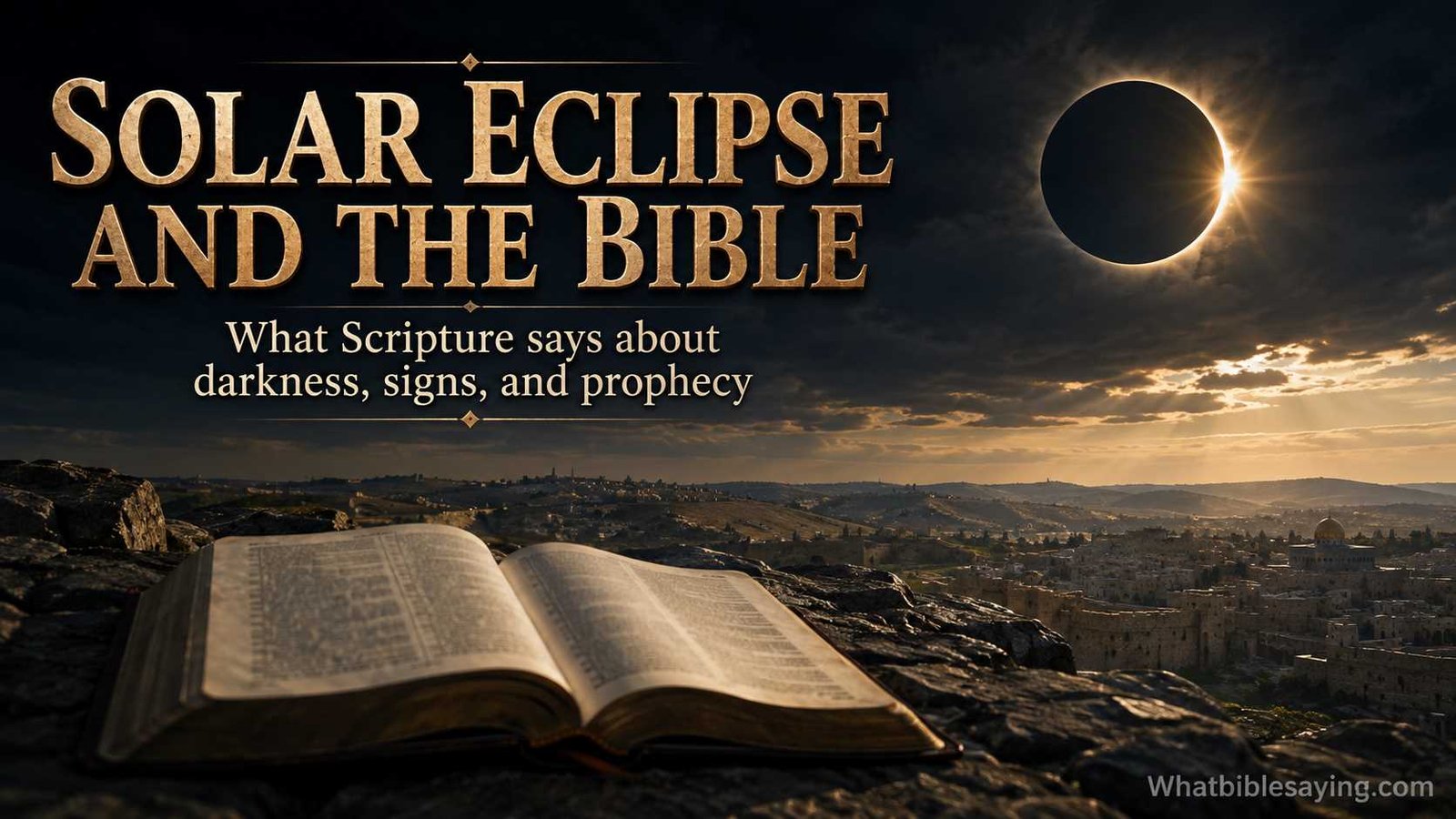
 A solar eclipse can be an unforgettable sight. The daylight becomes dim. The temperature may seem to change. The Sun slowly disappears behind the Moon, and for a few moments, the sky can look almost like evening.
For Christians, this amazing sight can also raise spiritual questions. What does the Bible say about the solar eclipse? Is an eclipse a warning from God? Is it connected with the end times? Does every darkened sun fulfill Bible prophecy?
The simple answer is this: the Bible does not teach that every solar eclipse is a special prophetic message from God. Scripture does speak several times about the Sun becoming dark, the Moon changing appearance, and signs appearing in the heavens. Some of these passages are connected with judgment, the Day of the Lord, and the return of Christ. But we should not automatically identify every natural eclipse with one of those prophecies.
Science explains how an eclipse happens. The Bible helps us understand how believers should think about creation, heavenly signs, prophecy, and God.
Both questions matter.
What Does the Bible Say About the Solar Eclipse as a Sign?
You will not normally find the modern phrase solar eclipse in English Bible translations. Biblical writers usually describe what people see: the Sun becomes dark, the Moon changes, the stars are affected, or unusual signs appear in the heavens.
One of the best-known passages is Joel 2:31:
“The sun shall be turned into darkness, and the moon into blood, before the great and terrible day of the Lord come.”
Joel connects these events with the Day of the Lord.
This is important because the passage is much larger than a simple description of an eclipse. Joel speaks about divine judgment, wonders in heaven and earth, and God’s saving call to those who turn to Him.
So we should be careful.
The verse certainly describes a darkened Sun, but it does not say, “Every time there is a solar eclipse, this prophecy is being fulfilled.”
That extra claim would go beyond the text.
Joel’s Darkened Sun and the Day of the Lord
Joel 2:30–31 places the darkened Sun beside other extraordinary signs:
“And I will shew wonders in the heavens and in the earth, blood, and fire, and pillars of smoke.”
Then the prophet speaks of the Sun turning to darkness and the Moon to blood.
The context is therefore prophetic and dramatic.
The New Testament later repeats Joel’s language. In Acts 2, Peter quotes Joel while preaching at Pentecost. He speaks about wonders in heaven, signs on earth, the darkened Sun, and the Day of the Lord.
This tells us something important about Bible interpretation: a verse about the Sun becoming dark should be read within its whole prophetic setting. It should not be removed from its context and attached to any eclipse that happens to appear in the news.
The Moon becoming like blood also connects naturally with the biblical question of what the Bible says about a blood moon. The same rule applies there. We should begin with Scripture, not with modern predictions.
Signs in the Sun, Moon, and Stars
Jesus also spoke about heavenly signs.
Luke 21:25 says:
“And there shall be signs in the sun, and in the moon, and in the stars.”
The passage continues with distress among nations and describes events associated with the coming of the Son of Man.
Again, the context is much greater than one ordinary eclipse.
Jesus is not giving His followers a rule that says every unusual event in the sky should be treated as a new prophecy. He is describing a much broader period of cosmic and earthly disturbance.
That is why Christians should also read passages about what the Bible says about stars in their biblical setting rather than treating every unusual object in the night sky as a hidden message.
What Does the Solar Eclipse Mean Biblically?
So what does the solar eclipse mean biblically?
There is no single verse that says, “A solar eclipse always means this.”
Instead, Scripture gives us several principles that help us think wisely about the heavens.
| Biblical truth | What it means for an eclipse |
|---|---|
| God created the heavens | An eclipse happens within the created order |
| The heavens display God’s glory | Celestial events can inspire awe and worship |
| Scripture sometimes uses a darkened Sun prophetically | Context determines the meaning |
| Jesus warned of heavenly signs | We should take prophecy seriously |
| The Bible does not label every eclipse a prophecy | Christians should avoid unsupported predictions |
This balanced approach protects us from two mistakes.
The first mistake is saying that an eclipse has no spiritual value at all. Christians believe the universe is God’s creation, so looking at the heavens can remind us of His greatness.
The second mistake is claiming that every eclipse is a direct warning, countdown, or secret code from God.
The Bible does not give us that rule.
Creation Can Point Us Toward the Creator
Psalm 19:1 says:
“The heavens declare the glory of God; and the firmament sheweth his handywork.”
The psalm presents the heavens as a witness to God’s glory and creative power.
A believer can therefore watch a solar eclipse and feel wonder.
The Moon is moving in its orbit. Earth is moving through space. The Sun continues shining. For a short time, their positions line up so that the Moon blocks some or all of the Sun from our view.
NASA explains that a solar eclipse happens when the Moon passes between Earth and the Sun, blocking at least part of the Sun and casting a shadow on Earth.
For a Christian, knowing the physical cause does not remove wonder.
Understanding how rain forms does not make rain less beautiful. Understanding how a seed grows does not make a tree less impressive. In the same way, understanding an eclipse does not stop us from seeing creation with gratitude.
Science describes the physical event. Faith asks what creation tells us about the One who made it.
Does Genesis 1:14 Mean Every Eclipse Is a Sign?
Genesis 1:14 is sometimes brought into discussions about eclipses because God says the heavenly lights will be “for signs, and for seasons, and for days, and years.”
But the word signs should not be turned into permission to invent meanings for every movement of the Sun or Moon.
The passage describes the purpose and order of the heavenly lights. They mark time, seasons, days, and years. Elsewhere in Scripture, God can certainly use heavenly events as signs. But Genesis 1 does not say that every eclipse contains a secret prophetic message.
The same caution is useful when considering what the Bible says about planets aligning. The fact that something happens in the heavens does not automatically make it a coded prediction.
What Does the Bible Say About the Solar Eclipse and the End Times?
This is where many people become worried.
A dramatic eclipse happens. Social media fills with videos. Someone connects the date with a Bible verse. Another person says judgment will begin. Someone else claims the eclipse proves the Second Coming is only days away.
Christians should be much more careful.
Jesus did speak about the Sun becoming dark in connection with future events.
Matthew 24:29 says that after the tribulation described in the passage, “the sun [will] be darkened” and “the moon will not give its light.” The verse also describes falling stars and the powers of heaven being shaken.
That is serious prophetic language.
But notice everything happening around the darkened Sun. This is not presented as a normal eclipse standing alone. It belongs to a much larger prophetic scene.
Revelation and the Darkened Sun
Revelation gives another powerful description.
When the sixth seal is opened in Revelation 6:12, John describes a great earthquake, the Sun becoming black like sackcloth, and the Moon becoming like blood. The following verses describe stars falling, the heavens receding, and mountains and islands being moved.
Whatever interpretive position a Christian takes on Revelation, one fact is clear: the passage describes far more than an ordinary solar eclipse.
Reducing Revelation 6 to a modern eclipse date misses the scale of John’s vision.
The Bible asks us to take prophecy seriously. Taking prophecy seriously also means refusing to add details that Scripture does not give us.
Should Christians Predict Prophecy From Eclipse Dates?
Christians throughout history have sometimes been tempted to connect extraordinary events with exact prophetic schedules.
The safer biblical approach is humility.
If Scripture clearly identifies an event, we can speak clearly. If Scripture does not identify it, we should not speak as though God has given us information that He has not actually revealed.
A solar eclipse can remind us of biblical passages about darkness and heavenly signs. It may lead someone to think about God, judgment, eternity, or Christ’s return.
That can be spiritually meaningful.
But saying “this eclipse definitely fulfills this prophecy” requires evidence from Scripture itself.
A dramatic sky is not permission to become careless with the Bible.
The same principle applies when studying what the Bible says about red moons. Biblical imagery deserves careful reading, not fear-driven speculation.
Was the Darkness at Jesus’ Crucifixion a Solar Eclipse?
The darkness during Jesus’ crucifixion is often connected with eclipses.
Matthew, Mark, and Luke report darkness during the crucifixion. Luke 23:44–45 describes darkness over the land from about the sixth hour until the ninth hour and refers to the Sun’s light failing.
Was this a normal solar eclipse?
There is a major astronomical problem with that explanation.
The crucifixion took place during Passover, which is associated with the full-moon period. A solar eclipse, however, can occur only around a new moon, when the Moon is positioned between Earth and the Sun. NASA confirms that solar eclipses occur at the new-moon phase.
The NET Bible’s study note makes the same point when discussing the crucifixion darkness: it could not have been an ordinary solar eclipse because Passover occurred at full moon.
There is another problem. The Gospel darkness is described as lasting roughly three hours. Totality in a normal solar eclipse lasts only minutes at a particular location, not three hours.
For those reasons, Christians should not casually say, “The crucifixion darkness was simply a solar eclipse.”
The Gospel writers present the darkness as part of the extraordinary events surrounding the death of Jesus.
Exactly what physical process God used is not explained in the text.
We can leave that question where Scripture leaves it.
Do Christians Believe in Solar Eclipses?
Yes. Christians believe solar eclipses are real astronomical events, and accepting their natural cause is not a rejection of the Bible.
A total solar eclipse occurs when the Moon passes between the Sun and Earth and completely blocks the visible face of the Sun for people located in the path of totality. A partial eclipse happens when only part of the Sun is covered. An annular eclipse happens when the Moon appears too small to cover the Sun completely, leaving a bright ring around it.
Christians do not need to choose between astronomy and faith.
You can understand an eclipse scientifically and still believe:
- God created the heavens.
- Creation displays God’s greatness.
- Scripture contains genuine prophecy.
- God can use signs according to His purposes.
- Human beings should not invent messages that God has not revealed.
That is a much stronger position than treating every eclipse as either meaningless or miraculous.
Can an Eclipse Still Have Spiritual Meaning?
Yes, but we should understand what that means.
Suppose you stand outside and watch the sky slowly darken. Birds become quiet. Shadows change. The Sun seems to disappear.
That experience may make you feel small.
It may remind you of Psalm 19.
It may make you think about God’s power.
It may cause you to pray.
It may even remind you that the world is larger than your daily worries.
Those are meaningful spiritual responses.
But they are different from saying, “God has revealed that this particular eclipse predicts a certain event next month.”
One response comes from wonder and Scripture.
The other requires a prophetic claim that needs biblical support.
What Did Prophet Muhammad Say About the Solar Eclipse?
Because many people searching this subject also ask what Prophet Muhammad said about the solar eclipse, it is helpful to answer respectfully and clearly.
This teaching comes from Islamic hadith rather than the Bible, so it should not be presented as Christian Scripture.
According to Sahih al-Bukhari, a solar eclipse occurred on the day Muhammad’s son Ibrahim died. Some people connected the eclipse with Ibrahim’s death. Muhammad rejected that idea and taught that the Sun and Moon do not eclipse because of someone’s death or birth. He instructed Muslims to pray when they witnessed an eclipse.
Other reports in Sahih al-Bukhari describe a special eclipse prayer and again call the Sun and Moon signs of Allah.
That gives us an important distinction.
Bible and Islamic Teaching on Eclipses
The Bible and Islamic hadith approach the subject differently.
The Bible contains prophetic passages about the Sun becoming dark, the Moon changing, and signs appearing in the heavens. Joel 2, Matthew 24, Luke 21, Acts 2, and Revelation 6 are important examples.
Islamic hadith gives a direct response to an actual eclipse witnessed during Muhammad’s lifetime. It specifically rejects the belief that an eclipse occurs because a particular person has died or been born.
Christians should understand this as a comparative religious point. A hadith is not part of the Christian Bible, and Christians do not use it as biblical authority.
We can still explain what another faith tradition teaches accurately and respectfully.
What Does the Bible Say About Eclipses and Fear?
For many readers, the real question is not astronomy.
It is fear.
You may see a headline saying a rare eclipse is coming. Then you find a video saying it is a warning. Another person connects cities in the eclipse path with Bible names. Someone adds numbers together. Another predicts disaster.
Soon a beautiful event in creation becomes frightening.
Jesus did teach His followers to be spiritually awake. He also warned about deception.
Biblical readiness does not mean believing every prediction.
It means trusting Christ, living faithfully, loving God and others, turning away from sin, and taking God’s Word seriously.
Luke 21 is especially interesting because after Jesus speaks about frightening events and heavenly signs, He points His followers toward hope. The passage moves toward the coming of the Son of Man and tells believers to lift up their heads because redemption is drawing near.
Christian prophecy is therefore not meant to produce endless panic.
It calls us to faithful living.
Test Claims Against Scripture
When someone tells you that an eclipse has a secret biblical meaning, ask simple questions:
- Where does the Bible say this?
- Does the verse actually refer to this eclipse?
- Am I reading the whole passage or only one sentence?
- Is the speaker explaining Scripture or guessing?
- Is the message producing faithfulness or unnecessary fear?
These questions can protect us from sensational claims.
They are also useful when reading about unusual weather, celestial events, or what the Bible says about the ring of fire.
Not every striking event is a coded prophecy.
What a Solar Eclipse Can Remind Christians About God
Even if a solar eclipse is not automatically a prophetic sign, it can still teach us something valuable.
Creation Is Larger Than We Are
We spend much of life focused on schedules, bills, work, phones, arguments, and daily problems.
Then the sky changes.
Millions of people look upward at the same time.
For a moment, we remember how small we are.
That sense of humility can be healthy.
God’s Creation Has Order
Eclipses can be calculated because the motions of Earth and the Moon follow regular patterns. NASA can predict future eclipses based on those orbital relationships.
For believers, the regularity of creation can inspire gratitude rather than reducing wonder.
Genesis presents the Sun, Moon, and stars as parts of the ordered world God made.
The Bible Deserves Careful Reading
Eclipse discussions remind us how easy it is to pull a dramatic verse from Scripture and give it a meaning the original passage does not clearly support.
Good Bible study slows down.
Read the verses before and after.
Ask who is speaking.
Ask what event is being described.
Notice whether the passage is poetry, prophecy, history, a vision, or teaching.
That approach helps with eclipses, what the Bible says about weather, blood moons, stars, and almost every other subject involving signs in nature.
Wonder Does Not Require Fear
A Christian can stand beneath an eclipsed Sun and simply say, “God’s creation is amazing.”
There does not have to be a hidden disaster behind every beautiful or unusual event.
Psalm 19 gives us a wonderful starting point: “The heavens declare the glory of God.”
Sometimes looking up should lead us to worship, not worry.
What Does the Bible Say About the Solar Eclipse in Simple Words?
Here is the answer in plain language:
The Bible does not say that every solar eclipse is a special warning or prophecy from God. It does contain passages where the Sun becomes dark and signs appear in the heavens, especially in teachings about God’s judgment and future events.
Joel 2:31 speaks about the Sun turning to darkness before the Day of the Lord. Matthew 24:29 describes the Sun being darkened in a larger end-times setting. Luke 21:25 speaks of signs in the Sun, Moon, and stars. Revelation 6:12 describes the Sun becoming black during the opening of the sixth seal.
None of these verses says that every ordinary solar eclipse fulfills Bible prophecy.
At the same time, Christians can appreciate an eclipse as part of God’s creation. Astronomy explains that the Moon moves between Earth and the Sun and blocks our view of the Sun.
Knowing how it happens does not take God out of the picture.
For believers, the heavens can still inspire wonder, humility, gratitude, and worship.
Looking at the Heavens With Faith, Not Fear
The next time you hear someone ask, What does the Bible say about the solar eclipse?, remember the difference between what Scripture clearly teaches and what people sometimes add to it.
The Bible really does speak about a darkened Sun.
It really does speak about heavenly signs.
It really does teach that history is moving toward God’s purposes.
Christians should not dismiss those truths.
But neither should we turn every eclipse into a countdown, omen, or private prophecy.
God’s Word deserves better than that.
Look at the sky with wonder. Learn how creation works. Read prophetic passages with care. Let the heavens remind you of the greatness of their Creator.
And when frightening predictions appear, return to Scripture.
Faith does not need rumors to survive.
It needs truth.
Dr. Rachel is very smart and knows a lot about the Bible. He helps us understand the Bible better by talking about the old texts in a simple way.