

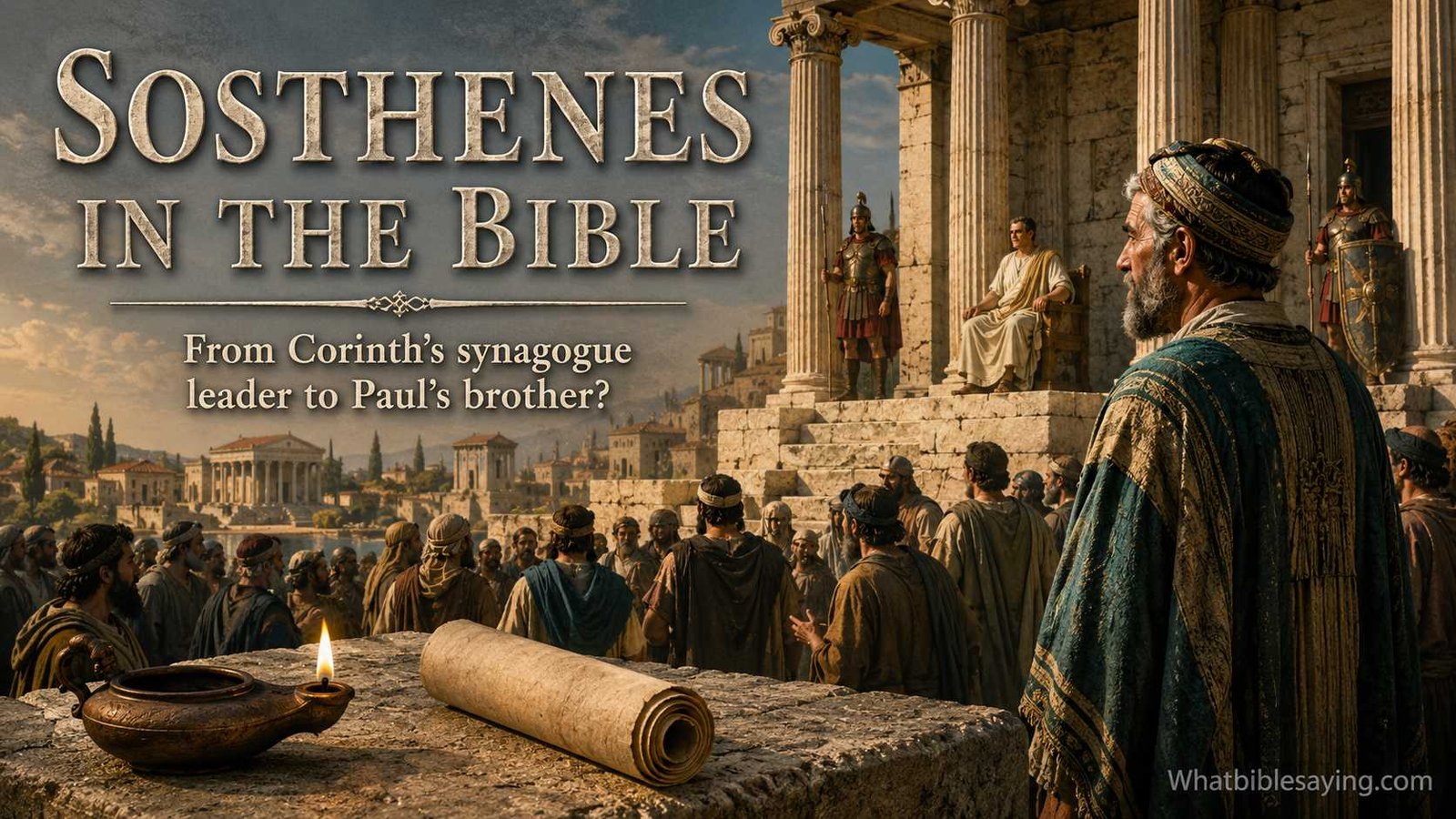
 Sosthenes in the Bible is a small character with a surprisingly interesting story. His name appears only twice in the New Testament, yet those two mentions raise an important question.
Was Sosthenes first a Jewish synagogue leader who opposed Paul and later became a Christian brother serving beside him?
The Bible does not give us enough information to answer that question with certainty.
What Scripture does tell us is clear. In Acts 18:17, a man named Sosthenes was the leader of a synagogue in Corinth. After a legal case against Paul failed, Sosthenes was seized and beaten near the judgment seat of the Roman governor Gallio. Then, in 1 Corinthians 1:1, Paul mentions another Sosthenes and calls him his “brother.”
They may have been the same man. Many readers and interpreters have believed they were. But the Bible never directly says so.
That distinction matters. Good Bible study means holding firmly to what Scripture says while being careful with what Scripture leaves unanswered.
Sosthenes in the Bible at a Glance
| Question | Biblical Answer |
|---|---|
| Who was Sosthenes? | A synagogue leader in Corinth is named Sosthenes in Acts 18:17. |
| What happened to him? | He was seized and beaten after Gallio refused to hear the case against Paul. |
| Is Sosthenes mentioned again? | A Sosthenes is called “our brother” in 1 Corinthians 1:1. |
| Were they the same person? | Possibly, but Scripture does not confirm it. |
| Did Sosthenes travel with Paul? | He was associated with Paul, but the Bible gives no record of his journeys. |
| What does Sosthenes mean? | The Greek name is commonly explained as “of safe strength.” |
| How is Sosthenes pronounced? | A common pronunciation is soce-THEN-ace or an English form such as SAHS-thuh-neez. |
Who Was Sosthenes in the Bible?
To understand Sosthenes, we need to visit the city of Corinth during Paul’s ministry.
Acts 18 tells us that Paul traveled from Athens to Corinth. There he met Aquila and Priscilla and worked while preaching the message about Jesus. Paul regularly spoke in the synagogue and tried to persuade both Jews and Greeks.
His preaching produced very different reactions.
Some people opposed him. Others believed.
One important believer was Crispus, who is identified in Acts 18:8 as the leader of the synagogue. Crispus and his household believed in the Lord, and many other Corinthians also believed and were baptized.
Later in the same chapter, Sosthenes is also called a synagogue leader.
The Bible does not explain how or when the leadership changed from Crispus to Sosthenes. It would therefore go beyond Scripture to say with certainty that Sosthenes directly replaced Crispus. We simply know that both men are described in connection with synagogue leadership during the Corinthian account.
This background is helpful if you are also studying what Paul did in the Bible or what the book of Acts is about. Acts often shows the gospel moving into new cities where some people accepted Paul’s message and others resisted it.
Sosthenes Was a Synagogue Leader in Corinth
Acts 18:17 gives us the clearest description of Sosthenes. He was connected with the synagogue in Corinth as one of its leaders.
A synagogue was a local Jewish gathering place for prayer, Scripture reading, teaching, and community life. A synagogue leader carried responsibility and would have been a recognized person within the Jewish community.
That means Sosthenes was not simply an unknown man standing in the crowd. He held an important position.
His role becomes especially significant because of what happened when opponents of Paul brought Paul before Gallio.
What Happened to Sosthenes in the Bible?
The most dramatic event in the story of Sosthenes takes place in Acts 18:12–17.
Gallio was serving as proconsul of Achaia. During his time in office, Paul’s Jewish opponents brought Paul before the judgment seat. They accused him of persuading people to worship God in a way that they believed was contrary to the law.
Paul was ready to respond.
Gallio, however, did not allow the dispute to become a Roman legal case.
He said, in effect, that if Paul had committed a serious crime, he would listen. But because the disagreement concerned religious words, names, and Jewish law, Gallio wanted the people involved to settle it themselves.
He then dismissed them from the court.
What happened next is where Sosthenes enters the story.
Acts 18:17 says the crowd seized Sosthenes, the synagogue leader, and beat him in front of the tribunal. Gallio did not intervene.
It is a sudden and troubling scene.
Why Was Sosthenes Beaten?
The simple answer is that the Bible does not tell us why.
This is one place where readers should resist the temptation to fill in the missing details.
We know that Sosthenes was beaten.
We know it happened after Gallio rejected the case against Paul.
We know Gallio did not stop it.
But Luke, the writer of Acts, does not explain the crowd’s motive.
Some have suggested that Sosthenes may have been blamed because the case against Paul had failed. Others have wondered whether he had already become sympathetic to Paul. Still others understand the attack differently.
These are possibilities, not stated biblical facts.
Even the wording about the crowd differs somewhat among ancient textual traditions and English translations. The safest approach is therefore to stay with Luke’s main point: the attempted legal attack against Paul failed, and Sosthenes was beaten afterward.
That may feel unsatisfying. We naturally want every detail.
Yet sometimes careful Bible study requires us to say, “Scripture does not tell us.”
There is wisdom in that answer.
Was Sosthenes in the Bible a Companion of Paul?
The mystery becomes more interesting when we open Paul’s First Letter to the Corinthians.
The letter begins:
“Paul … and our brother Sosthenes”
That short phrase in 1 Corinthians 1:1 tells us that a Christian named Sosthenes was closely associated with Paul when the letter was sent to the Corinthian church.
Paul does not introduce him as a synagogue ruler.
He calls him a brother.
In New Testament Christian language, this points to Sosthenes as a fellow believer.
This has led to a natural question: Is Paul’s Christian brother the same Sosthenes who was beaten in Acts 18?
Were the Two Men Named Sosthenes the Same Person?
They could have been.
The connection is attractive for several reasons.
Both names appear in a Corinthian setting. The Sosthenes of Acts was known in Corinth. The Sosthenes of 1 Corinthians would also have been mentioned to readers in Corinth for some reason. If they were the same man, the Corinthians would immediately have known who Paul meant.
There is also an appealing spiritual story if we connect the two men.
A synagogue leader caught in conflict surrounding Paul’s ministry later becomes Paul’s Christian brother and coworker.
It sounds like a beautiful conversion story.
But there is one problem: the New Testament never actually tells that story.
Acts does not say Sosthenes became a Christian. It does not say Paul baptized him. It does not say Sosthenes began traveling with Paul. First Corinthians does not identify Paul’s Sosthenes as the former synagogue leader.
The identification is an old and reasonable possibility, but it cannot be treated as certain history. Modern scholars likewise note that the traditional identification cannot be proven from Acts itself.
A careful sentence would therefore be:
The Sosthenes mentioned with Paul in 1 Corinthians 1:1 may have been the same Sosthenes who served as a synagogue leader in Acts 18:17, but the Bible does not confirm this.
That single sentence protects us from turning an attractive theory into biblical fact.
If you are studying the background of this letter, our guide to who wrote First Corinthians in the Bible provides more context about Paul and the Corinthian church.
Did Sosthenes Travel With Paul?
We can say that the Sosthenes of 1 Corinthians was associated with Paul.
We cannot confidently say how much he traveled with him.
This distinction answers another common question about Sosthenes in the Bible.
Paul names several coworkers whose movements can be followed through Acts or his letters. Timothy, Silas, Titus, Luke, Aquila, and Priscilla are examples. Their locations, journeys, or ministries are mentioned more than once.
We do not receive that kind of information about Sosthenes.
First Corinthians 1:1 places him with Paul in some meaningful sense when Paul sends the greeting. A scholarly discussion of Paul’s letters also notes that 1 Corinthians is among the letters that name more than one sender, listing Paul and Sosthenes together.
But that does not give us a travel diary.
The Bible never says:
Sosthenes traveled from Corinth to Ephesus.
Sosthenes accompanied Paul on a particular missionary journey.
Sosthenes preached in a certain city.
Sosthenes later became a pastor or bishop.
Those details are simply not in the New Testament.
So, did Sosthenes travel with Paul?
Perhaps he traveled with Paul at some point, but Scripture only gives us enough evidence to call him an associate or fellow believer connected with Paul. It does not allow us to reconstruct his travels with confidence.
What Is the Spiritual Meaning of Sosthenes?
People searching for the spiritual meaning of Sosthenes may be asking two different questions.
First, what does the name itself mean?
Second, does the life of Sosthenes carry a spiritual lesson?
Those questions should be separated.
What Does the Name Sosthenes Mean?
Sosthenes comes from the Greek name Sōsthenēs, written Σωσθένης.
Strong’s Greek entry 4988 gives the meaning as “of safe strength.” The same lexical entry connects the name with Greek roots related to saving or safety and strength.
You may also see the idea expressed as “safe in strength.”
That is the meaning of the Greek name. It is not, however, a special prophecy about the man’s life.
Biblical names sometimes have meanings that are important to a story, but Scripture never stops in Acts or First Corinthians to explain Sosthenes’ name as a message from God.
We should therefore avoid claims such as:
“Seeing the name Sosthenes means God is sending you strength.”
Or:
“Sosthenes represents a spiritual sign that protection is coming.”
Those ideas are not taught in the Bible.
What Is the Spiritual Meaning of Sosthenes’ Story?
We can still draw useful lessons from the passages.
That is different from claiming a hidden meaning.
If the Sosthenes of Acts and the Sosthenes of First Corinthians were the same person, his life would offer a powerful picture of change. A man involved in the synagogue conflict around Paul would later appear beside Paul as a Christian brother.
That is possible.
But because the identification is uncertain, our strongest spiritual lessons should come from what is certain.
One lesson is humility.
Sosthenes receives very little space in Scripture. We do not know his childhood, family, later ministry, or death. Yet his name has been preserved for nearly two thousand years because of his connection with important moments in the early church.
Not every faithful life receives a long biography.
God’s work is filled with people whose names appear briefly or whose names are never recorded at all.
Another lesson is that suffering does not tell the whole story of a person.
In Acts 18, Sosthenes is remembered as the man beaten before Gallio. If this were the only fact we knew about him, his story might seem to end in pain and humiliation.
But Scripture often reminds us that one hard event is not the whole meaning of a human life.
How Do You Say Sosthenes in the Bible?
Sosthenes can look difficult when you first see it.
A pronunciation based closely on the common Greek lexical form is:
soce-THEN-ace
Strong’s references give a phonetic spelling close to “soce-then’-ace.”
In ordinary English Bible reading, you may also hear something closer to:
SAHS-thuh-neez
Pronunciation can vary because an ancient Greek name changes slightly when spoken through different modern English accents.
A simple way to practice it is:
Sos – the – nes
Do not worry if your pronunciation sounds a little different from someone else’s. The important thing is recognizing the biblical name and understanding the person behind it.
Sosthenes in the Bible and the Story of Corinth
Sosthenes makes more sense when we see him as part of the larger story of Corinth.
Corinth was a major city in the Roman world. Paul’s ministry there became important enough that Acts devotes significant space to it, and two New Testament letters are addressed to the Corinthian church.
Acts 18 presents a city where the gospel produced both belief and opposition.
Paul arrived and worked with Aquila and Priscilla.
He taught in the synagogue.
Crispus, a synagogue leader, believed in the Lord with his household. Many Corinthians also believed and were baptized. Paul remained in Corinth for a year and a half teaching God’s word.
Then came the confrontation before Gallio.
Paul’s opponents wanted Roman authority to act against him.
Gallio refused.
Sosthenes was beaten.
Paul continued his ministry and later left Corinth.
These details show why what the book of Acts is about is larger than a collection of individual stories. Acts traces the spread of the Christian message from Jerusalem into the wider Mediterranean world despite opposition, political pressure, cultural differences, and danger.
Sosthenes appears for only a moment, but his moment belongs to that much larger story.
Sosthenes, Paul, and Apollos
There is another interesting Corinthian connection worth noticing.
After the account involving Sosthenes, Acts 18 introduces Apollos, an educated Jewish speaker who knew the Scriptures well. Aquila and Priscilla helped him understand the way of God more accurately, and Apollos later became influential among believers.
Paul mentions Apollos several times in First Corinthians.
This makes who Apollos was in the Bible another useful subject when studying Sosthenes and Corinth.
Yet Paul had to correct the Corinthian believers because some had begun forming groups around Christian teachers. Some said they followed Paul, while others identified themselves with Apollos or other leaders.
That makes the greeting of 1 Corinthians especially meaningful.
Paul does not begin by making himself the center of everything.
He begins with Christ, his calling, and a fellow believer named Sosthenes.
It is a small reminder that early Christian ministry was shared work.
Famous names like Paul mattered, but Paul did not serve alone.
What Happened to Sosthenes After 1 Corinthians?
The Bible does not tell us.
There is no later New Testament passage describing the death of Sosthenes.
We are not told where he lived in old age.
We are not told whether he became a church leader.
We are not told how long he remained with Paul.
This is another place where legends and assumptions can easily become mixed with biblical history.
For a Bible-based answer, we should stop where Scripture stops.
His final explicit New Testament appearance is in the opening of 1 Corinthians.
That may seem like a small ending for an interesting person, but many biblical characters disappear from the written record in the same way.
The Bible’s purpose is not to give us a complete biography of every person it names. Its larger story centers on God’s work, his covenant purposes, and, in the New Testament, the saving work and lordship of Jesus Christ.
What Sosthenes in the Bible Teaches Us About Faith
The few verses about Sosthenes leave us with several useful lessons.
We Should Separate Facts From Possibilities
This may be the most important lesson for Bible study.
Fact: Acts 18:17 names a synagogue leader called Sosthenes.
Fact: That Sosthenes was beaten.
Fact: 1 Corinthians 1:1 names a Christian brother called Sosthenes.
Possibility: Both passages describe the same person.
There is nothing wrong with considering a possibility. Problems begin when we speak about a possibility as though God clearly revealed it in Scripture.
Careful reading protects truth.
A Person’s Story Can Change
If the two references do describe the same Sosthenes, the transformation would be remarkable.
The synagogue leader caught in a painful dispute surrounding Paul would later stand beside Paul as a brother.
We cannot preach that as proven history, but the possibility fits a larger truth that Scripture teaches clearly elsewhere: people can change.
Paul himself is the strongest example.
The man who once persecuted Christians became an apostle who suffered to spread the Christian message.
Your past does not automatically tell us what your future must become.
Quiet Service Still Matters
Sosthenes does not receive chapters of biography.
He does not become as famous as Peter, Paul, John, or Timothy.
Yet Paul considered the Sosthenes of 1 Corinthians important enough to name at the beginning of a letter that Christians are still reading centuries later.
Faithful service does not need fame.
A teacher helping one child understand Scripture matters.
A parent praying quietly for a family matters.
A church member serving without recognition matters.
A friend encouraging another believer matters.
God’s work has always included people standing just outside the spotlight.
Scripture Deserves Patient Reading
Sosthenes also reminds us why small details matter.
It is easy to read Acts 18 quickly and move on.
But when we notice Crispus, Sosthenes, Gallio, Paul, Corinth, and the opening of First Corinthians, the New Testament begins to feel less like disconnected pages and more like a real historical world filled with real people.
Careful Bible reading rewards patience.
You do not have to be a professional scholar. Simply ask good questions:
What does the passage actually say?
What does it not say?
Who is speaking?
Where is this happening?
Does another Bible passage mention this person?
Am I reading a fact, or am I making an assumption?
Those questions can protect us from many misunderstandings.
Remembering What the Bible Actually Says About Sosthenes
So, who was Sosthenes in the Bible?
The safest answer is simple.
Acts 18 identifies Sosthenes as a synagogue leader in Corinth who was seized and beaten after Gallio dismissed the case brought against Paul. First Corinthians 1:1 later identifies a Sosthenes as a Christian brother associated with Paul.
The two men may have been the same person, but Scripture never says so directly.
Sosthenes’ Greek name is commonly understood as meaning “of safe strength.” He was associated with Paul in First Corinthians, but the Bible does not provide enough information to describe his missionary travels or later life with certainty.
That uncertainty is not a weakness in the biblical record.
It teaches us something valuable about reading Scripture well.
We can enjoy possibilities without turning them into facts. We can learn from a person’s story without inventing details. And we can remember that even people given only one or two lines in the Bible belonged to a much larger work of God.
Sosthenes may be a small name in the New Testament, but his story leads us into some of its biggest themes: courage, suffering, change, Christian fellowship, and the spread of the gospel.
For more background on his world, continue with What Did Paul Do in the Bible? and Who Is Apollos in the Bible? Both help complete the story of the early Christian community at Corinth.

Dr. Rachel is very smart and knows a lot about the Bible. He helps us understand the Bible better by talking about the old texts in a simple way.