
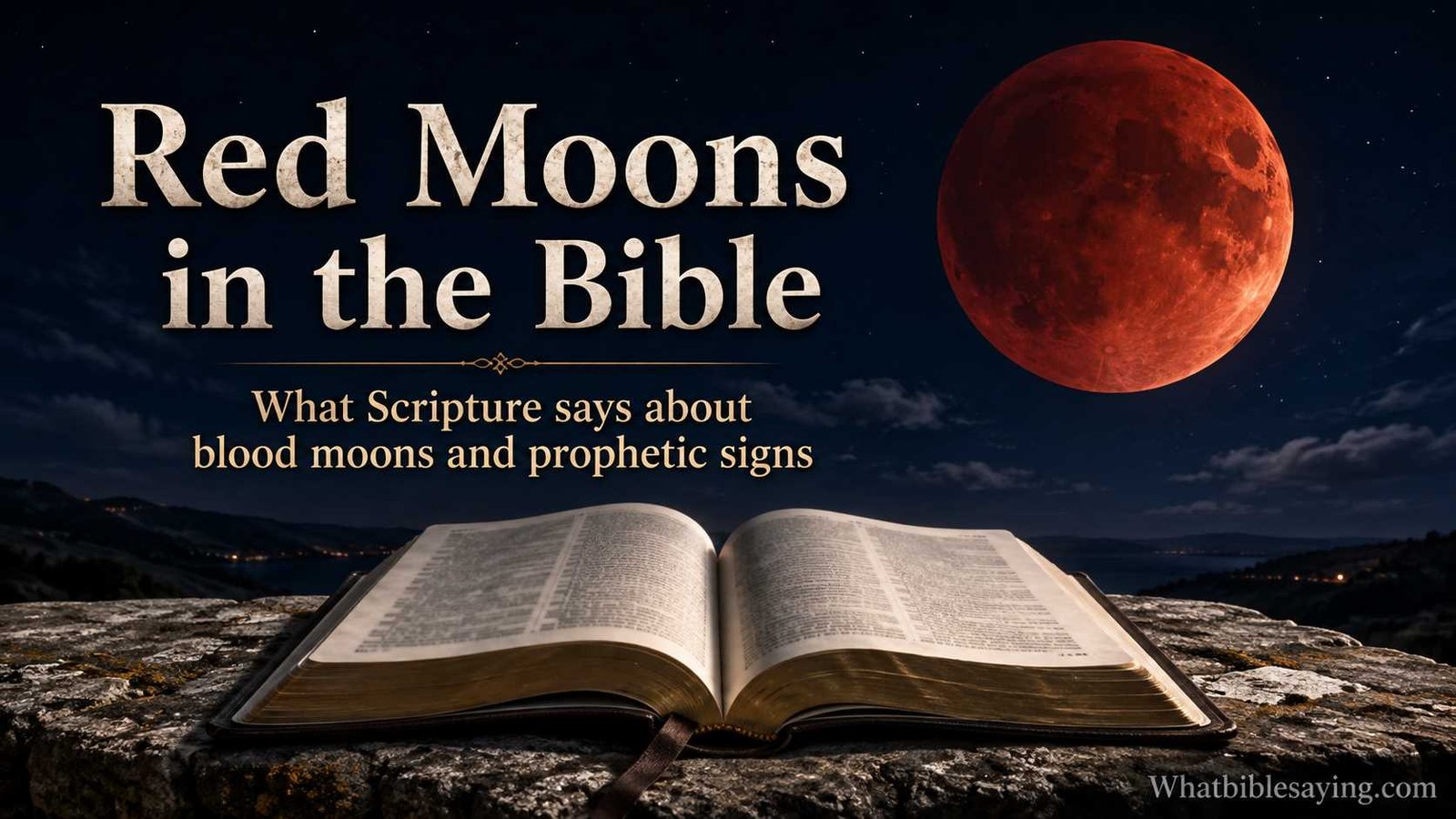
 A deep red moon hanging in the night sky can feel mysterious. It is beautiful, unusual, and sometimes even unsettling. For Christians, it can also bring certain Bible verses to mind. Joel speaks of the moon being turned to blood. Peter repeats those words in Acts. Revelation describes a moon that becomes like blood.
So, what does the Bible say about red moons?
The Bible uses the image of a blood-colored moon in passages connected with the day of the Lord, divine judgment, and great events in God’s plan. The clearest references are Joel 2:31, Acts 2:20, and Revelation 6:12.
But Scripture does not say that every naturally red moon or every lunar eclipse is a new prophetic fulfillment. It also does not identify the March 3, 2026 blood Moon as a specific fulfillment of Bible prophecy.
That distinction matters.
We can take biblical prophecy seriously without turning every unusual event in the sky into a prediction. We can also understand how an eclipse works scientifically while still believing that the heavens belong to God.
What Does the Bible Say About Red Moons and Blood Moons?
The Bible never uses the modern astronomical expression blood Moon in exactly the way people commonly use it today. Instead, Scripture describes the moon as being turned to blood or becoming like blood.
Three passages receive most of the attention.
Joel 2:31: The Moon Turned to Blood
Joel writes:
“The sun shall be turned into darkness, and the moon into blood, before the great and the terrible day of the LORD come.”
Joel 2:31 KJV
This verse appears in a prophetic passage about the day of the Lord.
Joel is describing extraordinary signs connected with God’s activity and judgment. The surrounding passage also speaks about God pouring out His Spirit and showing wonders in heaven and earth.
This means we should not separate the red moon from everything around it.
Joel is not simply saying, “Whenever you see a lunar eclipse, the end has arrived.” His language belongs to a much larger prophetic message.
Acts 2:20: Peter Repeats Joel’s Prophecy
The same words appear again in the New Testament.
On the day of Pentecost, Peter quotes the prophet Joel:
“The sun shall be turned into darkness, and the moon into blood, before that great and notable day of the Lord come.”
Acts 2:20 KJV
Peter had just witnessed the coming of the Holy Spirit upon the believers. People from many nations heard the disciples speaking in different languages, and some wondered what was happening.
Peter answered by pointing them to Joel.
This is important because it shows that Joel’s prophecy has a strong New Testament connection. Peter understood the events of Pentecost as connected with what Joel had announced.
Yet Acts 2 does not tell Christians to identify every future eclipse as a separate fulfillment of Joel 2:31.
Revelation 6:12: The Whole Moon Becomes Like Blood
Another powerful reference appears in Revelation.
John describes the opening of the sixth seal:
“The sun became black as sackcloth of hair, and the moon became as blood.”
Revelation 6:12 KJV
Notice the larger scene.
There is a great earthquake. The sun becomes dark. Stars fall. The sky changes. People on earth are terrified.
The moon becoming like blood is only one part of a much greater picture.
For this reason, it would be too simple to see a normal lunar eclipse and immediately say, “This is Revelation 6:12.”
Revelation describes something far greater than an ordinary evening of skywatching.
Why Is the Moon Red in Biblical Meaning?
When people ask, “Why is the moon red in biblical meaning?” they are usually asking about symbolism rather than astronomy.
In the passages above, a blood-colored moon is mainly connected with judgment, the day of the Lord, and dramatic divine action.
It can suggest that something serious is happening.
The Bible sometimes uses changes in the heavens to communicate the greatness of events on earth. The sun, moon, and stars become part of prophetic language.
We see similar cosmic imagery elsewhere.
Isaiah 13:10 speaks of the stars not giving their light and the sun being darkened.
Ezekiel 32:7 speaks about covering the heavens and darkening their stars.
Joel 3:15 says:
“The sun and the moon shall be darkened, and the stars shall withdraw their shining.”
These verses show that biblical writers sometimes describe judgment with powerful changes in creation.
Still, we should be careful.
The Bible does not give us a rule saying:
Red moon = one exact spiritual message every time.
Context determines meaning.
A red moon in Joel belongs to Joel’s prophecy. A moon like blood in Revelation belongs to John’s vision. We should allow each passage to speak in its own setting.
Does a Red Moon Mean Anything Spiritually?
A red moon can certainly remind a Christian of Scripture.
You may look at an eclipse and remember Joel 2. You may think about Revelation. You may be reminded that creation is far greater than we are.
That is different from claiming that God is sending you a secret personal message through that particular moon.
The Bible gives no instruction telling Christians to interpret each eclipse as a private spiritual sign.
The Heavens Point Us Toward God
Psalm 19:1 says:
“The heavens declare the glory of God; and the firmament sheweth his handywork.”
For a believer, looking into the night sky can become an act of wonder.
The moon does not have to predict your future to be spiritually meaningful.
Its beauty can remind you that creation has an order. It can make you feel small in a healthy way. It can draw your attention toward the Creator.
This is also helpful when considering what the Bible says about stars. Scripture often points to the heavens as part of God’s creation, but it does not encourage us to treat celestial objects as gods or as personal fortune-tellers.
Biblical Signs Are Not the Same as Superstition
There is a difference between a biblical sign and superstition.
Scripture contains real signs. God gave the rainbow after the flood in Genesis 9. Jesus performed signs. The prophets spoke of signs associated with important events.
But Scripture does not teach us to assign secret meanings to every unusual color, number, animal, planetary arrangement, or eclipse we see.
That is why questions about what the Bible says about planets aligning should be approached carefully as well.
Christians do not need to fear the sky.
We can observe it, study it, enjoy it, and remember that it belongs to God.
What Does the Bible Say About Red Moons in 2026?
The year 2026 has brought fresh interest in blood moons because a total lunar eclipse occurred on March 3, 2026.
NASA confirms that the Moon passed through Earth’s shadow on that date, producing a total lunar eclipse. During totality, the Moon appeared reddish or orange, which is why this kind of eclipse is often called a blood Moon.
The event was real.
The red appearance was real.
But we need to distinguish those facts from claims about prophecy.
What Is the Biblical Meaning of the Blood Moon in 2026?
There is no Bible verse identifying the March 3, 2026 eclipse as a particular prophetic event.
Joel does not mention 2026.
Acts does not mention 2026.
Revelation does not give March 3, 2026 as the date of the sixth seal.
Therefore, saying that this eclipse definitely fulfilled one of those prophecies would require us to go beyond what Scripture actually says.
That does not make the eclipse meaningless.
A Christian could watch such an event and remember God’s greatness. It could encourage someone to read Joel, Acts, Revelation, or the Psalms.
But that is different from saying, “God has revealed that this particular eclipse begins a prophetic countdown.”
The Bible gives us no clear basis for such certainty.
Was the March 3, 2026 Blood Moon Predicted in the Bible?
Not by date.
Biblical prophecy certainly contains descriptions of the moon becoming like blood. That part is true.
But no biblical passage identifies the ordinary astronomical eclipse of March 3, 2026 as the event Joel or John specifically had in view.
We should be careful with predictions because striking celestial events have happened many times throughout human history.
An interpretation should come from the biblical text, not simply from how dramatic an event looks.
Are There More Lunar Eclipses in 2026?
The U.S. Naval Observatory lists a partial lunar eclipse for August 28, 2026, in addition to the total lunar eclipse that occurred on March 3.
A partial eclipse is not the same as a total lunar eclipse.
This matters because the popular label blood Moon is usually associated most strongly with total lunar eclipses, when the Moon can take on a deep reddish or orange appearance.
How Does a Blood Moon Actually Turn Red?
The science behind a blood Moon is beautiful rather than threatening.
A lunar eclipse happens when Earth moves between the Sun and the Moon, causing Earth’s shadow to fall across the Moon.
During a total lunar eclipse, direct sunlight is mostly blocked.
But some sunlight passes through Earth’s atmosphere before reaching the Moon.
Earth’s atmosphere scatters shorter wavelengths of light, especially blue and violet, more easily. Redder and more orange wavelengths travel through the atmosphere and reach the lunar surface.
That makes the Moon appear reddish, copper-colored, or orange.
NASA compares the effect to the reddish light we see around sunrise and sunset.
So a red moon does not require the Moon itself to change color permanently.
It is an effect of light, Earth’s atmosphere, and the geometry of the Sun, Earth, and Moon.
For Christians, understanding this process does not have to weaken faith.
Knowing how an eclipse happens does not answer every question about why creation exists.
Science describes the physical process. Scripture teaches us about God, creation, human life, sin, redemption, judgment, and hope.
Those are different kinds of questions.
What Is the Difference Between a Lunar Eclipse and a Solar Eclipse?
This is useful because biblical discussions about signs in the sun and moon often lead people to ask what the Bible says about a solar eclipse.
A lunar eclipse happens when:
Sun → Earth → Moon
Earth’s shadow falls on the Moon.
A solar eclipse happens when:
Sun → Moon → Earth
The Moon passes between Earth and the Sun and blocks some or all of the Sun from our view.
| Event | What Happens | What We See |
|---|---|---|
| Lunar eclipse | Earth moves between Sun and Moon | Moon becomes dark or reddish |
| Solar eclipse | Moon moves between Sun and Earth | Sun appears partly or fully covered |
| Biblical blood-moon imagery | Moon becomes or appears like blood | Appears in prophetic passages |
The Bible contains descriptions of both the sun becoming dark and the moon becoming blood.
That does not mean every solar or lunar eclipse automatically fulfills those prophecies.
How Many Red Moons Have We Had in the Bible?
This question needs a careful answer because two different ideas can easily become mixed together.
If you mean, “How many historical red lunar eclipses does the Bible record?”, Scripture does not give us a count.
The Bible does not contain a list such as:
First eclipse
Second eclipse
Third eclipse
Nor does it identify ordinary lunar eclipses with dates and locations in the way modern astronomers do.
If instead you mean, “How many important Bible passages explicitly describe the moon as blood?”, three major passages stand out:
| Bible Passage | What It Says |
|---|---|
| Joel 2:31 | The moon is turned to blood |
| Acts 2:20 | Peter quotes Joel’s moon-to-blood prophecy |
| Revelation 6:12 | The moon becomes like blood |
These are three major biblical references, not three recorded historical blood-moon eclipses.
That distinction prevents a common misunderstanding.
Acts 2:20 is also a quotation of Joel 2:31, so it should not be treated as an entirely unrelated prophecy simply because it appears in another book.
Other biblical passages describe the sun, moon, or stars becoming dark, but they do not necessarily use the image of the moon turning to blood.
What Does the Bible Say About Red Moons as End-Times Signs?
This is where discussions can become emotionally charged.
Jesus did speak about signs involving the heavens.
Luke 21:25 says:
“And there shall be signs in the sun, and in the moon, and in the stars.”
Matthew 24:29 also describes the sun being darkened and the moon not giving its light.
These passages deserve serious attention.
But Jesus describes them within much larger teachings about suffering, His coming, judgment, endurance, and readiness.
The safest way to read them is to keep the entire passage together.
We should not take the word moon, connect it to tonight’s eclipse, and ignore everything else Jesus said.
Does Every Blood Moon Fulfill Bible Prophecy?
The Bible never says that every lunar eclipse fulfills Joel 2:31, Acts 2:20, or Revelation 6:12.
That is the simple answer.
Think about Revelation 6.
John does not merely see a red Moon.
He describes a great earthquake, a darkened sun, falling stars, changes in the sky, mountains and islands being moved, and terrified people facing divine judgment.
Reducing this enormous vision to an ordinary lunar eclipse removes much of what the passage actually says.
Likewise, Joel’s prophecy contains far more than a red Moon.
We need the whole text.
Why Do Blood Moons Become Connected With Prophecy?
There is an understandable reason.
Imagine living thousands of years ago without electric lights, weather satellites, astronomy apps, or modern eclipse predictions.
A darkening sun or suddenly red Moon would be unforgettable.
Celestial events naturally communicate greatness and power.
The biblical writers use the heavens as part of striking prophetic pictures because the sun, moon, and stars seem permanent from our human point of view.
When even these appear shaken, the message feels enormous.
That does not mean the writers were secretly giving us a calendar of every future eclipse.
Prophetic language directs our attention toward God’s authority and the seriousness of His message.
What Does the Bible Say About Red Moons and Asking for Signs?
Christians sometimes become anxious after seeing a strange event in the sky.
“Is God warning me?”
“Is something terrible about to happen?”
“Is this a sign that Jesus is returning immediately?”
Scripture calls believers to watch and remain faithful, but it does not encourage endless fear about signs.
Jesus also warned about an unhealthy hunger for signs.
Faith should not depend on finding a hidden message in every unusual event.
If you see a red Moon, you can appreciate it.
You can think about Joel.
You can read Revelation.
You can pray.
You can worship God as Creator.
But you do not need to invent a message God has not revealed.
There is peace in staying within what Scripture actually says.
Should Christians Be Afraid of a Red Moon?
No ordinary lunar eclipse should make a Christian panic.
The Bible’s prophetic passages are serious, but biblical faith is not built on terror over natural events.
Jesus repeatedly taught His followers to remain faithful, watchful, and trusting.
Christian hope rests in God, not in our ability to decode every object in the sky.
When Scripture speaks about future judgment, it calls us toward God.
When Scripture speaks about creation, it calls us toward wonder.
When Scripture speaks about Christ’s return, it calls us toward readiness.
None of those responses requires panic.
There is a large difference between being watchful and being fearful.
Watchfulness says:
“I want to live faithfully because God is Lord.”
Fearful speculation says:
“I must decode every eclipse or something terrible may happen.”
The first response has a strong biblical foundation.
The second can easily lead us beyond Scripture.
Can Science and the Bible Both Be Right About a Red Moon?
Yes, because they are not necessarily answering the same question.
Astronomy explains the physical cause of a lunar eclipse.
Earth moves between the Sun and Moon. Earth’s shadow covers the Moon. Light passing through Earth’s atmosphere gives the lunar surface its red or orange appearance. NASA’s explanation of the March 2026 eclipse follows this ordinary astronomical process.
The Bible’s prophetic passages use powerful language about the heavens in messages concerning God, judgment, salvation, and the day of the Lord.
Understanding the physical mechanism of a rainbow does not remove the biblical meaning of the rainbow in Genesis.
Understanding rain does not make biblical passages about rain meaningless.
In the same way, understanding lunar eclipses does not require us to dismiss Scripture.
It simply helps us avoid confusing an astronomical explanation with an unsupported prophetic claim.
Reading Blood-Moon Prophecy Without Fear
When you encounter a claim such as, “This blood Moon proves a major prophecy is happening tonight,” there are a few simple questions worth asking.
What Bible passage is being used?
Read it yourself.
What happens before and after the verse?
Context often changes the meaning of an isolated statement.
Does the passage name this particular eclipse?
If not, the person making the claim is interpreting the event rather than simply repeating what Scripture says.
Are other details in the prophecy happening too?
This is especially important in Revelation.
Is the interpretation producing faithful attention to God or endless fear and date-setting?
These questions can protect us from sensational claims without making us dismiss biblical prophecy.
The goal is not skepticism toward Scripture.
The goal is respect for Scripture.
What Does the Bible Say About Red Moons That Matters for Us Today?
The most important lesson may not be about predicting the next eclipse.
It may be about remembering who rules over creation.
Genesis begins with God creating the heavens and the earth.
Psalm 19 says the heavens declare His glory.
Joel points toward the day of the Lord.
Acts connects Joel’s words with the work of God through the Holy Spirit.
Revelation points toward God’s final authority over a world that often seems out of control.
The message keeps bringing us back to God.
A blood Moon can be impressive.
It may fill social media with photographs, theories, predictions, and frightening headlines.
But the Christian response does not need to begin with fear.
It can begin with Scripture.
Read what Joel actually says.
Read Peter’s sermon in Acts 2.
Read the entire sixth-seal scene in Revelation 6.
Then compare those passages with the claim you are hearing.
Often, the biblical text is more powerful than the speculation built around it.
What Red Moons Should Teach Us About Faith
So, what does the Bible say about red moons?
It tells us that the image of a moon becoming like blood appears in serious prophetic passages. Joel connects it with the day of the Lord. Peter repeats Joel’s words at Pentecost. Revelation includes a blood-like moon in a dramatic vision of judgment.
The Bible does not tell us that every reddish lunar eclipse fulfills those prophecies.
It does not identify the March 3, 2026 total lunar eclipse as a special prophetic fulfillment. That event was a real total lunar eclipse, and its reddish appearance has a well-understood astronomical explanation.
This should not make the Bible less meaningful.
It helps us read it more carefully.
When the Moon turns red during an eclipse, look up and enjoy the sight. Remember the greatness of creation. Think about the passages that speak of the heavens. Study prophecy with humility.
Most of all, keep your attention on the One Scripture points toward.
The sky can make us wonder.
Scripture tells us where to place our hope.

Pastor David shares Bible stories in a way that feels real and personal. The way he speaks makes it easier to understand and live out our faith every day.