
When we talk about Mary in the Bible, we often focus on her faith, her obedience, and her role as the mother of Jesus. All of that matters deeply. But many readers quietly wonder something else: where did Mary come from? What was her family line? Did her ancestry have anything to do with God’s plan?
Those are good questions. The Bible takes lineage seriously, not to elevate status, but to show continuity. God works through real families, real generations, and real history. Mary’s lineage fits right into that pattern.
Let me walk you through what Scripture actually tells us, what it leaves unspoken, and why Mary’s family line matters more than it may first appear.
Why Lineage Matters in the Bible
In the Bible, lineage is never random. Genealogies are not filler. They are testimonies.
From Abraham onward, God made promises that passed from generation to generation. These promises were often tied to a family line. Land, kingship, covenant, and ultimately salvation all flowed through ancestry. That is why Scripture carefully records who begat whom, even when it feels repetitive to modern readers.
When the Messiah arrived, people wanted to know one thing immediately: does He come from the right line?
The Old Testament promised that the Savior would come from the house of David, from the tribe of Judah. That promise did not disappear with time. It waited quietly, generation after generation, until the moment God chose.
Mary stands inside that waiting.
Who Were Mary’s Parents in the Bible?
This is one of the most common questions, and the answer may surprise some readers.
The Bible does not name Mary’s parents.
Neither the Gospels nor any other book of Scripture tells us who her mother and father were. That silence is important. It keeps our focus where God intended: on Mary’s faith, not her pedigree.
Later Christian tradition gives names to Mary’s parents, often calling them Joachim and Anne. These names appear in early writings outside the Bible, but they are not part of Scripture itself. For that reason, they should be treated as tradition, not doctrine.
What we can say with confidence is this: Mary came from a faithful Jewish family. She knew the Scriptures. She understood God’s promises. Her response to the angel shows a heart already shaped by trust and obedience.
God often chooses quiet households to carry His greatest work.
What Tribe Was Mary a Descendant Of?
This question goes straight to the heart of Mary’s lineage.
Mary was a descendant of the tribe of Judah.
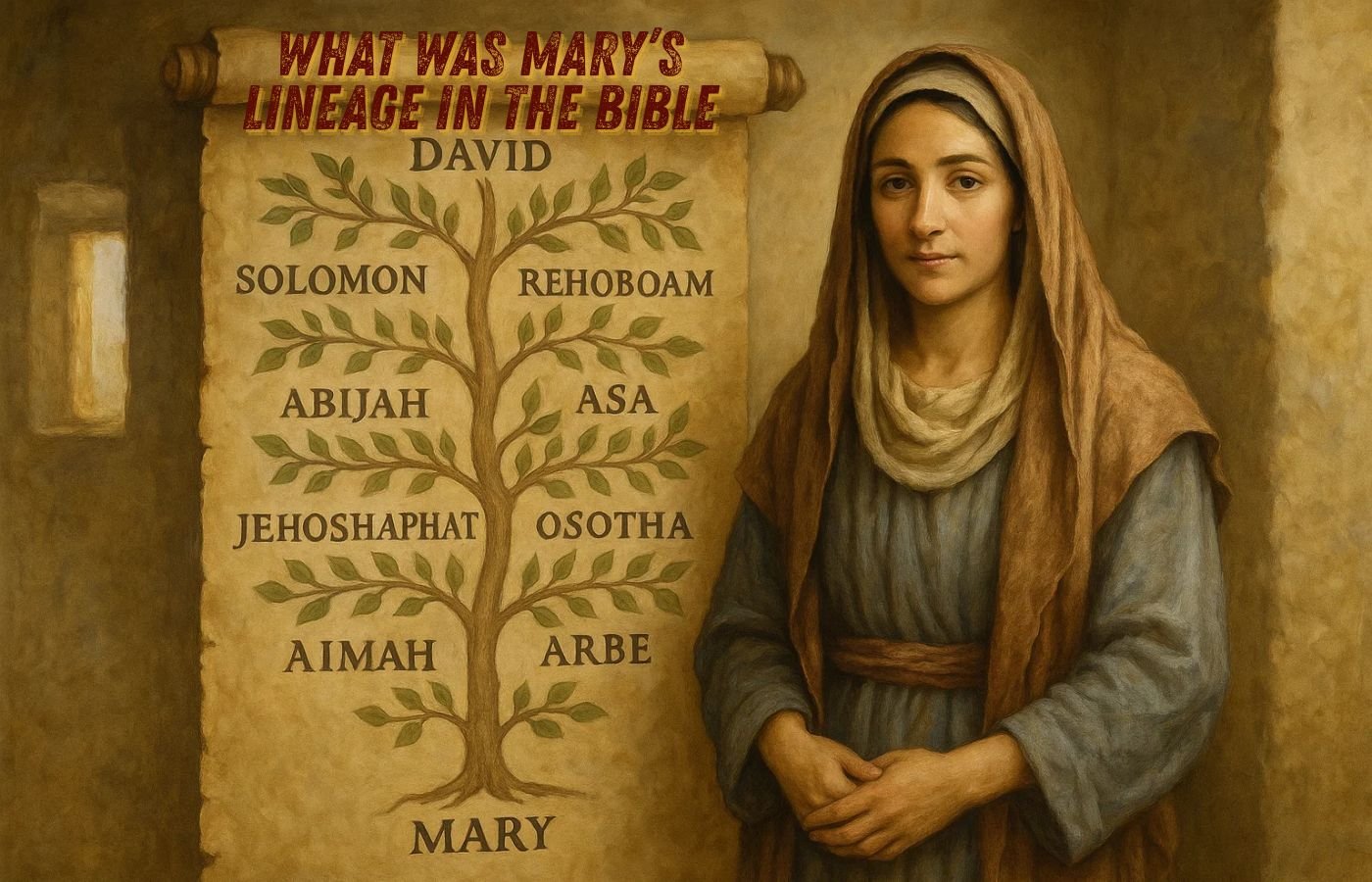
How do we know this? The Gospel of Luke gives us a genealogy that traces Jesus’ line all the way back through David and beyond. Many Bible scholars understand Luke’s genealogy in chapter 3 as tracing Mary’s family line, even though it names Joseph.
Here’s why that matters.
Joseph was not the biological father of Jesus, but he was Jesus’ legal father. Matthew’s Gospel focuses on Joseph’s royal line through King David, showing Jesus’ legal right to David’s throne. Luke, on the other hand, emphasizes Jesus’ human connection to all people. His genealogy moves backward to Adam.
In that genealogy, Jesus is connected to David through a different son than Solomon. This strongly suggests that Luke is recording Mary’s line, showing that Jesus is a physical descendant of David through His mother.
Mary was not from a random tribe. She stood firmly in the line God had promised centuries earlier.
Mary’s Lineage and the Genealogy in Luke
Luke 3 traces a long family line, ending with these simple words: “the son of Adam, the son of God.”
That ending tells us something important. Luke is less concerned with royal titles and more concerned with humanity. He wants readers to see Jesus as fully human, fully connected to the human story.
Mary is the bridge in that connection.
Through her, Jesus takes on real human flesh. Through her lineage, He enters history not as an outsider, but as a fulfillment. David’s bloodline does not end with kings and failures. It continues quietly until it reaches a young woman in Nazareth who says yes to God.
This is not accidental. It is careful. It is faithful.
Why Luke’s Genealogy Focuses on Humanity
Matthew writes primarily to a Jewish audience. He emphasizes kingship, prophecy, and legal authority. Luke writes to a broader audience. He emphasizes compassion, humility, and shared humanity.
By tracing Jesus’ lineage through Mary, Luke shows that Jesus belongs to all of us. He is not only the King of Israel. He is the Son of Man.
Mary’s role here is essential. Her lineage grounds Jesus in real human ancestry. Her obedience opens the door for God’s eternal plan to step into time.
Were Mary and Joseph Cousins?
This question often comes from curiosity about Jewish family structures.
The Bible does not say that Mary and Joseph were cousins.
What we do know is that they were both from the house of David. In Jewish culture, especially in small communities, it was common for people from the same tribal line to marry. That shared ancestry does not automatically mean they were closely related.
Some confusion comes from Mary’s relationship with Elizabeth, who is described as her relative. Elizabeth came from a priestly family, the tribe of Levi. That tells us something important: Mary’s family connections likely crossed tribal lines through marriage, which was normal.
Scripture gives us no reason to believe Mary and Joseph were immediate relatives. What it emphasizes instead is their shared faith and obedience.
Who Is the Biological Father of Mary?
Again, Scripture remains silent.
The Bible does not name Mary’s biological father. This absence is not a mistake. It teaches us something about how God values people.
Mary’s worth is not defined by her father’s name. Her place in God’s plan is not earned through ancestry alone. It is confirmed through faith.
When the angel speaks to Mary, he does not mention her family background. He speaks of grace. He speaks of favor. He speaks of God’s presence with her.
That is enough.
How Mary’s Lineage Fulfilled God’s Promise
God promised David that his throne would endure forever. At times, that promise seemed fragile. Kings failed. Kingdoms fell. Exile scattered the people.
But God never forgot.
Mary’s lineage shows us how God keeps promises quietly. The line of David does not end in a palace. It continues in a small town, in an ordinary home, in a young woman whose greatest qualification is trust.
Through Mary, Jesus enters the world not as a conqueror, but as a child. Yet His claim is legitimate. His roots are deep. His arrival is intentional.
God did not rush this plan. He prepared it across generations.
What Mary’s Family Story Teaches Us About Faith
Mary’s lineage reminds us of something deeply comforting.
God works through real people, not perfect ones. He honors faith more than fame. He keeps promises even when centuries pass.
Mary did not need a recorded pedigree to be chosen. She needed a willing heart. Her ancestry placed her within God’s plan, but her obedience allowed that plan to move forward.
If God can work through her quiet lineage, He can work through ours too.
That is the hope Mary’s story leaves with us: God is faithful, generation after generation, and He is never late.

Reverend James has spent years studying and teaching the Bible. With warmth and wisdom, he shares deep truths in a way that’s clear, simple, and easy to understand.