

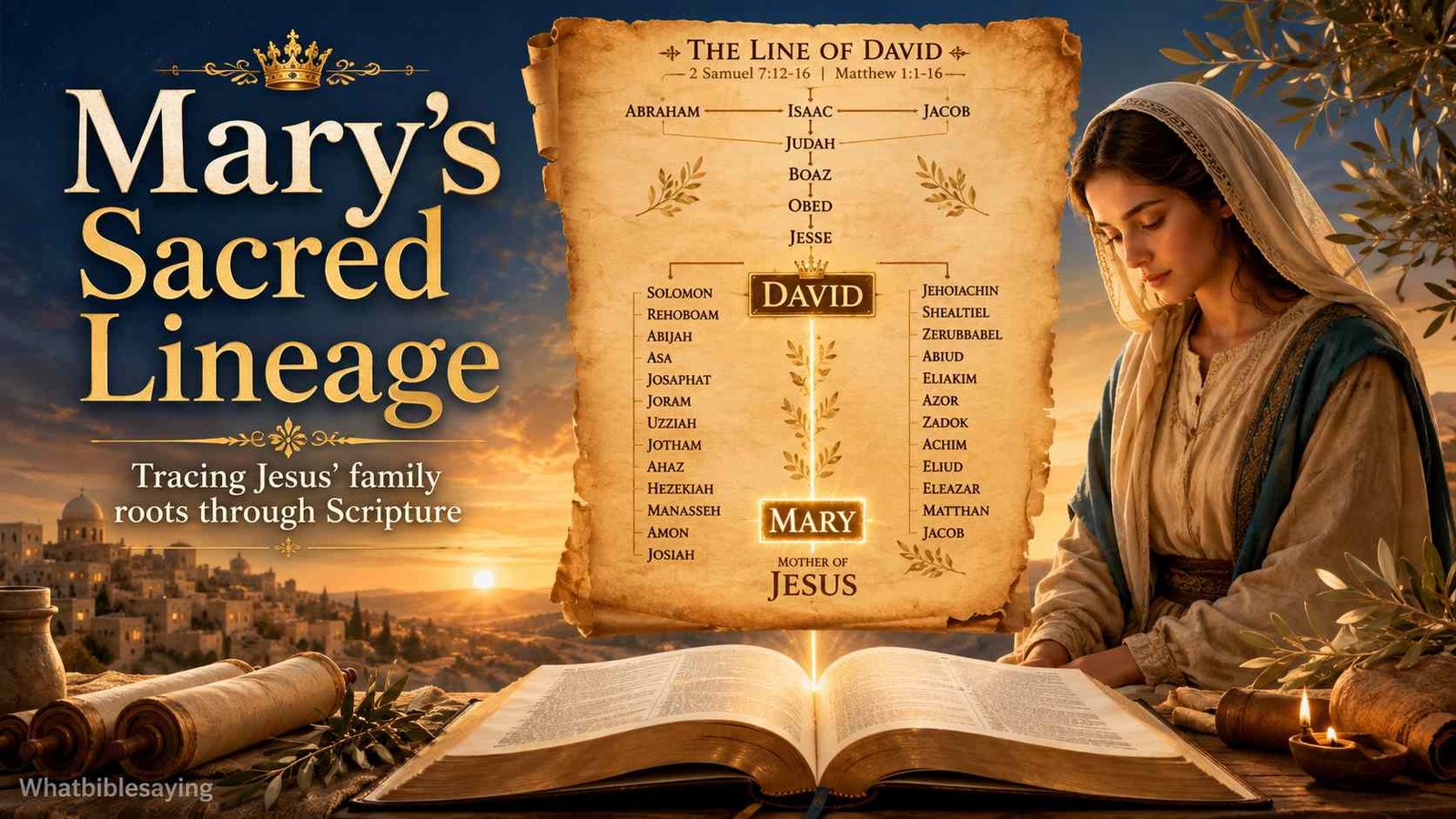
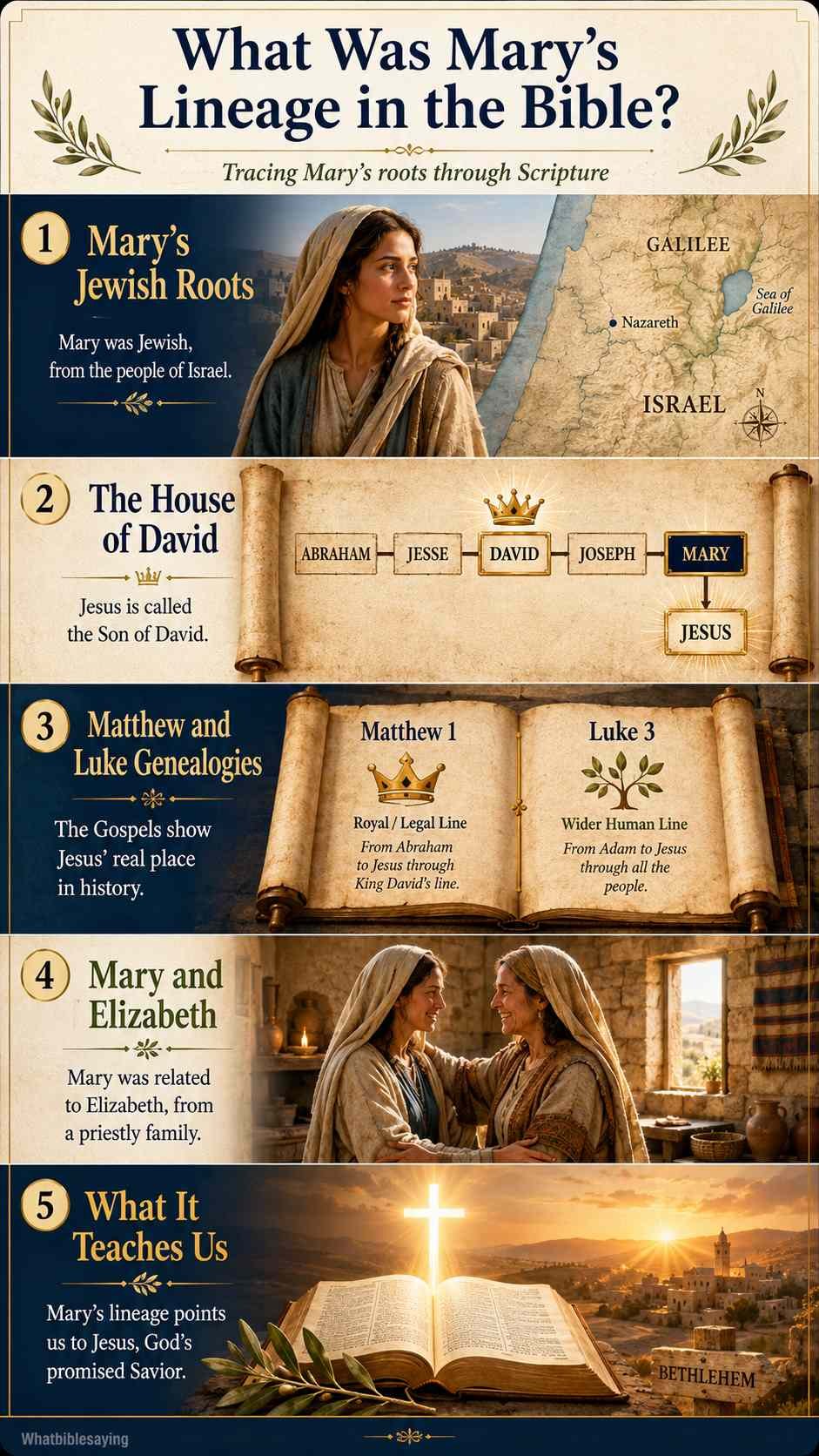
 Mary’s lineage in the Bible matters because it connects the birth of Jesus to the people of Israel, the promises made to Abraham, and the royal hope linked with King David. Mary was not a random woman suddenly placed into the story. She was a Jewish woman living in first-century Galilee, chosen by God to bear Jesus, the Messiah.
The Bible does not give us a separate family tree with Mary’s name at the top. That is important to say clearly. But Scripture gives us enough to understand her background. Mary belonged to the Jewish people. She lived in Nazareth. She was related to Elizabeth, who was from a priestly family. She was betrothed to Joseph, who was from the house of David. And through the birth of Jesus, her story becomes part of God’s long promise to bless the world through Israel.
So, what was Mary’s lineage in the Bible?
Mary was Jewish by birth, from the people of Israel, and many Christians believe her family line was connected to David, though the Bible states Joseph’s Davidic line more directly. Jesus is legally connected to David through Joseph and physically born through Mary. Together, the Gospel writers show that Jesus truly entered human history as the promised Son of David and Son of God.
What Is Mary’s Bloodline in the Bible?
Mary’s bloodline in the Bible begins with one clear truth: she was a Jewish woman from Israel.
Luke 1 places Mary in Nazareth, a town in Galilee. The angel Gabriel comes to her and announces that she will give birth to Jesus. Gabriel says this child will receive “the throne of his father David” and will reign over the house of Jacob. That language is deeply Jewish. It connects Jesus to Israel’s covenant history.
Mary’s bloodline is not described in the same direct way Joseph’s is in Matthew 1. Matthew gives the genealogy of Jesus through Joseph, showing the legal royal line from Abraham to David and from David to Joseph. Luke 3 also gives a genealogy of Jesus, but it differs from Matthew’s list. Because of that, many Bible readers have wondered whether Luke may preserve Mary’s family line, while Matthew gives Joseph’s legal line.
We should be careful here. Luke does not say, “This is Mary’s genealogy.” But some Christians have understood Luke’s genealogy this way because it seems to trace a different line from David than Matthew does. Matthew traces through Solomon, David’s son. Luke traces through Nathan, another son of David. This has led many believers to say that Jesus may have had a Davidic connection both legally through Joseph and naturally through Mary.
Still, the safest biblical answer is this: Mary was Jewish, part of Israel, and Jesus was born from her as a true human descendant of Israel. The Bible clearly presents Jesus as the promised Messiah from David’s line.
Was Mary from the Line of David?
This question is one of the most common when people ask about Mary’s lineage.
The Bible directly says Joseph was from David’s line. Matthew 1 opens with Jesus Christ as “the son of David, the son of Abraham.” Then Matthew traces the line down to Joseph, the husband of Mary. Luke 2 also says Joseph went to Bethlehem because he was “of the house and lineage of David.”
But what about Mary?
Luke 1 gives a strong clue. Gabriel tells Mary that her son will receive the throne of David. That promise is not only about Joseph’s legal family. It is about Jesus’ identity as the Messiah. Paul also says in Romans 1:3 that Jesus was descended from David according to the flesh. Since Jesus was born of Mary, many Christians believe this supports the idea that Mary herself also had Davidic ancestry.
This view is common, but we should explain it with humility. Scripture does not give us a verse that says, “Mary was the daughter of David’s line.” Yet the larger picture of the New Testament shows Jesus as truly connected to David, not only by adoption or social identity, but as the promised Messiah born into Israel.
The main point is not genealogy curiosity. The main point is promise.
God promised David that his kingdom would have lasting meaning. The prophets spoke of a coming king. The Gospels announce that Jesus is that king. Mary’s womb became the place where God’s promise entered the world in flesh and blood.
What Was Mary’s Race in the Bible?
Mary’s race in the Bible is best understood through the language of ethnicity, people, and covenant identity.
Mary was Jewish. She belonged to the people of Israel. She lived in a Jewish culture, knew the Scriptures of Israel, and worshiped the God of Abraham, Isaac, and Jacob.
Modern racial categories do not fit neatly onto the ancient biblical world. Mary was not European in the way she is sometimes painted in Western art. She was also not described by the Bible using today’s racial labels. She was a first-century Jewish woman from the land of Israel, likely with the appearance and cultural life of people from that region.
That matters because Jesus did not appear outside history. He was born into a real people, a real place, and a real family story.
Mary’s song in Luke 1, often called the Magnificat, shows this clearly. She praises God for remembering His mercy to Abraham and his descendants. Mary understood herself as part of Israel’s story. Her joy was not separate from the Old Testament. It grew from it.
So the simple answer is this: Mary was Jewish by race, ethnicity, faith, and covenant identity.
Why Joseph’s Lineage Still Matters If Mary Was Jesus’ Mother
Some people ask, “If Joseph was not Jesus’ biological father, why does his lineage matter?”
That is a fair question.
In the ancient Jewish world, legal fatherhood mattered deeply. Joseph was not Jesus’ biological father, but he was Jesus’ earthly legal father. He named Him. He protected Him. He brought Him into the household line recognized by the community.
Matthew’s genealogy focuses on Joseph because Matthew is showing Jesus’ legal right to the royal line of David. In that world, legal family identity was not a small thing. It shaped inheritance, tribal belonging, and public recognition.
Joseph’s obedience also matters. When he learns Mary is pregnant, he first plans to divorce her quietly. But an angel tells him that the child is conceived by the Holy Spirit. Joseph obeys God, takes Mary as his wife, and names the child Jesus.
That naming is important. Joseph accepts the child into his household. Through Joseph, Jesus is publicly known as part of David’s line.
Mary gives birth to Jesus. Joseph gives Him legal protection and family standing. Both roles matter in the Gospel story.
Did Joseph Ever Sleep With Mary?
This question should be answered with care because Christians have different traditions about Mary’s later married life.
Matthew 1:25 says Joseph “knew her not until she had given birth to a son.” In older Bible language, “knew her” means marital relations. This verse clearly teaches that Joseph did not sleep with Mary before Jesus was born. Jesus’ birth was miraculous. He was conceived by the Holy Spirit, not by a human father.
After Jesus’ birth, Christian traditions differ.
Many Protestants believe Mary and Joseph later lived together as a normal married couple and had other children. They point to passages that mention Jesus’ brothers and sisters.
Catholic and Orthodox Christians usually believe Mary remained ever-virgin, and they understand the “brothers and sisters” of Jesus as relatives, step-siblings, or close kin.
A respectful Bible article should not mock either view. The shared Christian truth is this: Jesus was born of the virgin Mary. Joseph was not His biological father. The conception of Jesus was the work of God.
That is the heart of the matter.
Was Jesus Conceived in a Physical Way?
One LSI question asks, “How old was Mary when Jesus impregnated her?” That wording is not accurate or respectful to the biblical account.
The Bible does not say Jesus impregnated Mary. Jesus was the child born from Mary. The angel told Mary that the Holy Spirit would come upon her and the power of the Most High would overshadow her. This was not a sexual act. It was a holy miracle of God.
The Bible also does not give Mary’s exact age. Many historians believe Jewish girls in that culture could be betrothed in their teenage years, but Scripture does not state Mary’s age. Because the Bible is silent, we should not claim certainty.
What we can say is this: Mary was young, humble, and obedient. Her response to Gabriel shows faith, courage, and surrender.
She said, “Let it be to me according to your word.”
That is one of the most beautiful responses of faith in Scripture.
Why Did Jesus Tell Mary Not to Touch Him?
This question often causes confusion because there is more than one Mary in the New Testament.
In John 20:17, Jesus says to Mary Magdalene, “Do not cling to me,” or in older wording, “Touch me not.” This was not Mary the mother of Jesus. It was Mary Magdalene, one of Jesus’ devoted followers.
After the resurrection, Mary Magdalene sees Jesus and wants to hold on to Him. Jesus tells her not to cling to Him because He has not yet ascended to the Father. He then sends her to tell the disciples the good news.
The meaning is not that Jesus was cold or harsh. It means the relationship with Jesus was entering a new stage. Mary could not hold Him as though everything would return to the way it was before the cross. The risen Christ was sending His followers into a new mission.
This is a good place for an internal link to a related topic like how many Marys in Bible, because many readers confuse Mary the mother of Jesus, Mary Magdalene, and Mary of Bethany.
Does the Bloodline of Mary Still Exist?
The Bible does not give enough information to trace Mary’s bloodline into the modern world.
Some people make dramatic claims about hidden bloodlines, secret descendants, or special family lines connected to Mary. These ideas are usually based on speculation, not Scripture.
The New Testament does not focus on preserving Mary’s biological family tree after Jesus. It focuses on who Jesus is.
Jesus is the promised Messiah. He is the Son of David. He is the Son of God. He is the Savior.
Mary’s bloodline matters because it shows that Jesus truly became human and truly entered Israel’s story. But the Christian faith does not rest on finding modern descendants of Mary. It rests on the death and resurrection of Christ.
The family line that matters most now is spiritual. Through faith in Christ, believers are brought into the family of God.
What Was Mary’s Connection to Elizabeth?
Luke 1 says Mary was related to Elizabeth. Elizabeth was from the daughters of Aaron, which means she had priestly ancestry. Her husband Zechariah was also a priest.
This detail is interesting because it places Mary near both royal and priestly themes. Joseph is linked to David’s royal house. Elizabeth is linked to Aaron’s priestly line. Mary’s relation to Elizabeth does not automatically prove Mary was from Levi, because family connections can come through marriage or mixed tribal ancestry. But it does show Mary belonged within the faithful Jewish world of Israel.
Elizabeth’s greeting to Mary is powerful. She calls Mary blessed and calls the child in Mary’s womb “my Lord.” Even before Jesus is born, Elizabeth recognizes something holy is happening.
Mary then responds with worship, not pride. She magnifies the Lord.
That tells us something about Mary’s spiritual lineage too. She stands in the line of faithful women who trusted God before they saw the full picture.
Mary and the Promise to Abraham
Mary’s lineage also connects us back to Abraham.
God promised Abraham that through his offspring all nations would be blessed. The New Testament shows Jesus as the fulfillment of that promise. Mary, as a daughter of Israel, becomes part of that fulfillment.
This is why Mary’s story is not only about motherhood. It is about covenant.
God made promises. Generations passed. People waited. Israel suffered, hoped, sinned, returned, prayed, and waited again. Then, in a small town, an angel came to a young Jewish woman and announced that the promise was moving forward.
Mary’s family background reminds us that God works through history. He does not forget His word.
For related internal linking, this section could naturally connect with topics like who is Jesse in the Bible, because Jesse was the father of David, and David’s line is central to the Messiah’s identity.
Mary and the House of David
The house of David is one of the most important themes in the Bible.
David was Israel’s great king. He was not perfect, but God made a covenant promise connected to his house. The prophets later spoke of a righteous branch, a coming king, and a ruler who would shepherd God’s people.
When the angel tells Mary that Jesus will receive David’s throne, that is not random language. It is royal language. It is Messiah language.
Mary may not have lived like royalty. She was not in a palace. She was not surrounded by wealth. Yet the child she carried was the true King.
That is one of the quiet wonders of the Bible.
God often hides glory inside humility.
Bethlehem was small. Nazareth was not famous. Mary was not powerful in the eyes of the world. Joseph was a carpenter. Yet through this humble family, God brought the Savior.
Was Cain’s Wife a Descendant of Adam and Eve?
This question is not directly about Mary’s lineage, but it is related to Bible genealogy.
Genesis says Adam and Eve had sons and daughters. Cain’s wife is not named, but the usual biblical explanation is that she came from Adam and Eve’s wider family. In the earliest generations, the human family was still small.
The Bible does not give every name. It often focuses on the line that matters most for the story of redemption. That is also true in many genealogies. They are not always meant to answer every modern question. They show theological meaning, family identity, and God’s plan through generations.
This connects naturally with internal topics like where is Adam and Eve in the Bible and where did Cain’s wife come from in the Bible.
Who Is the Only Apostle Not Chosen by Jesus?
This depends on what the person means.
Matthias was chosen after Jesus’ ascension to replace Judas Iscariot in Acts 1. The apostles prayed and cast lots, trusting God to guide the choice. In that sense, Matthias was not chosen during Jesus’ earthly ministry in the same way the Twelve were originally called.
Paul is also sometimes discussed here. He was not one of the Twelve during Jesus’ earthly ministry, but he was personally called by the risen Christ on the road to Damascus. Paul strongly understood his apostleship as coming from Jesus.
So the simple answer is: Matthias was chosen after Jesus’ ascension to replace Judas, while Paul was later called directly by the risen Christ.
What Was the Age Gap Between Mary and Joseph?
The Bible does not tell us Mary’s age. It also does not tell us Joseph’s age.
Many paintings and traditions picture Joseph as much older than Mary. Some traditions do this to support the idea that Joseph may have been a widower. Other traditions imagine him closer to Mary’s age. But Scripture does not give a number.
So the honest answer is this: we do not know the age gap between Mary and Joseph.
It is better not to build doctrine on guesses. The Bible tells us what we need most: Joseph was righteous, Mary was faithful, and God was at work.
Which Prophet Was Black in the Bible?
The Bible does not usually describe people using modern racial categories. But it does mention people from Cush, a region often associated with areas south of Egypt, including Nubia or Ethiopia.
Some readers connect Black identity with figures such as the Cushite people, Ebed-melech the Ethiopian, and the Ethiopian official in Acts 8. Moses’ Cushite wife is also mentioned in Numbers 12.
Was there a prophet who was Black? Some have suggested Zephaniah may have had Cushite ancestry because his genealogy includes the name Cushi, but this is debated and not certain. The Bible does not clearly label a prophet as Black in modern terms.
A careful answer should honor the presence of African and Cushite people in Scripture without forcing modern labels onto ancient texts.
Who Are the Four Demonic Mothers?
The phrase “four demonic mothers” is not a Bible teaching.
It comes from later mystical or occult traditions, not from Scripture as a doctrine Christians should build faith upon. The Bible does speak about evil, demons, Satan, temptation, and spiritual warfare. But it does not teach a standard Christian doctrine of “four demonic mothers.”
For a Bible-respecting article, this should be handled clearly: Christians should not treat non-biblical demon lists as equal to Scripture. The Bible calls believers to trust God, resist evil, and stay rooted in Christ.
A good internal link here could be what are the names of the demons in the Bible or where in the Bible does it talk about demons, if those articles exist on the site.
Which Woman Did Jesus Love the Most?
The Bible does not rank women by how much Jesus loved them.
Jesus loved His mother Mary. He cared for her even from the cross, entrusting her to the beloved disciple. Jesus also loved Mary Magdalene as a faithful disciple. He loved Mary of Bethany, Martha, and their brother Lazarus. John 11 says Jesus loved Martha, her sister, and Lazarus.
But Scripture does not say, “Jesus loved this woman the most.”
That is important. Jesus’ love is not a competition.
Mary His mother had a unique role. Mary Magdalene had a beautiful role as the first witness to the risen Christ. Mary of Bethany showed deep devotion by sitting at His feet and later anointing Him. Each woman’s story teaches us something different about faith.
What Were Mary’s Last Words?
The Bible does not record Mary’s final words before death.
The last recorded words of Mary in Scripture are found in John 2:5 at the wedding in Cana. She says to the servants, “Do whatever he tells you.”
Those words are simple, but they are full of meaning.
Mary does not point people to herself. She points them to Jesus.
That may be the best way to remember her voice in the Bible. Her final recorded message is a call to obedience. Listen to Him. Follow Him. Trust Him.
Why Is 2033 Important?
Some people say 2033 is important because it may mark about 2,000 years since the crucifixion and resurrection of Jesus, depending on how one dates those events.
That can be meaningful for reflection. Many Christians may use that year to remember the death and resurrection of Christ in a special way.
But the Bible does not say 2033 has a guaranteed prophetic meaning. Jesus warned His followers not to set dates for the times and seasons known to the Father.
So 2033 may be historically interesting, but it should not become a source of fear, date-setting, or speculation.
The Christian hope is not tied to a calendar theory. It is tied to Christ Himself.
Why Did Michael Stop Loving David?
This question does not appear to connect clearly with Mary’s lineage or a known Bible event in that wording.
There is a biblical woman named Michal, not Michael, who was David’s wife and the daughter of King Saul. The Bible says Michal loved David earlier in the story. Later, in 2 Samuel 6, she despised him in her heart when she saw him dancing before the Lord.
If the question means Michal and David, then the issue was not simply that she “stopped loving” him. The story reflects tension, pride, public shame, royal conflict, and spiritual misunderstanding. Michal saw David’s worship as undignified. David saw it as humble joy before God.
That story is separate from Mary’s lineage, but it reminds us that Bible family stories are often honest. They show faith, weakness, conflict, and the need for humility.
How Many Wives Did Joseph, the Father of Jesus, Have?
The Bible names only one wife of Joseph, the earthly father of Jesus: Mary.
Some later traditions suggest Joseph may have been a widower before marrying Mary, but Scripture does not say this directly. The Gospels do not name another wife.
So the safest Bible answer is: Joseph had one named wife in Scripture, Mary.
Anything beyond that belongs to tradition or speculation, not clear biblical teaching.
Mary’s Lineage and the Genealogy of Jesus
The genealogies in Matthew and Luke can feel difficult, especially when the names differ. But they are not useless lists. They carry meaning.
Matthew begins with Abraham and moves forward to Jesus. His genealogy highlights Jesus as the son of Abraham and son of David. It also includes surprising people, including Tamar, Rahab, Ruth, Bathsheba, and Mary. This shows God’s grace working through complicated human stories.
Luke moves backward from Jesus all the way to Adam. This wider genealogy presents Jesus not only as Israel’s Messiah but also as the Savior connected to all humanity.
Both genealogies teach us something important.
Matthew shows royal and covenant identity.
Luke shows human and universal identity.
Together, they show that Jesus belongs to Israel and also comes for the world.
Mary stands at the living center of that story. Through her, Jesus is born.
What Mary’s Lineage Teaches Us About Jesus
Mary’s lineage teaches us that Jesus was not a myth.
He had a mother. He had a legal father. He had a people. He had a place. He entered a real family line, in a real land, during real history.
This matters because Christianity is not only about ideas. It is about God acting in history.
Jesus was born under the law. He grew up in a Jewish home. He heard the Scriptures. He went to synagogue. He celebrated the feasts. He lived among the people of Israel.
Mary’s Jewish lineage helps us remember that salvation came through the story God had already been writing for centuries.
Jesus did not appear from nowhere. He came as the fulfillment of promise.
A Faithful Way to Read Mary’s Family Story
A faithful reading of Mary’s lineage should avoid two mistakes.
The first mistake is ignoring Mary. Some people treat her as if she were only a background figure. But Scripture honors her faith. Gabriel calls her favored. Elizabeth calls her blessed. Mary herself says generations will call her blessed.
The second mistake is turning Mary’s lineage into speculation. The Bible does not invite us to chase secret bloodlines or hidden theories. It invites us to see Christ.
Mary’s greatness is not that she gives us a mystery to decode. Her greatness is that she trusted God.
She received the word of the Lord. She carried Christ. She suffered misunderstanding. She watched her Son die. She remained connected to the early believers after the resurrection.
Her lineage matters because it points to Jesus. Her faith matters because it shows us how to respond to God.
When we ask, “What was Mary’s lineage in the Bible?” the answer leads us into something deeper than ancestry.
Mary was a Jewish daughter of Israel. She was connected to the people of promise. Through her, Jesus came into the world as the Son of David and Savior of all. And her last recorded words still speak with quiet strength:
Do whatever He tells you.

Dr. Rachel is very smart and knows a lot about the Bible. He helps us understand the Bible better by talking about the old texts in a simple way.