
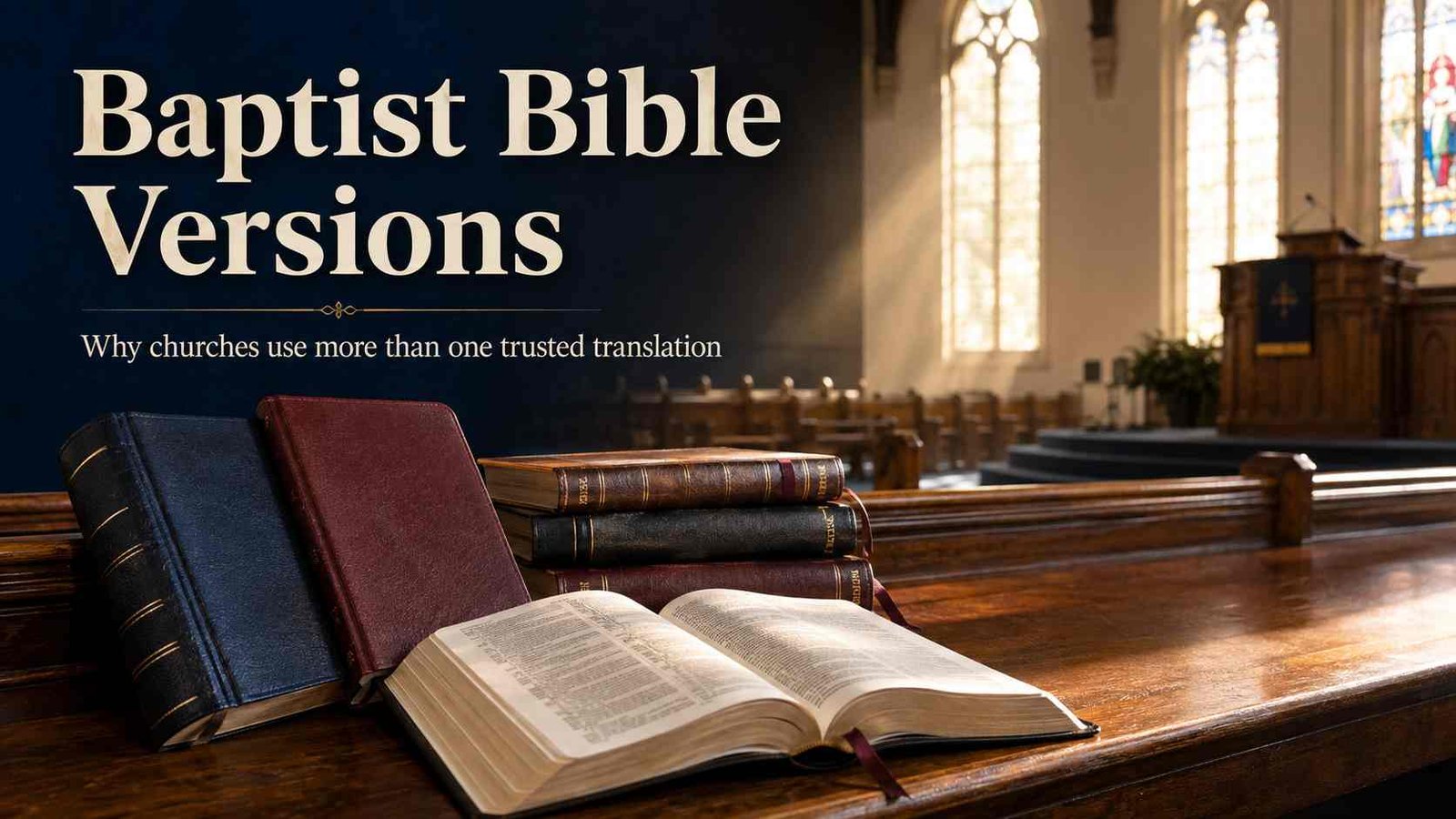
 If you walk into two Baptist churches on the same Sunday, you may notice something interesting. One pastor may preach from the King James Version (KJV), while another uses the Christian Standard Bible (CSB), New International Version (NIV), or English Standard Version (ESV).
So, what Bible does the Baptist Church use?
The simple answer is that Baptists do not have one official Bible translation that every Baptist church must use. Baptist churches generally use the 66-book Protestant Bible, but the English translation can vary from church to church.
Common choices include the KJV, NKJV, CSB, NIV, ESV, and NASB. Some traditional Baptist churches strongly prefer the KJV, while many modern Baptist congregations use the CSB, ESV, NIV, or another respected translation.
This variety makes sense because one important Baptist principle is the independence, or autonomy, of the local church. The Southern Baptist Convention’s Baptist Faith and Message describes a local church as an autonomous congregation. It also places Scripture at the center of Christian belief and practice.
Here is the basic picture:
| Question | Short Answer |
|---|---|
| What Bible do Baptists use? | Usually a 66-book Protestant Bible |
| Is there one official Baptist translation? | No |
| Do Baptists use the KJV? | Yes, many do |
| Do all Baptists use the KJV? | No |
| Is the CSB a Baptist Bible? | It has strong Baptist publishing connections, but it was translated by scholars from many denominations |
| Do Baptists and Catholics have exactly the same Bible? | No; their Old Testament canons differ |
| Do Baptists pray to God or Jesus? | Baptists pray to God, commonly to the Father in Jesus’ name, while also believing Jesus is fully divine |
What Bible Does the Baptist Church Use Most Often?
There is no honest way to name one translation as the Bible used by every Baptist.
Baptists are a large and diverse Christian family. There are Southern Baptists, American Baptists, National Baptists, Independent Baptists, Conservative Baptists, Free Will Baptists, Reformed Baptists, and Baptist churches in many countries.
They share several important convictions, but they do not all make the same decision about Bible translations.
In a Baptist church, you might hear Scripture read from:
- King James Version (KJV)
- New King James Version (NKJV)
- Christian Standard Bible (CSB)
- English Standard Version (ESV)
- New International Version (NIV)
- New American Standard Bible (NASB)
- New Living Translation (NLT)
Lifeway, which has deep historical ties to Southern Baptist life, currently offers Bibles in several of these translations rather than presenting one translation as the only acceptable Baptist Bible. Its translation selection includes the KJV, NASB, CSB, and other major English versions.
That tells us something important.
For most Baptists, the bigger question is not, “Does this Bible have Baptist on the cover?”
The question is, “Does this translation faithfully communicate Scripture?”
Why There Is No Single Official Baptist Bible
To understand why Baptists use different Bible versions, it helps to understand how Baptist churches are organized.
Many Christian denominations have a centralized authority that can establish practices for churches within that body. Baptist church life traditionally works differently.
The Southern Baptist Convention describes the local New Testament church as an autonomous local congregation. The SBC also explains that it operates through cooperation among churches rather than top-down control of each congregation.
That means one Baptist congregation may decide to use the KJV for preaching and teaching, while another may use the CSB.
A third may have a pastor who preaches from the ESV while members sitting in the pews read the NIV, NKJV, or NASB.
This usually does not mean they believe in different Bibles.
It means they are reading different English translations of the biblical texts.
The Baptist World Alliance also reflects the historic Baptist emphasis on reading and studying Scripture within the Christian community.
The authority, from a Baptist perspective, belongs to Scripture itself rather than to one modern English translation.
What Bible Does the Baptist Church Use Besides the KJV?
The King James Bible has had enormous influence among English-speaking Baptists, but it is far from the only Bible they read.
Several modern translations have become familiar in Baptist churches.
Christian Standard Bible
The Christian Standard Bible, usually called the CSB, is especially visible within many Southern Baptist settings.
Its story is connected with Holman Bible Publishers and Lifeway. The CSB was released in 2017 as a revision of the earlier Holman Christian Standard Bible.
That Baptist publishing connection sometimes causes people to call the CSB a “Baptist Bible.”
That description needs some care.
The CSB was developed by 100 scholars from 17 denominations, according to Lifeway. It was therefore not created only by Baptist scholars or only for Baptist readers.
Its translation philosophy is called Optimal Equivalence. The translators sought to use a more literal rendering when that communicated clearly in modern English and a more natural rendering when strict word-for-word translation would make the meaning difficult to understand.
For that reason, some Baptist pastors and readers like the CSB as a middle ground between close textual accuracy and easy reading.
New King James Version
The New King James Version (NKJV) is another popular choice, especially for people who appreciate the wording and tradition of the KJV but want more modern English.
It keeps much of the familiar style of the King James tradition while replacing many older spellings and expressions.
A Baptist News Global discussion of Bible translations notes that the KJV and NKJV are particularly preferred among some fundamentalist Christians as well as some Southern and independent Baptists.
The important word here is some.
It would be inaccurate to say that every Southern Baptist or every Independent Baptist uses the KJV or NKJV.
English Standard Version
The ESV is also found in many conservative Protestant churches, including Baptist congregations.
It tends toward a more formal translation style. Readers who enjoy detailed Bible study often appreciate translations that stay relatively close to the sentence structure and wording of the original languages.
A Baptist pastor may therefore choose the ESV for preaching while recommending a simpler translation for a young reader or someone reading Scripture in English for the first time.
New International Version
The NIV has been widely read throughout English-speaking Christianity and can also be found among Baptists.
Its language tends to be smoother and easier for modern readers than older English translations.
For a person asking how to read the Bible for beginners, the NIV may feel less difficult than the KJV because it does not depend on English expressions that were common hundreds of years ago.
New American Standard Bible
The NASB is often chosen for careful study because of its more formal, word-for-word approach.
Lifeway describes it as a highly literal translation using a formal-equivalence philosophy.
Some Baptist teachers and serious Bible students use the NASB alongside another translation so they can compare wording.
That practice is common in Bible study: reading the same passage in several translations can help a reader notice details that might otherwise be missed.
Do Baptists Use the King James Bible?
Yes. Many Baptists use the King James Bible.
But the statement needs a second sentence:
Not all Baptists use it.
The KJV holds a special place in Baptist history, particularly among English-speaking churches.
For generations, it was the Bible heard from pulpits, memorized by children, carried by missionaries, and read during family worship.
Its phrases became deeply connected with English-speaking Christian culture.
But the KJV was not originally created as a Baptist translation.
King James I commissioned a new English Bible translation in 1604. A group of scholars completed the work, and the King James Version was published in 1611. The translators worked in several committees, and the project emerged from the Church of England context rather than from the Baptist movement.
So when someone asks what is the KJV Bible, it is important to separate two facts.
The KJV became extremely important among Baptists.
But Baptists did not create the KJV.
Are All Baptists KJV-Only?
No.
Some Baptist churches teach that the King James Version should be the only English Bible used in their congregation. You may hear these churches described as KJV-only or King James only churches.
This position is especially visible within some Independent Fundamental Baptist circles.
But it should not be treated as the position of all Baptists.
Other Baptist churches may deeply respect the KJV while also using the NKJV, CSB, ESV, NASB, or NIV.
Still others prefer a modern translation for nearly everything they do.
So if you are visiting a Baptist church and want to bring the same Bible used by the pastor, the easiest solution is simply to check the church website, listen to a recent sermon, or ask which translation the church normally uses.
You do not need a special Bible labeled “Baptist” in order to attend a Baptist church.
What Bible Do Southern Baptists Read?
Southern Baptists also use more than one Bible translation.
The CSB has a particularly strong presence in Southern Baptist publishing and ministry because of its connection with Lifeway and Holman Bible Publishers. Lifeway describes the CSB as a translation designed to combine accuracy with readability.
But that does not make the CSB mandatory for Southern Baptist churches.
The Southern Baptist Convention is a cooperative body of local churches, and its own governance materials emphasize that local churches retain their autonomy.
A Southern Baptist pastor may therefore preach from the CSB.
Another may use the ESV.
Another may preach every Sunday from the KJV.
Another may use the NKJV or NASB.
You may even find several translations being used within the same congregation.
This is why the question what Bible do Southern Baptists read does not have a one-word answer.
The safest answer is:
Southern Baptists commonly use several Protestant Bible translations, with the CSB, KJV, NKJV, ESV, NIV, and NASB among the versions you may encounter. No single translation is required of every Southern Baptist congregation.
Do Baptists Use the Same Bible as Catholics?
Baptists and Catholics share most of the biblical books Christians know best, including the entire 27-book New Testament.
But their Bibles are not exactly the same in the Old Testament.
Baptists generally follow the Protestant biblical canon.
A standard Protestant Bible contains:
- 39 Old Testament books
- 27 New Testament books
- 66 books total
A Catholic Bible contains:
- 46 Old Testament books
- 27 New Testament books
- 73 books total
The United States Conference of Catholic Bishops identifies the seven Old Testament books found in Catholic Bibles but not in the standard Protestant Old Testament as:
- Tobit
- Judith
- Wisdom
- Sirach
- Baruch
- 1 Maccabees
- 2 Maccabees
Catholic Bibles also contain additional portions of Esther and Daniel. Catholics commonly call these writings the deuterocanonical books.
This is one of the main differences between a standard Protestant Bible and a Catholic Bible.
Do Baptists and Catholics Have the Same New Testament?
Yes, in terms of the list of books.
Both Baptists and Catholics recognize the same 27 New Testament books, beginning with Matthew and ending with Revelation.
That includes:
Matthew, Mark, Luke, John, Acts, the letters of Paul, Hebrews, the general letters, and Revelation.
The differences are mainly connected with the Old Testament canon, translation choices, and how Scripture relates to church tradition and authority.
It is therefore misleading to say that Baptists and Catholics have “completely different Bibles.”
They share the New Testament and most of the Old Testament, while differing over a smaller group of Old Testament writings.
Why Do Baptist Churches Care So Much About the Bible?
Although Baptists differ over translations, they tend to agree strongly on something more important: Scripture should have a central place in Christian faith and church life.
The Southern Baptist Faith and Message describes Scripture as divinely inspired and presents the Bible as the supreme standard by which religious teachings should be tested.
This helps explain several familiar parts of Baptist worship.
A Baptist service often includes:
- public Bible reading
- a sermon built around a biblical passage
- personal Bible study
- Sunday school or small-group study
- Scripture memorization
- family Bible reading
- encouragement to read Scripture at home
The sermon itself often takes a large part of the worship service because preaching and explaining Scripture have traditionally been important in Baptist life.
The translation may change.
The emphasis on the Bible usually does not.
Which Bible Translation Is Best for a Baptist?
There is no single answer for every reader.
The best Bible for you is one that is trustworthy, understandable, and suitable for the way you plan to use it.
Here is a simple guide:
| Translation | May Be Helpful For |
|---|---|
| KJV | Traditional language, memorization, historic church use |
| NKJV | Readers who like KJV style but want more modern English |
| CSB | Balance between accuracy and easy modern reading |
| ESV | Detailed study and a more formal translation style |
| NIV | Clear everyday reading and beginners |
| NASB | Close, detailed study of wording |
| NLT | Very easy and flowing reading |
These descriptions are general rather than absolute. Different translations make different decisions about how closely to follow the form of the original Hebrew and Greek while still communicating clearly in English. Lifeway itself presents several translation approaches and versions for readers rather than reducing Bible selection to one choice.
If your Baptist church already has a main translation, owning that version can make sermons and group Bible studies easier to follow.
But you can also keep another translation at home.
For example, you might study from the ESV but read the NIV devotionally.
You might attend a KJV church but compare difficult verses with the NKJV.
You might use the CSB for everyday reading and the NASB for deeper word study.
Using more than one translation does not mean you are reading several different Christian faiths. You are comparing English translations that seek to communicate ancient biblical texts to modern readers.
Should a Beginner Baptist Read the KJV?
A beginner certainly can read the KJV.
Many people love its beauty and traditional language.
Consider the familiar opening of Psalm 23:
“The LORD is my shepherd; I shall not want.”
Those words have comforted generations of Christians.
But some KJV expressions are no longer part of normal everyday English. Words such as thee, thou, ye, wherefore, and other older expressions can make reading harder for children, new Christians, and people learning English.
If you understand the KJV well and enjoy it, there is no need to avoid it.
If you struggle to understand what you are reading, choosing a clearer modern translation may help you spend more time understanding Scripture and less time decoding old English.
A good goal is not simply to own a respected Bible.
The goal is to read it and understand it.
That matters whether your Bible says KJV, CSB, NIV, ESV, NKJV, or NASB on the cover.
Does Using a Different Translation Change Baptist Beliefs?
Usually, no.
Major English Bible translations sometimes use different words or sentence structures, but Baptist doctrine is generally not built upon the wording of one English translation alone.
Consider a simple example.
One translation may use the word “servant,” while another may choose “slave” in a passage where the underlying Greek word can carry that stronger sense.
One translation may preserve a longer Greek-style sentence.
Another may divide the same thought into several short English sentences.
Those differences can matter when studying a passage closely, but they do not mean each translation teaches a separate religion.
This is one reason pastors and Bible teachers sometimes compare translations when preparing lessons.
A careful reader can ask:
What does the passage say?
What did the words mean in their original setting?
How does this verse fit with the chapter around it?
How does it fit with the wider teaching of Scripture?
Those questions are more useful than assuming one English wording automatically settles every difficult biblical issue.
Do Baptists Pray to God or Jesus?
Baptists pray to God and believe in one God revealed as Father, Son, and Holy Spirit.
The Baptist Faith and Message explicitly speaks of the Father, Son, and Holy Spirit within its doctrine of God.
In Baptist churches, prayer is very often addressed to God the Father in the name of Jesus Christ.
That pattern comes directly from Jesus’ teaching.
When Jesus taught His disciples how to pray in Matthew 6:9, He began by directing prayer to “Our Father.”
Lifeway teaching materials likewise describe Christian prayer as approaching God in Jesus’ name and discuss Jesus’ teaching in John 14 and John 16 about asking in His name.
You may therefore hear a Baptist prayer like this:
“Father, thank You for Your grace. Help us follow Your Word today. We ask this in Jesus’ name. Amen.”
But this does not mean Baptists believe Jesus is separate from God in the sense of being merely human.
Historic Baptist teaching confesses Jesus Christ as the divine Son.
The New Testament also includes prayers or appeals directed to Jesus. In Acts 7:59, for example, Stephen calls upon the Lord Jesus as he is dying.
So the simple answer to do Baptists pray to God or Jesus is:
Baptists pray to God. They commonly address the Father through Jesus Christ and in Jesus’ name, while also worshiping Jesus as Lord and recognizing that Christians can call directly upon Him.
It is not an either-or choice between God and Jesus within Baptist Trinitarian belief.
Does the Bible Translation Matter More Than Reading It?
Translation choice matters, especially when you are studying carefully.
But there is also a danger in arguing so much about translations that we forget why Christians have Bibles in the first place.
A beautiful leather Bible sitting unopened on a shelf cannot shape your daily life.
A Bible becomes useful when you read it, think about it, pray over its teaching, and seek to live faithfully.
If one translation constantly confuses you, try another respected translation.
If you love the KJV and understand it clearly, keep reading it.
If your church uses the CSB, consider using the CSB during sermons so you can follow easily.
If you are beginning your first Bible reading plan, an NIV, CSB, or another accessible translation may help you build the habit of reading regularly.
And if a difficult verse troubles you, compare several translations rather than immediately assuming that one must be wrong.
The different wording can sometimes help you see the meaning more clearly.
What This Teaches Us About Baptists and the Bible
So, what Bible does the Baptist Church use?
There is no universal Baptist translation.
Many Baptists have a deep attachment to the King James Version, and some Baptist churches use it exclusively. Others regularly read and preach from the CSB, NKJV, ESV, NIV, NASB, and other Protestant translations.
The CSB has particularly visible connections with Southern Baptist publishing, but even the CSB was produced with scholars from 17 denominations.
What unites Baptists is therefore not one English translation.
It is their historic emphasis on the authority and importance of Scripture.
A Baptist church in a small country town may have well-worn KJV Bibles in its pews. A large Baptist congregation in a city may project CSB or ESV verses on a screen. A Baptist family at home may read the NIV with their children.
The covers may look different.
The English wording may sometimes sound different.
But all are seeking to read and understand the biblical message.
If you are choosing a Bible for yourself, do not feel that you must find a secret “Baptist version.” Choose a reliable translation you can understand, and if you already attend a Baptist church, consider asking which translation your pastor normally teaches from.
Then open it.
Read it patiently.
Ask questions.
Compare passages.
And allow the words of Scripture to lead you toward a deeper knowledge of God.

Dr. Rachel is very smart and knows a lot about the Bible. He helps us understand the Bible better by talking about the old texts in a simple way.