

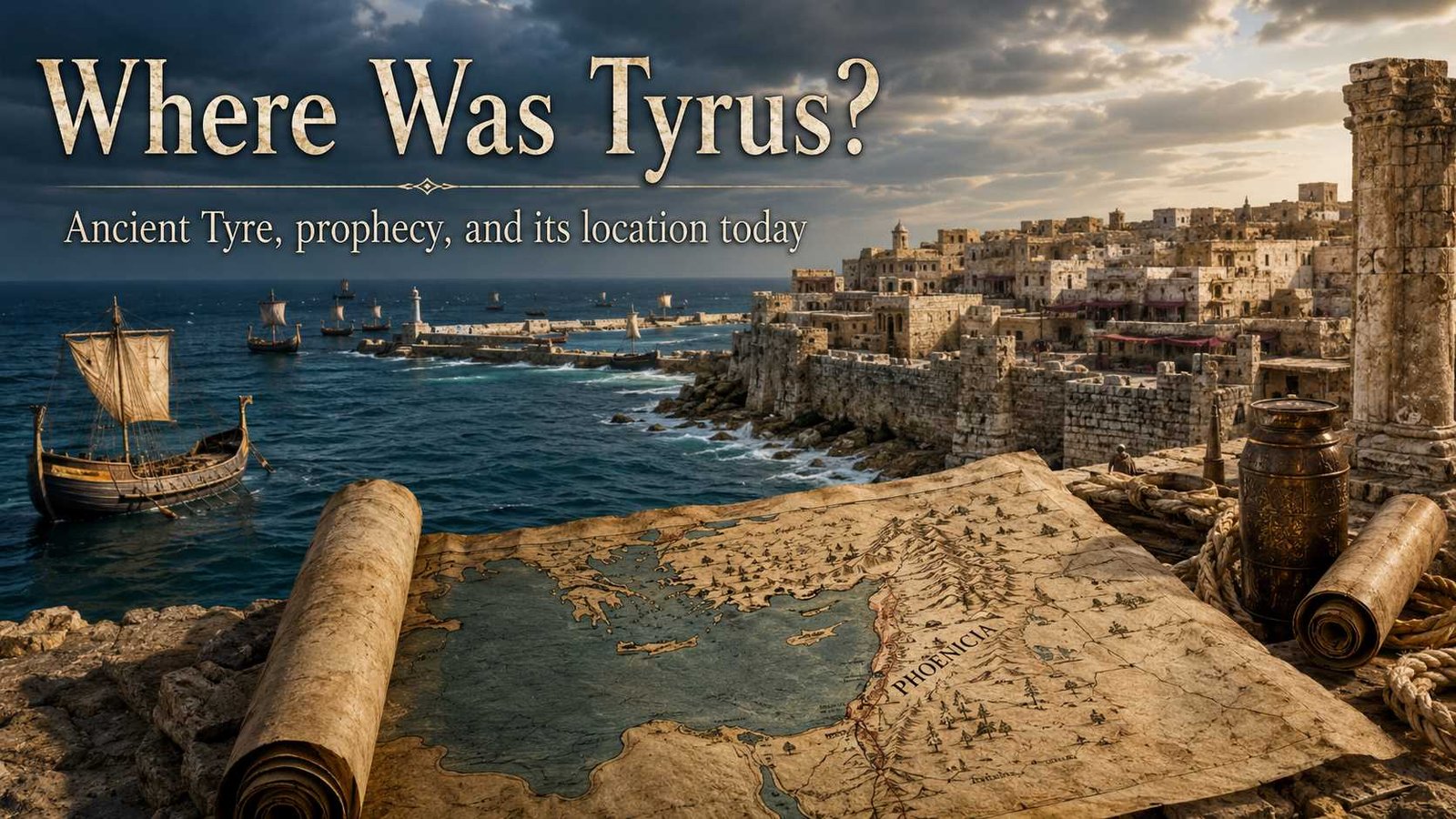
 If you are asking where is Tyrus in the Bible, the short answer is simple: Tyrus is the King James Bible spelling of Tyre, an ancient and very important coastal city on the Mediterranean Sea. Today, that ancient city is known as Tyre in southern Lebanon.
That answer helps, but most readers want more than a name on a map. They want to know why Tyrus matters in Scripture, what country it would be in today, whether Tyrus was a person or a place, and whether Nebuchadnezzar really destroyed it. Those are good questions. The Bible speaks about Tyrus in a serious and memorable way, especially in the book of Ezekiel. Tyrus was wealthy, proud, beautiful, and powerful. It was also a city God judged.
This topic matters because Bible geography is never just about places. It is about people, history, faith, and God’s dealings with nations. When we understand where Tyrus was, we also understand more of the world of the prophets.
Where Is Tyrus in the Bible?
Tyrus appears in the King James Version as the name of the city more commonly called Tyre in many modern translations. It was a famous Phoenician port city on the Mediterranean coast. In modern terms, its location is in southern Lebanon.
So if you are looking for Tyrus on a modern map, you should look for Tyre, Lebanon, sometimes also called Sour.
The Bible mentions Tyre or Tyrus in several places, but the most important passages are found in:
- Ezekiel 26
- Ezekiel 27
- Ezekiel 28
- Isaiah 23
- Joel 3:4
- Amos 1:9–10
- Zechariah 9:2–4
- New Testament references to Tyre and Sidon
This already tells us something important. Tyrus was not a small village with little meaning. It was a major city with a strong place in biblical history.
What Was Tyrus?
Tyrus was an ancient Phoenician city. The Phoenicians were known across the ancient world as skilled sailors, traders, shipbuilders, and merchants. Their cities were famous for sea trade, wealth, and cultural influence.
Tyre stood out even among Phoenician cities. It became known for:
- maritime trade
- costly goods
- strong fortifications
- influence across the Mediterranean
- pride in its beauty and success
When Ezekiel describes Tyrus, he paints the picture of a rich trading center connected with many nations. Tyrus was not important because of Israel’s faith. It was important because of commerce, sea power, and international trade.
That is why Ezekiel 27 reads almost like a long business record. It lists the nations and goods connected to Tyre. The city sat at the center of a huge trading world.
Where Is Tyrus in the Bible Today?
This is one of the most common search questions, and the direct answer is this:
Tyrus in the Bible today is Tyre in modern Lebanon.
Tyre is on the coast of the Mediterranean Sea, south of Beirut. In Bible times, it was part of the Phoenician world. Today, the ancient site belongs to the modern nation of Lebanon.
So if someone asks, Where is Tyrus in the Bible today? you can confidently say:
It is the ancient city of Tyre, located in present-day Lebanon.
That also connects naturally with another helpful Bible study question: Is Lebanon in the Bible? The answer is that the exact modern country name is not used the same way in biblical times, but the region that includes present-day Lebanon certainly appears in Scripture. Cities like Tyre and Sidon were part of that northern coastal region known in the ancient world.
Was Tyrus an Island or a Coastal City?
This is where the geography gets a little more interesting.
Ancient Tyre had both mainland and island features. Over time, the city included a mainland settlement and an offshore island stronghold. This helped make Tyre difficult to attack. A city protected by the sea had a real military advantage.
That detail helps explain why Tyre lasted so long and why conquering it was not simple. The city’s position made it prosperous in trade and strong in defense.
When people read Ezekiel’s prophecies against Tyrus, they should remember that this was not an easy place to defeat. It was wealthy, fortified, and protected by its sea setting. That makes God’s judgment on Tyre even more striking.
What Country Was Tyrus in the Bible?
Another common question is, What country is Tyrus in the Bible?
We need to answer that carefully.
In the modern sense, Tyrus is in Lebanon. But in the ancient biblical sense, Tyre was not part of a modern nation-state like the countries we know today. It was a Phoenician city-state.
So the best answer is:
- In Bible times: Tyrus was a major Phoenician city.
- Today: its site is in Lebanon.
This matters because modern maps and biblical maps are not the same. When we study Scripture, we must avoid forcing today’s political borders onto the ancient world.
That is also why related topics like what was Canaan in the Bible can help readers. The Bible often refers to broader lands and regions, not just modern countries. Tyre existed in the larger world surrounding Canaan and Israel, but it was not an Israelite city.
Why Was Tyrus So Important?
Tyrus mattered for at least three big reasons.
1. It was a trading city
Tyre was deeply involved in buying, selling, and shipping goods. It dealt with many regions and peoples. Ezekiel 27 shows this in great detail.
2. It was politically influential
A wealthy city often becomes a powerful city. Tyre had influence because people depended on its trade and sea connections.
3. It became a symbol of pride
This is where Scripture gives us more than history. Ezekiel does not only describe Tyre’s success. He also shows Tyre’s arrogance. The city trusted in its own splendor, wealth, and wisdom. That pride invited judgment.
That is a pattern we see often in the Bible. Human power looks permanent. It never is. Nations rise. Nations shine. Nations boast. Then God reminds the world that He alone rules over all.
Where Is Tyrus Mentioned in the Bible?
If you want to find Tyrus in the Bible, the most important place to start is Ezekiel 26–28.
Tyrus in Ezekiel 26
Ezekiel 26 announces judgment against Tyrus. The prophecy begins after Jerusalem’s fall, and Tyre is portrayed as reacting in a selfish way to Jerusalem’s downfall.
That detail is important. Tyrus was not being judged only because it was rich. It was also judged for its attitude, pride, and response toward others.
Ezekiel 26:7 names Nebuchadnezzar king of Babylon as the ruler God would bring against Tyrus. That is one reason people often ask, Did Nebuchadnezzar destroy Tyrus? We will answer that carefully in a later section.
Tyrus in Ezekiel 27
Ezekiel 27 is one of the most vivid chapters about Tyre. It describes the city almost like a grand ship, glorious and beautiful, filled with trade and luxury.
You can feel the majesty in the language. Yet the chapter is not a celebration. It is a lament. The point is that even the most impressive earthly system can fall.
This chapter helps answer where is Tyrus in the Bible because it shows what kind of city it was. Tyrus was not known mainly for farming, kingship, or temple worship. It was known for trade across the sea.
Tyrus in Ezekiel 28
Ezekiel 28 speaks against the prince of Tyrus and later includes a lament over the king of Tyrus. The language here has led to much discussion among Christians because some of it sounds larger than one human ruler. Some readers see behind the king of Tyre a picture of deeper spiritual pride.
Different Christian traditions explain this in slightly different ways. Still, most agree on the main lesson: pride before God is dangerous.
The ruler of Tyrus is condemned for saying, in effect, that he is above ordinary people. He trusted in wisdom, beauty, wealth, and status. But no ruler, however exalted, can stand against God.
Other Old Testament references
Tyrus or Tyre also appears in:
- Isaiah 23, which contains an oracle against Tyre
- Joel 3:4, where Tyre and Sidon are named together
- Amos 1:9–10, where Tyre is judged
- Zechariah 9:2–4, which describes Tyre’s wisdom, wealth, and coming fall
Tyre appears in the New Testament too. Jesus mentions Tyre and Sidon, and He also visited the region near them. That reminds us that Tyre remained known long after the Old Testament prophetic era.
Is the Name Tyrus in the Bible?
This is another question many readers ask: Is the name Tyrus in the Bible?
The answer is yes, the word Tyrus appears in the King James Version. But here is the key point:
Tyrus is not mainly the personal name of a Bible character. It is the name of a city, meaning Tyre.
That matters because some people see the word “Tyrus” and assume there must be a biblical man named Tyrus. Scripture does speak of the prince of Tyrus and the king of Tyrus, but those are rulers of the city, not a person simply introduced as “Tyrus.”
So if someone asks, Is the name Tyrus in the Bible? the best full answer is:
- Yes, the word appears in the KJV.
- No, it is not presented as the name of a well-known biblical person.
- It refers chiefly to the city of Tyre.
That also helps with a related search topic some readers ask: Who was Tyre in the Bible? Strictly speaking, Tyre was not a “who.” It was a where.
Did Nebuchadnezzar Destroy Tyrus?
This is one of the most debated and misunderstood parts of the topic.
The short answer is:
Nebuchadnezzar did attack Tyrus and laid siege to it, but saying he completely destroyed the whole city in a simple way is too strong and too simplistic.
Let me explain.
What the Bible says
Ezekiel 26:7 clearly says God would bring Nebuchadnezzar king of Babylon against Tyrus. So there is no doubt that Nebuchadnezzar is part of the prophecy and the judgment.
Later, in Ezekiel 29:18, Scripture says Nebuchadnezzar made his army serve in a hard campaign against Tyre. Every head was made bald and every shoulder peeled, meaning the work was exhausting. Yet he and his army did not receive wages from Tyre for that labor.
That verse is important because it suggests a long, difficult military effort that did not end in simple plunder.
The historical picture
Historically, Nebuchadnezzar is often said to have besieged Tyre for many years. The traditional number often given is thirteen years. Whether every detail is perfectly clear or not, the main point is that the siege was long and difficult.
Why difficult? Because Tyre’s geography made it hard to conquer fully.
So when people ask, Did Nebuchadnezzar destroy Tyrus? a careful answer would be:
- He attacked and besieged Tyre.
- He likely broke its power in significant ways.
- But the evidence does not support a careless statement that he instantly or totally wiped out the island city in one simple event.
Why readers often get confused
Many people confuse Nebuchadnezzar’s campaign with the later conquest of Tyre by Alexander the Great in 332 BC.
Alexander’s attack is famous because he built a causeway to reach the island stronghold. That later conquest is often the dramatic event people remember. But it happened long after Nebuchadnezzar.
So the safe and balanced answer is this:
Nebuchadnezzar did not leave Tyrus untouched. He judged it through siege and war. But the later and more complete military collapse most people remember is tied to Alexander the Great, not Nebuchadnezzar alone.
Why Was Tyrus Judged?
This is where the story moves from history to spiritual meaning.
Tyre was judged for more than its location or success. The prophets show several deeper reasons.
Pride
Tyrus became proud of its beauty, wealth, and wisdom. It believed its success made it secure.
Self-sufficiency
It trusted in commerce, ships, walls, and influence more than anything higher.
Cruel or sinful conduct
The prophets also condemn the city’s actions toward others. In Scripture, power without righteousness becomes dangerous.
Rejoicing in others’ downfall
Ezekiel begins with Tyre’s attitude toward fallen Jerusalem. That is sobering. God notices not only what nations do, but how they respond when others suffer.
This is a strong lesson for all of us. Wealth is not the problem by itself. Skill is not the problem by itself. Success is not the problem by itself. The problem comes when human beings begin to say, “I am secure because of what I have built,” and forget the Lord.
What Does Tyrus Teach Us About Bible Prophecy?
If you are interested in what the Bible says about prophecy, Tyre is a strong example of how biblical prophecy works.
First, prophecy is rooted in real history. Ezekiel was not speaking into a fantasy world. He was speaking about real cities, rulers, pride, trade, and war.
Second, prophecy often reveals God’s moral judgment, not just future events. God is not merely announcing facts. He is exposing sin.
Third, prophecy reminds us that God rules over all nations, not only Israel. Tyre was not part of Judah, yet God addressed it. That tells us His authority is universal.
This is helpful for readers who think prophetic books are too mysterious. Sometimes the message is very direct: God sees human pride, and He will not ignore it forever.
What Was Tyrus’s Relationship With Israel?
Tyrus did not exist in isolation. It had relationships, trade connections, and political interactions with Israel and surrounding nations.
In earlier biblical history, Tyre had connections to Israel during the time of kings. The city was well known for supplying valuable materials and skilled workers. This reminds us that Tyre’s story was not always framed only in judgment. It was also part of the wider world around God’s people.
Still, the prophetic books focus especially on Tyre’s moral and spiritual condition.
This also ties into the question where is Jerusalem in the Bible. Ezekiel 26 begins in the shadow of Jerusalem’s fall. Tyrus looked at Jerusalem’s collapse and saw opportunity. God saw something deeper.
That should make us pause. It is always a spiritual danger when someone sees another person’s pain and quietly thinks, “This is good for me.”
Tyrus, Exile, and the World of Ezekiel
To understand Tyre properly, it helps to understand what was the exile in the Bible.
Ezekiel prophesied during the Babylonian exile. Jerusalem had fallen. The people of Judah were under deep judgment and sorrow. This was not a peaceful moment in history. It was a time of shaken kingdoms and rising empires.
Tyrus stood in that world as a wealthy coastal power. Babylon was expanding. Judah had been humbled. In that setting, Tyre’s pride and confidence looked impressive. But God’s word through Ezekiel showed that Tyre too would face judgment.
This reminds us that no earthly system is beyond God’s reach. Exile was not just Israel’s story. It was part of a wider moment when God was dealing with nations across the region.
What This Teaches Us About Faith
By now, the question where is Tyrus in the Bible has a clear answer. Tyrus is ancient Tyre, the famous Phoenician city on the Mediterranean coast, located in modern Lebanon. The Bible speaks of it often, especially in Ezekiel. It was rich, admired, and strong. It was also proud.
That is why the story still speaks today.
We live in a world that admires success, money, influence, and image. Tyre had all of those things. Yet Scripture shows that prosperity without humility is fragile. A city can have ships, trade, walls, beauty, and reputation, and still stand under God’s rebuke.
There is a quiet warning here for every heart. Do not place your trust in what looks impressive on the outside. Do not measure safety only by wealth or power. And do not celebrate when others fall.
There is also comfort here. The God of Scripture is not absent from history. He sees cities. He sees rulers. He sees nations. He sees our hearts too.
So if you came asking, What country is Tyrus in the Bible? Is the name Tyrus in the Bible? Did Nebuchadnezzar destroy Tyrus? now you have the fuller picture:
- Tyrus is Tyre
- Tyre is in modern Lebanon
- Tyrus is a city, not mainly a personal name
- Nebuchadnezzar did attack and besiege Tyre, though the full history is more complex than a one-line answer
And beyond all that history stands one lasting truth: God opposes pride, but He honors truth and humility.

Dr. Rachel is very smart and knows a lot about the Bible. He helps us understand the Bible better by talking about the old texts in a simple way.