
 Death is one of the few experiences that touches every family. It may come after a long illness, suddenly through an accident, or quietly at the end of old age. When someone we love dies, questions often rise almost immediately.
Where are they now? Does the soul continue? Will we recognize one another again? Is heaven the final destination? What happens at the resurrection? And how do the rapture and tribulation fit into all of this?
So, what happens after death according to the Bible?
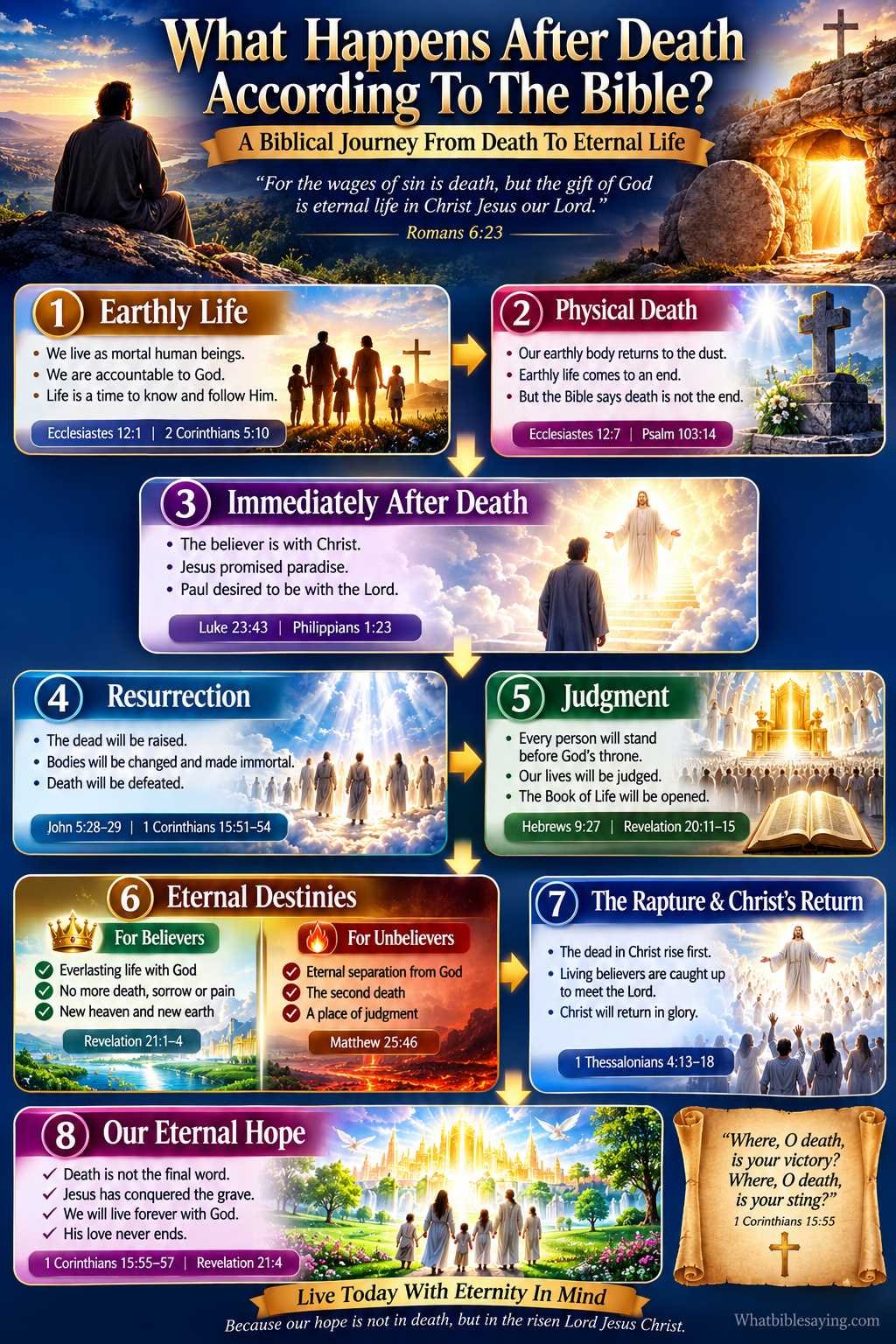
The Bible teaches that physical death is not the end of human existence. Scripture points beyond death to being accountable before God, resurrection, judgment, and an eternal future. For Christians, the heart of this hope is not simply the idea that a soul survives. It is that Jesus Christ conquered death and promises resurrection.
Hebrews 9:27 connects human death with judgment, while Jesus speaks in John 5:28–29 of a future resurrection. Paul goes further in 1 Corinthians 15, explaining that death itself will finally be defeated.
That gives us the broad biblical picture:
| Biblical Stage | What Scripture Teaches |
|---|---|
| Earthly life | We live as mortal human beings before God |
| Physical death | Our present bodily life ends |
| After death | Scripture points to continued existence before God |
| Christ’s return | The dead are raised and God’s people are gathered |
| Resurrection | God gives life beyond mortal death |
| Judgment | Every person is accountable before God |
| Eternal future | Scripture describes everlasting life and God’s renewed creation |
The Bible does not answer every question we may have about the experience between death and resurrection. Christians have also differed about some details for centuries. But the central message is remarkably clear: death does not have the final word.
What Happens Immediately After Death According to the Bible?
One of the first questions people ask is what happens at the exact moment of death.
The Bible gives us several important clues, though it does not provide a minute-by-minute description.
Physical death ends our present earthly life. Ecclesiastes uses the language of the body returning to the dust and the spirit returning to God who gave it. The New Testament then places even greater emphasis on belonging to Christ beyond death.
Two passages are especially important.
Jesus Spoke About Paradise
While Jesus was being crucified, one of the criminals beside Him turned toward Him in faith and asked to be remembered.
Jesus answered with the promise that the man would be with Him in paradise that day. Luke 23:43 therefore connects death with continued personal existence in the presence of Christ rather than simple extinction.
This does not answer every question about the state between death and resurrection. It does, however, tell us something deeply comforting: death could not separate that man from Christ.
Paul Expected to Be With Christ
The apostle Paul expressed a similar hope.
While discussing whether he would continue living or face death, Paul said that departing this life and being with Christ would be better. He clearly distinguished remaining in his physical body from departing and being with Christ.
In another passage, 2 Corinthians 5, Paul speaks about being away from the body and at home with the Lord. At the same time, he looks forward to a future transformed existence rather than treating disembodied life as the final goal.
This distinction matters.
According to the Bible, Christian hope is not simply:
Die → become a spirit forever.
The larger biblical picture is:
Life → death → presence with Christ → resurrection → eternal life in God’s restored creation.
That is why studying what is death in the Bible leads naturally into the Bible’s teaching about resurrection.
For a related explanation of physical death and the biblical idea of the second death, see What Is The First Death In The Bible?.
What the Bible Says Happens When We Die
When we gather the main Bible passages together, several truths appear again and again.
First, our earthly body dies.
Second, death does not remove us from God’s authority.
Third, the Bible speaks of continued existence beyond physical death.
Fourth, resurrection remains future.
Fifth, judgment is real.
Sixth, the final hope of God’s people is eternal life with God.
This is important because popular ideas about death sometimes come more from movies, traditions, or imagination than Scripture.
People may picture everyone becoming angels, floating permanently on clouds, or immediately knowing every mystery of the universe. The Bible does not teach those things.
Instead, Scripture consistently directs our attention toward God, Christ, resurrection, judgment, and restoration.
Hebrews 9:27 gives one of the shortest summaries. Human beings die, and afterward comes judgment.
That does not mean Scripture presents death without hope. Quite the opposite.
For those grieving someone they love, the New Testament repeatedly points to Jesus’ resurrection as the foundation for hope. Paul even tells grieving Christians that they should encourage one another with the promise of Christ’s return and the resurrection of those who have died in Him.
The question what the Bible says happens when we die therefore cannot be separated from what the Bible says will happen when Christ returns.
What Happens After Death According to the Bible at the Resurrection?
Resurrection stands at the center of biblical teaching about the future.
Sometimes Christians speak so much about going to heaven that resurrection receives less attention. Yet resurrection is one of the strongest themes in the New Testament.
Jesus Himself taught it.
In John 5:28–29, Jesus said a time would come when those in their graves would hear His voice and come out. The passage connects resurrection with both life and judgment.
Paul develops the idea in great detail in 1 Corinthians 15.
Jesus’ Resurrection Is the Pattern of Christian Hope
Paul describes Christ as the firstfruits of those who have died.
The picture comes from harvesting. The firstfruits were the beginning of a larger harvest still to come.
In the same way, Jesus’ resurrection was not presented as an isolated miracle that happened only to Him. It points toward the resurrection God promises for His people.
This is why Christianity’s answer to death is not merely, “Your soul continues.”
It is something greater:
God will raise the dead.
Mortal Life Will Be Changed
First Corinthians 15 says that mortal human existence must put on immortality. Paul describes a future transformation connected with the trumpet and the resurrection of the dead.
The language is powerful because Paul treats death as an enemy that God will defeat.
Death feels permanent to us.
We stand beside a grave and feel the terrible finality of it. A voice is gone. A chair is empty. A person we loved can no longer walk into the room.
But Scripture looks at that same grave and says the story is not finished.
For Christians, resurrection means God is able to restore what death has taken.
What Happens After Death According to the Bible for Believers?
For believers, the New Testament repeatedly connects life after death with Christ.
Jesus promised paradise.
Paul desired to depart and be with Christ.
Second Corinthians speaks of being with the Lord.
First Thessalonians speaks of believers being with the Lord forever after Christ’s coming and the resurrection.
Revelation then takes the picture even further.
Near the end of the Bible, John sees a new heaven and a new earth. God’s dwelling is with His people, and the old world marked by death, sorrow, crying, and pain passes away.
Notice how physical and personal this hope is.
The final biblical picture is not humanity escaping God’s creation forever. It is God renewing creation and dwelling with His people.
That is one reason what the Bible says about life after death is closely connected to everlasting life.
Everlasting life is more than endless existence. In Scripture it means life in fellowship with God, made possible through Christ.
You can explore that theme further in What Does Everlasting Life Mean In The Bible and Why It Matters.
What Does the Bible Say About Judgment After Death?
The subject of judgment can feel uncomfortable, but we should not remove it from the biblical picture.
Jesus spoke about resurrection and judgment. Hebrews connects death with judgment. Paul says people are accountable before Christ. Revelation presents a final judgment before God’s throne.
Revelation 20 describes the dead standing before the throne while books are opened. It also mentions the Book of Life and says people are judged according to what they have done. Death and Hades themselves are finally overcome.
This tells us something important about biblical justice.
What people do matters.
Our lives are not morally meaningless. Cruelty, deception, violence, love, faithfulness, mercy, and obedience are not all equal before God.
Yet Christians do not understand salvation as something earned simply by collecting enough good deeds.
The New Testament places salvation within God’s grace and Christ’s saving work. At the same time, it treats human choices and actions as meaningful evidence of what is happening in the heart.
That is why Scripture can speak both about grace and accountability without seeing them as contradictions.
Judgment also means something comforting that is sometimes forgotten: evil does not win forever.
There are people who suffer terrible injustice in this life and never see it corrected.
Biblical judgment means the universe is not finally ruled by injustice. God sees. God knows. And God judges rightly.
What Does the Bible Say About the Soul After Death?
The word soul can cause confusion because modern people often imagine the soul as a glowing, ghost-like version of a person living inside the body.
Biblical language is more complex.
In the Old Testament, the Hebrew word often translated as soul can describe a person, life, desire, or living being depending on context. The New Testament also uses words for soul and spirit in several ways.
So we should be careful about building an entire teaching from one English word.
The Bible certainly teaches that physical death does not erase a person’s existence before God. Jesus’ promise of paradise, Paul’s expectation of being with Christ, resurrection teaching, and final judgment all point in that direction.
But the biblical goal is not to become permanently bodiless.
Paul actually describes a longing to be clothed with the life God provides rather than remaining in an incomplete state. Resurrection completes the biblical picture.
That is why questions such as what does the Bible say about the soul should always be studied beside passages about resurrection.
The Bible’s hope includes the whole person.
How Does the Rapture Happen According to the Bible?
Another related question is how does the rapture happen?
The primary passage is 1 Thessalonians 4:13–18.
Paul was writing to Christians who were worried about fellow believers who had already died. His purpose was pastoral. He wanted grieving Christians to have hope.
He describes Christ descending from heaven. The dead in Christ rise first. Then believers who are still alive are caught up together with them to meet the Lord.
Paul ends by telling Christians to encourage one another with these words.
That last sentence tells us something about the purpose of this teaching.
The rapture was meant to produce hope, not endless fear.
Where Does the Word Rapture Come From?
Some readers are surprised that they cannot find the English word rapture in many Bible translations.
The idea comes from Paul’s language about believers being “caught up” in 1 Thessalonians 4:17.
The Greek verb is harpazō, a word carrying the sense of taking, seizing, or catching up. The English theological term rapture is connected historically with the Latin wording used for this idea.
So when someone asks where does the Bible mention the rapture, the most important passage is 1 Thessalonians 4:13–18, alongside 1 Corinthians 15:51–52.
First Corinthians describes a sudden transformation of believers associated with the resurrection and the trumpet.
Whatever position a Christian takes on end-times timing, these truths remain central:
- Christ will return.
- Believers who have died will be raised.
- Living believers will be transformed.
- God’s people will be gathered to Christ.
- Believers will be with the Lord.
Those statements come directly from the biblical texts.
The exact relationship between this gathering and the tribulation is where interpretations begin to differ.
Is the Rapture Before or After Tribulation?
The question rapture before or after tribulation has produced several Christian interpretations.
It is important to say clearly that sincere Christians who affirm the authority of Scripture have reached different conclusions.
The disagreement is mainly about sequence, not about whether Christ will return.
Academic and theological discussions commonly identify pre-tribulation, pre-wrath, and post-tribulation positions, with mid-tribulation also appearing in the wider debate.
The Pre-Tribulation View
The pre-tribulation view teaches that believers will be caught up to Christ before a future period of intense tribulation.
Supporters often connect 1 Thessalonians 4 with passages promising rescue from divine wrath, including 1 Thessalonians 5:9 and Revelation 3:10.
From this viewpoint, Christ first gathers His church, the tribulation follows, and Christ later returns visibly in judgment and victory.
This interpretation is especially associated with dispensational forms of premillennial theology.
The Mid-Tribulation View
Some Christians place the gathering of believers around the middle of the tribulation.
This position attempts to connect prophetic events in Daniel, Revelation, and Paul’s letters into a timeline where the church experiences part of the tribulation but is removed before later divine judgments.
It is less widely held than the main pre-tribulation and post-tribulation positions.
The Pre-Wrath View
The pre-wrath view distinguishes persecution or tribulation from the final outpouring of God’s wrath.
According to this interpretation, believers may experience severe end-times suffering but are gathered to Christ before God’s climactic wrath is poured out.
This position has received increasing attention in modern evangelical discussions.
The Post-Tribulation View
The post-tribulation view sees the gathering in 1 Thessalonians 4 as occurring with Christ’s visible return after the tribulation.
Supporters often connect Paul’s description with Matthew 24, where Jesus speaks about His coming and the gathering of the elect after tribulation.
They therefore understand Christ’s return, resurrection, gathering, and public appearing as closely connected rather than two separate returns.
What Can Christians Agree On?
When end-times discussions become heated, Paul’s original purpose can easily disappear.
He was comforting grieving believers.
The clearest truths are more important than charts and dates.
Christ will return.
The dead will be raised.
God will judge evil.
Believers are called to remain faithful.
No human being is given permission to set the date of Christ’s return.
And Christian hope rests in Christ Himself rather than in perfectly understanding every prophetic sequence.
So when studying where in the Bible does it talk about the tribulation, it is wise to read Matthew 24, Daniel, 1 and 2 Thessalonians, and Revelation together rather than allowing one isolated verse to carry an entire timeline.
Scripture About the Valley of Death
The LSI phrase scripture valley of death usually points readers toward Psalm 23:4.
The King James Version famously describes walking through the “valley of the shadow of death.” The NIV renders the expression as walking through the darkest valley while noting the traditional wording in a footnote.
Psalm 23 is not mainly an end-times prophecy.
It is a song of trust.
David pictures God as a shepherd who leads, protects, provides, and remains present even when the path becomes terrifying.
The central comfort of Psalm 23 is not that faithful people never enter dark valleys.
They do.
The comfort is that they do not walk there alone.
That difference matters when someone is facing death personally or grieving a loved one.
Faith does not always remove tears. Jesus Himself wept at Lazarus’ tomb.
Christian hope means tears are not the end of the story.
The Shepherd is present in the valley, and Revelation promises a future in which God will finally remove death and mourning.
Is Heaven the Final Destination After Death?
People often use the phrase “go to heaven” as a simple summary of Christian hope.
There is biblical truth behind that language. Paul expected to be with Christ after death, and Jesus spoke about paradise.
But the Bible’s final chapters show that the complete Christian hope is even larger.
Revelation does not end simply with souls remaining somewhere far from earth.
It ends with a new heaven and new earth, the New Jerusalem, and God dwelling with His people.
This is why the internal topic what will we do in heaven according to the Bible eventually leads us back to resurrection and renewed creation.
The Bible presents eternity as life with God.
There will be no final victory for death.
No final victory for grief.
No final victory for evil.
God’s presence is the heart of eternal hope.
Why the Bible Sometimes Calls Death Sleep
Another phrase can confuse readers.
The Bible sometimes describes dead believers as sleeping.
Paul uses this language in 1 Thessalonians 4 and 1 Corinthians 15.
Why?
Sleep is a powerful picture because sleep looks temporary. A sleeping person will wake again.
In the same way, death appears final from our earthly point of view, but resurrection means God will awaken the dead.
Christians disagree about whether biblical sleep language should also describe the state of consciousness between death and resurrection.
Some Christian traditions teach a conscious intermediate state with Christ.
Others emphasize a form of “soul sleep” until resurrection.
This is an area where it is wise not to speak more confidently than Scripture allows.
What is not uncertain is resurrection.
Paul’s point is that those who have died in Christ have not been forgotten.
They will rise.
What Happens to Our Bodies After Death?
Physically, our bodies return to the earth.
That truth can feel painful, especially at a funeral.
Yet Christianity places remarkable value on the body.
The body is not simply a disposable shell that God abandons forever.
Jesus was raised bodily.
Paul teaches bodily resurrection.
First Corinthians 15 speaks of mortal existence being transformed into immortality.
This means burial, cremation, decay, or the destruction of a body cannot defeat God’s ability to raise the dead.
The God who created life is not limited by the condition of human remains.
Resurrection is an act of God’s power.
How Should Knowing What Happens After Death Change the Way We Live?
Biblical teaching about death is never given merely to satisfy curiosity.
It changes how we live now.
If life continues beyond the grave, our choices matter.
If resurrection is real, suffering is not permanent.
If judgment is real, integrity matters.
If Christ will return, faithfulness matters.
If eternal life is found in God, temporary possessions cannot be our greatest treasure.
And if death has been defeated through Christ, fear does not need to control us.
That does not mean Christians never fear dying.
Fear is deeply human.
A believer sitting in a hospital room may still feel afraid. A family standing beside a grave may feel crushed by sorrow.
Faith does not require pretending those feelings do not exist.
Biblical hope gives us something stronger to hold beside those feelings.
Paul spoke about grief, but he spoke about grief with hope.
Psalm 23 speaks about the darkest valley, but it also speaks about God’s presence.
Revelation acknowledges crying and pain, then shows God removing them forever.
What This Teaches Us About Facing Death With Hope
So, what happens after death according to the Bible?
Our present physical life ends, but death is not the end of God’s story for humanity.
Scripture points to continued existence before God. It speaks about being with Christ, resurrection, judgment, Christ’s return, and an eternal future in God’s presence.
Some details remain debated.
Christians do not all agree on the exact state between death and resurrection. They do not all agree on whether the rapture occurs before, during, or after the tribulation. They interpret some prophetic passages differently.
Those disagreements should be acknowledged rather than hidden.
Yet the central biblical hope remains steady.
Jesus Christ was raised.
The dead will be raised.
Christ will return.
God will judge with justice.
Death itself will finally be defeated.
And Revelation ends not with a grave, but with life.
For someone grieving today, perhaps that is the truth worth holding closest.
Psalm 23 does not promise that we will never walk through the valley.
It promises that God is there.
The Bible does not tell us that death is harmless. It calls death an enemy.
But it also tells us that death is an enemy whose days are numbered.
That is the Christian hope after death: not wishful thinking, not a vague idea of floating somewhere beyond the clouds, but resurrection, restoration, and life with God.

Dr. Rachel is very smart and knows a lot about the Bible. He helps us understand the Bible better by talking about the old texts in a simple way.