
 If you are asking who recommends the CSB Bible, the short answer is that many pastors, Bible teachers, ministry leaders, and biblical scholars have publicly recommended the Christian Standard Bible.
Official CSB materials have featured endorsements from Christian leaders such as David Platt, Alistair Begg, Tony Evans, J.D. Greear, Lisa Harper, Kyle Idleman, Nancy DeMoss Wolgemuth, Derwin Gray, Daniel Akin, and others. More recent CSB promotional material also identifies leaders such as Derwin Gray, Nancy DeMoss Wolgemuth, Danny Akin, and Ben Gladd among those who endorse the translation.
Most of these recommendations center on the same two qualities: accuracy and readability.
That does not mean every Christian should automatically choose the CSB. A pastor’s recommendation can be helpful, but Bible translation choices also depend on why you are reading, how much detail you want, your church tradition, and how easily you understand the English.
So rather than simply giving you a list of famous names, it is worth looking at why people recommend the CSB and where it fits among other respected English Bible translations.
Who Recommends The CSB Bible?
The Christian Standard Bible has received public recommendations from pastors, Bible teachers, scholars, and Christian ministry leaders.
Some of the better-known names found in official CSB endorsement materials include:
| Christian Leader | Background | Main Reason Given for Recommending CSB |
|---|---|---|
| David Platt | Pastor and author | Accuracy with clear modern English |
| Alistair Begg | Pastor and Bible teacher | Trustworthy for preaching and understandable for readers |
| Tony Evans | Pastor and Bible teacher | Clarity and trustworthiness |
| J.D. Greear | Pastor and author | Readability and handling of difficult passages |
| Lisa Harper | Bible teacher and author | Accessibility and theological faithfulness |
| Kyle Idleman | Pastor and author | Faithfulness to original texts with clear language |
| Nancy DeMoss Wolgemuth | Bible teacher and author | Accessible Bible teaching and reading |
| Derwin Gray | Pastor and author | Recommended in recent official CSB materials |
| Daniel Akin | Seminary leader and scholar | Scholarly and ministry use |
| Ben Gladd | Biblical scholar | Recommended in recent official CSB materials |
These names come from CSB’s own published endorsement materials, so they should be understood correctly: they show who has publicly supported the translation, not independent proof that the CSB is automatically better than every other Bible.
That distinction matters.
A trusted pastor may prefer the CSB because it works well for preaching. A scholar may appreciate how it handles Hebrew or Greek. A new Christian may simply find it easier to understand.
Those are different reasons, and all are worth considering.
Why Do Pastors Recommend The CSB Bible?
When you read the published recommendations, one theme appears again and again.
The CSB tries to be accurate without becoming unnecessarily difficult to read.
David Platt’s published endorsement emphasizes faithfulness to the original languages together with readability. Alistair Begg points to its usefulness for both preaching and ordinary Bible readers. J.D. Greear praises its combination of readability and careful treatment of difficult passages. Lisa Harper has highlighted its accessibility for everyday people.
This explains much of the CSB’s appeal.
Pastors face an interesting challenge when choosing a Bible translation.
They need a translation that is reliable enough to study closely, but they also want people sitting in church to understand what they hear.
A translation can be highly literal yet difficult for some readers. Another translation may be wonderfully clear but translate more freely.
The CSB was designed to work between those two concerns.
That is why it appears frequently in preaching, small groups, Bible studies, personal devotion, and family reading.
What Is the CSB Bible Translation?
CSB stands for Christian Standard Bible.
The CSB was published in 2017 as a revision of the earlier Holman Christian Standard Bible, usually called the HCSB.
The history is important because people sometimes assume that more than 100 scholars created the CSB from nothing in 2017. The fuller story is slightly different.
More than 100 scholars representing 17 denominations worked on the original HCSB, translating from Hebrew, Aramaic, and Greek. Scholars later reviewed and revised that translation, incorporating advances in biblical scholarship along with feedback from pastors, seminaries, and readers. The revised text became the Christian Standard Bible.
The CSB revision team included scholars with expertise in biblical languages, Old Testament studies, New Testament studies, theology, linguistics, and related fields. Published team information identifies scholars such as Thomas Schreiner, David Allen, Andrew Das, Iain Duguid, Brian Rosner, Andrew Steinmann, Darian Lockett, and others.
This is serious translation work.
The Bible was not originally written in English. The Old Testament was written mainly in Hebrew, with some Aramaic, while the New Testament was written in Greek.
That means every English Bible is a translation.
Understanding that fact helps when people ask which Bible translation is the most accurate. Translation is not simply replacing one Hebrew or Greek word with one English word. Grammar, idioms, word order, cultural expressions, and context all have to be considered.
Readers interested in the ancient textual side of this question may also find the Septuagint helpful. Our guide to what LXX means in the Bible explains why ancient Greek translations remain important in biblical studies.
How Does the CSB Translate the Bible?
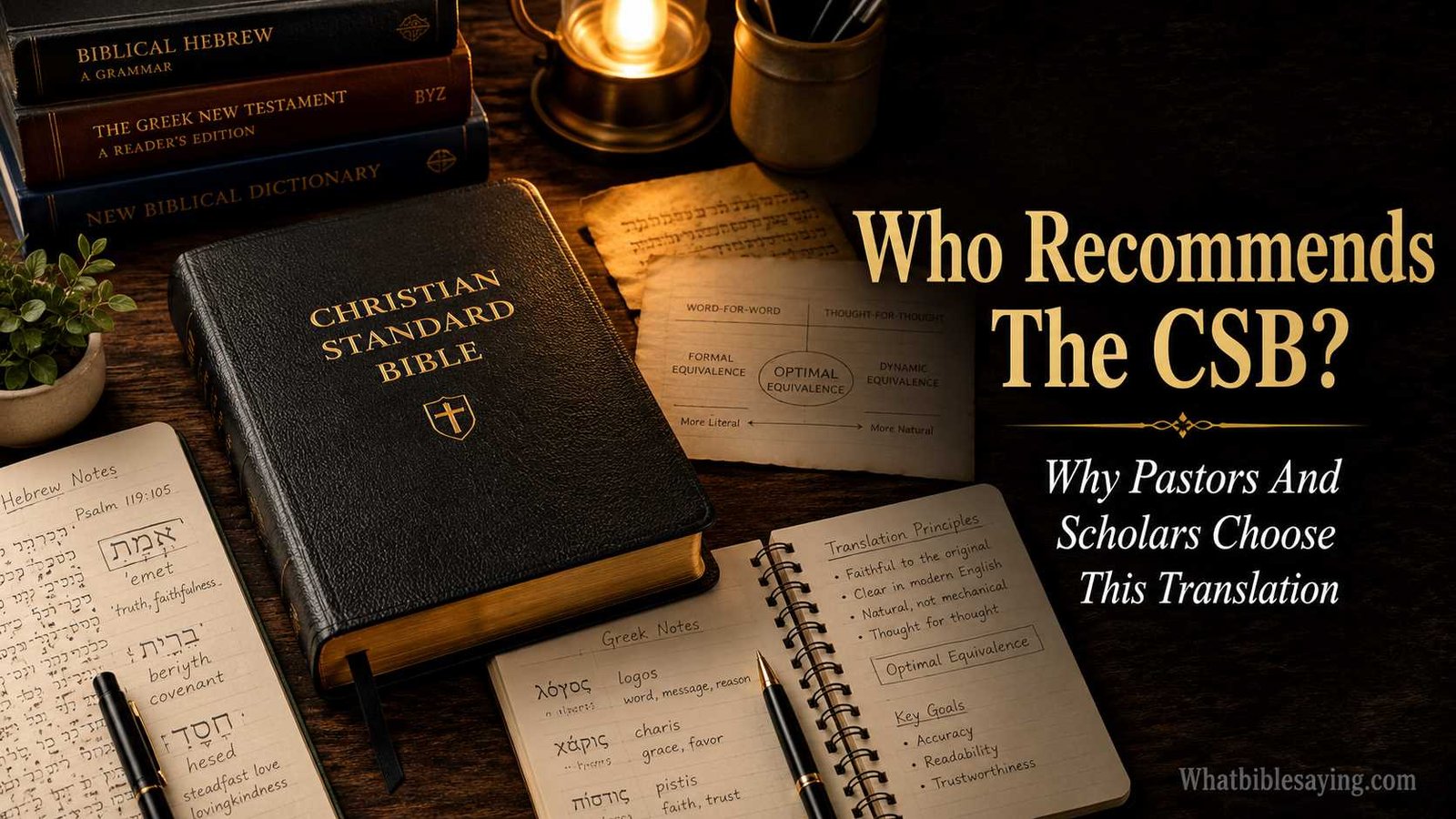
The CSB calls its translation method Optimal Equivalence.
That phrase sounds technical, but the basic idea is simple.
Imagine two goals.
One goal is to stay as close as possible to the wording and structure of the original Hebrew and Greek.
The other goal is to make the meaning understandable in natural modern English.
Sometimes both goals fit together easily.
Sometimes they do not.
The CSB says it uses a more literal rendering when the original structure communicates clearly in English. When a very literal rendering could hide or confuse the meaning, translators may use more natural English to communicate what the passage means.
CSB materials describe this as balancing linguistic precision with contemporary readability.
This helps explain why there are so many Bible translations.
Languages do not match each other perfectly.
An ancient Hebrew expression may sound strange if copied directly into English. A Greek sentence may follow a word order that feels unnatural to an English speaker. A phrase that made immediate sense two thousand years ago may need careful wording for a modern reader.
Translators therefore make decisions.
The important question is whether those decisions faithfully communicate the meaning of the biblical text.
Pros and Cons of CSB Bible Translation
People searching for the pros and cons of CSB Bible usually want something more useful than a list of endorsements.
Here is a balanced view.
The CSB Is Easy to Read Without Being a Paraphrase
The CSB uses contemporary English.
For many readers, that makes it easier to follow than translations that preserve more ancient or formal English patterns.
Yet the CSB is not a paraphrase.
Its translation committee works from the biblical languages and seeks to preserve the meaning of the original text while communicating clearly in English.
That makes the CSB attractive to people who want something readable without moving too far toward a highly interpretive style.
The CSB Works Well for Public Reading
A Bible is not only studied silently.
It is also read aloud in church, family worship, Bible studies, classrooms, and small groups.
Natural sentence structure matters in those settings.
One reason pastors recommend the CSB is that it tends to sound understandable when spoken aloud.
That can be especially useful when the audience includes children, teenagers, new Christians, and people who did not grow up hearing traditional biblical language.
The CSB Can Be Used for Serious Study
Readability does not mean the CSB was designed only for beginners.
Its published goals include personal study, sermon preparation, private devotion, memorization, and public reading.
Study editions also provide notes, maps, articles, timelines, and other resources.
Still, students doing detailed Hebrew or Greek work will normally compare several translations rather than depend on only one English Bible.
That is good practice no matter which translation you prefer.
The CSB Has Broad Evangelical Scholarly Participation
The original HCSB translation involved scholars from 17 denominations, and the CSB revision continued with scholars from several conservative evangelical traditions, including Baptist, Lutheran, Presbyterian, Anglican, and non-denominational backgrounds.
That provides broader input than a translation created around the views of one individual.
At the same time, readers should understand its theological setting.
The CSB comes from a conservative evangelical Protestant translation tradition. Its standard editions follow the Protestant biblical canon.
Catholic and Orthodox readers may therefore prefer an approved Bible edition that includes the books recognized within their own church tradition.
That does not make the CSB useless to them. It simply means church tradition and canon should be part of the decision.
Some Readers May Prefer a More Literal Style
Not everyone wants the same balance.
A reader doing close grammatical study may prefer a translation that follows Hebrew and Greek structure more closely.
The NASB, for example, describes its philosophy as formal equivalence, seeking to preserve the wording, grammar, and structure of the original languages as closely as workable English permits.
The ESV similarly describes itself as an essentially literal translation with a strong emphasis on word-for-word correspondence.
If that is your main priority, you may prefer one of those translations or use it beside the CSB.
Some Readers May Prefer Even Simpler English
At the other end, some readers want the easiest possible flow.
The New Living Translation puts strong emphasis on communicating the meaning of the original in clear, natural contemporary English. Its translators sometimes render passages more dynamically when a literal expression would be confusing or unnatural.
A new Bible reader may therefore compare the CSB and NLT and find the NLT easier in some passages.
That does not necessarily make one more faithful than the other. They approach the translation task somewhat differently.
Bible Translations Comparison Chart
A simple Bible translations comparison chart can help you understand where the CSB fits.
No Bible translation fits perfectly into one box, but the general differences look something like this:
| Translation | General Translation Style | Reading Feel | Often Chosen For |
|---|---|---|---|
| NASB | Strong formal equivalence | Detailed, sometimes more formal | Close study |
| ESV | Essentially literal | Formal but readable | Study, teaching, preaching |
| CSB | Optimal equivalence | Clear and moderately literal | Study, reading, preaching |
| NIV | Balanced approach | Smooth contemporary English | Church, study, general reading |
| NLT | More meaning-based | Very natural and easy | Devotion, beginners, public reading |
This table should not be treated as a ranking.
Each translation has its own stated philosophy.
Crossway describes the ESV as essentially literal. The Lockman Foundation describes the NASB as formal equivalence. Biblica says the NIV aims to balance faithfulness to the original with clear natural English. Tyndale describes the NLT as using both literal and meaning-based approaches, becoming more dynamic when necessary for clear communication.
The CSB sits somewhere in the middle of this spectrum by design.
That middle position is one of its greatest strengths for many readers.
Is the CSB One of the Most Accurate Bible Translations?
Yes, the CSB is generally regarded as a serious modern translation produced through scholarly work.
But the question which Bible translation is the most accurate needs careful wording.
There is no simple scientific score that proves one English Bible is the most accurate in every verse.
Why?
Because accuracy involves more than literalness.
Suppose an ancient expression translated word for word makes little sense in modern English. A completely literal rendering may preserve the form while hiding the meaning.
On the other hand, if translators explain too much inside the translation itself, they may move beyond translation into interpretation.
This creates a real tension.
A good translation has to consider:
- The original Hebrew, Aramaic, or Greek text
- Grammar
- Word meaning
- Historical context
- Idioms
- Literary style
- English readability
- The meaning of the larger passage
This is why two responsible translations can use different English words without one necessarily being dishonest or careless.
The NIV’s translation philosophy makes this point clearly. Biblica explains that a word-for-word rendering is not automatically the most accurate if it creates unnatural or misleading English.
The CSB addresses the same problem through Optimal Equivalence.
So a fair answer is:
The CSB belongs among serious modern English Bible translations, but accuracy should be judged passage by passage rather than by declaring one translation perfect for every purpose.
Who Recommends The CSB Bible for Beginners?
The CSB can be a strong choice for beginners because its English is modern without becoming overly simplified.
A new Bible reader already has enough challenges.
Names are unfamiliar.
Ancient cultures are unfamiliar.
Some books are thousands of years old.
The reader should not have to fight unnecessarily complicated English at the same time.
The CSB’s stated goal of combining clarity and precision can help here. Its publishers specifically present it as useful not only for serious study but also for new and younger readers.
I would still encourage a beginner to compare a few passages before buying a Bible.
Read Psalm 23.
Read Matthew 5.
Read John 1.
Read Romans 8.
Then compare the same passages in the CSB, NIV, NLT, ESV, or another respected translation.
Which one can you understand without constantly stopping?
Which one makes you want to keep reading?
Those questions matter.
Our guide on what to read in the Bible can also help if you have chosen a translation but are unsure where to begin.
What Bible Translation Should I Use?
When someone asks me, what Bible translation should I use, I rarely answer with only one name.
Instead, I ask what you plan to do with it.
Choose the CSB If You Want Balance
The CSB may be a very good choice if you want:
- Clear modern English
- Serious translation scholarship
- A Bible suitable for daily reading
- A translation useful in Bible study
- A Bible that reads naturally aloud
- Something between highly formal and strongly meaning-based translation styles
For many Christians, that is exactly the combination they want.
Consider the NASB or ESV for Very Close Word Study
If your main goal is tracing wording and sentence structure as closely as possible in English, you may want to compare the CSB with the NASB or ESV.
That does not mean those translations contain no interpretation.
Every translation requires interpretation at some level.
It simply means their stated philosophy gives more weight to preserving the form of the original text.
Consider the NIV for Another Balanced Approach
The NIV also aims to balance accuracy with clear contemporary English.
Its translation committee describes its goal as communicating the meaning of the ancient text naturally while still paying close attention to its form and details.
Readers choosing between the NIV and CSB should compare actual passages rather than relying only on translation labels.
Consider the NLT If Simplicity Is Your Main Need
If you are completely new to the Bible, struggle with English, or want very natural devotional reading, the NLT may feel easier.
Its translation team specifically emphasizes clear contemporary English and meaning-based communication where a literal form would be confusing.
Some people use the NLT for daily reading while keeping a more formal translation nearby for comparison.
That can work well.
Should You Study With More Than One Bible Translation?
Yes.
Using more than one reliable translation can be extremely helpful.
You may read the CSB as your main Bible and compare the ESV, NASB, NIV, or NLT when a passage is difficult.
This does not mean God’s Word is confused.
It means translation is difficult.
One English version may preserve an ancient expression more closely. Another may show its meaning more clearly.
Seeing both can help.
Our guide on how to read the Bible using Michael Youssef’s study principles discusses the usefulness of comparing two or three reliable translations when studying difficult passages.
Think of it like looking at the same landscape through more than one window.
The landscape has not changed.
Your view becomes broader.
Does the CSB Change or Update Its Text?
Bible translations sometimes receive revisions as language changes and scholars continue studying manuscripts.
The CSB has also made revisions.
A published 2020 update explained that its Translation Oversight Committee made adjustments after reviewing feedback from scholars, pastors, and readers. According to the committee, those changes affected less than one percent of the text and were intended to improve accuracy, readability, grammar, style, and consistency.
That should not automatically alarm Bible readers.
Revisions do not necessarily mean an earlier Bible was false.
Translation committees regularly review wording when scholarship improves or when English usage changes.
The important questions are what changed, why it changed, and whether the reasons are openly explained.
The CSB has published information explaining many of its translation decisions, including choices involving divine pronouns and the translation of words such as tongues.
Transparency is helpful whenever a translation committee makes changes.
Does a Pastor’s Recommendation Mean the CSB Is Right for You?
No.
It is valuable to know who recommends the CSB Bible, especially when those recommendations come from people who spend years preaching, teaching, or studying Scripture.
But you are not choosing a pastor.
You are choosing a Bible translation.
A famous person’s name should therefore be one piece of information, not the whole decision.
Ask yourself:
- Can I understand this translation?
- Is it translated from the biblical languages by qualified scholars?
- Does its translation philosophy fit my purpose?
- Can I read it comfortably every day?
- Does my church use a particular translation?
- Do I need a Catholic, Orthodox, or Protestant canon?
- Will I use it for devotion, study, teaching, or all three?
- Can I compare it with other reliable translations when necessary?
Those questions are much more useful than asking which translation has the longest endorsement list.
A Bible sitting unopened on a shelf will not help you much.
A faithful translation that you actually read can shape your thinking, prayer, worship, decisions, and understanding of God for years.
Who Recommends The CSB Bible for Serious Bible Study?
The CSB’s public supporters include pastors, teachers, and scholars who use Scripture in demanding settings.
That is significant.
Pastors need to explain passages publicly.
Bible teachers need understandable wording.
Scholars care about the original languages.
Ordinary Christians need something they can read without feeling that every sentence requires a dictionary.
The CSB was created with all of those needs in view.
Its published translation goals include personal study, sermon preparation, private devotion, memorization, public reading, and sharing Scripture with others.
For deep study, though, I would still recommend using more than one tool.
A good study pattern might include:
CSB for your main reading.
ESV or NASB for comparison with a more formal rendering.
NIV or NLT when you want to see how another translation expresses the meaning naturally.
Study Bible notes for historical and cultural context.
A Bible dictionary or commentary for difficult subjects.
Hebrew and Greek tools when deeper word study is necessary.
You do not need all of these every morning.
But they are valuable when you come to a difficult passage.
Choosing a Bible You Will Actually Read
So, who recommends the CSB Bible?
A wide range of pastors, Christian teachers, ministry leaders, and biblical scholars have publicly supported it. Official CSB endorsement materials have included names such as David Platt, Alistair Begg, Tony Evans, J.D. Greear, Lisa Harper, Kyle Idleman, Nancy DeMoss Wolgemuth, Derwin Gray, Daniel Akin, Ben Gladd, and others.
Their recommendations are worth hearing.
But the deeper question is not whether a famous Christian likes the CSB.
The deeper question is whether the translation will help you faithfully read and understand Scripture.
The CSB has a strong case for readers who want a middle path between formal wording and easy contemporary English. Its translation team calls that approach Optimal Equivalence. The translation comes from serious scholarly work, and its stated goal is to preserve biblical meaning while making Scripture understandable to modern readers.
For some people, the CSB may become their main Bible.
Others may prefer the NASB, ESV, NIV, NLT, or another respected translation.
You do not need to turn that choice into a contest.
Good Bible reading begins with something more important than winning an argument about translations.
Open the Bible.
Read slowly.
Pay attention to context.
Compare translations when something is unclear.
Ask what the biblical writer meant.
Pray for wisdom.
Then allow God’s Word to shape the way you believe and live.
The best Bible on your shelf is not simply the one recommended by the most famous people.
It is a trustworthy translation that you return to again and again with a willing heart.

Dr. Michael is a well-known author who shares why trusting the Bible matters. He speaks in a way that’s easy to follow, helping people see its truth clearly.