
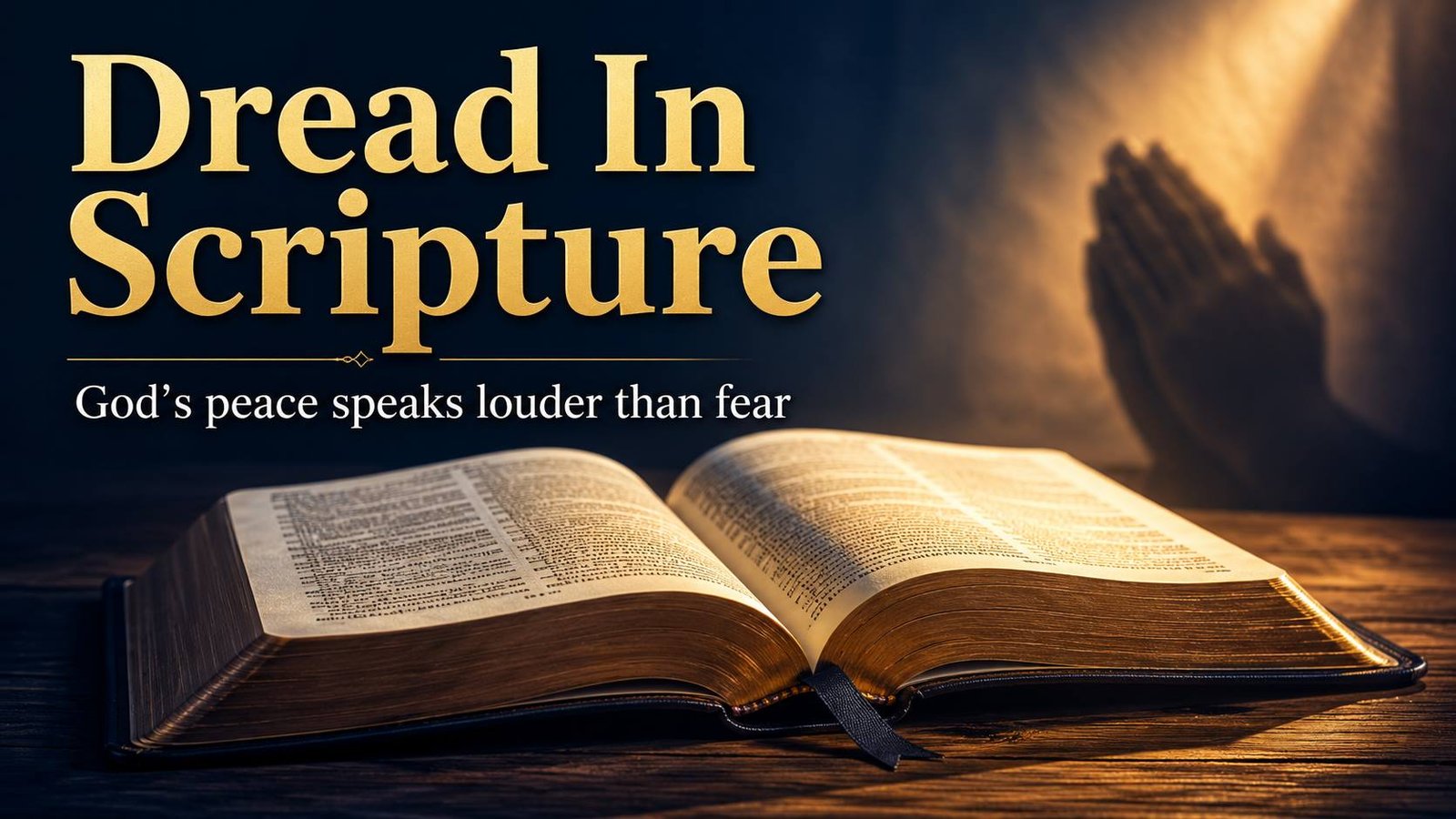
 Dread in the Bible means a deep, heavy kind of fear. It is more than feeling nervous for a moment. Dread is the kind of fear that can shake the heart, trouble the mind, and make a person feel weak before danger, judgment, or something greater than themselves.
Sometimes the Bible uses dread to describe terror before enemies. Sometimes it describes fear that falls on nations when they see God’s power. At other times, it can stand close to holy awe, the deep respect people feel when they realize God is not small, weak, or ordinary.
So, what does dread mean in the Bible? It usually means intense fear, trembling, terror, or deep awe. The meaning depends on the verse. Dread can be unhealthy when it controls us, but fear of the Lord, meaning reverence and holy respect, is good and wise.
The Bible does not pretend fear is fake. God knows people feel dread. Abraham, Moses, David, Elijah, Mary, Peter, and many others faced fear in different ways. But Scripture also teaches that dread does not have to rule the heart. God calls His people from fear into trust.
What Does Dread Mean In The Bible in Simple Words?
In simple words, dread means a strong fear of something serious or painful.
You may dread bad news.
You may dread a hard conversation.
You may dread sickness, loss, failure, or danger.
In the Bible, dread often appears when people face something bigger than human strength. This could be war, judgment, disaster, enemies, or the visible power of God.
For example, in Deuteronomy 2:25, God says He will put the “dread” and fear of Israel upon the nations. This does not mean Israel was naturally strong on its own. It means God’s power was with them, and other nations would tremble when they heard what God was doing.
That is one important point: biblical dread is often connected to power. People feel dread when they realize they are facing something they cannot control.
In daily life, dread can feel like a shadow over the heart. You wake up, and before anything happens, the fear is already there. It feels heavy. It feels close. It feels like something bad is coming.
The Bible understands that feeling. But it also speaks a better word over it.
Psalm 27:1 says the Lord is the believer’s light and salvation. David then asks, “Whom shall I fear?” This is not because David had no enemies. He had many. But he knew fear was not stronger than God.
That is where the Bible gives comfort. Dread may be real, but God is more real.
What Does “Dread” Mean in Hebrew and Greek?
The Old Testament was mostly written in Hebrew, and the New Testament was written in Greek. These languages have several words for fear, dread, terror, awe, and reverence.
One Hebrew word often connected with dread is pachad. It can mean fear, terror, trembling, or sudden alarm. It can describe fear that comes upon people when they face danger or judgment.
Another Hebrew word often related to fear is yirah. This word can mean fear, but it can also mean reverence or holy respect. This is the kind of fear often used in the phrase “fear of the Lord.”
That matters because not all fear in the Bible is the same.
Some fear is panic.
Some fear is wisdom.
Some fear is reverence.
Some fear is unbelief.
Some fear is a warning that something is wrong.
In the New Testament, the Greek word phobos can mean fear, terror, reverence, or awe, depending on the verse. It is where we get the English word “phobia.” But in Scripture, it is not always negative. Sometimes it means deep respect before God.
Another Greek word, deilia, appears in 2 Timothy 1:7. This word points to timidity, cowardice, or a shrinking-back kind of fear. Paul tells Timothy that God has not given believers a spirit of fear, but of power, love, and self-control.
This helps us understand the difference between fear that honors God and fear that controls us.
Holy fear bows before God.
Unhealthy dread runs from God.
Holy fear says, “God is great, and I belong to Him.”
Unhealthy dread says, “My fear is greater than God’s care.”
The Bible keeps these meanings clear. It does not tell us to be careless. It tells us not to be ruled by fear.
Dread Can Mean Terror, But It Can Also Point to Awe
Dread often sounds negative because we usually use it for something painful. But in Scripture, fear language can also point to awe.
Awe is not the same as panic. Awe is the deep feeling that comes when you stand before something great.
Think of standing near a powerful ocean. You may feel small, but not because the ocean hates you. You feel small because the ocean is strong, wide, and beyond your control.
In a much greater way, people in the Bible often trembled before God’s holiness. Not because God is evil, but because He is pure, mighty, and glorious.
This is why the “fear of the Lord” is called the beginning of wisdom in Proverbs 9:10. It means we finally see life clearly. We stop pretending we are the center of everything. We learn that God is holy, and His ways are right.
That kind of fear is not sinful. It is healthy. It leads to humility, obedience, worship, and wisdom.
But dread that makes us hide from God, doubt His goodness, or live in constant despair is not where God wants us to stay.
Is Dread a Sin in the Bible?
A simple answer is this: feeling dread is not automatically a sin in the Bible.
Many faithful people felt fear. David felt fear. Elijah felt afraid and ran from danger. The disciples were afraid in the storm. Even Jesus, in the garden before the cross, was deeply troubled. The Bible does not shame people for having real human emotions.
Fear can be a normal human response to danger. If you see a fire, fear helps you move away. If a child runs toward a road, fear pushes a parent to act quickly. That kind of fear is not sin. It is part of being human in a broken world.
But dread can become spiritually dangerous when it becomes our master.
Dread becomes a problem when it makes us stop trusting God.
Dread becomes a problem when it leads us into disobedience.
Dread becomes a problem when it controls every decision.
Dread becomes a problem when we believe fear more than Scripture.
This connects with the question, is worrying a sin in the Bible? Worry is not always a simple yes-or-no issue. A worried thought may come suddenly. But when worry grows into a lifestyle of distrust, Jesus calls us back to the Father’s care.
In Matthew 6, Jesus teaches His followers not to be anxious about food, clothing, or tomorrow. He does not say this harshly. He speaks like a loving Shepherd. He reminds us that the Father sees the birds, clothes the flowers, and knows what His children need.
So when someone asks, is dread a sin in the Bible? the better answer is this: feeling dread shows we are human, but living under dread as though God is absent is not the life God desires for us.
When Fear Becomes a Master
Fear becomes a master when it starts giving orders.
It says, “Do not obey God.”
It says, “Do not forgive.”
It says, “Do not speak truth.”
It says, “Do not trust anyone.”
It says, “Do not hope again.”
This is why Scripture often says, “Do not fear.” God is not pretending life is easy. He is reminding His people that fear is a terrible lord.
Fear takes much and gives little. It takes peace, courage, sleep, joy, and prayer. It gives only more fear.
That is why don’t be anxious Bible verse topics are so loved by many readers. People are not looking for cold information. They are looking for help in the middle of real pressure.
Philippians 4:6–7 tells believers to bring their requests to God with prayer and thanksgiving. Then God’s peace guards the heart and mind in Christ Jesus. Notice the order. God does not say, “Fix everything first, then come to Me.” He says, “Bring it to Me.”
Dread loses power when it is brought into God’s presence.
What Is the Difference Between Fear and Dread?
Fear and dread are close, but they are not exactly the same.
Fear can be sudden. Dread is often deeper and heavier. Fear may come when something happens. Dread can arrive before anything happens, because the heart is already expecting pain.
Here is a simple way to see the difference:
| Word | Simple Meaning | Bible Idea |
|---|---|---|
| Fear | A response to danger, warning, or greatness | Can be wise, sinful, natural, or reverent |
| Dread | Heavy, deep, troubling fear | Often linked with terror, enemies, judgment, or intense awe |
| Reverence | Holy respect before God | Good, wise, and spiritually healthy |
| Anxiety | Ongoing worry about what may happen | Something God invites us to bring to Him |
| Trust | Resting in God’s character | The answer Scripture gives to fear |
Fear can be good when it keeps us from danger. A child should fear touching fire. A driver should fear reckless speed. A believer should fear sin, not because God is cruel, but because sin destroys.
Dread is usually more intense. It is often the feeling of being overwhelmed before something terrible or unknown.
But reverence is different. Reverence is not panic. It is love mixed with holy respect. It is the quiet knowledge that God is God, and we are not.
This is important when studying what does fear in the Bible mean. The Bible does not treat every fear as evil. It teaches us to reject fear that controls us, while keeping reverence that honors God.
What Is the Spirit of Dread?
The exact phrase “spirit of dread” is not a main Bible phrase in the way some people use it today. People often use it to describe a heavy, controlling fear that seems to sit on the heart and mind.
A person may say, “I feel a spirit of dread,” when they mean:
They feel constant fear.
They expect something bad to happen.
They feel spiritually heavy.
They cannot rest.
They feel trapped by anxious thoughts.
The Bible does speak about fear in spiritual terms. In 2 Timothy 1:7, Paul says God has not given us a spirit of fear, but of power, love, and self-control.
This verse does not mean a Christian will never feel afraid. Timothy himself seems to have needed courage. Paul wrote to strengthen him, not shame him.
The point is that controlling fear does not come from God’s heart for His children. God may warn, correct, and humble us, but He does not delight in crushing us with dread.
When people ask, what is the spirit of dread? a careful biblical answer would be: it is not a formal Bible title, but it can describe a pattern of fear that weighs down the soul and pulls a person away from trust in God.
This also connects with what does the Bible say about the spirit of fear. Scripture teaches that fear should not rule believers. God gives power to obey, love to act rightly, and self-control to think clearly.
Fear confuses.
God gives a sound mind.
Fear isolates.
God calls us into prayer and wise community.
Fear says, “You are alone.”
God says, “I am with you.”
What Does Dread Mean In The Bible for Believers Today?
When we ask, what does dread mean in the Bible, we are not only asking about ancient words. We are asking about our own hearts.
People still live with dread today.
A parent may dread a doctor’s report.
A young person may dread failure.
A worker may dread losing a job.
A family may dread conflict.
A believer may dread the future, death, judgment, or not being enough.
The Bible speaks to all of this with truth and mercy.
God does not say, “Real believers never feel afraid.” That would not match the stories of Scripture. Instead, God keeps saying, “Do not fear, for I am with you.”
That phrase matters: I am with you.
God’s answer to dread is not always an instant explanation. Sometimes His answer is His presence.
When Israel stood at the Red Sea, they were afraid. When David faced enemies, he prayed. When the disciples were in the storm, Jesus came to them. When Paul faced danger, the Lord strengthened him.
The pattern is clear. God meets His people in fear.
God’s Peace Does Not Ignore Fear
Some people think peace means nothing bad is happening. But what the Bible says about peace is deeper than that.
Biblical peace is not just quiet around us. It is rest within us because God is near.
Jesus told His disciples, “Peace I leave with you.” He said this before the cross, not after all trouble had disappeared. That means Christian peace can exist even in a hard season.
Peace does not say danger is fake.
Peace says God is faithful.
Peace does not deny tears.
Peace says tears are not the end.
Peace does not remove every question.
Peace teaches the heart to rest in God while questions remain.
This is closely tied to what does the Bible say about trusting God. Trust is not pretending we understand everything. Trust is placing our weight on God’s character.
We trust Him because He is good.
We trust Him because He is wise.
We trust Him because He sees more than we see.
We trust Him because Christ has shown the depth of God’s love.
Dread may ask, “What if everything goes wrong?”
Faith answers, “Even then, God will not leave me.”
Bible Verses That Help Us Understand Dread
The Bible gives many passages that help us understand dread, fear, awe, and trust.
Deuteronomy 2:25
God says He will put dread and fear of Israel upon the nations. This shows dread as terror before God’s mighty acts. The nations would hear and tremble, not because Israel was great by itself, but because God was with Israel.
Deuteronomy 11:25
This verse speaks again of dread and fear falling on enemies because of the Lord’s promise. It reminds us that dread can be something God places on those who oppose His purposes.
Job 18:11
Job speaks of terrors frightening the wicked. Here dread is linked with judgment, fear, and the painful results of a life far from righteousness.
Psalm 27:1
David asks whom he should fear if the Lord is his light and salvation. This is one of the clearest faith answers to dread. David does not deny danger. He declares God’s strength above danger.
Proverbs 3:24–26
This passage speaks of sleeping without fear and not being afraid of sudden terror. It shows that wisdom and trust in the Lord bring steadiness to the heart.
Isaiah 12:2
Isaiah says, “I will trust, and not be afraid.” This is a beautiful movement from fear to faith. Trust does not always come naturally. Sometimes we must choose it again and again.
1 John 4:18
John teaches that perfect love casts out fear. This does not mean Christians never feel fear. It means God’s mature love drives away the fear of punishment and rejection. The more deeply we know God’s love, the less dread controls us.
2 Timothy 1:7
Paul reminds Timothy that God has not given a spirit of fear, but power, love, and self-control. This is one of the strongest verses for anyone struggling with controlling fear.
These verses show a balanced picture. The Bible takes fear seriously, but it never gives fear the final word.
How God Leads the Heart From Dread to Trust
God often leads the heart from dread to trust step by step.
Most people do not move from panic to peace in one second. Sometimes they do, by God’s grace. But often, God teaches us slowly, like a patient Father helping a child learn to walk.
The first step is to name the fear honestly.
You can pray, “Lord, I am afraid.” That is not weakness. That is truth. Many Psalms begin with honest pain and end with renewed trust.
The second step is to bring the fear into God’s presence.
Dread grows in silence. It grows when we hide it, feed it, and repeat it alone. Prayer brings dread into the light. It places fear before the One who is greater.
The third step is to listen to Scripture more than imagination.
Dread often creates pictures in the mind. It says, “This will happen. That will happen. You will not survive it.” But dread is not a prophet. It does not know the future.
God’s Word is more trustworthy than fear’s predictions.
The fourth step is to remember what God has already done.
In the Bible, God often tells His people to remember. Remember the Red Sea. Remember the wilderness. Remember the manna. Remember the cross. Remember the empty tomb.
Memory strengthens trust.
The fifth step is to take one faithful step.
Fear wants the whole road explained before we obey. God often gives enough light for the next step.
Make the call.
Ask for help.
Open the Bible.
Pray honestly.
Forgive slowly.
Tell the truth.
Rest tonight.
Small obedience matters.
The sixth step is to seek wise help when fear becomes too heavy.
Some dread is tied to trauma, deep anxiety, or painful life experiences. A believer should not feel ashamed to speak with a pastor, counselor, doctor, or trusted mature Christian. God often helps us through people.
Faith does not mean refusing help. Faith means receiving help with humility and wisdom.
Why the Fear of the Lord Is Different From Dread
One of the most important parts of this topic is the difference between dread and the fear of the Lord.
The fear of the Lord is not the fear of being hated by God. It is not terror that makes a believer run away from Him. It is holy reverence.
The fear of the Lord says:
God is holy.
God is true.
God is just.
God is wise.
God is worthy of worship.
God should be obeyed.
This fear is clean. Psalm 19:9 says the fear of the Lord is pure. It does not poison the soul. It cleans the soul.
Dread, when unhealthy, makes us shrink away from God. The fear of the Lord draws us near with humility.
Dread says, “Hide from God.”
The fear of the Lord says, “Bow before God.”
Dread says, “God will never help me.”
The fear of the Lord says, “God is my only true help.”
Dread says, “I am trapped.”
The fear of the Lord says, “God is greater than this.”
That is why Proverbs connects the fear of the Lord with wisdom. A person who reveres God sees life more clearly. They do not treat sin lightly. They do not treat God casually. They do not treat people as worthless.
Holy fear makes us wiser and kinder. Unhealthy dread makes us smaller and more afraid.
Did Bible Characters Feel Dread?
Yes, many Bible people felt deep fear.
David often cried out to God when enemies surrounded him. He was a brave man, but bravery does not mean never feeling fear. It means trusting God while fear is present.
Elijah saw God answer by fire on Mount Carmel, but later he ran from Jezebel in fear. God did not crush him. God gave him rest, food, and a gentle word.
The disciples feared the storm while Jesus slept in the boat. Jesus corrected their little faith, but He also calmed the storm. He cared for them while teaching them.
Mary was troubled when the angel Gabriel greeted her. The angel said, “Do not be afraid.” God was calling her into something holy, but the moment was still overwhelming.
Peter denied Jesus under pressure. Fear overcame him for a time. But Jesus restored him with mercy and gave him work to do.
These stories matter because they show us something tender about God. He knows our frame. He knows we are dust. He knows fear can rise quickly in the human heart.
But He also knows what His grace can do.
The Bible is not a book about fearless humans. It is the story of a faithful God who strengthens fearful people.
What Dread Teaches Us About Our Need for God
Dread shows us that we are not in control.
That can be painful, but it can also become a doorway to faith.
Many people try to defeat dread by controlling everything. They plan more, worry more, check more, and think more. But the soul does not find peace by becoming the ruler of the universe. That seat is already taken.
Peace begins when we admit, “Lord, I am not God.”
This is not defeat. It is freedom.
You do not have to hold the future in your hands.
You do not have to solve every possible problem tonight.
You do not have to carry tomorrow before it arrives.
You do not have to be strong without God.
Dread tells us we need shelter. Scripture tells us the Lord is that shelter.
Psalm 46 calls God our refuge and strength, a very present help in trouble. That means God is not far away from fearful people. He is present. He is near. He is strong.
How to Pray When You Feel Dread
When dread is heavy, long prayers can feel hard. Simple prayers are enough.
You can pray like this:
“Lord, I feel afraid. Help me trust You.”
“Father, my mind is not at peace. Guard my heart.”
“Jesus, You are with me. Teach me not to run from You.”
“Holy Spirit, give me power, love, and self-control.”
“God, I do not know what will happen, but I know You are faithful.”
Prayer is not magic words. Prayer is turning toward God.
Sometimes your emotions may not change right away. That does not mean prayer failed. It means you are learning to stand in faith while feelings are still moving.
A child may still tremble while holding a father’s hand. But the hand is real.
So keep holding.
What This Teaches Us About Faith
What does dread mean in the Bible? It means deep fear, terror, trembling, or awe. It can describe the fear people feel before danger, judgment, enemies, or the mighty power of God.
But the Bible does not leave us trapped in dread.
It teaches us that fear may come, but God is near. It teaches us that not all fear is sinful, but fear must never become our lord. It teaches us that holy reverence is good, while controlling dread is something God calls us out of.
The heart of Scripture is not, “Be strong by yourself.”
The message is better than that.
God is strong.
God is present.
God is faithful.
God’s love is greater than fear.
When dread visits your heart, do not pretend it is not there. Bring it to God. Open His Word. Speak honestly. Ask for help. Take the next faithful step.
Dread may knock on the door, but it does not have to sit on the throne.
That place belongs to the Lord.

Dr. Rachel is very smart and knows a lot about the Bible. He helps us understand the Bible better by talking about the old texts in a simple way.