

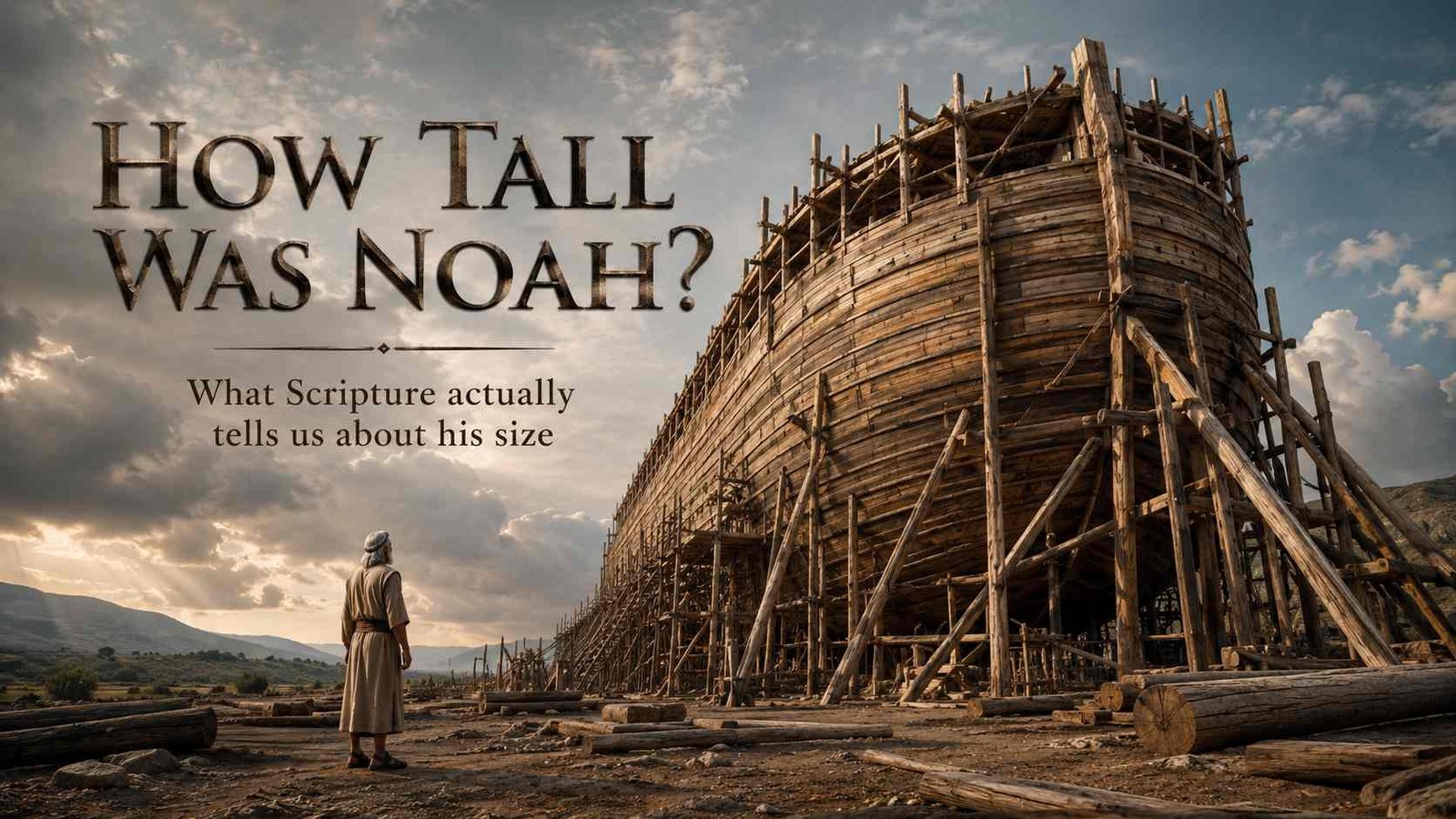
 How tall was Noah in the Bible? The simplest and most accurate answer is this: the Bible does not tell us Noah’s height.
Genesis gives us many details about Noah. We learn about his family, his age, his faith, the Flood, and the enormous ark he built. We even receive exact measurements for the ark. Yet Scripture never gives a measurement for Noah himself.
This matters because you may find claims online saying Noah was 9 feet, 15 feet, or even 30 feet tall. Some theories describe him as a giant because he lived before the Flood. Others try to estimate his height from the length of the cubit used to build the ark.
None of these estimates is given in the Bible.
Genesis describes Noah as a righteous man who walked with God. It gives the ark as 300 cubits long, 50 cubits wide, and 30 cubits high, but there is no verse stating Noah’s physical height.
So when we ask how big Noah was, we need to separate biblical facts from interesting but unproven ideas.
Does the Bible Tell Us How Tall Noah Was?
No. There is no passage in Genesis or elsewhere in Scripture that tells us Noah’s height.
The main account of Noah appears in Genesis 5 through Genesis 9. These chapters contain surprisingly precise information about parts of his life.
We know, for example, that Noah was the son of Lamech. We know his sons were Shem, Ham, and Japheth. We know he was 600 years old when the Flood came. We also know that he lived until the age of 950.
Yet none of those passages describes him as unusually tall.
Genesis 6:9 tells us what the biblical writer considered especially important about Noah:
“Noah was a righteous man, blameless among the people of his time, and he walked faithfully with God.”
That is the Bible’s portrait of Noah. His spiritual character receives attention. His physical size does not.
This is not unusual in Scripture. The Bible sometimes describes a person’s appearance, but many important biblical figures have no recorded height.
We know far more about what Noah believed and did than about what he looked like.
What Genesis Actually Tells Us About Noah
Rather than guessing about his height, consider what Genesis clearly tells us.
Noah:
- was a descendant of Adam through Seth
- was the son of Lamech
- had three sons named Shem, Ham, and Japheth
- found favor with God
- was described as righteous and blameless among his generation
- walked with God
- obeyed God’s command to build the ark
- entered the ark with his family
- survived the Flood
- lived 950 years
- became an important ancestor of the post-Flood human family
Those are biblical facts.
The statement that Noah was 10, 15, or 30 feet tall is not.
That distinction is important whenever we study questions about how tall were the giants in the Bible, the Nephilim, Adam, Goliath, or other ancient biblical people.
How Big Was Noah in the Bible Compared With the Ark?
One reason people wonder about Noah’s size is the enormous vessel he was commanded to build.
Genesis 6:15 gives actual measurements:
The ark was 300 cubits long, 50 cubits wide, and 30 cubits high.
That is a huge structure.
But the measurements describe the ark, not Noah.
What Is a Cubit?
A cubit was an ancient unit of measurement commonly connected with the distance from a person’s elbow to the tip of the fingers.
It was not exactly the same length in every ancient culture or period.
A commonly used approximation is around 18 inches, although longer cubit standards are also known. Because the exact cubit intended in Genesis is debated, modern reconstructions of the ark can differ somewhat in their measurements.
Using an 18-inch cubit would make an ark 300 cubits long about 450 feet long.
Using a longer cubit would produce an even larger vessel.
Readers interested in these ancient measurements can also see our guide on how big is a cubit in the Bible.
The important point is simple: Genesis deliberately gives the ark’s dimensions while giving us no corresponding dimensions for Noah.
If the writer wanted readers to know Noah’s height, he could have provided it. He did not.
Can Noah’s Cubit Tell Us His Height?
Some modern reconstructions have tried to estimate Noah’s height by assuming the cubit used for the ark was based directly on Noah’s own arm.
The reasoning sounds interesting.
If Noah’s personal forearm defined the cubit, perhaps the cubit’s length could tell us something about his overall body size.
But there is a major problem.
Genesis never says the ark’s cubit was literally Noah’s personal elbow-to-fingertip measurement.
A cubit was a recognized unit of length in ancient societies. Saying something was 300 cubits long does not mean we know the exact body measurements of the person using the unit.
Think about modern measurements. If someone tells you that a wall is twelve feet long, you cannot calculate the builder’s height from that information.
The same caution applies here.
The enormous ark does not require an enormous Noah.
Was Noah a Giant in the Bible?
The Bible never calls Noah a giant.
This question often comes from Genesis 6 because the Nephilim are mentioned shortly before Noah’s story.
Genesis 6:4 refers to the Nephilim being on the earth in those days. A few verses later, Genesis introduces Noah as a righteous man who found favor with God.
Because these statements appear close together, some readers assume Noah must somehow have been physically connected with the Nephilim.
The text does not say that.
Noah and the Nephilim
Genesis 6 is one of the Bible’s most discussed passages.
Interpretations of the “sons of God,” the “daughters of men,” and the Nephilim have differed among Jewish and Christian readers for centuries.
We do not need to settle every question about the Nephilim to answer the question about Noah.
Genesis does not identify Noah as one of them.
It does not call him a giant.
It does not give him extraordinary physical measurements.
Instead, Genesis draws attention to a moral contrast.
The surrounding world had become deeply corrupt and violent, while Noah found favor with God and walked faithfully with Him.
That is the contrast the passage emphasizes.
If you are studying this subject more deeply, how tall were the Nephilim in the Bible is a separate question from Noah’s height. Scripture’s silence about Noah’s stature should not be filled by simply borrowing descriptions connected with other groups.
Noah Was Known for Faith, Not Size
The New Testament remembers Noah in the same way.
Hebrews 11:7 places Noah among examples of faith. He believed God’s warning and prepared the ark for his household.
The focus remains on faith and obedience.
No New Testament writer says, “Noah was extraordinarily tall.”
No apostle presents Noah as an ancient giant.
His greatness in Scripture is spiritual, not physical.
That gives us a helpful principle for Bible study: when Scripture emphasizes one thing but remains silent about another, we should be careful not to make speculation more important than the biblical message.
How Tall Were Adam and Noah?
We do not know the height of either Adam or Noah.
The Bible gives Adam’s age. Genesis 5:5 says Adam lived 930 years.
The Bible also records Noah’s extraordinarily long life.
Yet it never gives either man’s height.
This has not stopped later theories from developing.
Some people have claimed Adam was enormously tall. Others argue that people living before the Flood were larger than modern humans because they lived much longer.
But longevity and height are not the same thing.
The Bible gives no rule saying that a person who lived hundreds of years must also have been extraordinarily tall.
Several Christian sources that examine Adam’s height reach the same basic textual conclusion: Scripture does not provide his physical measurement.
Where Do Stories About a Giant Adam Come From?
Some traditions outside the Bible describe Adam as having extraordinary height.
Those traditions may be historically interesting, but they should not be presented as statements from Genesis.
This distinction is especially important on a Bible-focused site.
A tradition about Adam is not automatically a biblical teaching about Adam.
Likewise, a later theory about Noah is not automatically part of the Noah story found in Genesis.
If someone asks, “How tall were Adam and Noah according to the Bible?” the best answer remains:
The Bible does not say.
We can discuss theories afterward, but we should label them clearly as theories.
Did Long Lifespans Mean People Were Giants?
Genesis records very long lifespans for several early people.
Adam lived 930 years. Noah lived 950.
Methuselah’s recorded lifespan was even longer.
That naturally raises questions about what human life was like during those early generations.
But Scripture never says their long lives caused them to grow continuously taller.
It never says greater lifespan meant greater height.
The connection is an assumption.
Perhaps people of that period differed physically from people today in ways we cannot reconstruct. But if we are asking strictly what the Bible teaches, we must stop where the evidence stops.
Long life is recorded.
Extraordinary height for Noah is not.
Who Was the Tallest Person in the Bible?
This question is harder than it first appears because the Bible does not provide the height of every tall person.
Therefore, we cannot confidently identify the tallest human being who ever appears in Scripture.
We can, however, look at several people whose unusual size is actually mentioned.
Saul Was a Very Tall Man
Before Saul became Israel’s first king, Scripture describes his impressive appearance.
According to 1 Samuel 9:2, Saul stood taller than the other Israelites around him. Several translations describe him as a head taller than anyone else.
That tells us Saul was unusually tall.
But once again, no measurement in feet or cubits is given.
We cannot say with certainty whether Saul was 6 feet 3 inches, 6 feet 6 inches, 7 feet, or some other height.
We simply know he stood out.
Goliath Has an Actual Height Measurement
Goliath is more useful for comparison because 1 Samuel 17 actually gives his height.
However, there is an important manuscript difference.
The traditional Hebrew text behind many English translations reads “six cubits and a span.” Using the common estimate of 18 inches per cubit, this produces a height of about 9 feet 9 inches.
Other ancient textual witnesses, including a Hebrew manuscript from the Dead Sea Scrolls and major manuscripts of the Greek Septuagint, give “four cubits and a span,” which would be about 6 feet 9 inches.
Biblical scholar J. Daniel Hays examined this textual question in the Journal of the Evangelical Theological Society. He notes that the Masoretic Hebrew text gives six cubits and a span, while the Septuagint and the Qumran Samuel manuscript support four cubits and a span.
This does not change the point of David and Goliath.
Goliath was a physically intimidating warrior. David trusted God rather than trusting physical strength.
But it does remind us to be careful about saying, “The tallest man in the Bible was exactly this tall.”
Even one of Scripture’s best-known height measurements has a textual variation.
For more detail, see how tall was Goliath according to the Bible.
What About King Og?
King Og of Bashan is another important figure in discussions about biblical giants.
Deuteronomy 3:11 associates Og with the remnant of the Rephaim and describes his enormous bed.
The bed measured nine cubits long and four cubits wide.
Using a common cubit estimate, nine cubits would be more than thirteen feet.
Does that mean Og was thirteen feet tall?
Not necessarily.
A bed is normally longer than the person lying in it. The passage gives the dimensions of the bed, not a direct measurement from Og’s feet to the top of his head.
His bed certainly suggests that he was remembered as an unusually large and impressive man, but turning the bed’s length into his exact height goes beyond the text.
That is why the question who is the tallest man in the Bible does not have one completely certain answer.
Why Do Some People Say Noah Was 9, 15, or 30 Feet Tall?
You may have seen very specific numbers attached to Noah.
One website says one height. Another gives something completely different.
A search result may confidently claim that Noah was around 15 feet tall, while another says he was more than 20 feet.
Where do these numbers come from?
Usually they come from one or more assumptions.
1. Comparing Noah With the Nephilim
Some people reason that because Noah lived during the time when Genesis mentions the Nephilim, he must have shared their unusual size.
But Genesis never makes that connection.
Living at the same time as someone does not mean sharing the same physical features.
2. Connecting Longevity With Height
Another idea says that early humans lived longer, so they must also have grown taller.
Again, the Bible gives us long lifespans but does not tell us that those lifespans produced giant bodies.
The theory may be discussed as speculation. It should not be described as a biblical fact.
3. Using the Ark’s Cubit to Reconstruct Noah’s Body
Others assume that Noah’s own forearm created the standard cubit used in Genesis 6.
From there, they estimate the rest of his body.
The problem is that the first assumption cannot be proven from Genesis.
Once the starting assumption is uncertain, every measurement based on it is uncertain too.
4. Repeating Later Traditions
Ancient biblical characters became the subjects of many later stories.
Jewish, Christian, Islamic, and other historical traditions sometimes preserve details that do not appear in the biblical text itself.
Such material can help us understand how later communities imagined biblical figures.
It cannot automatically tell us what Genesis originally says.
This is why a careful answer about Noah sounds less dramatic but is much stronger:
His height is unknown.
One Bible-study source reviewing the same question also concludes that Genesis gives Noah’s age, family, actions, and the ark’s measurements while providing no description of his height.
How Tall Was Noah In The Bible Compared With Normal People?
We cannot make a reliable comparison because we have no measurement for Noah and no exact average height for his generation recorded in Scripture.
Perhaps Noah was short by modern standards.
Perhaps he was average.
Perhaps he was tall.
Any of those possibilities could be true.
None can currently be demonstrated from Genesis.
This may feel unsatisfying. We often want the Bible to answer every question we can imagine.
But responsible Bible study includes learning to say, “Scripture does not tell us.”
That is not a weakness.
It is a sign that we are allowing the biblical text to speak for itself.
When Scripture gives us a measurement, we can study it.
When Scripture does not, we should resist creating certainty where there is none.
What Scripture Wants Us to Notice About Noah
The absence of Noah’s height becomes more meaningful when we notice what Genesis repeatedly emphasizes instead.
Noah walked with God.
Noah found favor with God.
Noah obeyed God’s command.
Noah built the ark.
Noah entered it with his household.
Noah endured the Flood.
Noah later built an altar to the Lord.
These details tell us what kind of man Noah was in the biblical story.
Genesis 6:22 gives one of the strongest summaries of his character: Noah did what God commanded him to do.
That obedience must have required great perseverance.
Building a vessel as large as the ark was no small task. Noah had to respond to a divine warning about events he had not yet seen.
The New Testament remembers this as faith.
So perhaps our curiosity about Noah’s height can lead us toward a better question.
Not, “How many feet tall was Noah?”
But:
“Why did Noah stand firm when the world around him had become corrupt?”
That question Genesis can answer.
Noah Walked With God
Walking with God is one of the most beautiful phrases in Genesis.
It describes relationship, faithfulness, and a life directed toward God.
Noah lived in a violent and corrupt generation, yet Scripture says he walked with God.
Physical height could not accomplish that.
Strength could not accomplish it.
Age alone could not accomplish it.
Faith mattered.
Noah Obeyed Before He Saw the Outcome
Noah had to act before the Flood came.
That is one reason Hebrews remembers him as a man of faith.
He obeyed God’s warning and prepared the ark.
There is something very practical here for us.
Faith does not always mean knowing every detail.
Noah himself probably had questions.
Yet he responded to what God had made clear.
Modern readers can do the same with Scripture. We do not have to invent answers for matters God has not revealed. We can trust what has been revealed and remain humble about what has not.
How Tall Was Noah In The Bible? The Answer We Can Trust
So, how tall was Noah in the Bible?
We do not know.
No biblical verse gives Noah’s height.
The Bible does not say he was 9 feet tall.
It does not say he was 15 feet tall.
It does not say he was 30 feet tall.
It does not call Noah a Nephilim or identify him as a giant.
Genesis gives precise measurements for the ark but none for Noah’s body. It gives Noah’s age, family, obedience, righteousness, and relationship with God while leaving his physical stature unrecorded.
The same caution applies when asking how tall were Adam and Noah. Scripture records the extraordinary ages of these early figures but does not give their heights.
And although people such as Saul, Goliath, and Og are connected with unusual size, they cannot be used to calculate Noah’s body measurements.
There is a quiet lesson in that.
We often measure greatness by what can be seen: height, strength, appearance, influence, or power.
The biblical story measures Noah differently.
He was a man who walked with God.
He believed.
He obeyed.
And when judgment came upon his generation, Noah trusted the One who had warned him.
We may never know how tall Noah stood physically.
Scripture gives us something far more important.
It tells us how he stood faithfully before God.

Dr. Rachel is very smart and knows a lot about the Bible. He helps us understand the Bible better by talking about the old texts in a simple way.