

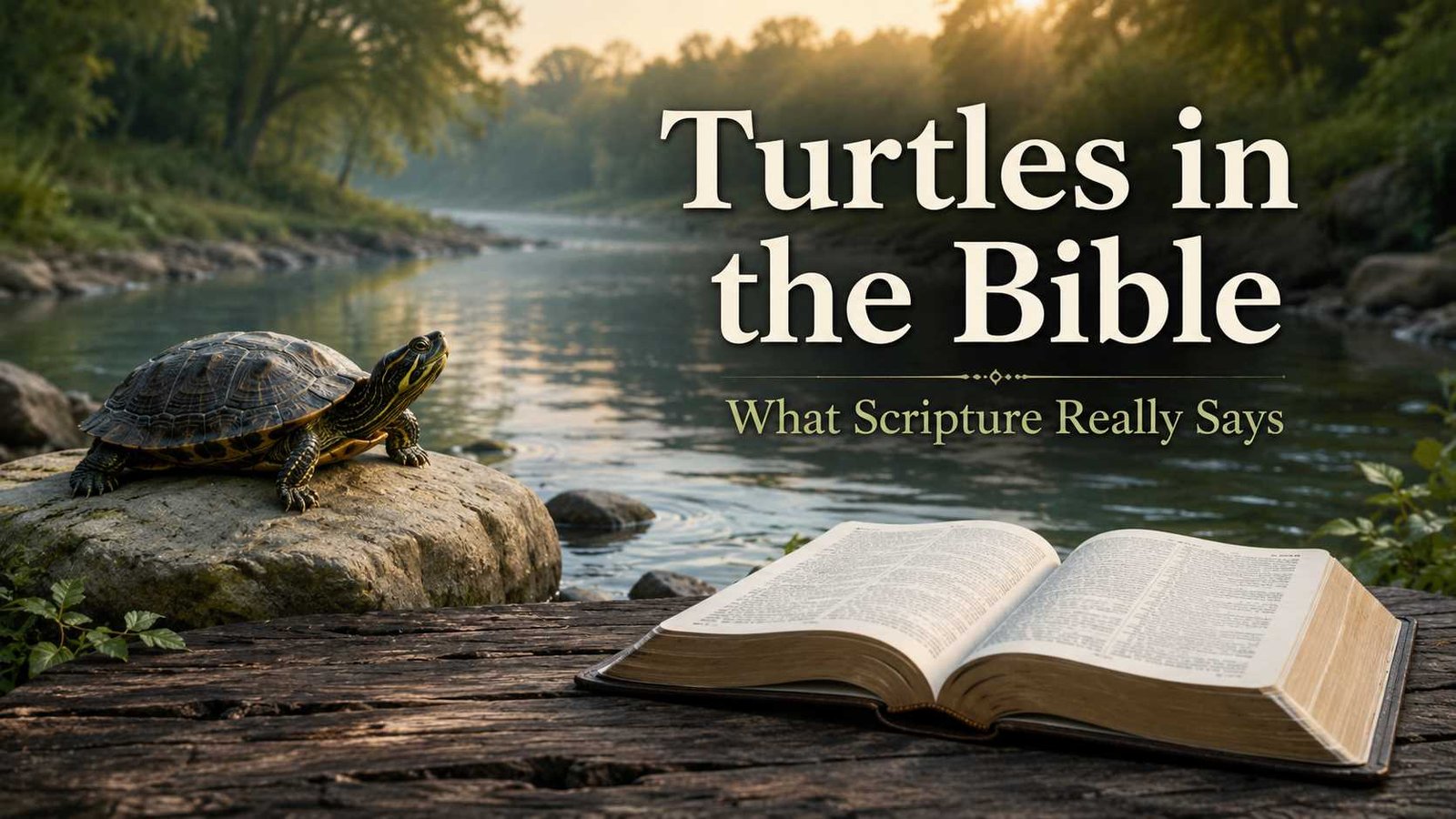
 If you are asking what do turtles symbolize in the Bible, the short answer is simple: the Bible does not clearly give turtles a fixed spiritual meaning.
That may surprise you. Many people connect turtles with patience, peace, protection, or long life. Those ideas are common in modern culture. Some Christians also use them as helpful illustrations. But when we stay close to Scripture, turtles are not presented as a major biblical symbol the way a lamb, dove, lion, serpent, or shepherd is.
Here is what matters most. The Bible does mention a word translated as tortoise in some older English versions, and it also uses the old English word turtle in a completely different place. But that second use does not mean the reptile we call a turtle today. It means a turtledove.
So if you have heard that turtles in the Bible are a sign of blessing, luck, wisdom, or a secret spiritual message, it is wise to slow down and check the text carefully.
A Quick Answer at a Glance
| Question | Simple Answer |
|---|---|
| What do turtles symbolize in the Bible? | The Bible does not assign turtles a clear symbolic meaning. |
| What do turtles symbolize in Christianity? | Some Christians connect turtles with patience, peace, or protection, but these are later reflections, not direct Bible symbols. |
| Is a turtle a good omen? | The Bible does not teach that turtles are good or bad omens. |
| What does a turtle mean in Hebrew? | The Hebrew word in Leviticus 11:29 is often linked to a reptile, but many modern scholars and translations understand it as a type of lizard rather than a turtle. |
| What are turtles known for spiritually? | In popular spirituality, turtles are linked with calmness, endurance, and stability, but that is not the same as biblical teaching. |
What Do Turtles Symbolize in the Bible? The Short Biblical Answer
The safest biblical answer is this:
- Turtles are not given a clear symbolic role in Scripture
- The Bible never teaches that a turtle is a sign from God
- The Bible never says a turtle is a good omen or bad omen
- Some qualities people associate with turtles can remind us of biblical truths, but the turtle itself is not the source of those truths
That distinction is important. Christians should build their beliefs on what God has revealed in His Word, not on guesses, trends, or modern symbolism.
This is true with many animal questions. People often ask what do crows symbolize in the Bible, what does a rabbit symbolize in the Bible, or what do moths symbolize in the Bible. Sometimes Scripture gives a strong answer. Other times it does not. Turtles belong more in that second group.
Does the Bible Actually Mention Turtles?
Yes, but the answer needs care.
There are two main places people usually point to. One is often misunderstood because of translation history.
The “tortoise” in Leviticus 11:29
In the King James Version, Leviticus 11:29 includes the word tortoise in a list of unclean creeping animals. That has led many readers to think the Bible is directly discussing turtles.
But there is a language issue here. The Hebrew word behind that verse is often understood by modern scholars as referring to a kind of lizard or reptile, not necessarily the shell-bearing tortoise that comes to mind in modern English.
That is why many newer Bible translations do not say “tortoise” there. They say something like great lizard.
So when someone asks, “What does a turtle mean in Hebrew?” the honest answer is that the Hebrew word in that verse is not a simple one-to-one match with our modern English word “turtle.” Older English translators made one choice. Modern translators often make another.
This means we should be careful about building spiritual meaning on that verse.
The “turtle” in Song of Solomon 2:12
Here is the other major source of confusion.
In the King James Version, Song of Solomon 2:12 says, “the voice of the turtle is heard in our land.” Many modern readers see the word turtle and think of the reptile.
But that is not what the verse means.
In older English, turtle could mean turtledove. In that passage, the setting is springtime. Flowers are appearing. The earth is singing. Birds are heard. The text is clearly speaking about a bird, not a reptile.
So this verse is not teaching turtle symbolism at all. It is talking about the gentle sound of the turtledove.
That one detail clears up a lot of confusion.
What Does a Turtle Mean in Hebrew?
This is one of the most important parts of the discussion.
The Hebrew word often connected with the “tortoise” in Leviticus 11:29 is tsav or tsab. Ancient animal names can be hard to identify with complete certainty. The world of the Bible was far removed from our modern scientific categories, and translators sometimes had to make educated choices.
Here is the plain truth:
- Older English versions such as the KJV used tortoise
- Many modern translations prefer great lizard
- The exact creature may not be known with total precision
- Because of that, we should not claim more than the text allows
So if someone asks, “What does a turtle mean in Hebrew?” the best answer is not a mystical one. It is a careful one. The Hebrew term probably refers to a reptile, but many scholars believe it points more closely to a lizard than to what we now call a turtle.
That may sound technical, but it actually helps us. It keeps us honest. Good Bible study often begins by admitting when a word is less certain than people assume.
What Do Turtles Symbolize in Christianity?
Now we come to the part many readers really mean when they ask the question.
Even if the Bible does not assign turtles a fixed symbol, some Christians still see turtle-like qualities as reminders of spiritual truths. That is not the same as saying Scripture itself gives the turtle a symbol. It simply means believers sometimes use God’s creation to reflect on God’s character and the Christian life.
Here are a few common Christian associations.
1. Patience
Turtles move slowly. Because of that, many people connect them with patience.
That can be a helpful devotional picture. The Christian life is not always fast. Growth takes time. Prayer takes patience. Spiritual maturity does not happen in one day.
The Bible does teach patience very clearly. It teaches us to wait on the Lord, endure trials, and keep walking in faith. The turtle can remind a person of that. But again, the reminder comes from observation, not from a direct Bible symbol.
2. Endurance
Turtles keep going. They are not flashy. They are steady.
That fits well with the biblical idea of perseverance. The Christian life often looks more like faithful daily walking than dramatic moments. We keep trusting God. We keep obeying Him. We keep moving forward.
That is a beautiful lesson. Still, it is a lesson drawn from nature, not a special spiritual code hidden in the animal.
3. Protection
A turtle’s shell naturally makes people think of safety and shelter.
For a Christian, that can point the heart toward a greater truth: God is our refuge. He is our shield. He is our strong tower. He is the One who protects His people.
The shell may serve as an illustration, but Scripture puts the focus on God, not on the creature.
4. Peace and Calmness
Turtles often appear quiet and peaceful. In a noisy world, that image can feel comforting.
Christians may connect that with God’s peace, gentle trust, and calm endurance. There is nothing wrong with making that kind of reflection as long as we keep our feet on solid ground and do not claim that the Bible gives turtles that meaning directly.
So what do turtles symbolize in Christianity? In a broad sense, some believers connect them with patience, peace, endurance, and protection. But these are Christian reflections, not formal biblical symbols.
Is a Turtle a Good Omen?
The Bible does not teach that a turtle is a good omen.
It also does not teach that a turtle is a bad omen.
This matters because many people today mix biblical language with superstition. They may see an animal and wonder if it means money is coming, a relationship will change, a spiritual door is opening, or a hidden message is being sent from heaven.
That is not how the Bible teaches us to live.
Scripture calls us to seek wisdom through God’s Word, prayer, obedience, and the leading of the Holy Spirit. It does not train believers to read everyday animals as personal fortune signs.
Can God use His creation to get our attention? Of course He can. A sunrise can remind us of mercy. Rain can remind us of provision. A turtle can remind us to slow down and trust God. But that is very different from saying, “I saw a turtle, so God must be predicting something for me.”
That kind of thinking can move us away from biblical faith and toward superstition.
If you have also wondered about topics like what the Bible says about superstitious beliefs, the same principle applies here. Faith rests on God’s truth, not on omens.
What Are Turtles Known for Spiritually?
In popular spiritual language, turtles are often linked with:
- patience
- grounding
- stability
- peace
- wisdom
- long life
- protection
- emotional balance
You will hear these ideas in many cultures and modern spiritual systems. Some of them sound beautiful. Some even sound close to biblical values. But we need to keep an important line clear.
Popular spiritual meaning is not the same as biblical meaning.
A Christian may appreciate a turtle as part of God’s creation. A Christian may even say, “This creature reminds me to move slowly, trust God, and stay steady.” That is fine. But a Christian should avoid turning those observations into doctrine.
The Bible does not say:
- turtles carry messages from the spirit world
- turtles are signs of blessing or luck
- turtles reveal your future
- turtles are biblical symbols of divine protection
- turtles have a hidden prophetic code
Those ideas may come from folklore, modern spirituality, or personal imagination, but they do not come from Scripture.
What Turtles Can Remind Us of in Faith
Now let me give the most balanced answer possible.
Even though turtles do not have a fixed biblical symbol, they can remind believers of good truths. Creation often does that. Jesus Himself used birds, seeds, sheep, vines, and weather as teaching pictures. The lesson was never that the object had secret power. The lesson was that ordinary things can point us back to God.
A turtle may remind us of these simple truths.
Slow growth is still growth
We live in a fast world. Many people feel behind. They want quick healing, quick answers, and quick spiritual progress.
A turtle quietly reminds us that slow faithfulness still matters. God is patient with us. We can be patient too.
Quiet strength is still strength
Not every strong life looks loud. Some of the strongest believers are gentle, steady, prayerful people who simply keep trusting God year after year.
That is a beautiful picture.
God is our shelter
A turtle carries its shell, but we do not carry our own ultimate safety. Our shelter is the Lord. He is the One we run to in fear, grief, temptation, and uncertainty.
Creation can lead us to worship
Psalm 19 teaches that creation speaks of God’s glory. A turtle is not a magic sign. But it is part of a world made by God. That alone can turn our hearts toward praise.
Why This Matters When Reading the Bible
Some readers may wonder why this topic needs so much care. The reason is simple. Once we stop reading the Bible carefully, we can start placing meaning where God did not place it.
That happens often with animal symbolism.
For example, if you study what does a bear represent in the Bible, you will find certain stronger images connected with danger, judgment, or fierce power in some passages. If you study what do crows symbolize in the Bible, you may explore themes of provision, mystery, or uncleanness depending on the context. If you ask what does a rabbit symbolize in the Bible, the answer becomes more limited and more careful.
The key is always the same: context decides meaning.
We should not begin with a modern symbolic idea and then force the Bible to support it. We should begin with the text itself.
That is one reason this question about turtles is important. It teaches us how to read Scripture honestly.
What the Bible Does Not Say About Turtles
Sometimes it helps to be direct.
The Bible does not say that turtles mean:
- good luck
- fertility
- money
- divine favor
- hidden wisdom
- spiritual protection from evil
- prosperity
- a message about your future spouse
- a sign to make a certain life decision
These kinds of claims may appear online, but they are not grounded in Scripture.
That does not mean every thought about turtles is wrong. It just means we should label things honestly.
- If it comes from the Bible, call it biblical.
- If it comes from culture, call it cultural.
- If it comes from personal reflection, call it personal reflection.
That kind of honesty protects both faith and truth.
A Healthy Christian Way to Think About Turtles
Here is a simple, healthy way to approach the question.
You can say:
- God made turtles.
- Turtles show beauty and order in creation.
- Their steady way of moving can remind us of patience.
- Their shell can remind us that God is our refuge.
- Their quiet nature can remind us of peace.
And then you can also say:
- The Bible does not assign turtles a formal symbolic meaning.
- I should not treat turtles as omens or secret messages.
- My beliefs should come from Scripture, not superstition.
That is a balanced Christian response.
What This Teaches Us About Faith
So, what do turtles symbolize in the Bible?
The best answer is still the simplest one: they do not carry a clear, fixed biblical symbol.
Some translation questions create confusion. The “tortoise” in Leviticus 11:29 may refer to a reptile more like a lizard. The “turtle” in Song of Solomon 2:12 means a turtledove, not the reptile we think of today. Once those two facts are understood, most of the mystery disappears.
Still, the question is worth asking because it teaches a deeper lesson. Not every beautiful spiritual idea is a biblical one. Sometimes we need to separate what Scripture truly says from what tradition, poetry, or modern symbolism adds later.
That is not a loss. It is actually a gift. It helps us rest in the truth.
If a turtle reminds you to be patient, peaceful, or steady, that can be a lovely reflection. Just remember where your faith stands. It stands on God’s Word, not on signs and symbols.
And maybe that is the best lesson of all. We do not need secret meanings hidden in creatures. We already have the clear voice of God in Scripture, calling us to trust Him, walk with Him, and grow in quiet faith day by day.
Dr. Rachel is very smart and knows a lot about the Bible. He helps us understand the Bible better by talking about the old texts in a simple way.