

 David married several women in the Bible, but his first wife was Michal, the daughter of King Saul. Later, David married Abigail, Ahinoam, Maacah, Haggith, Abital, Eglah, and Bathsheba. The Bible also says David took more wives and concubines after he became king in Jerusalem.
David’s marriage story is not simple. It includes love, politics, sorrow, wisdom, failure, repentance, and family pain. David was a man after God’s own heart, but he was not a perfect husband or father. His household shows us both the mercy of God and the painful results of human sin.
The main Bible passages about David’s wives are found in 1 Samuel 18, 1 Samuel 25, 2 Samuel 3, 2 Samuel 5, 2 Samuel 6, 2 Samuel 11, and 1 Chronicles 3.
Who Did David Marry In The Bible First?
David first married Michal, the daughter of King Saul.
Michal enters David’s story when David is already famous in Israel. He had defeated Goliath. The people praised him. Saul became jealous of him. Yet Saul’s daughter Michal loved David.
1 Samuel 18:20 says that Michal loved David. That is one of the clearest early details about their relationship. Saul then offered Michal to David as a wife, but his motive was not pure. Saul hoped David would be killed by the Philistines while trying to win the bride price.
David survived. He married Michal. So, the answer to who was David’s first wife is clear: Michal was David’s first wife.
Their marriage began with love, but it did not remain peaceful. Their story became one of the saddest marriage stories in David’s life.
Who Was David’s First Wife?
David’s first wife was Michal, Saul’s younger daughter.
Michal’s story is emotional because she loved David before many others in the royal house accepted him. She also helped save David’s life.
When Saul wanted to kill David, Michal warned him. She helped him escape through a window and then placed an image in the bed to delay Saul’s men. This is found in 1 Samuel 19:11–17.
That moment shows courage. Michal risked her father’s anger to protect her husband.
But later, Saul gave Michal to another man named Palti, also called Paltiel in some translations. This was a painful act. David was still alive, but Saul treated the marriage as broken. Later, when David became stronger politically, he demanded Michal back.
So Michal’s life was not easy. She was daughter of Saul, wife of David, then wife of another man, and then returned to David again. Her story carries pain, politics, and emotional distance.
Did David And Michal Fall In Love?
The Bible says Michal loved David. It does not directly say David loved Michal in the same way.
That matters.
In 1 Samuel 18:20, Scripture says, “Michal Saul’s daughter loved David.” The text gives us her feeling clearly. It does not give us David’s inner feelings with the same clarity.
So did David and Michal fall in love? We can say Michal loved David, and David accepted her as his wife. But the Bible does not describe their relationship like a modern romance story.
Their marriage began in a royal and political setting. Saul used Michal as part of his plan against David. David also became Saul’s son-in-law through this marriage, which had public and political meaning.
Still, Michal’s actions show real concern. She protected David when his life was in danger. That is not a small thing.
But love can be wounded. Trust can be damaged. Years of separation can change people. Michal and David’s marriage later became cold and bitter.
Why Did Michal Stop Loving David?
Many people search, “Why did Michael stop loving David?” The correct Bible name is Michal, not Michael. Michael is an angelic name in Scripture, while Michal was Saul’s daughter and David’s wife.
The Bible does not say, “Michal stopped loving David” in those exact words. But it does say that Michal later despised David in her heart.
This happened in 2 Samuel 6.
David brought the ark of the Lord to Jerusalem. He danced before the Lord with joy. Michal looked out of a window and saw David leaping and dancing. The Bible says she despised him in her heart.
Why did this happen?
There may be several reasons.
Michal may have felt David acted without royal dignity. She may have felt embarrassed. She may have still carried pain from being taken from Palti and returned to David. She may have felt forgotten inside David’s growing household.
The Bible gives the scene, but it does not explain every emotion behind it.
David saw the day as worship. Michal saw it as shameful. Their hearts were no longer moving together.
This is one of the saddest pictures in David’s marriage story: David rejoicing before God, and Michal watching from a window with bitterness inside.
What Happened To David’s First Wife Michal?
Michal’s story ends quietly and sadly.
After she criticized David for dancing before the Lord, David answered her strongly. Then 2 Samuel 6:23 says Michal had no child to the day of her death.
That is the last major detail Scripture gives about her.
So what happened to David’s first wife Michal?
She loved David, saved his life, was taken from him, was given to another man, was later returned to David, and ended her life without children. Her story is full of brokenness.
We should be careful not to judge Michal too quickly. Many sermons focus only on her criticism of David, but her life had deep wounds. She was used by Saul. She lost one home and was pulled into another. She lived inside a royal family filled with conflict.
Her story reminds us that people in the Bible were real people. They had fears, pain, disappointment, and complicated family lives.
How Many Wives Did David Marry In The Bible?
The Bible names several wives of David. The clearest list appears in 2 Samuel 3:2–5 and 1 Chronicles 3:1–9.
Here is a simple table:
| Wife of David | Bible Reference | Important Detail |
|---|---|---|
| Michal | 1 Samuel 18 | David’s first wife, daughter of Saul |
| Ahinoam | 1 Samuel 25, 2 Samuel 3 | Mother of Amnon |
| Abigail | 1 Samuel 25, 2 Samuel 3 | Wise widow of Nabal |
| Maacah | 2 Samuel 3 | Mother of Absalom |
| Haggith | 2 Samuel 3 | Mother of Adonijah |
| Abital | 2 Samuel 3 | Mother of Shephatiah |
| Eglah | 2 Samuel 3 | Mother of Ithream |
| Bathsheba | 2 Samuel 11–12 | Mother of Solomon |
The Bible also says David took more wives and concubines in Jerusalem. 2 Samuel 5:13 says David took more concubines and wives after he came from Hebron.
So when people ask, how many wives did David marry in the Bible, the answer depends on whether we count only the wives named clearly or include the additional wives and concubines not named in that verse.
The named wives are at least eight, including Michal and Bathsheba. But David had more women in his household than the named list alone.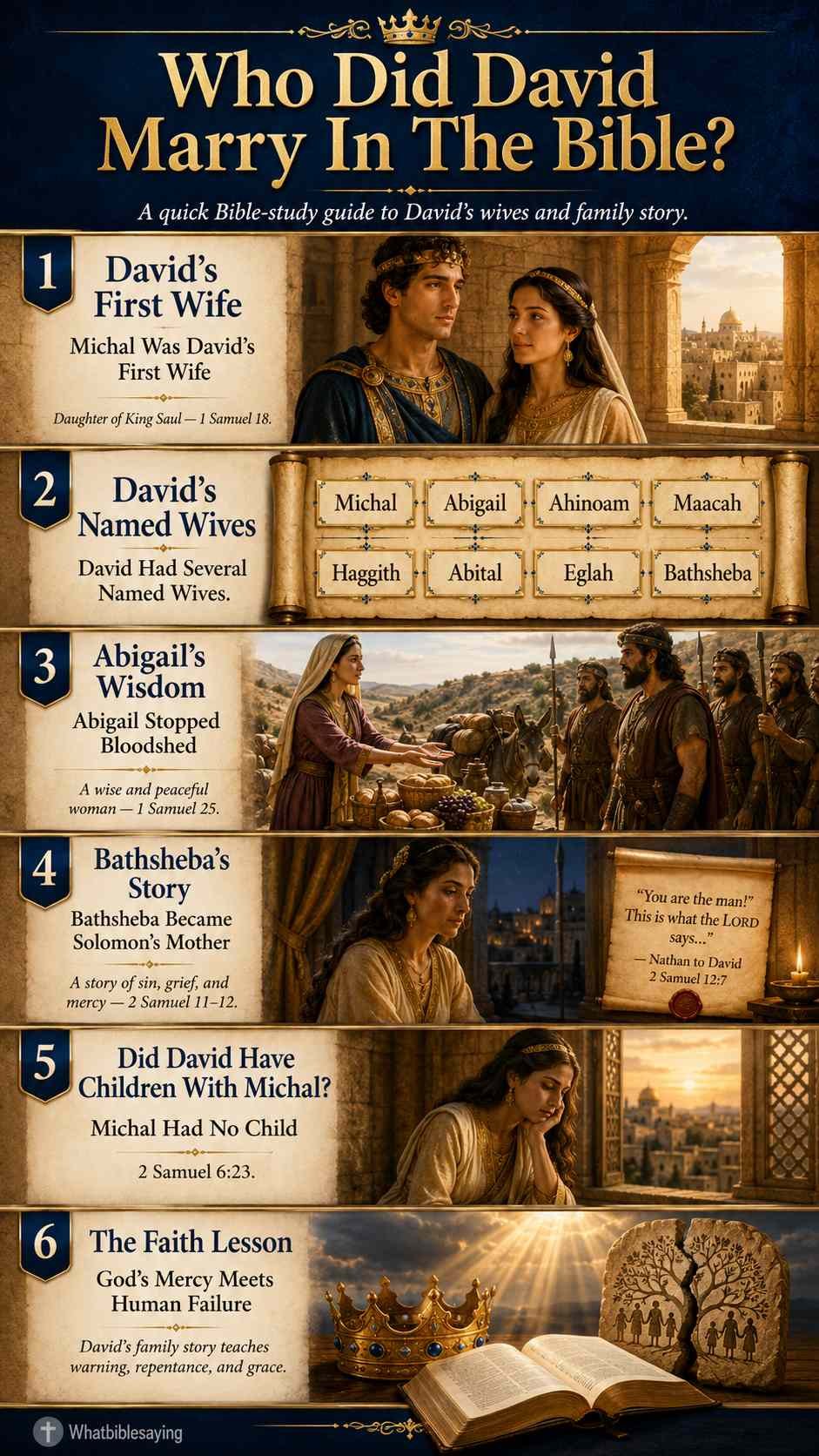
Who Were David’s Wives In Order?
The exact order can be hard because the Bible does not always present every marriage in full timeline detail. But based on the major passages, we can understand David’s marriages like this:
David first married Michal, Saul’s daughter.
Later, while fleeing from Saul, David married Ahinoam of Jezreel and Abigail, the widow of Nabal. Abigail’s story is in 1 Samuel 25. She was wise, brave, and peaceful. She stopped David from taking revenge against Nabal’s household.
In Hebron, David had sons through Ahinoam, Abigail, Maacah, Haggith, Abital, and Eglah. These wives are listed in 2 Samuel 3.
Later in Jerusalem, David took more wives and concubines. Bathsheba entered David’s story in 2 Samuel 11, in one of the most serious sins of David’s life.
This is why David’s family story becomes so troubled. Many wives meant many sons, rival claims, jealousy, and future conflict.
David’s household later suffered through Amnon’s sin, Absalom’s rebellion, Adonijah’s ambition, and deep family grief.
Who Was David’s Favorite Wife In The Bible?
The Bible does not clearly say who David’s favorite wife was.
Some readers assume it was Bathsheba because she became the mother of Solomon, and Solomon later became king. Others may think of Abigail because Scripture presents her as wise and respectful. Some may think of Michal because she was David’s first wife and once loved him.
But the honest answer is this: Scripture does not name David’s favorite wife.
That is important for a Bible-study article. We should not say more than the Bible says.
Bathsheba became very important in David’s royal line. Abigail stands out as one of the wisest women connected to David. Michal stands out as his first wife. But the Bible does not give us a verse that says David loved one wife most.
Who Was David’s Greatest Love?
This question needs a careful answer.
If we speak about David’s deepest emotional bond, many readers think of Jonathan, Saul’s son. David and Jonathan had a covenant friendship. Their love was loyal, sacrificial, and deeply faithful. But Jonathan was not David’s wife, and their bond should be understood as covenant friendship, not marriage.
Among David’s wives, the Bible does not clearly say who was his greatest love.
Michal loved David first. Abigail showed wisdom and became David’s wife after Nabal died. Bathsheba became central to the royal story because Solomon came from her. But Scripture does not rank David’s wives by love.
David’s greatest love in the spiritual sense should have been the Lord. The Psalms show David pouring out his heart to God. Psalm 18 begins with the words, “I love you, O Lord, my strength” in many modern translations.
That gives us a better lens. David’s human loves were complicated, but his prayers show a heart that kept returning to God.
What Actually Happened To Bathsheba?
Bathsheba’s story is one of the most serious and painful stories in David’s life.
In 2 Samuel 11, David saw Bathsheba bathing. She was the wife of Uriah the Hittite, one of David’s loyal soldiers. David sent for her and slept with her. Bathsheba became pregnant.
David then tried to hide the sin. He called Uriah back from battle, hoping Uriah would go home to his wife. But Uriah refused to enjoy the comfort of home while Israel’s army was still in the field.
Then David arranged for Uriah to be placed in the front lines of battle, where he was killed.
This was not a small mistake. It was adultery, abuse of royal power, deception, and murder.
The prophet Nathan confronted David in 2 Samuel 12. David confessed, “I have sinned against the Lord.” The child born from that first union died. Later, David and Bathsheba had another son, Solomon.
Solomon became king after David.
We should speak about Bathsheba with care. The Bible places the moral responsibility on David. David was the king. He had power. He sent for her. He tried to cover the sin. He arranged Uriah’s death.
Bathsheba’s story is not just a scandal story. It is also a story of grief, survival, and later honor. She became the mother of Solomon and appears in the royal line connected to the Messiah in Matthew 1, though Matthew refers to her as “the wife of Uriah.”
That detail keeps the memory of David’s sin honest.
Did David Have A Child With Michal?
No, David did not have a child with Michal.
2 Samuel 6:23 says Michal had no child to the day of her death.
This is one of the clearest answers in the whole topic. The Bible does not name any child born to David and Michal.
This also matters for David’s royal line. Michal was Saul’s daughter. If she had given David a son, that child would have joined the house of Saul and the house of David. But no such child is recorded.
Her childlessness also makes her ending feel more lonely in the story.
Who Was The Youngest Wife Of David?
The Bible does not clearly tell us which wife of David was the youngest.
Some readers think of Abishag, the young woman who cared for David in his old age in 1 Kings 1. But the Bible does not describe Abishag as David’s wife in the normal marriage sense. She served the aged king and kept him warm, but the text says David did not have relations with her.
So it is not safe to call Abishag David’s youngest wife.
Among David’s named wives, Scripture does not give ages. We do not know whether Michal, Abigail, Ahinoam, Bathsheba, or another wife was youngest.
A careful Bible answer is better than a guessed one: the Bible does not identify David’s youngest wife.
Who Was David’s Ex-Wife?
The Bible does not use the modern term “ex-wife” for David. But Michal is the closest person connected to this idea.
David married Michal first. Then Saul gave her to another man, Palti. Later David demanded her return.
This is found in 1 Samuel 25:44 and 2 Samuel 3:13–16.
Was Michal David’s ex-wife? In modern language, some may describe her that way because she was taken from David and given to another man. But biblically, the situation was more political and royal than a normal divorce story.
The safer wording is:
Michal was David’s first wife, later given by Saul to another man, and then returned to David.
That keeps the answer accurate.
Abigail: The Wise Wife Who Stopped Bloodshed
Abigail is one of the most admirable women in David’s story.
Before she married David, she was married to Nabal, a harsh and foolish man. David’s men had protected Nabal’s shepherds, but Nabal insulted David when David asked for help.
David became angry and planned to destroy Nabal’s household. Abigail acted quickly. She prepared food, went to David, bowed before him, and spoke with great wisdom.
Her words stopped David from shedding blood in anger.
After Nabal died, David married Abigail.
Abigail’s story shows wisdom, courage, and peace-making. She did not have military power. She did not sit on a throne. But her words changed the direction of a dangerous moment.
Among David’s wives, Abigail stands out as a woman of spiritual wisdom.
Her story also connects naturally with topics like what does the Bible say about choosing a spouse and what does the Bible say about being angry, because Abigail’s life shows the value of wisdom under pressure.
Ahinoam: A Less-Known Wife Of David
Ahinoam of Jezreel was another wife of David.
She is mentioned near Abigail in 1 Samuel 25:43. She became the mother of Amnon, David’s firstborn son.
Amnon’s later story is tragic. His sin against Tamar brought deep pain into David’s family and helped lead to Absalom’s hatred and rebellion.
The Bible gives us fewer personal details about Ahinoam herself. We know her name, her connection to David, and her son. But we do not get a long scene showing her personality like we do with Abigail.
This often happens in Scripture. Some people are named because they are part of the covenant history, even when their personal story is not fully told.
Maacah, Haggith, Abital, And Eglah
Several of David’s wives are listed in 2 Samuel 3:2–5.
Maacah was the mother of Absalom. She was the daughter of Talmai, king of Geshur. This marriage likely had political meaning because it connected David with another royal family. Absalom later became one of the most troubled and tragic sons of David.
Haggith was the mother of Adonijah. Adonijah later tried to become king when David was old, even though Solomon was chosen.
Abital was the mother of Shephatiah.
Eglah was the mother of Ithream.
The Bible does not give long personal stories for all these women. But their sons became part of David’s family record, and some of those sons played major roles in Israel’s royal history.
David’s family grew large, but not peaceful. His many marriages created a royal household filled with divided loyalties.
Why David’s Marriage Story Is So Complicated
David’s marriage story can feel confusing because it reflects an ancient royal world very different from modern family life.
Kings often married for alliances, family status, and political strength. But the Bible does not present every royal practice as God’s ideal.
In fact, Deuteronomy 17:17 warned Israel’s kings not to multiply wives. The warning was wise. Many wives could turn a king’s heart, divide his home, and create future conflict.
David’s family shows this danger clearly.
His sons fought. His daughter Tamar suffered terribly. Absalom rebelled. Adonijah tried to take the throne. The household became heavy with grief.
David loved God, but his private life carried deep failures. That is one reason his story is so honest. The Bible does not hide the sins of its heroes.
David was brave before Goliath. He wrote psalms of worship. He showed mercy at times. But he also failed badly in marriage, fatherhood, and self-control.
This truth does not destroy the Bible’s message. It strengthens it. Scripture tells the truth about human beings.
What David’s Wives Teach Us About Faith And Human Weakness
David’s wives teach us that Bible people were not flat characters. They were real people living through real pain.
Michal teaches us about love that became wounded.
Abigail teaches us about wisdom that prevents violence.
Bathsheba teaches us about the danger of power misused and the mercy of God after deep sin.
Maacah, Haggith, Abital, and Eglah remind us that royal homes can look strong outside while carrying sorrow inside.
David’s story also teaches us that spiritual gifts do not remove the need for obedience. David could worship deeply and still fail morally. He could write psalms and still need repentance.
That should make us humble.
It should also give hope.
If God dealt patiently with David, then broken people can still come back to God. But David’s life also warns us that forgiven sin may still leave painful consequences.
What Disease Did King David Have?
The Bible does not name a modern disease for King David.
In 1 Kings 1:1, David was old and could not keep warm, even when covered with blankets. Because of this, Abishag was brought to care for him and help keep him warm.
Some modern readers wonder if David had poor circulation, weakness from old age, or another health condition. But the Bible does not give a medical diagnosis.
A careful answer is: David was very old and physically weak, but Scripture does not name a specific disease.
What Two Men In The Bible Never Died?
The two men commonly understood as never dying are Enoch and Elijah.
Genesis 5:24 says Enoch walked with God, and he was not, because God took him.
2 Kings 2:11 describes Elijah being taken up by a whirlwind into heaven.
These men are not part of David’s marriage story, but many readers ask this question alongside other Bible-history questions.
Which Prophet Was Black In The Bible?
The Bible does not usually use modern racial categories the way people do today. But it does mention people from Cush, often connected with regions south of Egypt, sometimes associated with Ethiopia or Nubia.
One important figure is Ebed-Melech the Cushite in Jeremiah 38. He is not called a prophet, but he was a faithful man who helped rescue Jeremiah from a cistern.
Some readers also discuss Zephaniah, because his genealogy includes the name Cushi in Zephaniah 1:1, though scholars debate what that means.
The respectful answer is this: the Bible includes African and Cushite figures, but it does not always describe prophets by modern racial terms.
What Psalm Says “I Love You”?
Psalm 18:1 says, “I love you, O Lord, my strength” in many modern translations.
This psalm is connected to David. It expresses love, trust, rescue, and worship.
That verse is beautiful beside David’s complicated family story. Human love in David’s life was often broken, but his love for the Lord remained central to his prayers.
What Actually Happened To Bathsheba’s First Child?
After Nathan confronted David, the child born from David and Bathsheba’s first union became sick and died.
This is found in 2 Samuel 12:15–23.
David fasted and prayed while the child was sick. After the child died, David rose, worshiped, washed, and ate. His servants were confused. David explained that while the child lived, he fasted and wept, but after the child died, he could not bring him back.
This passage is painful. It shows grief, judgment, and David’s helplessness before God.
Later, Bathsheba gave birth to Solomon. The Bible says the Lord loved him.
Did David’s Marriages Affect His Children?
Yes, David’s family life deeply affected the next generation.
David had many wives and many children. Some of his sons became rivals. Some caused great harm. Some fought for power.
Amnon, David’s firstborn, sinned against Tamar.
Absalom killed Amnon and later rebelled against David.
Adonijah tried to make himself king near the end of David’s life.
Solomon became king, but even his later life showed the danger of multiplying wives, just as Deuteronomy warned.
David’s family story teaches a serious lesson: private sin can create public sorrow. A divided home can shape a whole nation.
What Books Of The Bible Talk About David?
David’s story appears mainly in:
| Bible Book | What It Covers |
|---|---|
| 1 Samuel | David’s youth, Goliath, Saul’s jealousy, Michal, Abigail |
| 2 Samuel | David’s reign, wives, Bathsheba, family troubles |
| 1 Kings | David’s old age and Solomon becoming king |
| 1 Chronicles | David’s family records and kingdom details |
| Psalms | Many prayers and songs connected to David |
For deeper study, a related article on where is the story of David in the Bible would help readers follow the full timeline.
Another helpful internal topic is who was King David in the Bible, because David’s marriages make more sense when we understand his full life as shepherd, warrior, king, sinner, and worshiper.
Did David’s Life Show God’s Approval Of Polygamy?
This is an important question.
The Bible records David’s many wives, but recording something is not the same as approving everything about it.
Scripture often tells us what happened without saying it was ideal.
Genesis presents the first marriage as one man and one woman. Deuteronomy warns kings not to multiply wives. David’s family troubles show why that warning mattered.
So David’s polygamy should not be treated as God’s perfect design for marriage. It was part of the ancient royal world, but it brought pain and division.
A faithful reading should say: the Bible records David’s many wives honestly, but it also shows the painful results of a divided household.
What Does David’s Marriage Story Say About God’s Mercy?
David’s story is not only about failure. It is also about mercy.
After David sinned with Bathsheba and arranged Uriah’s death, Nathan confronted him. David confessed. Psalm 51 is traditionally connected with this season of repentance.
David did not hide behind excuses. He said, “I have sinned against the Lord.”
That does not erase the harm. Uriah was dead. Bathsheba suffered loss. The child died. David’s house later faced turmoil.
But God still worked through David’s line. Solomon was born. The royal line continued. And in the New Testament, Jesus is called the Son of David.
That is grace.
Not cheap grace. Not grace that ignores sin. But grace that reaches into a broken human story and still carries God’s promise forward.
A Simple Answer For Readers
David married Michal first. He later married Abigail, Ahinoam, Maacah, Haggith, Abital, Eglah, and Bathsheba, along with other wives and concubines mentioned more generally in Scripture.
Michal loved David at first, but their marriage later became bitter. Abigail was wise and helped prevent bloodshed. Bathsheba’s story involved David’s serious sin, Uriah’s death, deep grief, and later the birth of Solomon.
The Bible does not clearly name David’s favorite wife. It does not say which wife was youngest. It does say David had no child with Michal.
David’s marriages show us a man greatly used by God, yet deeply flawed. They also show us why obedience matters, why power must be handled with humility, and why God’s mercy is never an excuse for sin.
What David’s Family Story Still Says To Us Today
David’s story is honest because the Bible is honest.
It does not turn David into a perfect hero. It lets us see his courage and his weakness. His worship and his sin. His love for God and his failures at home.
That should make us read with humility.
When we ask, who did David marry in the Bible, we are not just collecting names. We are looking at a family story filled with warning and grace.
Michal reminds us that wounded love can grow cold.
Abigail reminds us that wisdom can stop destruction.
Bathsheba reminds us that power without holiness can wound others deeply.
David reminds us that even people close to God must repent when they sin.
And above all, the Lord reminds us that He can work through broken stories without calling brokenness good.

Reverend James has spent years studying and teaching the Bible. With warmth and wisdom, he shares deep truths in a way that’s clear, simple, and easy to understand.