
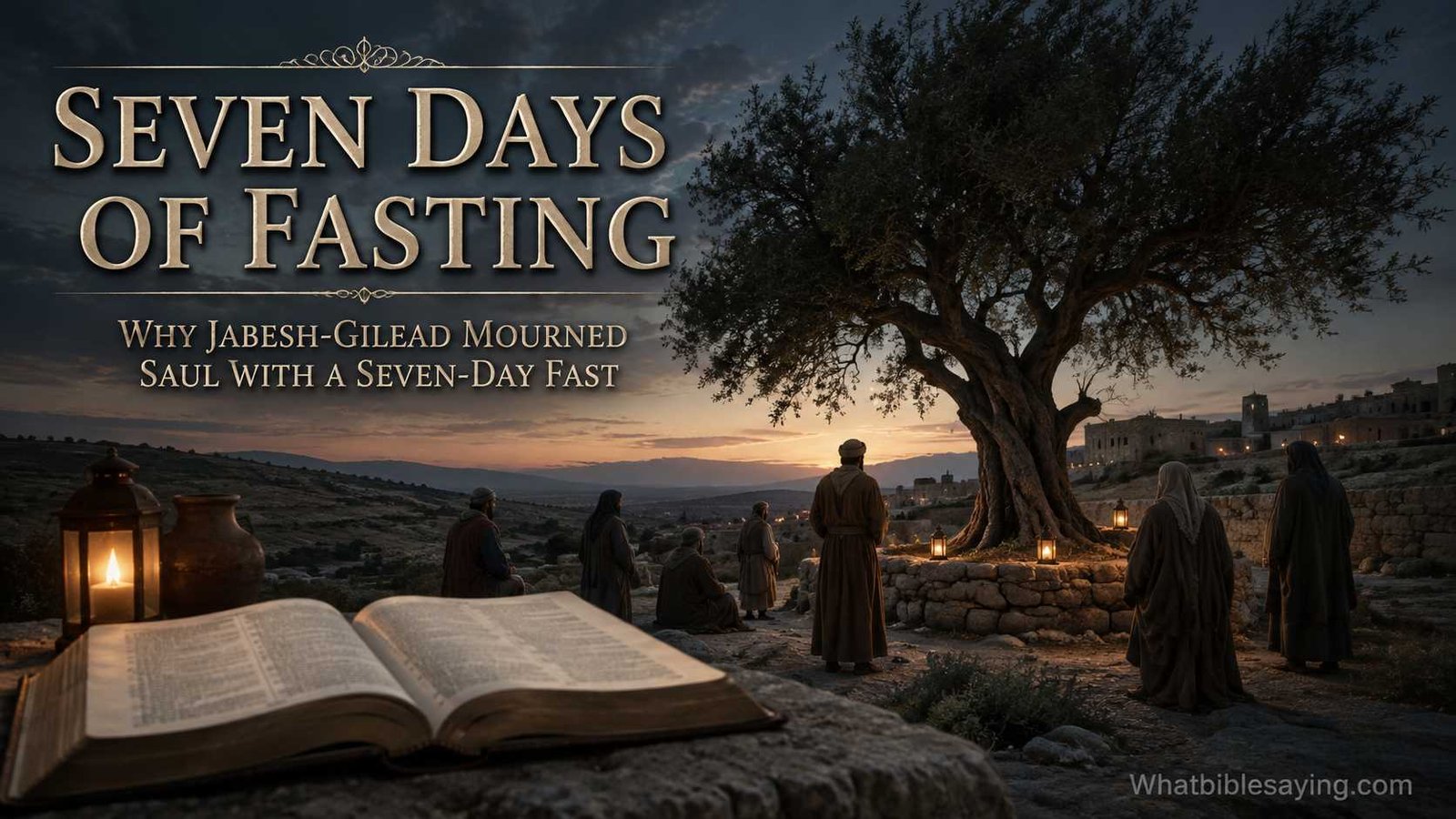
 The clearest answer to who fasted for 7 days in the Bible is the people of Jabesh-Gilead. After King Saul and his sons died in battle, brave men from Jabesh-Gilead recovered their remains, brought them back, buried their bones, and then fasted for seven days.
The Bible states this directly in 1 Samuel 31:13. The same event is recorded again in 1 Chronicles 10:12. These are not two different seven-day fasts. They are two biblical accounts describing the same event.
There is also another story that sometimes causes confusion. King David fasted while his sick child was alive, and the child died on the seventh day. However, the text does not use the same clear wording that David “fasted seven days.” That distinction is important when we want to answer the question carefully.
So the short answer is simple:
The people of Jabesh-Gilead are the people the Bible explicitly says fasted for seven days.
But their story has much more meaning when we understand why they fasted and what had happened between them and King Saul.
Who Fasted for 7 Days in the Bible? The Direct Answer
The seven-day fast appears at the very end of 1 Samuel.
King Saul and his sons had been fighting the Philistines. Israel suffered a terrible defeat, and Saul and three of his sons died. The Philistines later displayed their bodies at Beth Shan.
When the people of Jabesh-Gilead heard what had happened, their brave men acted.
They traveled through the night, recovered the bodies of Saul and his sons, brought them to Jabesh, and cared for their remains. After burying their bones beneath a tamarisk tree, Scripture says that they fasted seven days.
This gives us the most direct answer to the question.
The fast was not described as a way to gain wealth, receive a vision, or force God to answer a request. It happened in a setting of death, burial, sorrow, and respect.
The people were grieving.
They had lost their king, and Saul’s death marked a painful moment for Israel.
Where Is the Seven-Day Fast Recorded?
The first record is 1 Samuel 31:11–13.
The second is 1 Chronicles 10:11–12.
Both accounts tell us that the people of Jabesh-Gilead learned what had happened to Saul. Their courageous men recovered the remains of Saul and his sons, brought them back to Jabesh, buried them, and fasted for seven days.
This is helpful because sometimes readers see these two references and assume two groups fasted for seven days.
They did not.
Chronicles is retelling the same event recorded in Samuel.
When someone asks, Are there any 7 day fasts in the Bible?, this event should come first because Scripture gives the length clearly.
Why Did the People of Jabesh-Gilead Fast for Seven Days?
The immediate context points strongly to mourning.
Saul and his sons were dead. Their bodies had been dishonored by their enemies. The men of Jabesh-Gilead risked themselves to recover them and give them a burial.
Their seven-day fast followed that burial.
Fasting in Scripture can appear in several settings. Sometimes people fast while praying for help. At other times they fast as an expression of humility, grief, repentance, or serious devotion to God.
Here, sorrow is at the center of the story.
This also reminds us not to treat every biblical fast as if it had exactly the same purpose.
A fast during mourning is different from Esther’s fast before approaching the king. It is different from Jesus fasting in the wilderness. It is also different from the church at Antioch fasting while worshiping and seeking direction.
The outward act may look similar, but the circumstances are different.
That is one reason learning what fasting is in the Bible requires us to read each passage in context rather than simply counting the number of days.
Why Did Jabesh-Gilead Care So Much About Saul?
Their response becomes easier to understand when we go back to an earlier chapter.
In 1 Samuel 11, Jabesh-Gilead was under threat from Nahash the Ammonite. The city faced a humiliating and dangerous situation. Saul gathered Israel’s forces and came to their rescue.
This happened early in Saul’s reign.
Years later, when Saul died and his body was dishonored by the Philistines, the people of Jabesh-Gilead did not forget him.
The Bible does not give us a speech explaining every thought in their minds. We should therefore avoid claiming more than Scripture says.
Still, the connection between the two events is clear.
Saul had once helped deliver Jabesh-Gilead. After his death, the people of Jabesh-Gilead showed unusual courage and respect toward him.
Their actions involved effort and danger. Their men traveled at night to recover the bodies. Then, after the burial, the community fasted for seven days.
There is something deeply human about this story.
People remember those who stood beside them when they were in trouble.
Even though Saul’s life and reign included serious failure, the people of Jabesh-Gilead remembered the help they had received.
Did David Also Fast for 7 Days in the Bible?
This is where the answer needs careful wording.
David certainly fasted during a painful seven-day period.
In 2 Samuel 12, David’s child became very sick. David pleaded with God for the child. He fasted, spent the nights on the ground, and refused food offered by the elders of his household. Then the child died on the seventh day.
After learning that the child had died, David got up. He washed, changed his clothes, went to worship, returned home, and ate.
His servants were surprised.
While the child was alive, David had fasted and wept. After the child died, David ended the fast.
So did David fast seven days?
It is reasonable to describe his fasting as taking place during this seven-day crisis, but Scripture does not phrase it exactly as it does in the story of Jabesh-Gilead.
With Jabesh-Gilead, the Bible directly says they fasted seven days.
With David, the text says he fasted while the child was ill and that the child died on the seventh day.
That may seem like a small difference, but careful Bible study pays attention to such differences.
If someone asks, Who in the Bible fasted for 7 days?, Jabesh-Gilead is therefore the clearest direct answer.
David’s story can be mentioned as an important related example.
Are There Any 7 Day Fasts in the Bible?
Yes.
The clearest explicitly stated seven-day fast is the fast of the people of Jabesh-Gilead after the burial of Saul and his sons.
It appears in two places:
| Biblical event | Reference | Length or description | Main setting |
|---|---|---|---|
| People of Jabesh-Gilead | 1 Samuel 31:11–13 | Seven days | Mourning after Saul’s death |
| People of Jabesh-Gilead | 1 Chronicles 10:11–12 | Seven days | Same event retold |
| David and his sick child | 2 Samuel 12:16–23 | Fast continued until the child died on the seventh day | Prayer and grief |
| Esther and the Jews | Esther 4:16 | Three days and nights | Crisis and approaching the king |
| Saul, later Paul | Acts 9:9 | Three days without food or drink | After encountering Jesus |
| Moses | Exodus 34:28 | Forty days and nights | With God at Sinai |
| Jesus | Matthew 4:1–2 | Forty days and nights | Wilderness temptation |
The table shows why counting biblical fasts requires care.
For example, 1 Samuel and 1 Chronicles do not give us two seven-day fasts. They give us two records of one fast.
This is also why we should be cautious about statements such as, “Seven days is the biblical length of a mourning fast.”
The Bible records what Jabesh-Gilead did. It does not turn their seven-day fast into a universal command for every Christian who mourns.
Who Were the People That Fasted in the Bible?
Many people fasted in Scripture, and they did so under very different circumstances.
Moses is one of the most famous examples. Exodus 34:28 says he was with the Lord for forty days and forty nights and did not eat bread or drink water during that period. The setting was connected with God’s covenant and the tablets of the commandments.
Jesus also fasted for forty days and forty nights in the wilderness before facing temptation. Matthew specifically describes this as fasting.
Esther called for a three-day fast when she faced the dangerous task of approaching the Persian king.
David fasted as he prayed for his sick child.
Ezra proclaimed a fast when the returning community humbled themselves before God and sought a safe journey for themselves, their children, and their possessions.
The early Christians fasted too. In Acts 13, leaders in the church at Antioch were worshiping and fasting when Barnabas and Saul were set apart for missionary work. They fasted and prayed before sending them out.
Daniel also practiced a form of food restriction during a period of mourning. Daniel 10 says that for three weeks he ate no choice food, and no meat or wine touched his lips.
These examples help answer the broader question of why people fasted in the Bible.
Sometimes there was grief.
Sometimes there was prayer.
Sometimes people were humbling themselves before God.
Sometimes they were facing danger or a major decision.
Fasting was never merely about proving how long someone could live without food.
The spiritual setting mattered.
Who Fasted 3 Days in the Bible?
Two important biblical examples involve three days.
The first is Esther and the Jewish community in Susa.
Esther faced an extraordinary danger. She needed to approach King Xerxes even though going to the king without being summoned could cost her life.
Before doing so, she told Mordecai to gather the Jews in Susa and have them fast for her. They were to go without food or drink for three days, night and day. Esther and her attendants would do the same.
This was not casual religious activity.
Esther was preparing to take a courageous step that could determine whether her people lived or died.
The second well-known three-day example is Saul of Tarsus, later known as the apostle Paul.
After encountering Jesus on the road to Damascus, Saul became blind. Acts 9:9 says he spent three days without sight and did not eat or drink.
These two stories are very different.
Esther knew why she was fasting and asked others to join her before she acted.
Saul’s three days followed a life-changing encounter that overturned his understanding of Jesus and changed the direction of his life.
The number of days is the same, but the stories are not.
That is a useful principle whenever we study biblical numbers or practices: context comes before symbolism.
What Does Fasting Mean in the Bible?
At its simplest, fasting in the Bible usually means willingly going without food for a period of time in a serious spiritual setting.
But that simple definition does not tell the whole story.
Biblical fasting is often connected with the condition of the heart.
Ezra called a fast so that the people could humble themselves before God and seek His help for their journey.
The church at Antioch fasted while worshiping the Lord and before sending Barnabas and Saul into their work.
David fasted while pleading for his child.
The people of Jabesh-Gilead fasted after burying Saul and his sons.
These examples show that fasting could accompany grief, humility, worship, prayer, or a serious need.
This is an important point for anyone learning how to fast according to the Bible.
Simply avoiding food is not automatically a spiritual achievement.
A person can be hungry without being humble.
A person can skip meals without seeking God.
Biblical fasting should therefore be understood within the larger life of prayer, faith, repentance, worship, and dependence on God.
Why Did People Fast in the Bible?
People fasted for several reasons, and Scripture does not reduce every fast to one formula.
Jabesh-Gilead fasted in a time of mourning.
David fasted while pleading with God.
Esther called for fasting during a life-threatening crisis.
Ezra connected fasting with humility and seeking God’s protection.
The believers in Antioch fasted while worshiping and preparing to send people into ministry.
This helps correct a common misunderstanding.
Fasting is not presented in Scripture as a spiritual trick that makes God give someone what they want.
David’s experience makes that especially clear.
He sincerely prayed and fasted for his sick child, but the child still died. David then accepted what had happened, rose from the ground, worshiped God, and ate.
His story shows that fasting can express a deeply serious request without becoming a way of controlling God.
Faith asks.
Faith seeks.
Faith grieves.
But faith also recognizes that God is God.
What About Daniel’s Fast?
People often hear the phrase “Daniel fast” today, so it is helpful to see what the biblical text actually says.
Daniel 10 describes Daniel mourning for three weeks. During that time, he ate no choice food. He also says that no meat or wine touched his lips.
This differs from Esther’s three-day fast, where the instruction was not to eat or drink.
It also differs from Moses’ forty days without bread or water.
The Bible therefore gives us more than one pattern.
Not every biblical fast had the same length.
Not every fast involved the same kind of food restriction.
Not every fast had the same reason.
So when studying why Daniel fasted in the Bible, it is better to read Daniel’s own account than to assume every modern practice called a “Daniel fast” is described word for word in Scripture.
The biblical text should remain our starting point.
Did Elijah Fast for 40 Days?
This question also needs careful wording.
Elijah is often included in lists of people who fasted forty days. However, 1 Kings 19:7–8 says Elijah ate and drank before beginning his journey. Strengthened by that food, he traveled forty days and forty nights to Horeb, the mountain of God.
The passage clearly gives us a forty-day journey.
It does not state as directly as Matthew does about Jesus that Elijah “fasted forty days and forty nights.”
By contrast, Matthew 4 explicitly says Jesus fasted forty days and forty nights. Exodus 34 says Moses did not eat bread or drink water during his forty days with the Lord.
This does not mean Elijah’s story is unimportant.
It simply shows why precise wording matters when answering Bible questions.
A good study of who fasted 40 days in the Bible should distinguish between what Scripture states directly and what readers sometimes infer from the surrounding events.
Does the Bible Tell Christians How to Fast?
Jesus spoke directly about fasting.
In Matthew 6:16–18, He warned people not to make their fasting a public performance.
Some people wanted others to notice how religious they were. Jesus taught His followers not to fast for that kind of attention. Instead, fasting was to be done sincerely before God rather than used to win praise from people.
That teaching reaches deeper than rules about meals.
It asks a question about motive.
Why am I doing this?
Am I trying to impress people?
Do I want others to think I am unusually spiritual?
Or am I sincerely seeking God?
This is one of the most important principles in any study of whether the Bible says to fast.
Jesus cared about the heart behind the practice.
The New Testament also shows Christians fasting together. Acts 13 describes believers worshiping, fasting, praying, and sending Barnabas and Saul into ministry.
So fasting did continue among early Christians.
Yet Scripture does not teach that every believer must copy the seven days of Jabesh-Gilead, Esther’s three days, Daniel’s three weeks, or Jesus’ forty days.
Those passages describe different people in different circumstances.
Is Seven a Special Number in This Story?
Seven appears many times in Scripture, and readers often associate it with completeness or fullness.
But we should be careful here.
1 Samuel 31 does not explain why the people of Jabesh-Gilead chose seven days.
The text tells us what they did. It does not give us a hidden numerical explanation for their choice.
That means we should resist the temptation to build a large spiritual message from the number alone.
Sometimes readers become so interested in numbers that they miss the human story.
Saul was dead.
His sons were dead.
Israel had suffered defeat.
The people of Jabesh-Gilead recovered the remains, buried them, and mourned.
That is the story Scripture gives us.
There may be wider biblical significance connected with seven in other passages, but we do not need to invent a secret meaning here.
The plain meaning is already powerful.
What the Seven-Day Fast at Jabesh-Gilead Teaches Us
The seven-day fast is a small part of the biblical story, but it reveals several important truths.
First, Scripture takes grief seriously.
The Bible does not act as if faithful people never feel deep sorrow. Loss can affect individuals, families, and whole communities.
Second, the story shows the importance of remembering past kindness.
Saul had once rescued Jabesh-Gilead from danger. Later, after his death, its people treated his remains with courage and respect. The connection between Saul and the city appears clearly when 1 Samuel 11 and 1 Samuel 31 are read together.
Third, fasting can express something words cannot easily say.
Sometimes grief is too deep for ordinary conversation.
Sometimes prayer becomes more serious.
Sometimes people feel the need to humble themselves before God.
Biblical fasting can appear in those moments.
But the story also teaches us not to turn someone else’s fast into our personal rule.
The Bible does not say, “Everyone must fast seven days when someone dies.”
It tells us what Jabesh-Gilead did.
That difference between description and command is one of the most useful habits we can develop when reading Scripture.
The Real Answer Is Simple
So, who fasted for 7 days in the Bible?
The clearest answer is the people of Jabesh-Gilead.
After King Saul and his sons died, brave men from Jabesh-Gilead recovered their remains. The bones were buried at Jabesh, and the people fasted for seven days. The event is recorded in 1 Samuel 31:11–13 and repeated in 1 Chronicles 10:11–12.
David is another important person to remember. He fasted while pleading with God for his sick child, and the child died on the seventh day. But Scripture describes his fast differently from the clear seven-day statement about Jabesh-Gilead.
Esther and the Jews of Susa give us a clear three-day example. Saul of Tarsus also went three days without eating or drinking after his encounter with Jesus. Moses and Jesus are connected with remarkable forty-day periods of going without food.
Yet the deepest lesson is not about finding the most impressive number.
Biblical fasting is about what is happening before God.
For Jabesh-Gilead, it accompanied mourning.
For Esther, it came during danger.
For Ezra, it expressed humility and dependence.
For the early church, it accompanied worship, prayer, and an important calling.
The length changed because the circumstances changed.
That is worth remembering when we read any passage about fasting. Scripture calls us to look beyond the number of days and ask what was happening in the heart.
The seven days at Jabesh-Gilead were not a spiritual competition. They were part of a community’s sorrow after a painful loss.
And sometimes the most faithful way to read such a story is simply to let Scripture say what it says: they buried Saul and his sons, they mourned, and they fasted seven days.

Dr. Rachel is very smart and knows a lot about the Bible. He helps us understand the Bible better by talking about the old texts in a simple way.