

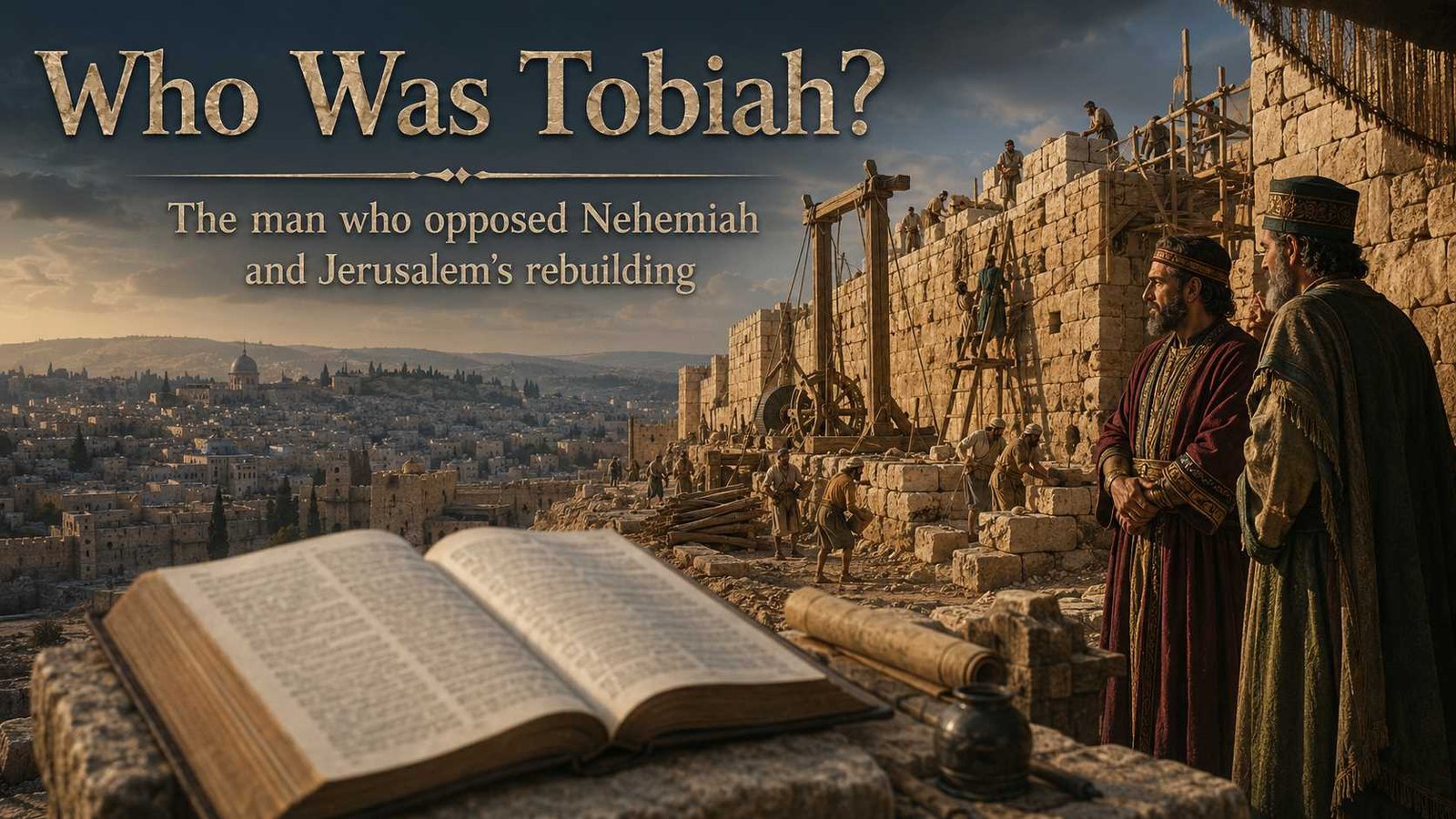
 Tobiah is one of the main opponents of Nehemiah in the Old Testament. He appears during the rebuilding of Jerusalem after the Jewish people had returned from exile. The Book of Nehemiah calls him Tobiah the Ammonite and describes him as an official or servant, depending on the Bible translation. He worked closely with Sanballat and resisted Nehemiah’s efforts to strengthen Jerusalem.
At first, Tobiah’s opposition took the form of anger and mockery. Later, it became more serious. He joined plans against Jerusalem, maintained close relationships with important people in Judah, exchanged letters with them, and sent messages meant to frighten Nehemiah. Even after Jerusalem’s wall was finished, Tobiah remained influential. A priest named Eliashib eventually gave him a large room within the temple complex, which Nehemiah later cleared out.
So, who is Tobiah in the Bible? He is best understood as a real historical figure in Nehemiah’s story: an Ammonite-connected official who opposed Nehemiah and had surprising influence among some of Judah’s leaders.
His story also offers a deeper lesson. Opposition does not always come openly. Sometimes it begins with mocking words. Sometimes it works through fear, relationships, influence, and compromise.
Tobiah in the Bible at a Glance
| Question | Biblical Answer |
|---|---|
| Who was Tobiah? | An Ammonite official or servant who opposed Nehemiah |
| Where is he mainly found? | The Book of Nehemiah |
| Who worked with him? | Sanballat and, at times, Geshem the Arab |
| What did he oppose? | Nehemiah’s work to restore Jerusalem and rebuild its walls |
| How did he oppose Nehemiah? | Mockery, threats, political pressure, letters, and alliances |
| Did he have friends in Judah? | Yes. He had family and political connections among Judah’s nobles |
| What happened later? | Eliashib gave him a temple storeroom, but Nehemiah threw his belongings out |
| Does Tobiah symbolize something officially? | No. Scripture presents him as a person, though his actions can teach lessons about opposition and compromise |
These details come mainly from Nehemiah 2, 4, 6, and 13.
Who Is Tobiah In The Bible and Where Does He First Appear?
Tobiah first becomes important in Nehemiah 2.
Nehemiah had been serving King Artaxerxes in the Persian court. When he learned that Jerusalem’s walls were broken and its gates had been burned, he was deeply troubled. He prayed and later received permission from the king to travel to Jerusalem. His goal was to help restore the city. The events belong to the Persian period, in the fifth century BC.
When Nehemiah arrived, two men were immediately unhappy: Sanballat the Horonite and Tobiah the Ammonite.
Nehemiah 2:10 says they were greatly disturbed because someone had come to seek the welfare of Israel. That verse gives us the clearest starting point for understanding Tobiah’s opposition. He was not simply having a personal disagreement with Nehemiah. He opposed a project that would strengthen Jerusalem and improve conditions for its people.
A little later, Geshem the Arab joined Sanballat and Tobiah in mocking Nehemiah. They questioned the rebuilding project and even suggested that Nehemiah might be rebelling against the Persian king.
Nehemiah refused to be distracted. His confidence was centered on God and the work before him.
What Does the Name Tobiah Mean?
The name Tobiah is related to a Hebrew expression meaning Yahweh is good or the Lord is good. This makes his name interesting because the man carrying it became one of Nehemiah’s strongest opponents. Translation notes also point out that the Hebrew title used for Tobiah can be understood as “servant” or as a title for an official. His exact government position is not fully explained in the biblical text.
Some English Bibles therefore call him an Ammonite servant, while others call him an Ammonite official. It is wiser not to give him a precise political office that Scripture itself does not clearly name.
Was Tobiah an Ammonite?
Nehemiah repeatedly identifies Tobiah with Ammon. Bible translations normally call him Tobiah the Ammonite.
The wording, however, leaves some historical questions open. Translation scholars have noted that the description might point to Ammonite heritage or to an official connection with the region of Ammon. The Bible does not pause to give us Tobiah’s complete family background.
What is clear is that Tobiah was strongly connected with Judah socially. That becomes very important later in the story.
What Is the Story of Tobiah in the Bible?
The story of Tobiah develops in stages.
He begins as a critic. Then he becomes part of organized opposition. After that, we discover that he has powerful connections inside Judah itself.
That progression is one reason his story is so memorable.
Tobiah Mocked the Rebuilding of Jerusalem
In Nehemiah 4, Sanballat became angry when the rebuilding of Jerusalem’s wall continued.
Tobiah stood beside him and joined the mockery. He joked that the wall was so weak that even a fox could break it down by climbing on it. His words were designed to make the builders and their work look foolish.
Mockery can be powerful.
People who are working hard can sometimes handle physical difficulty more easily than constant ridicule. A mocking voice says, “Your work is useless. You will fail. What you are building will not last.”
Nehemiah did not allow those words to become the voice guiding him.
He prayed and continued building.
If you study what did Nehemiah do in the Bible, this pattern appears again and again. Nehemiah prayed, planned, organized people, faced problems directly, and kept moving forward.
Mockery Turned Into a Threat
The opposition soon became more dangerous.
Nehemiah 4 says that Sanballat, Tobiah, the Arabs, the Ammonites, and people from Ashdod became angry as the gaps in Jerusalem’s wall were being closed. They plotted together to fight Jerusalem and create trouble. Nehemiah responded with both prayer and practical protection. The people prayed to God and posted guards.
This is an important detail.
Nehemiah did not treat faith and wise action as opposites.
He prayed.
He also posted guards.
He trusted God.
He also prepared the people.
That balance is part of what makes Nehemiah such an important example of biblical leadership.
Why Was Tobiah Against Nehemiah?
This question deserves a careful answer because it is easy to add motives that the Bible never actually gives.
The Bible does not provide a full personal explanation for why Tobiah hated Nehemiah’s work.
What it does tell us is enough to see the basic conflict.
Nehemiah 2:10 says Tobiah and Sanballat were upset because Nehemiah had come to promote the welfare of Israel. Nehemiah 2:19 shows them mocking the project and questioning whether Nehemiah was rebelling against the king. Nehemiah 4 shows the opposition becoming an organized threat against Jerusalem.
It is reasonable to recognize that rebuilding Jerusalem was more than a small construction project. A repaired wall meant a more secure and organized city. Yet we should label any detailed theory about Tobiah’s political motives as an inference rather than a direct statement from Scripture.
The safest biblical answer is this:
Tobiah opposed Nehemiah because he resisted Nehemiah’s efforts to strengthen Jerusalem and improve the condition of its people.
Jerusalem Was Being Restored
To understand the conflict, it helps to understand where Jerusalem is in the Bible and why the city mattered.
Jerusalem had suffered terrible destruction during the Babylonian conquest. Later, Jewish exiles returned. The temple was rebuilt before Nehemiah’s wall project. Ezra records that the temple was completed during the reign of Darius, while Nehemiah’s account takes place later under Artaxerxes.
This distinction matters because people sometimes say that Nehemiah rebuilt the temple.
He did not.
Nehemiah’s famous building project was the wall of Jerusalem. The temple already stood.
Nehemiah did, however, care deeply about worship, the temple community, the Levites, the Sabbath, and proper use of the temple rooms. That becomes especially clear in Nehemiah 13.
Readers interested in the earlier restoration of worship can also study what the Bible says about rebuilding the temple, which is a related but separate story.
Who Are Sanballat and Tobiah in the Bible?
Sanballat and Tobiah were two different men who worked together against Nehemiah.
The Bible calls Sanballat the Horonite and Tobiah the Ammonite official. Geshem the Arab also joined them at important moments.
Their opposition took several forms.
They mocked the builders.
They questioned Nehemiah’s intentions.
They became angry as the wall repairs advanced.
Their wider group plotted to create trouble in Jerusalem.
Later, Sanballat tried repeatedly to draw Nehemiah away from the city for a meeting. Nehemiah believed the invitation was dangerous and refused to leave the work.
Sanballat and Tobiah are therefore often mentioned together because they belonged to the same opposition movement, but they were not the same person.
Sanballat, Tobiah, and Geshem
The three names often appear in discussions of Nehemiah:
- Sanballat is called the Horonite.
- Tobiah is called the Ammonite.
- Geshem is called the Arab.
Together they challenged Nehemiah’s authority and the rebuilding of Jerusalem.
Yet Tobiah becomes especially interesting because his influence did not stay outside Jerusalem.
He had connections inside Judah.
Tobiah Had Powerful Friends Inside Judah
Nehemiah 6 gives us one of the most revealing details about Tobiah.
While Nehemiah was facing opposition, nobles in Judah were exchanging many letters with Tobiah. Tobiah was writing back to them. The Bible explains that many people in Judah were connected to him through oaths and family relationships.
Tobiah had married into a family connected with Judah. His son Jehohanan had also married the daughter of Meshullam son of Berekiah.
These were not meaningless relationships.
They gave Tobiah a social network inside the community Nehemiah was trying to lead.
Nehemiah says people spoke positively about Tobiah in his presence and then reported Nehemiah’s words back to Tobiah. Tobiah, meanwhile, sent letters designed to intimidate Nehemiah.
This changes the picture.
Tobiah was not simply standing outside the wall shouting insults.
He had contacts on the inside.
He had people who listened to him.
He had people willing to pass information between him and Nehemiah.
That kind of opposition can be much harder to deal with than an obvious enemy.
Did Tobiah Stop Nehemiah From Building the Wall?
No.
Despite the mockery, threats, pressure, and fear surrounding the project, Jerusalem’s wall was completed.
Nehemiah 6 records the completion of the wall after a remarkably short period of rebuilding. The wider story presents this as a major defeat for Nehemiah’s opponents because they had failed to stop the work.
The important point is not that Nehemiah faced no fear or trouble.
He faced plenty.
The important point is that the trouble did not become his master.
There are moments in life when people may laugh at something good you are trying to do. Other times, resistance may be more serious. Nehemiah’s example is not a promise that every personal project will succeed. Rather, it shows the value of prayer, wise planning, courage, and faithfulness when doing work that honors God.
Why Did Tobiah Have a Room in the Temple?
Tobiah appears again near the end of Nehemiah, and this part of his story can surprise readers.
Nehemiah 13 says Eliashib the priest was closely associated with Tobiah. Eliashib had authority over storerooms connected with the house of God. He prepared a large room for Tobiah. That room had previously been used to store offerings, incense, temple articles, and portions intended for those serving in worship.
Nehemiah was away when this arrangement was made.
When he returned and discovered what had happened, he was deeply displeased.
He threw Tobiah’s belongings out of the room, ordered the rooms to be cleansed, and restored the temple articles and offerings to their proper place.
This scene brings Tobiah’s story full circle.
At the beginning, he opposed the restoration of Jerusalem from outside.
Later, he gained a place inside a sacred area connected with the temple.
Nehemiah removed him.
Was Tobiah Living Inside the Temple Itself?
It is better to speak carefully here.
The passage describes a large chamber or storeroom connected with the courts or rooms of the house of God. It does not mean that Tobiah was living inside the innermost sanctuary where Israel’s priests performed their most sacred duties.
Still, the arrangement was serious enough that Nehemiah called it wrong and immediately reversed it.
The room had a purpose connected with temple service. Giving it over for Tobiah’s personal use interfered with that purpose.
What Does Tobiah Represent in the Bible?
Tobiah does not have an official symbolic meaning in Scripture.
The Bible never says, “Tobiah represents fear,” “Tobiah represents Satan,” or “Tobiah represents the enemies of your destiny.”
Those ideas go beyond the text.
Tobiah is presented first as a person within a historical narrative.
Still, biblical stories teach through the actions and choices of real people. In that sense, Tobiah’s behavior can illustrate several dangers.
Opposition to Good Work
Tobiah opposed a project meant to restore Jerusalem.
His reaction reminds us that doing something worthwhile does not guarantee universal approval.
Sometimes people resist change because they dislike what the change may produce.
Mockery and Discouragement
Tobiah laughed at the wall and tried to make the builders’ efforts look weak.
Mockery can make a person question work that was perfectly sound before someone laughed at it.
Nehemiah did not measure the value of the project by Tobiah’s opinion.
Fear and Intimidation
Nehemiah specifically says that Tobiah sent letters meant to frighten him.
Fear was therefore part of the pressure Nehemiah faced.
The lesson is not that faithful people never feel afraid. It is that fear does not have to make their decisions for them.
Divided Loyalties
Tobiah’s relationships with Judah’s nobles created divided loyalties inside the community.
Some people around Nehemiah were connected to the very man who was trying to intimidate him.
This reminds us that leadership problems are rarely as simple as “good people on one side and bad people on the other.”
Human relationships are complicated.
Compromise
The temple-room episode is perhaps the clearest picture of compromise in Tobiah’s story.
A space set aside for sacred purposes had been handed to a man who had spent much of the story opposing Nehemiah.
Nehemiah responded by restoring the room to its proper purpose.
That makes the scene useful for reflection, as long as we remember that “Tobiah equals compromise” is an application from the story, not a symbolic definition given by the Bible.
Is This Tobiah the Same Tobiah Mentioned Elsewhere?
The name Tobiah, or a closely related form of it, occurs in more than one biblical setting.
Ezra 2 mentions descendants of a man named Tobiah among returning families who could not clearly prove their Israelite ancestry. The text does not identify that Tobiah as Nehemiah’s Ammonite opponent. We should not assume they are the same person without evidence.
There is also a character named Tobias in the Book of Tobit, which is included in Catholic and Orthodox biblical traditions but not in the Protestant Old Testament. Tobias is the son of Tobit and belongs to a completely different story.
So when people ask who was Tobiah in the Bible, the context matters.
The Tobiah most commonly connected with Nehemiah is the Ammonite official who opposed Jerusalem’s restoration.
What Can We Learn From Tobiah and Nehemiah?
The story is ancient, but the human behavior inside it feels familiar.
People still face criticism.
Leaders still deal with pressure.
Important work still creates opposition.
Relationships can still create conflicts of loyalty.
Fear can still arrive in the form of threatening words.
Nehemiah’s response gives us several useful principles.
Do Not Let Mockery Decide What Is True
Tobiah made fun of the wall.
His joke did not determine whether the wall was worth rebuilding.
Other people’s laughter does not automatically prove that your work is wrong.
At the same time, wisdom requires humility. We should listen to honest correction. Nehemiah’s example is not permission to ignore every critic. It shows us the difference between useful correction and words meant mainly to discourage.
Pray and Act Wisely
When danger increased, Nehemiah prayed and organized guards.
That is a simple but powerful pattern.
Faith is not carelessness.
Prayer does not stop us from making wise preparations.
For a parent, that may mean praying and setting healthy boundaries.
For a church leader, it may mean praying and creating responsible safeguards.
For an ordinary believer facing a hard decision, it may mean asking God for wisdom and then taking the next sensible step.
Stay Focused on the Work God Has Given You
Nehemiah repeatedly refused distractions.
His opponents wanted his attention. They wanted his fear. They wanted him away from the work.
He kept returning to his responsibility.
This does not mean we should become obsessed with achievement.
It means we should be careful about allowing conflict to consume all our energy.
Sometimes the best answer to discouragement is faithful progress.
Guard Against Compromise From Within
Tobiah’s story did not end outside Jerusalem’s wall.
His influence reached nobles in Judah and eventually a room connected to the temple.
That part of the story asks a deeper question: what happens when something we resisted openly begins to gain acceptance quietly?
Nehemiah was willing to correct the problem even when it involved people inside his own community.
That takes courage.
What Tobiah’s Story Teaches Us About Faithful Leadership
Tobiah is remembered mainly because he stood against Nehemiah.
Yet his story is not really centered on his power.
Again and again, Tobiah tried to discourage, weaken, influence, or intimidate the rebuilding effort. Still, the wall was completed, Jerusalem was reorganized, and Nehemiah continued his reforms.
That gives the story its deeper direction.
Opposition may be loud, but it is not always lasting.
Fear may arrive, but it does not have to control you.
Relationships may become complicated, but truth still matters.
Compromise may enter quietly, but it can still be corrected.
When asking who is Tobiah in the Bible, we should therefore begin with the historical answer. Tobiah was an Ammonite-connected official, an ally of Sanballat, and a determined opponent of Nehemiah’s work in Jerusalem.
Then we can ask what his actions teach us.
They warn us about ridicule, intimidation, hidden influence, and compromise. Nehemiah’s response points in another direction: prayer, courage, watchfulness, wise action, and perseverance.
The Book of Nehemiah never promises a life without opposition.
It shows something better.
Faithfulness can continue even when opposition is present.

Dr. Rachel is very smart and knows a lot about the Bible. He helps us understand the Bible better by talking about the old texts in a simple way.