
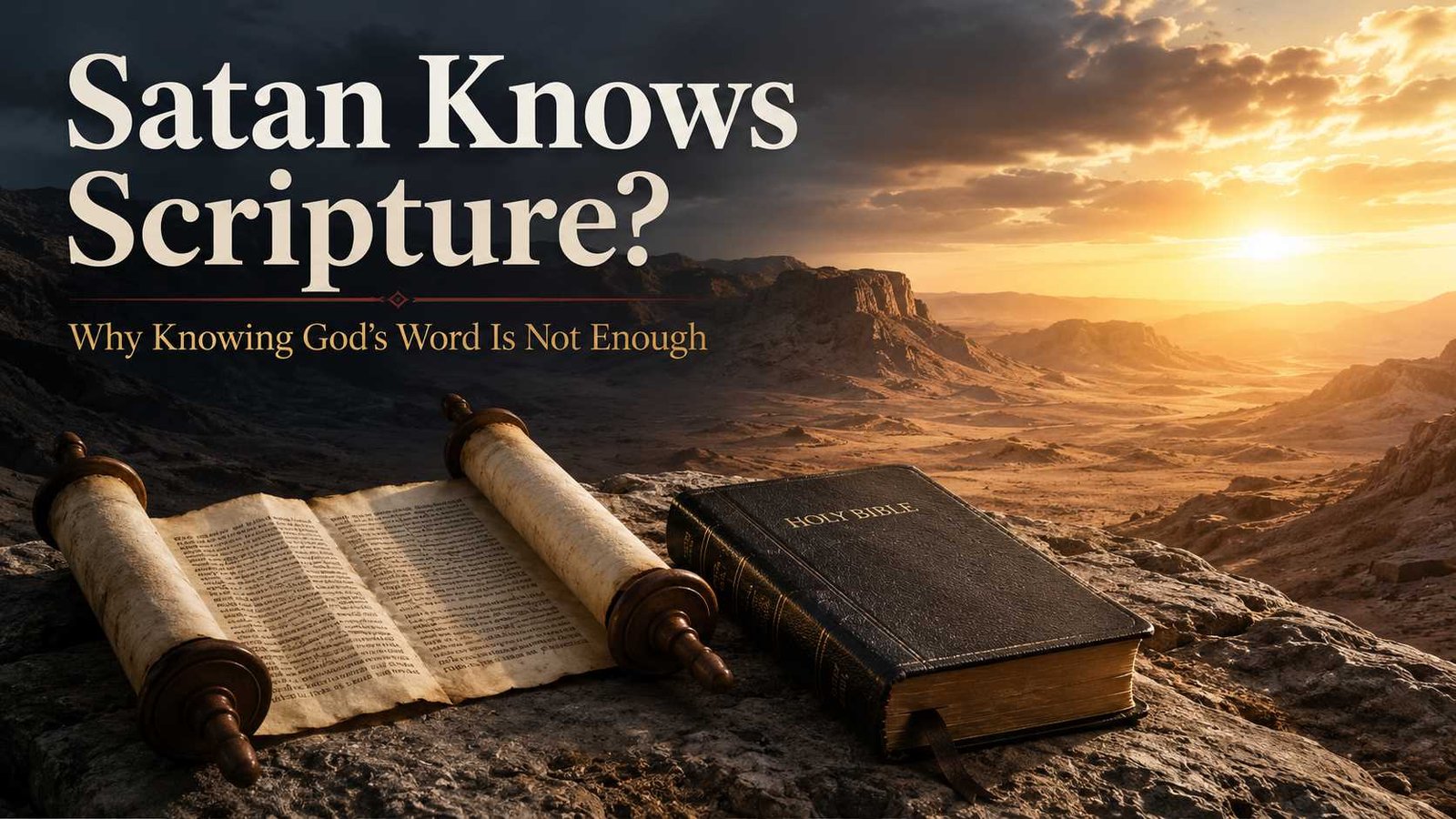
 Does Satan know the Bible? The clearest biblical answer is yes, Satan shows that he knows Scripture. We see this plainly when the devil tempts Jesus in the wilderness. Satan does not simply speak about God. He actually quotes words from Psalm 91 and tries to use them against Jesus.
That may sound surprising. We often connect Bible knowledge with faith. Yet Scripture teaches us an important truth: knowing God’s Word is not the same as loving God, trusting Him, or obeying Him.
Matthew 4 gives us one of the strongest examples. Satan quotes Scripture, but Jesus recognizes that the passage is being used in a wrong and deceptive way. Jesus then answers with Scripture understood in its proper place.
The Bible also shows demons knowing important truths about God and Jesus. They recognize Jesus’ identity. They know He has authority over them. They even appear aware that judgment is coming. Yet none of that knowledge produces loving faith or obedience.
So the deeper question is not only, “Does Satan know the Bible?” It is also this:
What kind of relationship do we have with the truth we know?
Does Satan Know the Bible? Matthew 4 Gives the Clearest Answer
Matthew 4 records Jesus being tempted by the devil after fasting in the wilderness.
Satan approaches Jesus three times with temptations. Jesus responds by appealing to God’s Word.
Then something especially interesting happens.
Satan begins using Scripture too.
Matthew 4:5–6 says the devil takes Jesus to the holy city and tells Him to throw Himself down. Satan introduces his argument with the words, “For it is written.” He then draws from Psalm 91:11–12, a passage about God’s protection.
This tells us something important.
Satan was familiar enough with Scripture to quote it during his temptation of Jesus.
The Bible does not tell us how many passages Satan knows. It never says that Satan has memorized the entire Bible. We should not make claims Scripture itself does not make.
But Matthew 4 gives us solid ground for saying that Satan knows Scripture and is capable of quoting it.
Satan Quotes Psalm 91 to Jesus
Psalm 91 is a beautiful passage about trusting God’s protection.
Satan takes words from that psalm and tries to turn them into a temptation.
His argument is basically this: If Jesus is truly the Son of God, He should throw Himself down and expect God to protect Him.
The words came from Scripture.
The application was wrong.
That distinction matters.
A Bible verse does not become correctly interpreted simply because someone quotes it.
Satan’s use of Psalm 91 shows why Christians should care about the meaning and context of Scripture, not just isolated sentences.
You can quote a true verse while using it to support a false idea.
This is one reason learning what the Bible says about resisting temptation involves more than memorizing words. We also need to understand what those words mean.
Jesus Answers Scripture With Scripture
Jesus does not accept Satan’s interpretation.
He answers by referring to Deuteronomy 6:16, which teaches God’s people not to put the Lord to the test.
Notice what Jesus does.
He does not say Psalm 91 is false.
He does not argue that God’s protection cannot be trusted.
Instead, He shows that God’s promise of protection should never be turned into an excuse for deliberately testing God.
This gives us a helpful way to read difficult Bible passages.
Scripture should be understood in harmony with Scripture.
One passage should not be pulled away from the rest of God’s Word and forced to say something it was never meant to say.
Where in the Bible Does It Say Satan Knows the Bible?
You will not find a verse that says word for word:
“Satan knows the Bible.”
That exact statement is not in Scripture.
Instead, we reach the conclusion from what Satan actually does.
The strongest evidence is found in:
- Matthew 4:5–7, where Satan quotes from Psalm 91.
- Luke 4:9–12, which records the same temptation.
- Job 1–2, where Satan speaks directly in the narrative and shows awareness of Job and God’s dealings with him.
Luke’s account confirms that the devil cites words from Scripture while tempting Jesus in Jerusalem. Jesus again answers with God’s command against testing Him.
Job gives us another important picture.
In Job 1, Satan appears in the heavenly scene described by the text and speaks with the Lord about Job. Satan knows who Job is and challenges Job’s motives for serving God.
Job does not show Satan quoting Scripture, so Matthew 4 remains the clearest passage for our main question.
Here is the careful biblical answer:
The Bible does not directly say, “Satan knows the Bible,” but it clearly records Satan quoting Scripture.
That is stronger and more accurate than making guesses about exactly how much Satan knows.
Is It True That the Devil Knows the Bible?
Yes, in the sense that Scripture portrays the devil as knowing and quoting biblical words.
But another distinction is necessary.
There is a difference between:
- knowing words from Scripture,
- understanding God’s truth,
- believing facts about God,
- trusting God’s character,
- loving God,
- and obeying God.
Those things are not identical.
A person might memorize hundreds of Bible verses and still refuse to live by them.
Someone can know a great deal about Christianity while having little love for God or other people.
Satan provides the most extreme biblical example of this difference.
He can refer to Scripture while opposing God’s purposes.
Knowledge Is Not the Same as Faithfulness
This principle appears elsewhere in the New Testament.
James 2:19 points out that demons believe the truth that God is one, yet they shudder. James’ point is that merely recognizing a true fact about God is not the same as living faith.
That is worth thinking about.
Bible knowledge is valuable. Christians should read, study, remember, and meditate on Scripture.
But information alone is not the goal.
God’s Word is meant to shape our hearts and lives.
It should lead us toward truth, humility, love, repentance, trust, wisdom, and obedience.
Satan’s example warns us that it is possible to know religious truth and still resist the God who gave it.
Does Satan Know the Bible but Twist Its Meaning?
Matthew 4 strongly shows Satan using a genuine biblical passage in a deceptive way.
That does not mean Psalm 91 itself is unclear or unreliable.
The problem is what Satan tries to make the passage mean.
Psalm 91 speaks beautifully about trusting God. Satan tries to turn that trust into presumption: Jesus should deliberately place Himself in danger so that God will have to prove His protection.
Jesus refuses.
His response from Deuteronomy shows that trusting God does not mean forcing God to prove Himself.
This is an important lesson for anyone who reads the Bible.
Why Biblical Context Matters
Imagine someone tells you:
“The Bible says this.”
Your next question should sometimes be:
“What does that verse mean in its context?”
That is not unbelief. It is careful reading.
A responsible understanding of Scripture asks questions such as:
- What is happening around this verse?
- Who is speaking?
- Who is being addressed?
- What is the passage actually teaching?
- How does it fit with other clear biblical teachings?
- Am I using the verse for the purpose the passage gives it?
Satan’s temptation of Jesus shows why this matters.
Even biblical words can be placed inside a misleading argument.
That is one reason Christians studying what the Bible says about the devil tempting you should pay attention to Jesus’ response. Jesus knows the words, but He also understands their proper meaning.
Do Demons Know Scripture?
The Bible clearly presents demons as having spiritual knowledge, but we should be precise about what that means.
Scripture does not say that every demon knows the whole Bible.
It does show demons knowing certain important truths.
James 2:19 says demons believe that God is one and shudder.
In Mark 1, an unclean spirit confronts Jesus and identifies Him as “the Holy One of God.” Jesus rebukes the spirit and commands it to come out.
Luke 4 gives another striking statement. Demons coming out of people identify Jesus as the Son of God, and the Gospel says they knew He was the Messiah.
Matthew 8 adds another detail. The demons recognize Jesus as the Son of God and ask whether He has come to punish them before the appointed time. That suggests awareness not only of Jesus’ identity but also of coming judgment.
What Demons Clearly Know
Based on these passages, we can safely say that demons are shown knowing several spiritual realities:
- God exists.
- Jesus has authority over them.
- Jesus has a unique divine identity.
- They cannot simply ignore His commands.
- Judgment awaits evil.
What we cannot safely say is that Scripture teaches every demon has complete knowledge of every biblical passage.
The Bible does not give us that information.
This distinction is especially useful when reading about where in the Bible it talks about demons or studying fallen angels in the Bible. It is better to stay close to what Scripture actually reveals than to build detailed ideas from speculation.
Does Satan Ever Speak in the Bible?
Yes.
Satan speaks in several biblical passages.
The clearest examples come from Jesus’ temptation and the book of Job.
Satan Speaks During Jesus’ Temptation
Matthew 4 directly records the devil speaking to Jesus.
He challenges Jesus concerning His identity, tempts Him to turn stones into bread, urges Him to throw Himself from the temple, and offers Him worldly kingdoms in exchange for worship.
Jesus rejects each temptation.
Luke 4 records the same period of temptation and likewise presents direct speech from the devil.
So the answer to “Does Satan ever speak in the Bible?” is clearly yes.
Satan Speaks in the Book of Job
Satan also speaks in Job 1.
When the Lord asks where he has come from, Satan replies that he has been roaming the earth. He later challenges Job’s motives, arguing that Job serves God because he has been blessed and protected.
The book then describes limits placed upon what Satan is allowed to do.
This is another reason Christians should avoid picturing Satan as equal to God.
The biblical story does not present two equal powers fighting for control.
God remains sovereign.
What About the Serpent in Genesis?
Many readers also think immediately about the serpent in Genesis 3.
Genesis describes the serpent speaking to Eve and challenging what God had said.
Later biblical language helps explain why Christians have historically connected this serpent with Satan. Revelation 12:9 describes the devil and Satan as the ancient serpent who deceives the world.
Still, careful wording is useful.
Genesis 3 itself calls the creature “the serpent.” Revelation later explicitly connects the ancient serpent with the devil and Satan.
That is more accurate than claiming Genesis 3 repeatedly calls the serpent “Satan,” because it does not.
Does Satan Know the Bible Better Than Humans?
People sometimes say, “Satan knows the Bible better than any Christian.”
That may sound dramatic, but Scripture never gives us enough information to measure Satan’s Bible knowledge against that of a human being.
We should therefore treat such statements as speculation rather than biblical teaching.
What can we say confidently?
Satan knows at least some Scripture.
He quoted Scripture to Jesus.
He is shown knowing things about God’s work and God’s people.
He is deceptive.
But the Bible never tells us, “Satan has memorized every biblical verse,” nor does it give us a test comparing his knowledge with that of pastors, scholars, or ordinary believers.
There is also another problem with the comparison.
The Bible’s concern is not mainly how much information Satan possesses.
The concern is what he does with truth.
Knowledge used for deception is very different from knowledge received with faith.
Why Knowing Scripture Did Not Make Satan Righteous
This may be the most important lesson in the whole discussion.
Satan can quote Scripture, yet that knowledge does not make him righteous.
Demons recognize Jesus, yet recognition does not make them disciples.
James tells us demons believe certain truths and tremble.
So biblical faith must mean more than collecting correct facts.
Think about a simple example.
You could know every rule in a driver’s handbook and still drive dangerously.
Knowing the rules is useful. But knowing them is not the same as following them.
In a much deeper way, Bible knowledge should lead to a life shaped by God’s truth.
Jesus once faced religious people who knew many Scriptures. The problem was not that they studied God’s Word too much. The problem was that knowledge could become separated from humble trust and obedience.
The answer is not to study less.
The answer is to study Scripture with the right heart.
We read because we want to know God more truly.
We study because we want our thinking corrected.
We remember God’s promises because we want to trust Him.
We learn God’s commands because we want to walk faithfully.
How Jesus Responded When Satan Used Scripture
Jesus’ response in the wilderness gives Christians a powerful model.
Satan’s use of Scripture did not confuse Jesus.
Jesus knew the wider teaching of God’s Word.
When Satan tried to turn God’s promise into a reason for reckless testing, Jesus answered from Deuteronomy 6:16.
When tempted concerning bread, Jesus drew from Deuteronomy.
When tempted with worldly kingdoms and worship, Jesus again appealed to God’s Word.
Jesus remained faithful through every temptation recorded in the passage.
There are several practical lessons here.
Know More Than Isolated Verses
Memorizing individual verses can be very helpful.
But we should also learn whole passages, stories, themes, and books.
That makes it easier to recognize when a verse is being used in a strange way.
Ask What the Passage Really Means
We should not begin with the question:
“How can I make this verse support what I already want?”
A healthier question is:
“What is God teaching here?”
That small change in attitude can make a big difference.
Compare Scripture With Scripture
Jesus’ answer to Satan shows that one biblical statement should not be interpreted in a way that contradicts another clear biblical teaching.
Psalm 91 teaches trust.
Deuteronomy 6 warns against testing God.
Both are true.
Proper interpretation respects both.
Stay Focused on God, Not on Satan
There is a danger in becoming fascinated with the devil.
The Bible tells us enough about evil to take it seriously, but the center of Christian faith is not Satan.
It is Christ.
Even the temptation account is ultimately a story about Jesus’ faithfulness, not Satan’s cleverness.
When reading about spiritual warfare in the Bible, our attention should remain on God’s authority, truth, and faithfulness.
Can Satan Understand God’s Plans?
Satan clearly knows some things about what God is doing, but Scripture does not present him as all-knowing.
That distinction is important.
Christians traditionally describe God as omniscient, meaning that God knows all things.
The Bible never gives Satan that status.
The devil is a creature, not God.
The passages we have examined show knowledge, intelligence, speech, temptation, and deception. They do not show unlimited knowledge.
This means we should be cautious about claims such as:
“Satan knows exactly what you are thinking.”
“Satan knows everything that will happen.”
“Satan understands every part of God’s plan.”
Those claims go beyond the passages we have examined.
Biblically, Satan is dangerous, but he is not divine.
He opposes God, but he is not God’s equal.
That difference should give Christians perspective rather than fear.
Why Satan’s Use of Scripture Should Make Us Careful
The wilderness temptation teaches a lesson that applies far beyond conversations about Satan.
Not every person who quotes the Bible is using it correctly.
A verse may appear on a social media post, in a sermon, in a video, in a book, or during a conversation.
The presence of a Bible verse does not automatically prove the surrounding claim.
This does not mean we should become suspicious of everyone.
It means we should become thoughtful readers.
Ask:
Does the passage really teach what I am being told it teaches?
Read before and after the verse.
Look at who is speaking.
Consider the situation.
Compare the idea with other clear passages.
And when something seems confusing, slow down rather than forcing an answer.
Truth does not need careless interpretation to defend it.
Does Bible Knowledge Protect Us From Temptation?
Knowing Scripture can certainly help us recognize lies and remember God’s truth.
Jesus’ wilderness experience shows the importance of God’s Word when facing temptation.
But simply owning a Bible or memorizing verses does not automatically make temptation disappear.
Satan himself quoted Scripture.
The difference lies in how truth is received and lived.
We need knowledge joined with faith.
We need understanding joined with humility.
We need truth joined with obedience.
And when we fail, Christians do not place their hope in perfect Bible knowledge. We place our hope in God’s mercy and return to Him.
This keeps Bible study from becoming a contest about who knows the most verses.
The goal is transformation, not spiritual pride.
What Satan’s Knowledge of Scripture Teaches Us
So, does Satan know the Bible?
The biblical evidence gives us a careful but clear answer.
Satan knows Scripture well enough to quote it. Matthew 4 and Luke 4 prove that much. He cites words from Psalm 91 while tempting Jesus.
The Bible also shows demons recognizing major spiritual truths. They know God exists. They recognize Jesus. They understand His authority, and Matthew’s account suggests awareness of coming judgment.
But none of this should cause fear.
The main lesson is not that Satan is an impressive Bible student.
The main lesson is that knowledge without faithful obedience is not enough.
Jesus shows us something much better.
He knows God’s Word.
He understands it rightly.
He refuses to twist it.
He trusts the Father.
He resists temptation.
He remains faithful.
That is the pattern worth following.
Knowing God’s Word Should Lead Us Toward God
You do not need to be afraid because the devil knows Scripture.
Instead, allow this truth to deepen the way you approach the Bible.
Read slowly.
Pay attention to context.
Do not build a belief on half a verse.
Ask God for wisdom.
Compare Scripture with Scripture.
Most of all, remember why we read God’s Word in the first place.
The goal is not simply to know more facts than someone else.
It is to know God’s truth, trust His character, and allow His Word to shape the way we live.
Satan’s quotation of Psalm 91 reminds us that biblical words can be misused. Jesus’ response reminds us that truth understood faithfully remains powerful.
So when someone asks, “Does Satan know the Bible?”, we can answer without exaggeration:
Yes, Scripture clearly shows Satan quoting the Bible. But knowing Scripture is not the same as loving its Author, trusting His truth, or obeying His will.
That is the difference that matters.

Dr. Michael is a well-known author who shares why trusting the Bible matters. He speaks in a way that’s easy to follow, helping people see its truth clearly.