
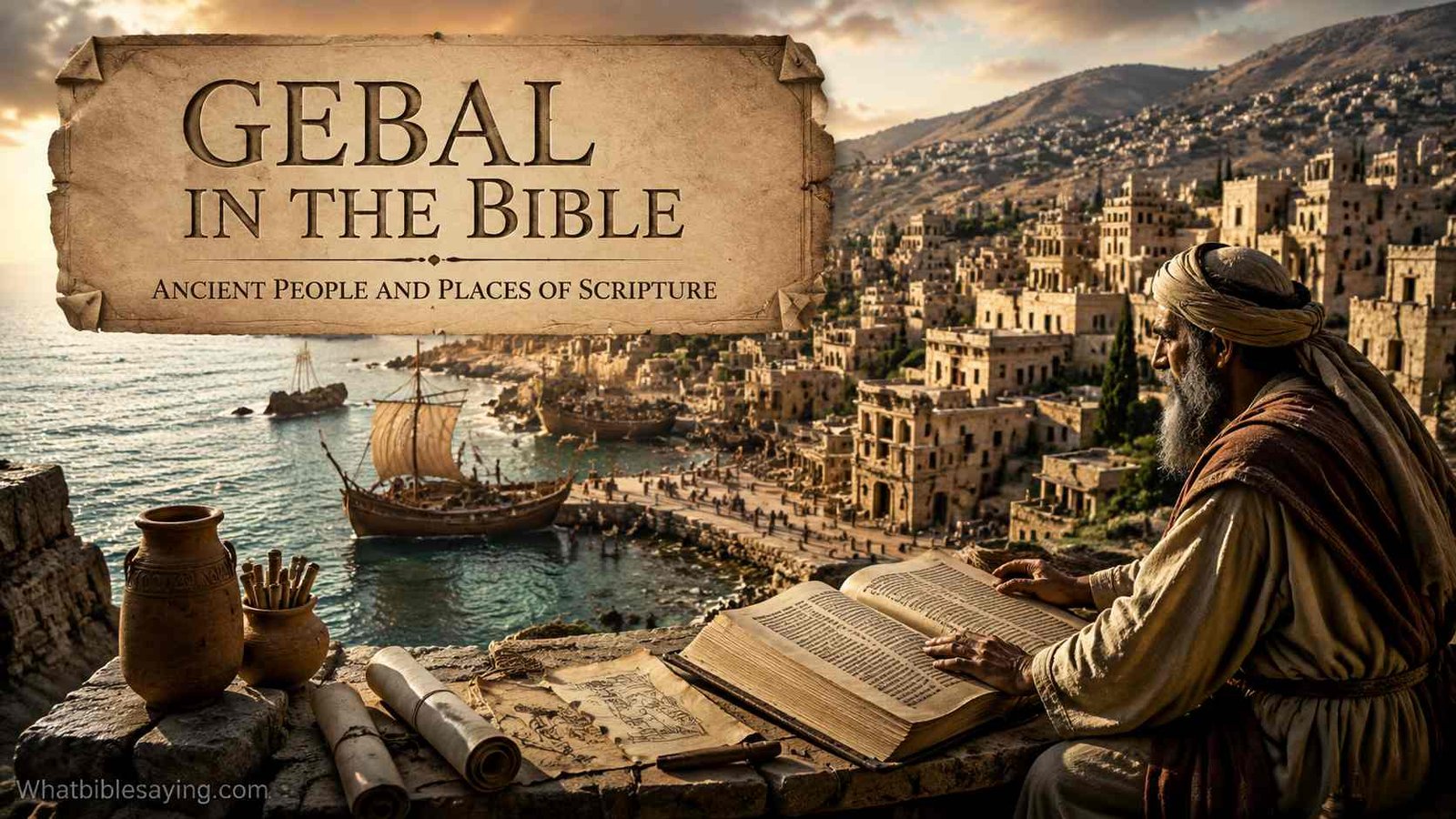
 The Bible contains many names of places and peoples that may seem unfamiliar to modern readers. One of these names is Gebal. When people ask, “Who is Gebal in the Bible?” they are usually looking for information about a person, but Gebal was not a person. It was the name of an ancient city and the people who lived there.
Gebal appears in several Old Testament passages connected with trade, craftsmanship, construction, and ancient nations surrounding Israel. The most well-known Gebal was the Phoenician city of Byblos, located along the Mediterranean coast in modern-day Lebanon.
The people of Gebal, called the Gebalites, were respected for their skills as builders, craftsmen, and ship workers. They helped with important projects, including work connected with Solomon’s temple and the ships of Tyre.
Understanding Gebal helps us see that the Bible is not only a spiritual book but also a historical record connected to real places, cultures, and people.
What Does Gebal Mean In The Bible?
The name Gebal comes from a Hebrew word connected with the idea of a boundary or border. In Scripture, however, the word mainly functions as a place name rather than a description of a person.
Ancient cities in the Bible often carried names that reflected their location, history, or identity. Gebal became known throughout the ancient world as a major coastal city with skilled workers and important trade connections.
The Bible mentions Gebal in different contexts:
- As a source of skilled craftsmen
- As a trading city connected with maritime activity
- As one of the nations or regions mentioned in biblical prophecy and poetry
The references show that Gebal was part of the wider world surrounding Israel. Although the people of Gebal were not Israelites, their work became connected with events recorded in Scripture.
Where Was Gebal Located In Biblical Times?
The most famous biblical Gebal was the ancient Phoenician city of Byblos, located on the Mediterranean coast north of modern Beirut, Lebanon.
Byblos was one of the oldest continuously inhabited cities in the world. It became an important center for:
- Trade
- Writing materials
- Shipbuilding
- Stone and wood craftsmanship
The city was especially famous for its connection with papyrus trade. In fact, the Greek word connected with books, biblos, comes from the name Byblos because of the city’s association with writing materials.
During biblical times, Gebal belonged to the Phoenician cultural world. The Phoenicians were known as skilled sailors and traders who traveled across the Mediterranean.
This historical background helps explain why the Bible describes the people of Gebal as talented workers.
Who Were The Gebalites In The Bible?
The Gebalites were the inhabitants of Gebal. They were not one of the tribes of Israel, but they interacted with Israel during important historical periods.
The Bible describes them as skilled craftsmen.
One important reference appears in:
1 Kings 5:18
The verse mentions craftsmen involved in preparing materials for Solomon’s temple. Many translations refer to workers from Gebal who helped with the preparation of stone and timber.
Their involvement shows that Solomon’s temple was built with help from many skilled people from different regions.
The Gebalites were known for abilities such as:
- Cutting and preparing stone
- Working with wood
- Construction skills
- Maritime knowledge
Their contribution reminds us that God can use people from different backgrounds to accomplish important purposes.
Gebal And The Construction Of Solomon’s Temple
One of the most significant connections between Gebal and the Bible is the building of Solomon’s temple.
King Solomon wanted to build a magnificent house of worship for God in Jerusalem. Because the project required expert craftsmanship and valuable materials, Solomon worked with neighboring nations.
The Phoenician king Hiram of Tyre provided resources and skilled workers. The people of Gebal were among those recognized for their abilities.
The temple project required:
- Large amounts of cedar wood
- Skilled stonecutters
- Experienced builders
- Careful planning
The involvement of Gebalite craftsmen shows the importance of skill and cooperation in accomplishing great works.
This also connects with the biblical understanding that different people have different gifts and abilities.
The Bible teaches:
“There are different kinds of gifts, but the same Spirit distributes them.”
1 Corinthians 12:4
Although this verse speaks about spiritual gifts, the principle applies broadly: God can work through many people and abilities.
Readers interested in this topic may also want to learn about [Who Was Solomon In The Bible?], because Solomon’s reign and temple project are central to understanding Gebal’s biblical connection.
Why Is Gebal Mentioned In Ezekiel?
Another important reference appears in the book of Ezekiel.
In Ezekiel 27:9, Gebal is mentioned in connection with the city of Tyre. The passage describes skilled workers who repaired ships and contributed to maritime activity.
Tyre was a powerful Phoenician trading city, and Gebal was part of the same wider maritime culture.
The people of Gebal had a reputation for craftsmanship. Their skills were valuable in a world where ships were essential for trade, travel, and communication.
This passage gives us a picture of the ancient Mediterranean world:
- Tyre was a major trading center
- Phoenician cities depended on skilled workers
- Gebal contributed knowledge and craftsmanship
The Bible often includes these historical details because they help readers understand the real-world setting behind biblical events.
Is The Gebal In Psalm 83 The Same Gebal?
A common question is whether every mention of Gebal refers to the same place.
The answer is not completely certain.
In Psalm 83:7, Gebal appears among nations mentioned as enemies of Israel. Some scholars believe this refers to a different location, possibly a region south of the Dead Sea rather than the Phoenician city of Byblos.
This is an important reminder when studying the Bible: the same name can sometimes refer to different places.
For example, many ancient names were reused across different regions. Understanding geography and historical context helps avoid confusion.
So when reading about Gebal:
- Gebal of Phoenicia is the best-known biblical reference.
- Another Gebal may appear in Psalm 83.
Careful Bible study considers each passage in its own context.
Was Gebal Connected To Baal Worship?
Some readers connect Gebal with Baal because both names appear in discussions about ancient Near Eastern cultures. However, they are separate terms.
The word Baal means “lord” or “master” in ancient Semitic languages. In the Old Testament, Baal usually refers to the false gods worshiped by surrounding nations.
The Bible repeatedly warns Israel against worshiping Baal because it turned people away from worshiping the true God.
For example, the prophet Elijah confronted Baal worship during the time of King Ahab and Queen Jezebel.
So, is Baal good or evil?
From the biblical perspective, Baal worship was considered evil because it involved worship of false gods instead of the Lord God of Israel.
However, the city of Gebal itself should not automatically be identified with Baal worship. Gebal was a city with craftsmen, traders, and workers. Its name does not mean that every person there followed the same religious practices.
Readers can also explore What Does Baal Mean In The Bible? to understand this ancient religious system more deeply.
What Was Belial In The Bible?
Another related question asks, “What was Belial the demon of?”
Belial is different from Gebal and Baal.
In the Old Testament, Belial is a term used to describe wickedness, worthlessness, or people who reject God’s ways.
For example, the phrase “sons of Belial” describes people who are morally corrupt or rebellious.
Later Jewish and Christian writings developed the idea of Belial as a name or representation of an evil spiritual power.
However, the Bible itself does not present Belial as a major character with a detailed story like some other biblical figures.
The important distinction is:
| Name | Meaning or Identity |
|---|---|
| Gebal | Ancient city and its people |
| Baal | A title used for ancient false gods |
| Belial | A term connected with wickedness and evil |
These names sound similar but describe different biblical concepts.
What Can We Learn From Gebal’s Story?
The story of Gebal teaches several valuable lessons.
God Works Through Different People
The Gebalites were not Israelites, yet their skills contributed to important biblical events.
This reminds us that God can use people from different cultures, backgrounds, and professions.
History Helps Us Understand Scripture
Knowing that Gebal was an ancient Phoenician city makes biblical passages clearer.
The Bible was written in real places among real civilizations. Geography, archaeology, and history help us understand its message more deeply.
Skills Can Be Used For Good Purposes
The Gebalites were known for craftsmanship. Their abilities were valuable and recognized.
This reflects a broader biblical principle: our talents can become tools for serving God and others.
How Gebal Reminds Us That The Bible Is Rooted In History
Sometimes people read biblical names and places without realizing how much history is behind them.
Gebal was not a fictional location. It was part of the ancient world of the Mediterranean. Its craftsmen, ships, and trade networks were part of the environment in which biblical events took place.
When we study places like Gebal, we see the Bible from a wider perspective. Scripture tells the story of God’s work among real nations, cultures, and generations.
The same Bible that speaks about faith and salvation also records cities, kings, workers, and historical events.
Learning about Gebal encourages us to read Scripture carefully and appreciate the depth behind every name.
What This Teaches Us About Faith
Gebal may seem like a small name in the Bible, but it reveals something important. God’s story includes many people and places that may not appear central but still played a meaningful role.
The Gebalites were remembered because of their skills and their contribution to important work. Their example reminds us that every ability, when used wisely, can have value in God’s purposes.
Studying biblical history helps us see Scripture not as a distant collection of stories, but as a record connected to real places, real people, and God’s continuing work in the world.

Dr. Rachel is very smart and knows a lot about the Bible. He helps us understand the Bible better by talking about the old texts in a simple way.